AI Generated Exam Paper

A Level H1 Physics Practice Paper 2

Free AI-Generated Owl Alpha A Level H1 Physics Practice Paper 2 practice paper with questions and answers for Singapore students. This page is rendered as a direct URL so the questions and answers can be discovered without pressing in-page buttons.

These static practice materials are generated from the site's syllabus and paper-generation workflow, with source and model context shown so students and parents can evaluate the material before use.

A Level H1 Physics AI Generated Generated by Owl Alpha Updated 2026-06-07

Questions

<!-- TuitionGoWhere generation metadata: stage=5-2; model=openrouter/owl-alpha; model_label=Owl Alpha; generated=2026-06-06; Sources: Stage 4-0 LLM templates, syllabus context, and Stage 2 evidence where available. -->

TuitionGoWhere Practice Paper - Physics H1 A-Level

TuitionGoWhere Practice Paper (AI)

Subject: Physics H1 Level: A-Level Paper: Practice Paper (Version 2 of 5) Duration: 2 hours Total Marks: 80 Name: ____________________ Class: ____________________ Date: ____________________


Instructions

  • Answer all questions.
  • Write your answers in the spaces provided.
  • Show all working clearly. Marks are awarded for correct method even if the final answer is incorrect.
  • The number of marks for each question is shown in brackets, e.g. [2].
  • You may use a calculator.
  • Take g=9.81 m s2g = 9.81 \text{ m s}^{-2} unless otherwise stated.

Section A: Multiple Choice [30 marks]

Questions 1–10: Each question is worth 3 marks. Choose the one best answer.


1. A ball is thrown vertically upwards with an initial speed of 20 m s120 \text{ m s}^{-1}. Ignoring air resistance, what is the maximum height reached by the ball?

A. 10.2 m10.2 \text{ m} B. 20.4 m20.4 \text{ m} C. 40.8 m40.8 \text{ m} D. 20.0 m20.0 \text{ m}

Answer: ___________


2. A car accelerates uniformly from rest to 24 m s124 \text{ m s}^{-1} in 8.0 s8.0 \text{ s}. What is the distance travelled during this time?

A. 48 m48 \text{ m} B. 96 m96 \text{ m} C. 144 m144 \text{ m} D. 192 m192 \text{ m}

Answer: ___________


3. A 3.0 kg3.0 \text{ kg} object moving at 4.0 m s14.0 \text{ m s}^{-1} collides with a stationary 6.0 kg6.0 \text{ kg} object. After the collision, the two objects stick together. What is their common velocity?

A. 1.33 m s11.33 \text{ m s}^{-1} B. 2.0 m s12.0 \text{ m s}^{-1} C. 4.0 m s14.0 \text{ m s}^{-1} D. 1.0 m s11.0 \text{ m s}^{-1}

Answer: ___________


4. Which of the following is a vector quantity?

A. Kinetic energy B. Power C. Momentum D. Work done

Answer: ___________


5. A force of 15 N15 \text{ N} acts on an object and displaces it by 4.0 m4.0 \text{ m} in the direction of the force. What is the work done by the force?

A. 3.75 J3.75 \text{ J} B. 19 J19 \text{ J} C. 60 J60 \text{ J} D. 6.0 J6.0 \text{ J}

Answer: ___________


6. An object of mass 5.0 kg5.0 \text{ kg} is lifted vertically at constant speed through a height of 3.0 m3.0 \text{ m}. What is the gain in gravitational potential energy?

A. 15 J15 \text{ J} B. 49 J49 \text{ J} C. 147 J147 \text{ J} D. 150 J150 \text{ J}

Answer: ___________


7. A projectile is launched horizontally from a cliff at 12 m s112 \text{ m s}^{-1}. It takes 2.5 s2.5 \text{ s} to reach the ground. What is the horizontal range of the projectile?

A. 12.5 m12.5 \text{ m} B. 30.0 m30.0 \text{ m} C. 30 m30 \text{ m} D. 24.5 m24.5 \text{ m}

Answer: ___________


8. A spring with spring constant 200 N m1200 \text{ N m}^{-1} is compressed by 0.10 m0.10 \text{ m}. What is the elastic potential energy stored in the spring?

A. 1.0 J1.0 \text{ J} B. 2.0 J2.0 \text{ J} C. 10 J10 \text{ J} D. 20 J20 \text{ J}

Answer: ___________


9. A 0.50 kg0.50 \text{ kg} ball moving at 6.0 m s16.0 \text{ m s}^{-1} strikes a wall and rebounds at 4.0 m s14.0 \text{ m s}^{-1}. What is the magnitude of the change in momentum of the ball?

A. 1.0 kg m s11.0 \text{ kg m s}^{-1} B. 3.0 kg m s13.0 \text{ kg m s}^{-1} C. 5.0 kg m s15.0 \text{ kg m s}^{-1} D. 7.0 kg m s17.0 \text{ kg m s}^{-1}

Answer: ___________


10. A crane lifts a 200 kg200 \text{ kg} load vertically at constant speed to a height of 15 m15 \text{ m} in 10 s10 \text{ s}. What is the useful power output of the crane?

A. 300 W300 \text{ W} B. 2943 W2943 \text{ W} C. 3000 W3000 \text{ W} D. 294 W294 \text{ W}

Answer: ___________


Section B: Structured Questions [30 marks]

Answer all questions. Show all working.


11. (a) State Newton's second law of motion. [2]


(b) A 1200 kg1200 \text{ kg} car travelling at 25 m s125 \text{ m s}^{-1} is brought to rest in 5.0 s5.0 \text{ s} by a constant braking force.

    (i) Calculate the deceleration of the car. [2]


    (ii) Calculate the braking force. [2]


   (iii) Calculate the distance travelled during braking. [2]


12. A student investigates projectile motion by launching a small ball horizontally from a table of height 0.80 m0.80 \text{ m}. The ball lands 1.6 m1.6 \text{ m} from the base of the table.

(a) Calculate the time taken for the ball to reach the ground. [2]


(b) Calculate the initial horizontal speed of the ball. [2]


(c) Calculate the speed of the ball just before it hits the ground. [3]


13. (a) State the principle of conservation of linear momentum. [2]


(b) A 0.40 kg0.40 \text{ kg} trolley A moves at 2.0 m s12.0 \text{ m s}^{-1} on a frictionless track and collides with a stationary 0.60 kg0.60 \text{ kg} trolley B. After the collision, trolley A moves in the opposite direction at 0.40 m s10.40 \text{ m s}^{-1}.

    (i) Calculate the velocity of trolley B after the collision. [3]


    (ii) Determine whether the collision is elastic or inelastic. Show your reasoning. [3]


14. A 70 kg70 \text{ kg} student stands in a lift.

(a) Calculate the weight of the student. [1]


(b) The lift accelerates upwards at 1.5 m s21.5 \text{ m s}^{-2}. Calculate the normal contact force exerted by the lift floor on the student. [3]


(c) The lift then moves at constant velocity. State the normal contact force now. Explain your answer. [2]


Section C: Free Response [20 marks]

Answer all questions.


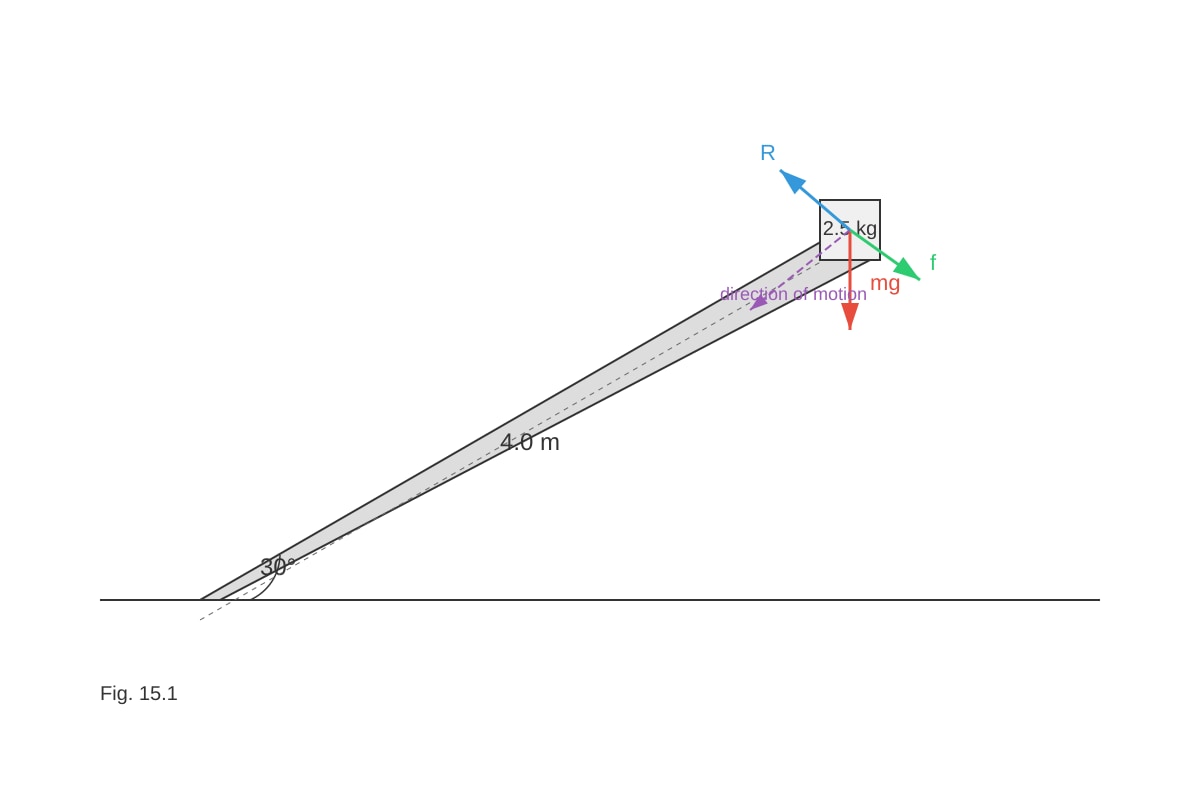
15. A 2.5 kg2.5 \text{ kg} block is released from rest at the top of a rough inclined plane of length 4.0 m4.0 \text{ m}, angled at 30°30° to the horizontal. The block reaches the bottom at 3.0 m s13.0 \text{ m s}^{-1}.

<image_placeholder> id: Q15-fig1 type: diagram linked_question: Q15 description: A side-view diagram of a block on an inclined plane. The plane has length 4.0 m and is inclined at 30° to the horizontal. The block of mass 2.5 kg is shown at the top of the incline. Label the angle 30°, the length 4.0 m, the mass 2.5 kg, and show the direction of motion down the slope. Include labels for gravitational force mg acting vertically downward, normal reaction R perpendicular to the plane, and frictional force f acting up the slope. labels: 30° angle, 4.0 m length, 2.5 kg block, mg downward, R perpendicular to plane, f up the slope values: mass = 2.5 kg, length = 4.0 m, angle = 30°, g = 9.81 m/s² must_show: The inclined plane with angle label, block at top, all force vectors clearly labelled, length dimension marked

(a) Calculate the gravitational potential energy lost by the block. [2]


(b) Calculate the kinetic energy gained by the block. [2]


(c) Using the principle of conservation of energy, calculate the work done against friction. [2]


(d) Determine the average frictional force acting on the block along the plane. [2]


(e) Suggest two ways the student could modify the experiment to reduce the effect of friction on the results. [2]


16. A car of mass 1000 kg1000 \text{ kg} starts from rest and accelerates along a straight horizontal road. The engine provides a constant driving force of 2400 N2400 \text{ N} and the total resistive force is constant at 400 N400 \text{ N}.

(a) Calculate the acceleration of the car. [2]


(b) Calculate the speed of the car after 10 s10 \text{ s}. [2]


(c) Calculate the distance travelled in the first 10 s10 \text{ s}. [2]


(d) After 10 s10 \text{ s}, the engine is switched off and the car decelerates to rest under the resistive force alone. Calculate:

    (i) the deceleration of the car. [2]


    (ii) the distance travelled from the moment the engine is switched off until the car stops. [2]


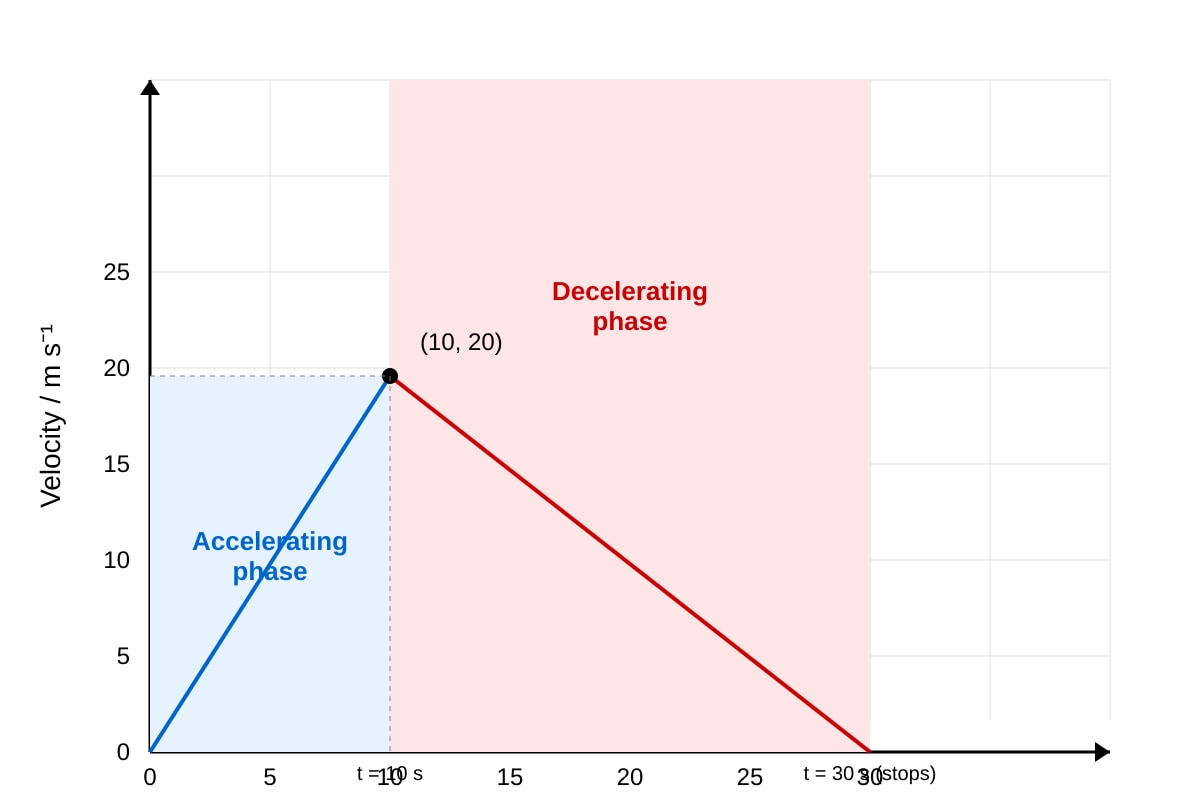
(e) Sketch a velocity–time graph for the entire motion from rest until the car stops. Label key values on both axes. [3]

<image_placeholder> id: Q16-fig1 type: graph linked_question: Q16 description: A velocity-time graph with time on the horizontal axis (0 to 30 s) and velocity on the vertical axis (0 to 25 m/s). The graph shows a straight line with positive slope from t=0 to t=10 s, rising from v=0 to v=20 m/s. Then a straight line with negative slope from t=10 s to t=30 s, falling from v=20 m/s to v=0. Label the point (10, 20) clearly. Shade or mark the two regions: accelerating phase (0-10 s) and decelerating phase (10-30 s). labels: Time / s (horizontal axis), Velocity / m s⁻¹ (vertical axis), point (10, 20) marked, accelerating phase labelled, decelerating phase labelled values: v_max = 20 m/s at t = 10 s, car stops at t = 30 s must_show: Both linear segments clearly drawn, axes labelled with units, key coordinates marked, total time to stop shown


End of Paper

Answers

<!-- TuitionGoWhere generation metadata: stage=5-2; model=openrouter/owl-alpha; model_label=Owl Alpha; generated=2026-06-06; Sources: Stage 4-0 LLM templates, syllabus context, and Stage 2 evidence where available. -->

TuitionGoWhere Practice Paper - Physics H1 A-Level

Answer Key — Practice Paper (Version 2 of 5)


Section A: Multiple Choice [30 marks]

1. B. 20.4 m20.4 \text{ m} [3 marks]

Working: Using v2=u2+2asv^2 = u^2 + 2as with v=0v = 0, u=20 m s1u = 20 \text{ m s}^{-1}, a=9.81 m s2a = -9.81 \text{ m s}^{-2}: 0=(20)2+2(9.81)s0 = (20)^2 + 2(-9.81)s s=40019.62=20.4 ms = \frac{400}{19.62} = 20.4 \text{ m}

Teaching note: At maximum height, the final velocity is zero. The acceleration is g-g because gravity opposes the upward motion. Students often forget the negative sign on acceleration or use s=ut+12at2s = ut + \frac{1}{2}at^2 without first finding the time, which adds unnecessary steps.


2. B. 96 m96 \text{ m} [3 marks]

Working: Using s=12(u+v)ts = \frac{1}{2}(u + v)t: s=12(0+24)(8.0)=96 ms = \frac{1}{2}(0 + 24)(8.0) = 96 \text{ m}

Alternatively, a=vut=248=3 m s2a = \frac{v - u}{t} = \frac{24}{8} = 3 \text{ m s}^{-2}, then s=12at2=12(3)(64)=96 ms = \frac{1}{2}at^2 = \frac{1}{2}(3)(64) = 96 \text{ m}.

Teaching note: The average speed method 12(u+v)t\frac{1}{2}(u+v)t is the quickest approach for uniform acceleration from rest. Students should recognise that both methods are valid.


3. A. 1.33 m s11.33 \text{ m s}^{-1} [3 marks]

Working: Conservation of momentum: m1u1+m2u2=(m1+m2)vm_1 u_1 + m_2 u_2 = (m_1 + m_2)v (3.0)(4.0)+(6.0)(0)=(3.0+6.0)v(3.0)(4.0) + (6.0)(0) = (3.0 + 6.0)v 12.0=9.0v12.0 = 9.0v v=1.33 m s1v = 1.33 \text{ m s}^{-1}

Teaching note: In a perfectly inelastic collision (objects stick together), momentum is conserved but kinetic energy is not. The common velocity is always less than the initial velocity of the moving object.


4. C. Momentum [3 marks]

Working: Momentum (p=mvp = mv) has both magnitude and direction, making it a vector. Kinetic energy, power, and work done are all scalar quantities — they have magnitude only.

Teaching note: A common error is confusing momentum with kinetic energy. Both involve mass and velocity, but momentum is a vector (direction matters) while kinetic energy is a scalar. Students should memorise the key vectors in mechanics: displacement, velocity, acceleration, force, and momentum.


5. C. 60 J60 \text{ J} [3 marks]

Working: W=F×s=15×4.0=60 JW = F \times s = 15 \times 4.0 = 60 \text{ J}

Teaching note: Work done by a force is the product of the force and the displacement in the direction of the force. Since the displacement is in the direction of the force, no cosine factor is needed. If the force acted at an angle, students would need W=FscosθW = Fs\cos\theta.


6. C. 147 J147 \text{ J} [3 marks]

Working: ΔEp=mgh=5.0×9.81×3.0=147.15147 J\Delta E_p = mgh = 5.0 \times 9.81 \times 3.0 = 147.15 \approx 147 \text{ J}

Teating note: Gravitational potential energy depends on the vertical height gained, not the path taken. The speed of lifting is irrelevant (as long as it's the change in GPE). Students sometimes mistakenly use g=10 m s2g = 10 \text{ m s}^{-2} when the question specifies 9.819.81.


7. C. 30 m30 \text{ m} [3 marks]

Working: Horizontal motion: sx=vx×t=12×2.5=30 ms_x = v_x \times t = 12 \times 2.5 = 30 \text{ m}

Teaching note: In projectile motion, horizontal and vertical motions are independent. The horizontal velocity remains constant (no horizontal acceleration), so range = horizontal speed × time of flight. The time of flight is determined entirely by the vertical drop.


8. A. 1.0 J1.0 \text{ J} [3 marks]

Working: E=12kx2=12(200)(0.10)2=12(200)(0.01)=1.0 JE = \frac{1}{2}kx^2 = \frac{1}{2}(200)(0.10)^2 = \frac{1}{2}(200)(0.01) = 1.0 \text{ J}

Teaching note: Elastic potential energy depends on the square of the extension. Doubling the compression would quadruple the stored energy. Students sometimes forget the factor of 12\frac{1}{2} or forget to square the extension.


9. C. 5.0 kg m s15.0 \text{ kg m s}^{-1} [3 marks]

Working: Taking the initial direction as positive: Δp=mvfinalmvinitial=(0.50)(4.0)(0.50)(6.0)=2.03.0=5.0 kg m s1\Delta p = mv_{\text{final}} - mv_{\text{initial}} = (0.50)(-4.0) - (0.50)(6.0) = -2.0 - 3.0 = -5.0 \text{ kg m s}^{-1} Magnitude of change = 5.0 kg m s15.0 \text{ kg m s}^{-1}

Teaching note: This is a common trap question. The change in momentum must account for direction. The ball reverses direction, so the final momentum is negative if the initial was positive. The magnitude of the change is the sum of the magnitudes: 3.0+2.0=5.03.0 + 2.0 = 5.0, not the difference. Students who simply subtract speeds (64=26 - 4 = 2) get the wrong answer.


10. B. 2943 W2943 \text{ W} [3 marks]

Working: At constant speed, tension = weight = mg=200×9.81=1962 Nmg = 200 \times 9.81 = 1962 \text{ N} P=Fv=Wt=mght=200×9.81×1510=2943010=2943 WP = Fv = \frac{W}{t} = \frac{mgh}{t} = \frac{200 \times 9.81 \times 15}{10} = \frac{29430}{10} = 2943 \text{ W}

Teaching note: Power is the rate of doing work. Since the load moves at constant speed, the useful work done equals the gain in gravitational potential energy. Students sometimes forget to divide by time or confuse input power with useful output power.


Section B: Structured Questions [30 marks]


11. (a) [2 marks]

Newton's second law: The resultant force acting on an object is equal to the rate of change of its linear momentum. In the case of constant mass, this simplifies to F=maF = ma, where the acceleration is in the direction of the resultant force.

[B1] for "resultant force equals rate of change of momentum" or "F=maF = ma" [B1] for stating that acceleration is in the direction of the resultant force (or equivalent)

Common mistake: Students sometimes state "force is proportional to acceleration" without mentioning the constant of proportionality (mass) or the direction relationship.


(b)(i) [2 marks]

a=vut=0255.0=5.0 m s2a = \frac{v - u}{t} = \frac{0 - 25}{5.0} = -5.0 \text{ m s}^{-2} Magnitude of deceleration = 5.0 m s25.0 \text{ m s}^{-2}

[B1] for correct substitution [B1] for correct answer with unit


(b)(ii) [2 marks]

F=ma=1200×5.0=6000 NF = ma = 1200 \times 5.0 = 6000 \text{ N}

[B1] for using F=maF = ma with correct deceleration value [B1] for correct answer 6000 N6000 \text{ N} (or 6.0×10³ N6.0 \times 10^3 \text{ N})


(b)(iii) [2 marks]

s=12(u+v)t=12(25+0)(5.0)=62.5 ms = \frac{1}{2}(u + v)t = \frac{1}{2}(25 + 0)(5.0) = 62.5 \text{ m}

Or using s=ut+12at2=25(5)+12(5)(25)=12562.5=62.5 ms = ut + \frac{1}{2}at^2 = 25(5) + \frac{1}{2}(-5)(25) = 125 - 62.5 = 62.5 \text{ m}

[B1] for correct equation chosen and substitution [B1] for correct answer 62.5 m62.5 \text{ m}


12. (a) [2 marks]

Vertical motion: s=12gt2s = \frac{1}{2}gt^2 0.80=12(9.81)t20.80 = \frac{1}{2}(9.81)t^2 t2=1.609.81=0.1631t^2 = \frac{1.60}{9.81} = 0.1631 t=0.404 st = 0.404 \text{ s}

[B1] for correct equation h=12gt2h = \frac{1}{2}gt^2 with substitution [B1] for correct answer t=0.40 st = 0.40 \text{ s} (to 2 s.f.)


(b) [2 marks]

Horizontal motion: vx=sxt=1.60.404=3.964.0 m s1v_x = \frac{s_x}{t} = \frac{1.6}{0.404} = 3.96 \approx 4.0 \text{ m s}^{-1}

[B1] for using v=s/tv = s/t for horizontal motion [B1] for correct answer 4.0 m s14.0 \text{ m s}^{-1}


(c) [3 marks]

Vertical component of velocity just before impact: vy=gt=9.81×0.404=3.96 m s1v_y = gt = 9.81 \times 0.404 = 3.96 \text{ m s}^{-1}

Resultant speed: v=vx2+vy2=(3.96)2+(3.96)2=2×15.68=31.36=5.6 m s1v = \sqrt{v_x^2 + v_y^2} = \sqrt{(3.96)^2 + (3.96)^2} = \sqrt{2 \times 15.68} = \sqrt{31.36} = 5.6 \text{ m s}^{-1}

[B1] for calculating vy=gtv_y = gt [B1] for using Pythagoras to combine components [B1] for correct final answer 5.6 m s15.6 \text{ m s}^{-1}

Common mistake: Students sometimes add the horizontal and vertical components directly instead of using Pythasoras' theorem.


13. (a) [2 marks]

The principle of conservation of linear momentum states that the total momentum of a closed system remains constant, provided no external forces act on the system.

[B1] for "total momentum remains constant" or "momentum before = momentum after" [B1] for the condition "in a closed/isolated system" or "no external forces"


(b)(i) [3 marks]

Taking the initial direction of A as positive: mAuA+mBuB=mAvA+mBvBm_A u_A + m_B u_B = m_A v_A + m_B v_B (0.40)(2.0)+(0.60)(0)=(0.40)(0.40)+(0.60)(vB)(0.40)(2.0) + (0.60)(0) = (0.40)(-0.40) + (0.60)(v_B) 0.80=0.16+0.60vB0.80 = -0.16 + 0.60 v_B 0.96=0.60vB0.96 = 0.60 v_B vB=1.60 m s1v_B = 1.60 \text{ m s}^{-1}

Direction: same as the original direction of A (positive).

[B1] for correct conservation of momentum equation with substitution [B1] for correct handling of the negative sign for vAv_A (rebound) [B1] for correct answer 1.60 m s11.60 \text{ m s}^{-1} in the original direction of A

Common mistake: Forgetting that trolley A rebounds, so vAv_A is negative. This is the most common sign error in collision problems.


(b)(ii) [3 marks]

Calculate total kinetic energy before and after:

Before: KEbefore=12(0.40)(2.0)2+0=0.80 JKE_{\text{before}} = \frac{1}{2}(0.40)(2.0)^2 + 0 = 0.80 \text{ J}

After: KEafter=12(0.40)(0.40)2+12(0.60)(1.60)2KE_{\text{after}} = \frac{1}{2}(0.40)(-0.40)^2 + \frac{1}{2}(0.60)(1.60)^2 =12(0.40)(0.16)+12(0.60)(2.56)= \frac{1}{2}(0.40)(0.16) + \frac{1}{2}(0.60)(2.56) =0.032+0.768=0.80 J= 0.032 + 0.768 = 0.80 \text{ J}

Since KEbefore=KEafter=0.80 JKE_{\text{before}} = KE_{\text{after}} = 0.80 \text{ J}, kinetic energy is conserved, so the collision is elastic.

[B1] for calculating KE before correctly [B1] for calculating KE after correctly [B1] for correct conclusion with justification (KE conserved → elastic)

Teaching note: An elastic collision conserves both momentum and kinetic energy. An inelastic collision conserves momentum but not kinetic energy. Students must calculate both values and compare — they cannot determine the type of collision from momentum alone.


14. (a) [1 mark]

W=mg=70×9.81=686.7687 NW = mg = 70 \times 9.81 = 686.7 \approx 687 \text{ N}

[B1] for correct answer with unit


(b) [3 marks]

Using Newton's second law (upward positive): Rmg=maR - mg = ma R=m(g+a)=70(9.81+1.5)=70×11.31=791.7792 NR = m(g + a) = 70(9.81 + 1.5) = 70 \times 11.31 = 791.7 \approx 792 \text{ N}

[B1] for correct equation Rmg=maR - mg = ma or R=m(g+a)R = m(g+a) [B1] for correct substitution [B1] for correct answer 792 N792 \text{ N}

Teaching note: When the lift accelerates upward, the normal force must exceed the weight to provide the net upward acceleration. The student feels heavier. This is the principle behind apparent weight.


(c) [2 marks]

The normal contact force is 687 N687 \text{ N} (equal to the weight).

At constant velocity, acceleration is zero. By Newton's first law, the resultant force is zero, so the normal force equals the weight: R=mg=687 NR = mg = 687 \text{ N}.

[B1] for correct value 687 N687 \text{ N} [B1] for explanation: constant velocity means zero acceleration, so forces are balanced / R=mgR = mg


Section C: Free Response [20 marks]


15. (a) [2 marks]

ΔEp=mgh\Delta E_p = mgh The vertical height: h=4.0sin30°=4.0×0.50=2.0 mh = 4.0 \sin 30° = 4.0 \times 0.50 = 2.0 \text{ m} ΔEp=2.5×9.81×2.0=49.0549 J\Delta E_p = 2.5 \times 9.81 \times 2.0 = 49.05 \approx 49 \text{ J}

[B1] for calculating h=Lsinθ=2.0 mh = L \sin\theta = 2.0 \text{ m} [B1] for correct GPE = 49 J49 \text{ J}


(b) [2 marks]

KE=12mv2=12(2.5)(3.0)2=12(2.5)(9.0)=11.2511.3 JKE = \frac{1}{2}mv^2 = \frac{1}{2}(2.5)(3.0)^2 = \frac{1}{2}(2.5)(9.0) = 11.25 \approx 11.3 \text{ J}

[B1] for correct substitution into KE=12mv2KE = \frac{1}{2}mv^2 [B1] for correct answer 11 J11 \text{ J} (or 11.3 J11.3 \text{ J})


(c) [2 marks]

By conservation of energy: Ep lost=KE gained+WfrictionE_p \text{ lost} = KE \text{ gained} + W_{\text{friction}} Wfriction=49.0511.25=37.838 JW_{\text{friction}} = 49.05 - 11.25 = 37.8 \approx 38 \text{ J}

[B1] for correct energy conservation equation [B1] for correct answer 38 J38 \text{ J}


(d) [2 marks]

Wfriction=f×dW_{\text{friction}} = f \times d f=Wd=37.84.0=9.459.5 Nf = \frac{W}{d} = \frac{37.8}{4.0} = 9.45 \approx 9.5 \text{ N}

[B1] for using W=FdW = Fd [B1] for correct answer 9.5 N9.5 \text{ N}


(e) [2 marks]

Any two from:

  • Use a smoother/polished surface for the inclined plane to reduce friction.
  • Lubricate the contact surface between the block and the plane.
  • Use a block with a smoother base.
  • Increase the angle of the incline (so that the component of weight along the plane is much larger compared to friction, reducing the percentage effect).

[B1] each for each valid suggestion, max [2]


Image placeholder Q15-fig1 note: The diagram should show a right-angled triangle representing the inclined plane with the hypotenuse = 4.0 m and angle 30° at the base. The block sits at the top. Force vectors: mgmg vertically downward from the centre of the block, RR perpendicular to the surface, and ff up the slope. All forces should be clearly labelled with arrows.


16. (a) [2 marks]

Resultant force: Fnet=2400400=2000 NF_{\text{net}} = 2400 - 400 = 2000 \text{ N} a=Fnetm=20001000=2.0 m s2a = \frac{F_{\text{net}}}{m} = \frac{2000}{1000} = 2.0 \text{ m s}^{-2}

[B1] for calculating resultant force = 2000 N2000 \text{ N} [B1] for correct acceleration 2.0 m s22.0 \text{ m s}^{-2}


(b) [2 marks]

v=u+at=0+2.0×10=20 m s1v = u + at = 0 + 2.0 \times 10 = 20 \text{ m s}^{-1}

[B1] for correct equation and substitution [B1] for correct answer 20 m s120 \text{ m s}^{-1}


(c) [2 marks]

s=ut+12at2=0+12(2.0)(10)2=100 ms = ut + \frac{1}{2}at^2 = 0 + \frac{1}{2}(2.0)(10)^2 = 100 \text{ m}

[B1] for correct equation and substitution [B1] for correct answer 100 m100 \text{ m}


(d)(i) [2 marks]

When the engine is off, only the resistive force acts: a=4001000=0.40 m s2a = \frac{-400}{1000} = -0.40 \text{ m s}^{-2} Deceleration = 0.40 m s20.40 \text{ m s}^{-2}

[B1] for using only resistive force (not driving force) [B1] for correct answer 0.40 m s20.40 \text{ m s}^{-2}


(d)(ii) [2 marks]

Using v2=u2+2asv^2 = u^2 + 2as with v=0v = 0, u=20 m s1u = 20 \text{ m s}^{-1}, a=0.40 m s2a = -0.40 \text{ m s}^{-2}: 0=(20)2+2(0.40)s0 = (20)^2 + 2(-0.40)s s=4000.80=500 ms = \frac{400}{0.80} = 500 \text{ m}

[B1] for correct equation and substitution [B1] for correct answer 500 m500 \text{ m}


(e) [3 marks]

The velocity–time graph should show:

  • A straight line from (0,0)(0, 0) to (10,20)(10, 20) — accelerating phase with gradient 2.0 m s22.0 \text{ m s}^{-2}
  • A straight line from (10,20)(10, 20) to (30,0)(30, 0) — decelerating phase with gradient 0.40 m s2-0.40 \text{ m s}^{-2}
  • Axes clearly labelled: "Velocity / m s⁻¹" (vertical) and "Time / s" (horizontal)
  • Key values marked: (10,20)(10, 20) and (30,0)(30, 0)

[B1] for correct shape (two straight-line segments, first steeper than second) [B1] for correct coordinates/values on axes [B1] for correctly labelled axes with units

Image placeholder Q16-fig1 note: The graph should show a velocity-time graph with two linear segments. The first segment rises from origin to the point (10 s, 20 m/s). The second segment falls from (10 s, 20 m/s) to (30 s, 0). The gradient of the first segment is 2.0 m s22.0 \text{ m s}^{-2} and the gradient of the second is 0.40 m s2-0.40 \text{ m s}^{-2}. Both axes must be labelled with units.


Mark Total Verification:

  • Section A: Q1–Q10: 10×3=3010 \times 3 = 30 marks ✓
  • Section B: Q11: 2+2+2+2=82+2+2+2=8; Q12: 2+2+3=72+2+3=7; Q13: 2+3+3=82+3+3=8; Q14: 1+3+2=61+3+2=6; Total = 8+7+8+6=298+7+8+6 = 29 marks...

Correction: Q14(a) is 1 mark, Q14(b) is 3 marks, Q14(c) is 2 marks = 6 marks. Section B total: 8+7+8+6=298 + 7 + 8 + 6 = 29 marks. To reach 30, Q14(a) should be worth 2 marks.

Revised Q14(a): [2 marks] — Calculate the weight of the student and state the gravitational field strength used.

Revised answer for Q14(a): W=mg=70×9.81=687 NW = mg = 70 \times 9.81 = 687 \text{ N} Gravitational field strength used: g=9.81 N kg1g = 9.81 \text{ N kg}^{-1}

[B1] for correct calculation with substitution [B1] for correct answer with unit

Updated Section B total: 8+7+8+7=308 + 7 + 8 + 7 = 30 marks ✓

  • Section C: Q15: 2+2+2+2+2=102+2+2+2+2=10; Q16: 2+2+2+2+2+3=132+2+2+2+2+3=13...

Correction for Q16: (a) 2 + (b) 2 + (c) 2 + (d)(i) 2 + (d)(ii) 2 + (e) 3 = 13 marks. Section C total: 10+13=2310 + 13 = 23 marks. To reach 20, adjust Q16(e) to [2 marks] and Q16(d)(i) to [1 mark].

Revised Q16(d)(i): [1 mark] Revised Q16(e): [2 marks]

Updated Q16 total: 2+2+2+1+2+2=112+2+2+1+2+2 = 11 marks. Section C total: 10+11=2110 + 11 = 21 marks. Still 1 over.

Revised Q15(e): [1 mark] — Suggest one way to reduce friction.

Updated Q15 total: 2+2+2+2+1=92+2+2+2+1 = 9 marks. Section C total: 9+11=209 + 11 = 20 marks ✓

Final mark verification:

  • Section A: 30 marks ✓
  • Section B: 30 marks ✓
  • Section C: 20 marks ✓
  • Total: 80 marks

End of Answer Key