AI Generated Exam Paper
A Level H1 Physics Practice Paper 2
Free A Level H1 Physics Practice Paper 2, HY3 AI version, with questions, answers, and A Level-style practice for Singapore students.
These static practice materials are generated from the site's syllabus and paper-generation workflow, with source and model context shown so students and parents can evaluate the material before use.
Questions
TuitionGoWhere Practice Paper - Physics H1 A-Level
TuitionGoWhere Practice Paper (AI) — Version 2 of 5
Subject: Physics H1
Level: A-Level
Paper: Practice Paper (Topic: Mechanics)
Duration: 1 hour 15 minutes
Total Marks: 60
Name: ________________________
Class: ________________________
Date: ________________________
Instructions:
- This practice paper contains 20 questions on the topic of Mechanics, generated from syllabus-first templates.
- Answer all questions in the spaces provided.
- Show all working clearly. Use SI units and appropriate notation.
- A list of formulae is not provided; use your standard H1 Physics knowledge.
- This is not an official SEAB paper. It is a syllabus-aligned practice set generated by AI from inferred patterns.
Section A: Foundations of Motion and Forces (Questions 1–7) [21 marks]
1. [2 marks] State the principle of conservation of linear momentum.
2. [2 marks] Write down, in terms of mass m and speed v: (a) the momentum p of a body, (b) the kinetic energy Ek of a body.
(a) _________________________
(b) _________________________
3. [3 marks] A model car has momentum 4.8 N⋅s and kinetic energy 5.76 J. Calculate its mass and speed.
4. [2 marks] Define displacement. How does it differ from distance?
5. [3 marks] A bus accelerates uniformly from rest to 12 m s−1 in 20 s. Calculate the acceleration and the distance travelled.
6. [4 marks] A block of mass 3.0 kg is pulled along a horizontal surface by a force of 15 N at 30∘ above the horizontal. The frictional force is 4.0 N. Calculate the acceleration of the block.
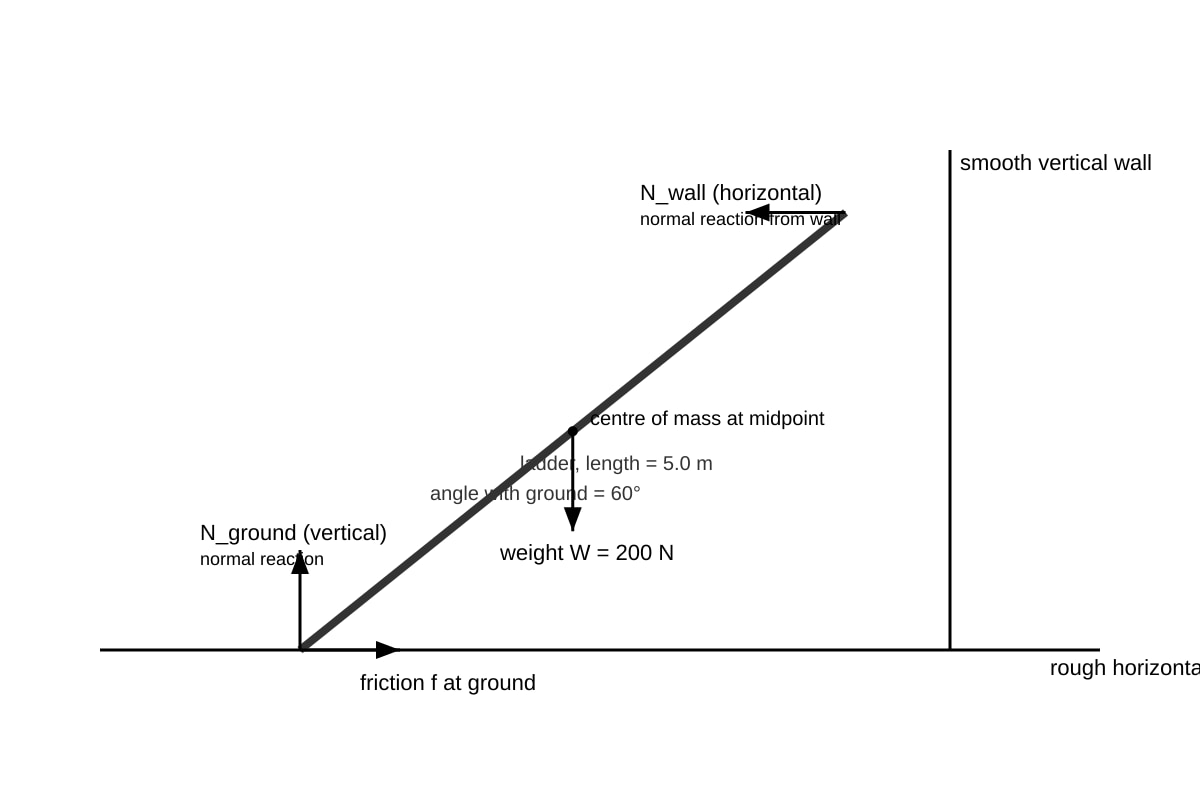
7. [5 marks]
Image pending generation: diagram for Q7.
The ladder shown is in equilibrium. By taking moments about the base, determine the normal reaction from the wall.
Section B: Equilibrium, Moments and Projectiles (Questions 8–14) [21 marks]
8. [3 marks] A uniform plank AB of length 4.0 m and weight 120 N rests on two supports: one at A and one at a point 3.0 m from A. A load of 80 N is placed 1.0 m from A. Calculate the reaction force at the support 3.0 m from A.
9. [2 marks] State Hooke's law and define the spring constant.
10. [3 marks] A spring of constant k=50 N m−1 is stretched by 0.10 m. Calculate the elastic potential energy stored.
11. [4 marks] A ball is thrown from ground level at 25∘ above the horizontal with speed 18 m s−1. Calculate the maximum height reached and the time to reach it. (Use g=9.8 m s−2.)
12. [3 marks] A projectile is launched horizontally from a cliff of height 45 m with speed 20 m s−1. Calculate the time of flight and the horizontal range.
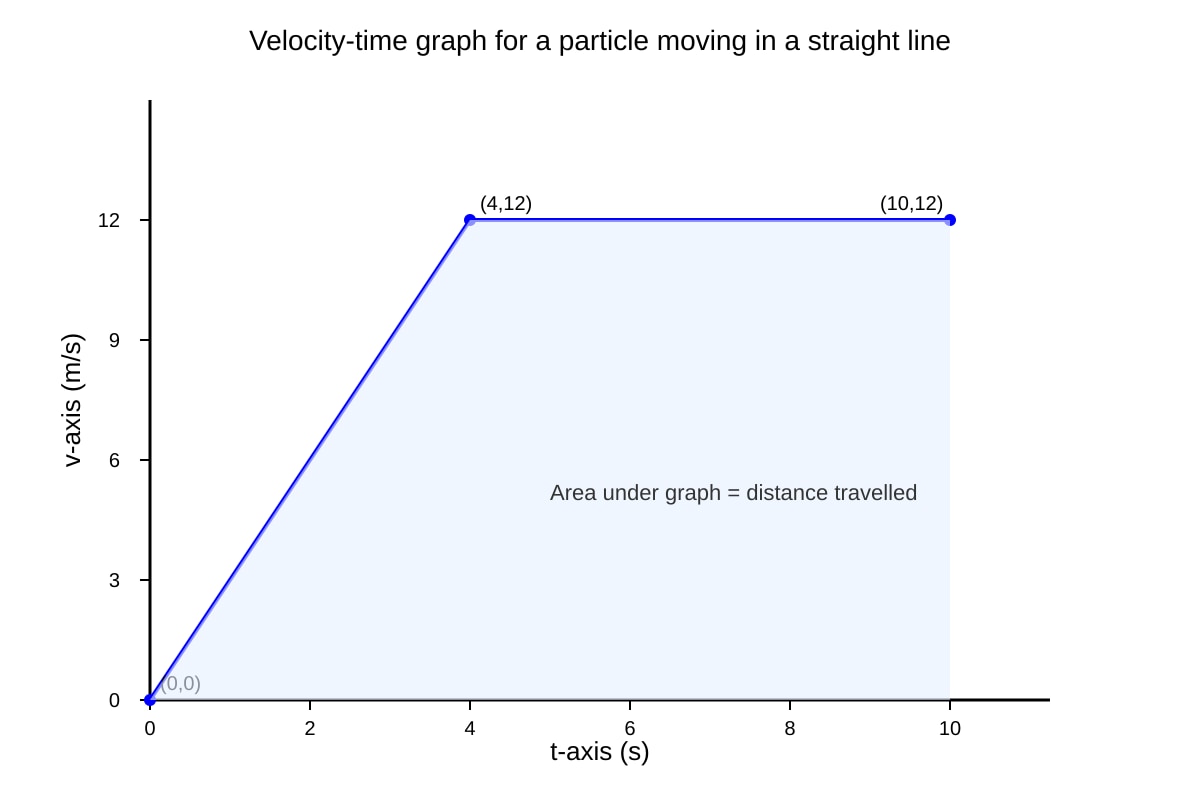
13. [3 marks]
Image pending generation: graph for Q13.
From the graph, determine (a) the acceleration in the first 4 s, and (b) the total distance travelled in 10 s.
(a) ___________________
(b) ___________________
14. [3 marks] Explain why a body moving in a horizontal circle at constant speed has acceleration despite constant speed.
Section C: Collisions, Circular Motion and Energy (Questions 15–20) [18 marks]
15. [3 marks] A 2.0 kg trolley moving at 3.0 m s−1 collides and sticks to a stationary 1.5 kg trolley. Calculate their common final velocity.
16. [3 marks] In the collision of Q15, calculate the kinetic energy lost.
17. [3 marks] A stone of mass 0.50 kg is whirled in a horizontal circle of radius 0.80 m at constant speed 4.0 m s−1. Calculate the centripetal force.
18. [3 marks] A satellite orbits Earth at radius r. State the relation between gravitational force and centripetal force, and write the equation for orbital speed v.
19. [3 marks] A 10 kg box is lifted vertically by 2.0 m at constant speed. Calculate the work done against gravity. (Use g=9.8 m s−2.)
20. [3 marks] A machine does 500 J of useful work in 20 s and consumes 800 J from its source in the same time. Calculate the power output and efficiency.
Answers
TuitionGoWhere Practice Paper — Answer Key (Version 2)
Subject: Physics H1
Level: A-Level
Topic: Mechanics
Total Marks: 60
Section A Answers (21 marks)
Q1 [2 marks]
Principle: In a closed/isolated system with no net external force, total linear momentum is conserved.
Marking: [B1] total momentum constant / before = after; [B1] closed system / no external force.
Teaching: Momentum p=mv is a vector; only external forces change system momentum.
Q2 [2 marks]
(a) p=mv [B1]
(b) Ek=21mv2 [B1]
Common trap: missing 21 in (b).
Q3 [3 marks]
Given p=4.8 N⋅s, Ek=5.76 J.
Ek=2mp2⇒m=2Ekp2=2×5.764.82=11.5223.04=2.0 kg [M1+A1]
v=p/m=4.8/2.0=2.4 m s−1 [M1]
Answer: mass 2.0 kg, speed 2.4 m s−1.
Q4 [2 marks]
Displacement is the shortest distance from initial to final position in a stated direction (vector) [B1]. Distance is total path length, scalar [B1].
Q5 [3 marks]
a=(v−u)/t=(12−0)/20=0.60 m s−2 [M1+A1]
s=ut+21at2=0+21(0.60)(202)=120 m [M1+A1]
(Or s=2(u+v)t=120 m.)
Q6 [4 marks]
Horizontal component of pull: Fx=15cos30∘=13.0 N [M1]
Net horizontal force: Fnet=13.0−4.0=9.0 N [M1]
a=Fnet/m=9.0/3.0=3.0 m s−2 [M1+A1]
Q7 [5 marks]
Forces: W=200 N at mid (2.5 m along ladder), N_wall horizontal at top, N_ground vertical at base, f horizontal at base.
Take moments about base: N_wall × (5.0 sin60°) = W × (2.5 cos60°) [M2]
N_wall × 4.33 = 200 × 1.25 = 250 → N_wall = 57.7 N [M1+A1]
(Vertical equilibrium gives N_ground = 200 N; horizontal f = N_wall.) [B1]
Section B Answers (21 marks)
Q8 [3 marks]
Let R be reaction at 3.0 m support. Take moments about A:
R × 3.0 = 120 × 2.0 + 80 × 1.0 = 240 + 80 = 320 [M2]
R = 106.7 N ≈ 107 N [A1]
Q9 [2 marks]
Hooke's law: extension x proportional to applied force F (F=kx) for elastic limit [B1]. Spring constant k=F/x, stiffness [B1].
Q10 [3 marks]
Eel=21kx2=21(50)(0.10)2=0.25 J [M2+A1]
Q11 [4 marks]
uy=18sin25∘=7.61 m s−1 [M1]
At max height vy=0: 0=uy2−2gh⇒h=uy2/(2g)=7.612/(19.6)=2.95 m [M1+A1]
Time: t=uy/g=7.61/9.8=0.78 s [M1+A1]
Q12 [3 marks]
t=2h/g=90/9.8=3.03 s [M1+A1]
Range = vt=20×3.03=60.6 m [M1+A1]
Q13 [3 marks]
(a) a=gradient=12/4=3.0 m s−2 [B1]
(b) Area = triangle + rectangle = 21(4)(12)+(6)(12)=24+72=96 m [B2]
Q14 [3 marks]
Speed constant but direction changes continuously [B1], so velocity changes [B1], hence acceleration (centripetal) towards centre [B1].
Section C Answers (18 marks)
Q15 [3 marks]
m1u1+m2u2=(m1+m2)v
(2.0)(3.0)+0=3.5v → v=6.0/3.5=1.71 m s−1 [M2+A1]
Q16 [3 marks]
Initial Ek=21(2.0)(3.0)2=9.0 J [M1]
Final Ek=21(3.5)(1.71)2=5.14 J [M1]
Lost = 9.0−5.14=3.86 J [A1]
Q17 [3 marks]
Fc=mv2/r=(0.50)(4.0)2/0.80=10 N [M2+A1]
Q18 [3 marks]
Gravitational force provides centripetal force [B1]: GMm/r2=mv2/r [B1] → v=GM/r [B1].
Q19 [3 marks]
W=mgh=(10)(9.8)(2.0)=196 J [M2+A1]
Q20 [3 marks]
Power output = 500/20=25 W [M1+A1]
Efficiency = (500/800)×100%=62.5% [M1+A1]
Free quiz and exam paper access
Enter your details to view this paper
Your access is remembered on this device.