AI Generated Exam Paper
A Level H1 Physics Practice Paper 2
Free A Level H1 Physics Practice Paper 2, DeepSeek AI version, with questions, answers, and A Level-style practice for Singapore students.
These static practice materials are generated from the site's syllabus and paper-generation workflow, with source and model context shown so students and parents can evaluate the material before use.
Questions
Free quiz and exam paper access
Enter your details to view this paper
Your access is remembered on this device.
Answers
TuitionGoWhere Practice Paper - Physics H1 A-Level
Answer Key and Marking Scheme – Version 2
Section A: Structured Questions [50 marks]
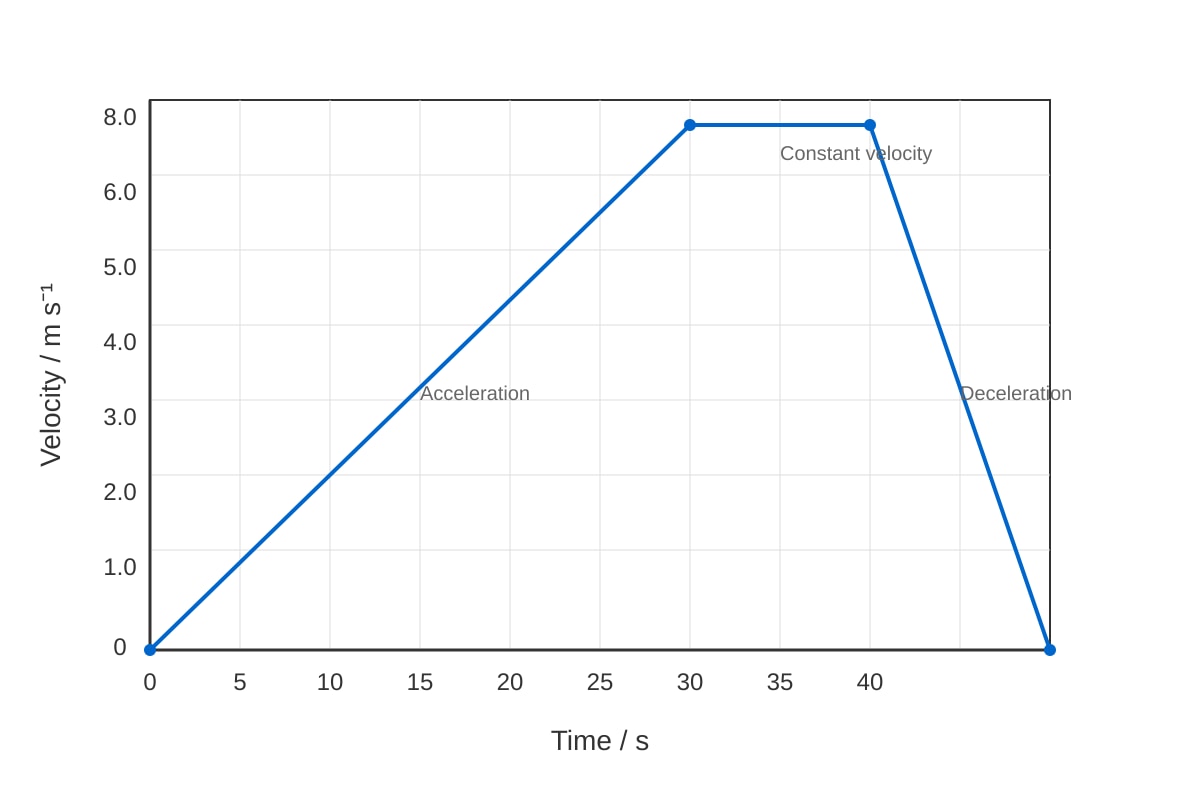
Question 1: Kinematics – Motion Graphs [6 marks]
(a) Describe the motion of the cyclist during each of the three time intervals. [2 marks]
- 0–10 s: The cyclist accelerates uniformly from rest. [B1]
- 10–30 s: The cyclist moves at constant velocity (8.0 m s⁻¹). [B1]
- 30–40 s: The cyclist decelerates uniformly to rest. [B1 – max 2 marks]
(b) Calculate the acceleration of the cyclist during the first 10 seconds. [1 mark]
a = Δv / Δt = (8.0 − 0) / 10 = 0.80 m s⁻² [A1]
(c) Determine the total distance travelled by the cyclist in the 40-second journey. [3 marks]
Distance = area under v–t graph [M1] Area = ½ × 10 × 8.0 + 20 × 8.0 + ½ × 10 × 8.0 [M1] = 40 + 160 + 40 = 240 m [A1]
Question 2: Dynamics – Newton's Laws [5 marks]
(a) Draw a free-body diagram showing all the forces acting on the crate. [2 marks]
Forces: Weight (mg, downward), Normal contact force (N, upward), Tension (T, at 30° above horizontal), Friction (f, opposing motion, horizontal). [B2 – all four forces correctly labelled and directed]
(b) Calculate the normal contact force between the crate and the floor. [2 marks]
Vertical equilibrium: N + T sin 30° = mg [M1] N = mg − T sin 30° = (25 × 9.81) − (150 × 0.5) = 245.25 − 75 = 170.25 N ≈ 170 N [A1]
(c) Determine the coefficient of kinetic friction between the crate and the floor. [1 mark]
Horizontal equilibrium (constant velocity): T cos 30° = f = μN [M1 implied] μ = T cos 30° / N = (150 × 0.866) / 170.25 = 129.9 / 170.25 = 0.76 [A1]
Question 3: Momentum and Impulse [6 marks]
(a) Calculate the speed of the ball just before it strikes the floor. [1 mark]
v² = u² + 2as → v² = 0 + 2 × 9.81 × 2.0 = 39.24 v = √39.24 = 6.26 m s⁻¹ ≈ 6.3 m s⁻¹ downward [A1]
(b) Calculate the speed of the ball just after it leaves the floor. [1 mark]
v² = u² + 2as → 0 = u² + 2(−9.81)(1.2) → u² = 23.544 u = √23.544 = 4.85 m s⁻¹ ≈ 4.9 m s⁻¹ upward [A1]
(c) Determine the change in momentum of the ball during the impact. State the direction clearly. [2 marks]
Taking upward as positive: Initial momentum (downward) = −mv_before = −0.15 × 6.26 = −0.939 kg m s⁻¹ [M1] Final momentum (upward) = +mv_after = +0.15 × 4.85 = +0.728 kg m s⁻¹ Δp = 0.728 − (−0.939) = 1.667 kg m s⁻¹ ≈ 1.7 kg m s⁻¹ upward [A1]
(d) Calculate the average force exerted by the floor on the ball during the impact. [2 marks]
F_avg = Δp / Δt = 1.667 / 0.080 = 20.8 N ≈ 21 N upward [M1, A1]
Question 4: Work, Energy and Power [6 marks]
(a) Calculate the kinetic energy gained by the car. [1 mark]
KE = ½mv² = ½ × 1200 × (25)² = 375,000 J = 375 kJ [A1]
(b) Calculate the useful power output of the car's engine at the instant it reaches 25 m s⁻¹. [2 marks]
At 25 m s⁻¹, net force = ma. a = (25 − 0) / 8.0 = 3.125 m s⁻² [M1] Driving force F = ma + resistive force = 1200 × 3.125 + 600 = 3750 + 600 = 4350 N Power = Fv = 4350 × 25 = 108,750 W ≈ 109 kW [A1]
(c) Determine the average power output of the engine during the 8.0 s acceleration period. [3 marks]
Work done by engine = gain in KE + work against resistive forces [M1] Distance travelled: s = ½(u + v)t = ½(0 + 25) × 8.0 = 100 m [M1] Work against resistance = 600 × 100 = 60,000 J Total work = 375,000 + 60,000 = 435,000 J Average power = 435,000 / 8.0 = 54,375 W ≈ 54.4 kW [A1]
Question 5: Forces and Equilibrium [5 marks]
(a) Draw a diagram showing all the forces acting on the beam. [1 mark]
Forces: Weight of beam (300 N, downward at centre, 2.0 m from A), Load (500 N, downward at A), Reaction at P (R_P, upward, 0.50 m from A), Reaction at Q (R_Q, upward, 3.0 m from A). [B1]
(b) By taking moments about a suitable point, calculate the reaction force at support P. [3 marks]
Take moments about Q (3.0 m from A): [M1 – suitable point chosen] Clockwise moments = Anticlockwise moments R_P × (3.0 − 0.50) + 500 × 3.0 = 300 × (3.0 − 2.0) [M1] R_P × 2.5 + 1500 = 300 × 1.0 R_P × 2.5 = 300 − 1500 = −1200 R_P = −480 N (negative indicates direction error in assumption; magnitude 480 N) Correct equation: R_P × 2.5 = 300 × 1.0 + 500 × 3.0 = 300 + 1500 = 1800 R_P = 1800 / 2.5 = 720 N [A1]
(c) Calculate the reaction force at support Q. [1 mark]
Vertical equilibrium: R_P + R_Q = 300 + 500 = 800 N R_Q = 800 − 720 = 80 N [A1]
Question 6: Projectile Motion [6 marks]
(a) Calculate the initial horizontal and vertical components of the stone's velocity. [1 mark]
u_x = 20 cos 30° = 20 × 0.866 = 17.32 m s⁻¹ ≈ 17.3 m s⁻¹ [B1] u_y = 20 sin 30° = 20 × 0.5 = 10.0 m s⁻¹ [B1 – max 1 mark]
(b) Determine the time taken for the stone to reach the sea. [3 marks]
Taking downward as positive: s = −45 m, u_y = +10.0 m s⁻¹ (upward), a = +9.81 m s⁻² [M1 – correct sign convention] s = u_y t + ½at² → −45 = 10.0t + ½(9.81)t² [M1] 4.905t² + 10.0t − 45 = 0 t = [−10.0 ± √(100 + 4 × 4.905 × 45)] / (2 × 4.905) t = [−10.0 ± √(100 + 882.9)] / 9.81 = [−10.0 ± √982.9] / 9.81 t = [−10.0 ± 31.35] / 9.81 t = 21.35 / 9.81 = 2.18 s (positive root only) [A1]
(c) Calculate the horizontal distance from the base of the cliff to the point where the stone enters the sea. [2 marks]
Horizontal distance = u_x × t = 17.32 × 2.18 = 37.8 m ≈ 38 m [M1, A1]
Question 7: Conservation of Momentum [5 marks]
(a) State the principle of conservation of linear momentum. [1 mark]
The total momentum of a closed system remains constant provided no external forces act on the system. [B1]
(b) Calculate the velocity of trolley B after the collision. State its direction. [2 marks]
Taking right as positive: m_A u_A + m_B u_B = m_A v_A + m_B v_B [M1] (2.0 × 3.0) + (1.0 × −2.0) = (2.0 × 1.0) + (1.0 × v_B) 6.0 − 2.0 = 2.0 + v_B v_B = 2.0 m s⁻¹ to the right [A1]
(c) Determine whether the collision is elastic or inelastic. Show your working. [2 marks]
Initial KE = ½(2.0)(3.0)² + ½(1.0)(2.0)² = 9.0 + 2.0 = 11.0 J [M1] Final KE = ½(2.0)(1.0)² + ½(1.0)(2.0)² = 1.0 + 2.0 = 3.0 J KE not conserved → inelastic collision [A1]
Question 8: Energy Conservation [5 marks]
(a) Calculate the speed of the bob at point B, assuming no energy losses. [2 marks]
Loss in GPE = Gain in KE → mgh = ½mv² [M1] v = √(2gh) = √(2 × 9.81 × 0.30) = √5.886 = 2.43 m s⁻¹ ≈ 2.4 m s⁻¹ [A1]
(b) In practice, the speed at B is measured to be 2.2 m s⁻¹. Calculate the work done against air resistance during the swing from A to B. [2 marks]
Theoretical KE at B = ½ × 0.50 × (2.43)² = 1.47 J [M1] Actual KE at B = ½ × 0.50 × (2.2)² = 1.21 J Work done against air resistance = 1.47 − 1.21 = 0.26 J [A1]
(c) Suggest one reason why the work done against air resistance may vary between successive swings. [1 mark]
Air resistance depends on speed; as the amplitude decreases, the maximum speed decreases, so air resistance per swing decreases. [B1] Accept any valid reason, e.g., changes in air currents, bob orientation.
Question 9: Connected Bodies [6 marks]
(a) Draw free-body diagrams for both blocks, showing all forces. [2 marks]
Block P (on table): Weight (m_P g, downward), Normal contact force (N, upward), Tension (T, to the right). [B1] Block Q (hanging): Weight (m_Q g, downward), Tension (T, upward). [B1]
(b) Calculate the acceleration of the system. [2 marks]
For block Q: m_Q g − T = m_Q a → 2.0 × 9.81 − T = 2.0a → 19.62 − T = 2.0a [M1] For block P: T = m_P a → T = 4.0a Substituting: 19.62 − 4.0a = 2.0a → 19.62 = 6.0a → a = 3.27 m s⁻² ≈ 3.3 m s⁻² [A1]
(c) Calculate the tension in the string. [2 marks]
T = m_P a = 4.0 × 3.27 = 13.08 N ≈ 13.1 N [M1, A1]
Section B: Free Response Questions [30 marks]
Question 10: Mechanics – Integrated Problem [15 marks]
(a) Show that the block will slide down the plane when released from rest. [3 marks]
Component of weight down plane = mg sin 25° = 5.0 × 9.81 × sin 25° = 49.05 × 0.4226 = 20.73 N [M1] Maximum static friction = μ_s N = μ_s mg cos 25° = 0.45 × 5.0 × 9.81 × cos 25° = 0.45 × 49.05 × 0.9063 = 20.00 N [M1] Since 20.73 N > 20.00 N, the component of weight exceeds maximum static friction, so the block slides. [A1]
(b) Calculate the acceleration of the block as it slides down the plane. [3 marks]
Net force down plane = mg sin 25° − μ_k mg cos 25° [M1] = 20.73 − (0.35 × 49.05 × 0.9063) = 20.73 − 15.56 = 5.17 N [M1] a = F_net / m = 5.17 / 5.0 = 1.03 m s⁻² ≈ 1.0 m s⁻² [A1]
(c) The block slides 2.5 m down the incline from rest. Calculate:
(i) the speed of the block at the end of this distance, [2 marks]
v² = u² + 2as = 0 + 2 × 1.034 × 2.5 = 5.17 [M1] v = √5.17 = 2.27 m s⁻¹ ≈ 2.3 m s⁻¹ [A1]
(ii) the time taken to travel this distance. [2 marks]
s = ½(u + v)t → 2.5 = ½(0 + 2.27)t [M1] t = 5.0 / 2.27 = 2.20 s ≈ 2.2 s [A1]
(d) At the bottom of the incline, the block continues onto a rough horizontal surface with the same coefficient of kinetic friction. Calculate the distance the block travels on the horizontal surface before coming to rest. [3 marks]
On horizontal surface: friction = μ_k mg = 0.35 × 5.0 × 9.81 = 17.17 N [M1] Deceleration: a = F/m = 17.17 / 5.0 = 3.43 m s⁻² [M1] v² = u² + 2as → 0 = (2.27)² + 2(−3.43)s → s = 5.15 / 6.86 = 0.75 m [A1]
(e) Discuss the energy transformations that occur from the moment the block is released until it comes to rest on the horizontal surface. [2 marks]
Gravitational potential energy is converted to kinetic energy as the block slides down the incline. Some mechanical energy is dissipated as thermal energy due to friction on both the incline and horizontal surface. [B1] By the time the block stops, all the initial GPE has been converted to thermal energy (via work done against friction). [B1]
Question 11: Mechanics – Collisions and Energy [15 marks]
(a) If the collision is perfectly elastic, calculate:
(i) the velocity of ball X after the collision, [3 marks]
For elastic collision: v_X = [(m_X − m_Y) / (m_X + m_Y)] × u_X + [2m_Y / (m_X + m_Y)] × u_Y [M1] u_Y = 0, so v_X = [(0.20 − 0.30) / (0.20 + 0.30)] × 4.0 [M1] v_X = (−0.10 / 0.50) × 4.0 = −0.80 m s⁻¹ (i.e., 0.80 m s⁻¹ to the left) [A1]
(ii) the velocity of ball Y after the collision. [2 marks]
v_Y = [2m_X / (m_X + m_Y)] × u_X + [(m_Y − m_X) / (m_X + m_Y)] × u_Y [M1] v_Y = [2 × 0.20 / 0.50] × 4.0 + 0 = (0.40 / 0.50) × 4.0 = 3.2 m s⁻¹ to the right [A1]
(b) In a different scenario, the balls stick together on impact. Calculate:
(i) the velocity of the combined mass after the collision, [2 marks]
m_X u_X + m_Y u_Y = (m_X + m_Y)v [M1] (0.20 × 4.0) + 0 = (0.20 + 0.30)v → 0.80 = 0.50v → v = 1.6 m s⁻¹ to the right [A1]
(ii) the kinetic energy lost in the collision. [2 marks]
Initial KE = ½ × 0.20 × (4.0)² = 1.6 J [M1] Final KE = ½ × 0.50 × (1.6)² = 0.64 J KE lost = 1.6 − 0.64 = 0.96 J [A1]
(c) Explain, in terms of the forces between the balls, why momentum is conserved in both types of collision but kinetic energy is only conserved in elastic collisions. [3 marks]
Momentum is conserved because the forces between the balls are internal to the system; no external forces act horizontally. [B1] In elastic collisions, the internal forces are conservative; kinetic energy is temporarily stored as elastic potential energy and fully recovered. [B1] In inelastic collisions, some kinetic energy is dissipated as thermal energy or used in permanent deformation; the internal forces are non-conservative. [B1]
(d) Ball Y then rolls off the edge of the table, which is 0.85 m high. Calculate the horizontal distance from the table edge where ball Y lands, assuming it leaves the table with the velocity calculated in part (a)(ii). [3 marks]
Time to fall: s = ½gt² → 0.85 = ½ × 9.81 × t² → t = √(1.70 / 9.81) = √0.1733 = 0.416 s [M1] Horizontal distance = v × t = 3.2 × 0.416 [M1] = 1.33 m ≈ 1.3 m [A1]
Question 12: Mechanics – Forces and Motion [15 marks]
(a) Calculate the acceleration of the car and trailer. [3 marks]
Total mass = 900 + 300 = 1200 kg [M1] Net force = Driving force − Total resistive force = 2400 − (400 + 200) = 1800 N [M1] a = F_net / m_total = 1800 / 1200 = 1.5 m s⁻² [A1]
(b) Determine the tension in the tow bar connecting the car and trailer. [3 marks]
Consider trailer alone: T − 200 = 300 × 1.5 [M1] T = 200 + 450 = 650 N [A1] Alternatively, consider car: 2400 − 400 − T = 900 × 1.5 → T = 2400 − 400 − 1350 = 650 N. [M1 for correct method]
(c) The car and trailer ascend a hill inclined at 8.0° to the horizontal. The driving force and resistive forces remain the same. Calculate:
(i) the new acceleration of the system, [4 marks]
Component of total weight down slope = (m_car + m_trailer)g sin 8.0° [M1] = 1200 × 9.81 × sin 8.0° = 11,772 × 0.1392 = 1639 N [M1] Net force up slope = 2400 − (400 + 200) − 1639 = 2400 − 600 − 1639 = 161 N [M1] a = 161 / 1200 = 0.134 m s⁻² ≈ 0.13 m s⁻² [A1]
(ii) the new tension in the tow bar. [2 marks]
Consider trailer: T − 200 − m_trailer g sin 8.0° = m_trailer a [M1] T − 200 − (300 × 9.81 × 0.1392) = 300 × 0.134 T − 200 − 409.7 = 40.2 T = 649.9 N ≈ 650 N [A1]
(d) Explain why the tension in the tow bar changes when ascending the hill compared to travelling on the horizontal road. [3 marks]
On the horizontal, the tension provides the net force to accelerate the trailer and overcome its resistive force. [B1] On the incline, the tension must also overcome the component of the trailer's weight acting down the slope. [B1] However, since the acceleration is much smaller on the incline, the net force required for acceleration decreases. The two effects approximately cancel in this case, resulting in a similar tension. [B1]
END OF ANSWER KEY