AI Generated Exam Paper

A Level H1 Physics Practice Paper 1

Free AI-Generated Owl Alpha A Level H1 Physics Practice Paper 1 practice paper with questions and answers for Singapore students. This page is rendered as a direct URL so the questions and answers can be discovered without pressing in-page buttons.

These static practice materials are generated from the site's syllabus and paper-generation workflow, with source and model context shown so students and parents can evaluate the material before use.

A Level H1 Physics AI Generated Generated by Owl Alpha Updated 2026-06-07

Questions

<!-- TuitionGoWhere generation metadata: stage=5-2; model=openrouter/owl-alpha; model_label=Owl Alpha; generated=2026-06-06; Sources: Stage 4-0 LLM templates, syllabus context, and Stage 2 evidence where available. -->

TuitionGoWhere Practice Paper - Physics H1 A-Level

TuitionGoWhere Practice Paper (AI)

Subject: Physics H1 Level: A-Level Paper: Practice Paper — Mechanics Duration: 1 hour 30 minutes Total Marks: 60

Name: ___________________________ Class: ___________________________ Date: ___________________________


Instructions

  • Answer all questions in the spaces provided.
  • The number of marks for each question or part-question is shown in brackets [ ].
  • You are advised to show all working clearly. Marks may be awarded for correct working even if the final answer is incorrect.
  • Non-programmable scientific calculators may be used.
  • Take g=9.81 m s2g = 9.81 \text{ m s}^{-2} unless otherwise stated.

Section A: Multiple Choice [15 marks]

Questions 1–15: Choose the most appropriate answer.

1. A car accelerates uniformly from rest to 24 m s124 \text{ m s}^{-1} in 8.0 s8.0 \text{ s}. What is its acceleration?

A. 2.0 m s22.0 \text{ m s}^{-2} B. 3.0 m s23.0 \text{ m s}^{-2} C. 4.0 m s24.0 \text{ m s}^{-2} D. 6.0 m s26.0 \text{ m s}^{-2}

[1]

2. Which of the following is a vector quantity?

A. Energy B. Power C. Speed D. Momentum

[1]

3. A ball is thrown horizontally from the top of a cliff at 15 m s115 \text{ m s}^{-1}. It takes 3.0 s3.0 \text{ s} to reach the ground. What is the horizontal distance travelled by the ball?

A. 15 m15 \text{ m} B. 30 m30 \text{ m} C. 45 m45 \text{ m} D. 60 m60 \text{ m}

[1]

4. A 5.0 kg5.0 \text{ kg} object is acted upon by two forces: F1=12 NF_1 = 12 \text{ N} to the right and F2=5.0 NF_2 = 5.0 \text{ N} to the left. What is the acceleration of the object?

A. 0.71 m s20.71 \text{ m s}^{-2} B. 1.4 m s21.4 \text{ m s}^{-2} C. 2.4 m s22.4 \text{ m s}^{-2} D. 3.4 m s23.4 \text{ m s}^{-2}

[1]

5. A force of 20 N20 \text{ N} acts on a body of mass 4.0 kg4.0 \text{ kg} for 5.0 s5.0 \text{ s}. What is the change in momentum of the body?

A. 25 kg m s125 \text{ kg m s}^{-1} B. 40 kg m s140 \text{ kg m s}^{-1} C. 80 kg m s180 \text{ kg m s}^{-1} D. 100 kg m s1100 \text{ kg m s}^{-1}

[1]

6. A projectile is launched at an angle of 30°30° above the horizontal with speed 40 m s140 \text{ m s}^{-1}. What is the horizontal component of its initial velocity?

A. 20 m s120 \text{ m s}^{-1} B. 23 m s123 \text{ m s}^{-1} C. 35 m s135 \text{ m s}^{-1} D. 40 m s140 \text{ m s}^{-1}

[1]

7. A 2.0 kg2.0 \text{ kg} trolley moving at 6.0 m s16.0 \text{ m s}^{-1} collides with a stationary 4.0 kg4.0 \text{ kg} trolley. After the collision, the two trolleys stick together. What is their common velocity?

A. 1.0 m s11.0 \text{ m s}^{-1} B. 2.0 m s12.0 \text{ m s}^{-1} C. 3.0 m s13.0 \text{ m s}^{-1} D. 4.0 m s14.0 \text{ m s}^{-1}

[1]

8. Which statement about work done is correct?

A. Work is done when a force acts on a body, regardless of displacement. B. Work done is a vector quantity. C. No work is done when the force is perpendicular to the displacement. D. Work done depends only on the magnitude of the force.

[1]

9. A crane lifts a 200 kg200 \text{ kg} load vertically at constant speed through a height of 10 m10 \text{ m} in 4.0 s4.0 \text{ s}. What is the useful power output of the crane?

A. 490 W490 \text{ W} B. 1960 W1960 \text{ W} C. 4900 W4900 \text{ W} D. 7840 W7840 \text{ W}

[1]

10. A 0.50 kg0.50 \text{ kg} ball moving at 8.0 m s18.0 \text{ m s}^{-1} collides elastically with a stationary 1.5 kg1.5 \text{ kg} ball. What is the velocity of the 0.50 kg0.50 \text{ kg} ball after the collision?

A. 4.0 m s1-4.0 \text{ m s}^{-1} B. 2.0 m s1-2.0 \text{ m s}^{-1} C. 0 m s10 \text{ m s}^{-1} D. 2.0 m s12.0 \text{ m s}^{-1}

[1]

11. An object is in equilibrium under the action of three forces. Which statement is always true?

A. The three forces must be equal in magnitude. B. The three forces must be parallel. C. The resultant of the three forces is zero. D. The three forces must act at the same point.

[1]

12. A stone is thrown vertically upwards with an initial speed of 20 m s120 \text{ m s}^{-1}. What is the maximum height it reaches? (Take g=9.81 m s2g = 9.81 \text{ m s}^{-2})

A. 10.2 m10.2 \text{ m} B. 20.4 m20.4 \text{ m} C. 30.6 m30.6 \text{ m} D. 40.8 m40.8 \text{ m}

[1]

13. A 3.0 kg3.0 \text{ kg} block slides down a frictionless slope inclined at 30°30° to the horizontal. What is the acceleration of the block along the slope?

A. 2.5 m s22.5 \text{ m s}^{-2} B. 4.9 m s24.9 \text{ m s}^{-2} C. 8.5 m s28.5 \text{ m s}^{-2} D. 9.8 m s29.8 \text{ m s}^{-2}

[1]

14. A car of mass 1200 kg1200 \text{ kg} travelling at 25 m s125 \text{ m s}^{-1} is brought to rest in 10 s10 \text{ s}. What is the average braking force?

A. 3000 N3000 \text{ N} B. 4500 N4500 \text{ N} C. 6000 N6000 \text{ N} D. 12000 N12000 \text{ N}

[1]

15. A 1.0 kg1.0 \text{ kg} ball is dropped from a height of 20 m20 \text{ m}. Just before it hits the ground, what is its kinetic energy? (Take g=9.81 m s1g = 9.81 \text{ m s}^{-1})

A. 98 J98 \text{ J} B. 196 J196 \text{ J} C. 294 J294 \text{ J} D. 392 J392 \text{ J}

[1]


Section B: Structured Questions [30 marks]

Answer all questions. Show all working clearly.

16. (a) State Newton's first law of motion. [2]


(b) A 60 kg60 \text{ kg} student stands in a lift. The lift accelerates upwards at 1.5 m s21.5 \text{ m s}^{-2}.

(i) Draw a free-body diagram showing the forces acting on the student. Label the forces clearly. [2]


(ii) Calculate the normal reaction force exerted by the lift floor on the student. [3]


17. A 0.20 kg0.20 \text{ kg} steel ball is released from rest at the top of a smooth curved track of height 1.8 m1.8 \text{ m}. It slides down and collides with a stationary 0.30 kg0.30 \text{ kg} ball at the bottom. After the collision, the 0.30 kg0.30 \text{ kg} ball moves at 3.2 m s13.2 \text{ m s}^{-1}.

(a) Calculate the speed of the 0.20 kg0.20 \text{ kg} ball just before the collision. [3]


(b) Using the principle of conservation of momentum, calculate the velocity of the 0.20 kg0.20 \text{ kg} ball immediately after the collision. State both magnitude and direction. [4]


(c) Determine whether this collision is elastic or inelastic. Show your reasoning. [3]


18. A small ball is projected from the top of a horizontal cliff with a horizontal velocity of 12 m s112 \text{ m s}^{-1}. The cliff is 45 m45 \text{ m} above the ground.

(a) Calculate the time taken for the ball to reach the ground. [3]


(b) Calculate the horizontal distance from the base of the cliff to where the ball lands. [2]


(c) Calculate the speed of the ball just before it hits the ground. [3]


(d) State the effect on the time of flight if the horizontal projection speed is doubled. Justify your answer. [2]


Section C: Free Response [15 marks]

Answer all questions.

19. A 1500 kg1500 \text{ kg} car travels along a straight horizontal road. The engine provides a driving force of 3600 N3600 \text{ N}, and the total resistive force acting on the car is 600 N600 \text{ N}.

(a) Calculate the acceleration of the car. [3]


(b) The car starts from rest. Calculate its velocity after 12 s12 \text{ s}. [2]


(c) Calculate the kinetic energy of the car at this instant. [2]


(d) The car now travels up a slope inclined at 5.0°5.0° to the horizontal. The driving force and resistive force remain unchanged.

(i) Calculate the component of the car's weight acting down the slope. [2]


(ii) Calculate the new acceleration of the car up the slope. [3]


(e) Explain, using the concept of energy, why the car's speed decreases as it travels up the slope. [3]


20. A student investigates the motion of a ball bearing projected horizontally from a bench. The ball bearing is launched with an initial horizontal speed and lands on the floor at a measured horizontal distance from the edge of the bench.

(a) Describe an experimental procedure the student could use to determine the horizontal speed of the ball bearing as it leaves the bench. Include the measurements to be taken and how the speed is calculated. [4]


(b) The bench is 0.85 m0.85 \text{ m} high and the ball lands 1.40 m1.40 \text{ m} from the base of the bench. Calculate the horizontal speed of the ball bearing as it leaves the bench. [4]


(c) In a real experiment, air resistance is present. State and explain the effect of air resistance on the measured horizontal distance compared to the theoretical value. [3]


(d) Suggest one improvement the student could make to reduce the effect of random errors in this experiment. [2]


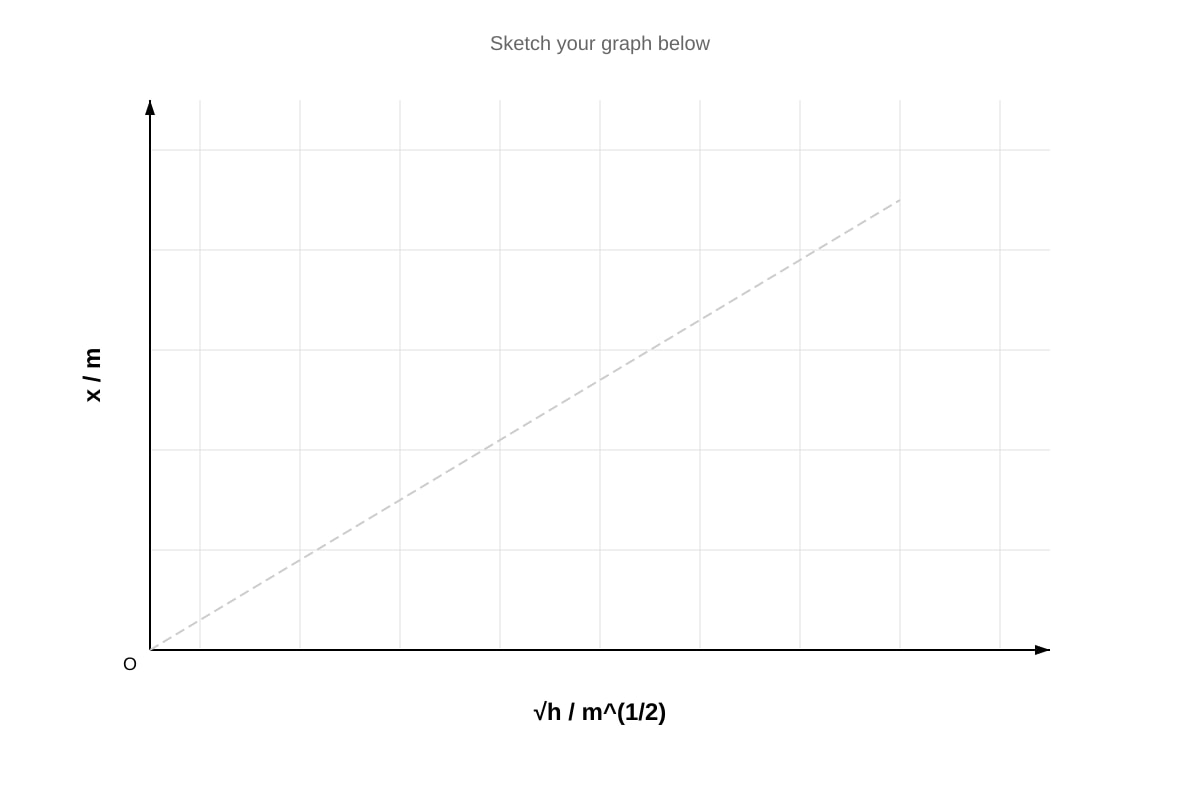
(e) The student repeats the experiment with the bench at a different height. Without calculation, sketch on the axes below how you would expect the horizontal distance xx to vary with the square root of the bench height h\sqrt{h}. [2]

<image_placeholder> id: Q20-fig1 type: graph linked_question: Q20(e) description: A set of axes for the student to sketch a graph of horizontal distance x (vertical axis) against square root of bench height sqrt(h) (horizontal axis). Both axes should be unnumbered but labelled. labels: "x / m" on vertical axis, "sqrt(h) / m^(1/2)" on horizontal axis values: No specific values needed — student sketch graph must_show: Straight line passing through the origin showing positive linear relationship between x and sqrt(h) </image_placeholder>


End of Practice Paper


Summary of Marks

SectionMarks
A: Multiple Choice (Q1–15)15
B: Structured Questions (Q16–18)30
C: Free Response (Q19–20)15
Total60

Answers

<!-- TuitionGoWhere generation metadata: stage=5-2; model=openrouter/owl-alpha; model_label=Owl Alpha; generated=2026-06-06; Sources: Stage 4-0 LLM templates, syllabus context, and Stage 2 evidence where available. -->

TuitionGoWhere Practice Paper — Physics H1 A-Level

Answer Key — Practice Paper: Mechanics


Section A: Multiple Choice

1. B. 3.0 m s23.0 \text{ m s}^{-2}

Teaching note: Using a=vut=2408.0=3.0 m s2a = \frac{v - u}{t} = \frac{24 - 0}{8.0} = 3.0 \text{ m s}^{-2}. Uniform acceleration means the velocity increases at a constant rate. The equation of motion directly relates initial velocity, final velocity, time, and acceleration.

[1]


2. D. Momentum

Teaching note: Momentum (p=mvp = mv) is a vector quantity because it has both magnitude and direction (the direction of velocity). Energy, power, and speed are all scalar quantities — they have magnitude only. This is a fundamental distinction in mechanics.

[1]


3. C. 45 m45 \text{ m}

Teaching note: For horizontal projectile motion, horizontal velocity is constant (no horizontal acceleration). Using sx=vx×t=15×3.0=45 ms_x = v_x \times t = 15 \times 3.0 = 45 \text{ m}. The vertical motion is independent of the horizontal motion — the time to fall is determined entirely by the vertical drop.

[1]


4. B. 1.4 m s21.4 \text{ m s}^{-2}

Teaching note: Net force Fnet=125.0=7.0 NF_{\text{net}} = 12 - 5.0 = 7.0 \text{ N} (taking right as positive). Using Newton's second law: a=Fnetm=7.04.0=1.75 m s2a = \frac{F_{\text{net}}}{m} = \frac{7.0}{4.0} = 1.75 \text{ m s}^{-2}. Wait — recalculating: a=7.05.0=1.4 m s2a = \frac{7.0}{5.0} = 1.4 \text{ m s}^{-2}. The mass is 5.0 kg5.0 \text{ kg}, not 4.0 kg4.0 \text{ kg}. Common trap: using the wrong mass.

[1]


5. D. 100 kg m s1100 \text{ kg m s}^{-1}

Teaching note: Using the impulse-momentum theorem: Δp=F×t=20×5.0=100 kg m s1\Delta p = F \times t = 20 \times 5.0 = 100 \text{ kg m s}^{-1}. Impulse equals change in momentum. This is a direct application of Newton's second law in the form F=ΔpΔtF = \frac{\Delta p}{\Delta t}.

[1]


6. C. 35 m s135 \text{ m s}^{-1}

Teaching note: The horizontal component is vx=vcosθ=40cos30°=40×32=40×0.866=34.6 m s135 m s1v_x = v \cos\theta = 40 \cos 30° = 40 \times \frac{\sqrt{3}}{2} = 40 \times 0.866 = 34.6 \text{ m s}^{-1} \approx 35 \text{ m s}^{-1}. Students must resolve the velocity into components using trigonometry. Common error: using sin\sin instead of cos\cos for the horizontal component.

[1]


7. B. 2.0 m s12.0 \text{ m s}^{-1}

Teaching note: Using conservation of momentum for a perfectly inelastic collision (they stick together): m1u1+m2u2=(m1+m2)vm_1 u_1 + m_2 u_2 = (m_1 + m_2)v. (2.0)(6.0)+(4.0)(0)=(2.0+4.0)v(2.0)(6.0) + (4.0)(0) = (2.0 + 4.0)v. 12=6.0v12 = 6.0v. v=2.0 m s1v = 2.0 \text{ m s}^{-1}. Kinetic energy is not conserved in this type of collision — some is converted to heat and sound.

[1]


8. C. No work is done when the force is perpendicular to the displacement.

Teaching note: Work done is defined as W=FdcosθW = Fd\cos\theta. When the force is perpendicular to displacement, θ=90°\theta = 90° and cos90°=0\cos 90° = 0, so W=0W = 0. Work is a scalar quantity (not vector), and it requires both force AND displacement in the direction of the force.

[1]


9. C. 4900 W4900 \text{ W}

Teaching note: At constant speed, the tension equals the weight: T=mg=200×9.81=1962 NT = mg = 200 \times 9.81 = 1962 \text{ N}. Work done =F×d=1962×10=19620 J= F \times d = 1962 \times 10 = 19620 \text{ J}. Power =Wt=196204.0=4905 W4900 W= \frac{W}{t} = \frac{19620}{4.0} = 4905 \text{ W} \approx 4900 \text{ W}. Alternatively, P=Fv=1962×104.0=1962×2.5=4905 WP = Fv = 1962 \times \frac{10}{4.0} = 1962 \times 2.5 = 4905 \text{ W}.

[1]


10. A. 4.0 m s1-4.0 \text{ m s}^{-1}

Teaching note: For elastic collisions, both momentum and kinetic energy are conserved. Using conservation of momentum: 0.50×8.0+0=0.50v1+1.5v20.50 \times 8.0 + 0 = 0.50 v_1 + 1.5 v_2, giving 4.0=0.50v1+1.5v24.0 = 0.50 v_1 + 1.5 v_2. For elastic collisions, relative speed of approach = relative speed of separation: 8.00=v2v18.0 - 0 = v_2 - v_1, so v2=8.0+v1v_2 = 8.0 + v_1. Substituting: 4.0=0.50v1+1.5(8.0+v1)=0.50v1+12+1.5v1=2.0v1+124.0 = 0.50 v_1 + 1.5(8.0 + v_1) = 0.50 v_1 + 12 + 1.5 v_1 = 2.0 v_1 + 12. So 2.0v1=8.02.0 v_1 = -8.0, giving v1=4.0 m s1v_1 = -4.0 \text{ m s}^{-1}. The negative sign means the lighter ball rebounds in the opposite direction.

[1]


11. C. The resultant of the three forces is zero.

Teaching note: For equilibrium, the vector sum (resultant) of all forces must be zero. This is the defining condition for equilibrium. The forces need not be equal, parallel, or act at the same point — they only need to sum to zero as vectors.

[1]


12. B. 20.4 m20.4 \text{ m}

Teaching note: At maximum height, the final velocity is zero. Using v2=u22ghv^2 = u^2 - 2gh: 0=(20)22(9.81)h0 = (20)^2 - 2(9.81)h. h=40019.62=20.4 mh = \frac{400}{19.62} = 20.4 \text{ m}. Alternatively, using conservation of energy: 12mv2=mgh\frac{1}{2}mv^2 = mgh, so h=v22g=40019.62=20.4 mh = \frac{v^2}{2g} = \frac{400}{19.62} = 20.4 \text{ m}.

[1]


13. B. 4.9 m s24.9 \text{ m s}^{-2}

Teaching note: On a frictionless slope, the component of weight along the slope is mgsinθmg\sin\theta. Using Newton's second law along the slope: ma=mgsinθma = mg\sin\theta, so a=gsinθ=9.81×sin30°=9.81×0.5=4.9 m s2a = g\sin\theta = 9.81 \times \sin 30° = 9.81 \times 0.5 = 4.9 \text{ m s}^{-2}. The acceleration is independent of mass on a frictionless incline.

[1]


14. A. 3000 N3000 \text{ N}

Teaching note: First find acceleration: a=vut=02510=2.5 m s2a = \frac{v - u}{t} = \frac{0 - 25}{10} = -2.5 \text{ m s}^{-2}. Then F=ma=1200×2.5=3000 NF = ma = 1200 \times 2.5 = 3000 \text{ N}. The braking force opposes the direction of motion. Common trap: forgetting that deceleration is negative, but the magnitude of force is asked for.

[1]


15. B. 196 J196 \text{ J}

Teaching note: By conservation of energy, the gravitational potential energy lost equals the kinetic energy gained: KE=mgh=1.0×9.81×20=196.2 J196 JKE = mgh = 1.0 \times 9.81 \times 20 = 196.2 \text{ J} \approx 196 \text{ J}. This assumes no air resistance. Alternatively, find the speed using v2=2gh=2×9.81×20=392.4v^2 = 2gh = 2 \times 9.81 \times 20 = 392.4, then KE=12mv2=12(1.0)(392.4)=196.2 JKE = \frac{1}{2}mv^2 = \frac{1}{2}(1.0)(392.4) = 196.2 \text{ J}.

[1]


Section B: Structured Questions

16. (a) Newton's first law of motion states that an object remains at rest or continues to move at a constant velocity unless acted upon by a resultant external force. [2]

[B1] for "remains at rest or moves at constant velocity" (or equivalent) [B1] for "unless acted upon by a resultant external force" (or "no net/resultant force")

Teaching note: This is the law of inertia. The key idea is that a force is not needed to keep something moving — it is needed to change its motion. Students often incorrectly state that a force is needed to maintain constant velocity.


(b)(i) Free-body diagram showing:

<image_placeholder> id: Q16-fig1 type: diagram linked_question: Q16(b)(i) description: A simple box representing the student with two forces: Weight (W) arrow pointing downward from the centre of the box, labelled "W = mg" or "Weight". Normal reaction (R) arrow pointing upward from the bottom of the box, labelled "R" or "Normal reaction". The normal reaction arrow should be longer than the weight arrow since the lift is accelerating upward. labels: "W (Weight, downward)", "R (Normal reaction, upward)", "R > W shown by arrow length" values: No numerical values needed on the diagram must_show: Two forces clearly labelled, with the upward arrow (R) longer than the downward arrow (W) to indicate net upward force for upward acceleration </image_placeholder>

[B1] for two forces correctly drawn and labelled (weight and normal reaction) [B1] for correct directions and the normal reaction arrow being longer than the weight arrow


(b)(ii) Taking upward as positive:

Rmg=maR - mg = ma

R=m(g+a)R = m(g + a)

R=60(9.81+1.5)R = 60(9.81 + 1.5)

R=60×11.31R = 60 \times 11.31

R=678.6 N679 NR = 678.6 \text{ N} \approx 679 \text{ N}

[B1] for correct equation: Rmg=maR - mg = ma (or equivalent Newton's second law setup) [B1] for correct substitution [B1] for correct answer with unit: 679 N679 \text{ N} (or 680 N680 \text{ N} to 2 s.f.)

Teaching note: Since the lift accelerates upward, the normal reaction must be greater than the weight to provide a net upward force. This is why you feel heavier in an accelerating lift. The net upward force RmgR - mg equals mama by Newton's second law.


17. (a) Using conservation of energy:

mgh=12mv2mgh = \frac{1}{2}mv^2

v=2ghv = \sqrt{2gh}

v=2×9.81×1.8v = \sqrt{2 \times 9.81 \times 1.8}

v=35.316v = \sqrt{35.316}

v=5.94 m s1v = 5.94 \text{ m s}^{-1}

[B1] for using conservation of energy / v=2ghv = \sqrt{2gh} [B1] for correct substitution [B1] for correct answer: 5.94 m s15.94 \text{ m s}^{-1} (or 5.9 m s15.9 \text{ m s}^{-1} to 2 s.f.)

Teaching note: On a smooth track, mechanical energy is conserved. All gravitational potential energy converts to kinetic energy. The mass cancels out, so the speed at the bottom depends only on the height.


(b) Using conservation of momentum (taking the initial direction of the 0.20 kg0.20 \text{ kg} ball as positive):

m1u1+m2u2=m1v1+m2v2m_1 u_1 + m_2 u_2 = m_1 v_1 + m_2 v_2

(0.20)(5.94)+(0.30)(0)=(0.20)v1+(0.30)(3.2)(0.20)(5.94) + (0.30)(0) = (0.20)v_1 + (0.30)(3.2)

1.188=0.20v1+0.961.188 = 0.20 v_1 + 0.96

0.20v1=1.1880.96=0.2280.20 v_1 = 1.188 - 0.96 = 0.228

v1=0.2280.20=1.14 m s1v_1 = \frac{0.228}{0.20} = 1.14 \text{ m s}^{-1}

The velocity of the 0.20 kg0.20 \text{ kg} ball after the collision is 1.14 m s11.14 \text{ m s}^{-1} in the same direction as its initial motion (positive direction).

[B1] for correct conservation of momentum equation [B1] for correct substitution of all values [B1] for correct calculation of v1v_1 [B1] for stating the direction (same direction as initial motion / positive direction)

Teaching note: The 0.20 kg0.20 \text{ kg} ball continues moving forward after the collision but at a reduced speed, having transferred some momentum to the 0.30 kg0.30 \text{ kg} ball. The positive result confirms it continues in the original direction.


(c) Calculate total kinetic energy before and after:

Before collision: KEbefore=12(0.20)(5.94)2=12(0.20)(35.28)=3.53 JKE_{\text{before}} = \frac{1}{2}(0.20)(5.94)^2 = \frac{1}{2}(0.20)(35.28) = 3.53 \text{ J}

After collision: KEafter=12(0.20)(1.14)2+12(0.30)(3.2)2KE_{\text{after}} = \frac{1}{2}(0.20)(1.14)^2 + \frac{1}{2}(0.30)(3.2)^2 =12(0.20)(1.30)+12(0.30)(10.24)= \frac{1}{2}(0.20)(1.30) + \frac{1}{2}(0.30)(10.24) =0.130+1.536=1.67 J= 0.130 + 1.536 = 1.67 \text{ J}

Since KEafter<KEbeforeKE_{\text{after}} < KE_{\text{before}} (1.67 J<3.53 J1.67 \text{ J} < 3.53 \text{ J}), kinetic energy is not conserved, so the collision is inelastic.

[B1] for calculating KEbeforeKE_{\text{before}} correctly [B1] for calculating KEafterKE_{\text{after}} correctly [B1] for correct conclusion with reasoning (KE not conserved → inelastic)

Teaching note: In any collision, momentum is always conserved (no external forces). However, kinetic energy is only conserved in elastic collisions. Here, some kinetic energy has been converted to other forms (heat, sound, deformation energy), making it inelastic.


18. (a) Using the vertical motion (taking downward as positive):

h=12gt2h = \frac{1}{2}gt^2

t=2hg=2×459.81=909.81=9.174=3.03 st = \sqrt{\frac{2h}{g}} = \sqrt{\frac{2 \times 45}{9.81}} = \sqrt{\frac{90}{9.81}} = \sqrt{9.174} = 3.03 \text{ s}

[B1] for using h=12gt2h = \frac{1}{2}gt^2 (vertical displacement with zero initial vertical velocity) [B1] for correct substitution [B1] for correct answer: 3.03 s3.03 \text{ s} (or 3.0 s3.0 \text{ s} to 2 s.f.)

Teaching note: The time of flight depends only on the vertical height and gg. The horizontal velocity does not affect how long the ball takes to fall — this is the principle of independence of perpendicular motions.


(b) Horizontal distance:

sx=vx×t=12×3.03=36.4 ms_x = v_x \times t = 12 \times 3.03 = 36.4 \text{ m}

[B1] for using sx=vx×ts_x = v_x \times t [B1] for correct answer: 36 m36 \text{ m} (to 2 s.f.) or 36.4 m36.4 \text{ m}


(c) Vertical component of velocity just before impact:

vy=gt=9.81×3.03=29.7 m s1v_y = gt = 9.81 \times 3.03 = 29.7 \text{ m s}^{-1}

Resultant speed:

v=vx2+vy2=122+29.72=144+882.1=1026.1=32.0 m s1v = \sqrt{v_x^2 + v_y^2} = \sqrt{12^2 + 29.7^2} = \sqrt{144 + 882.1} = \sqrt{1026.1} = 32.0 \text{ m s}^{-1}

[B1] for finding vy=gtv_y = gt correctly [B1] for using Pythagoras' theorem to find resultant speed [B1] for correct final answer: 32 m s132 \text{ m s}^{-1} (to 2 s.f.)

Teaching note: The final speed is found by combining the horizontal and vertical components using Pythagoras' theorem. The horizontal component remains constant (12 m s112 \text{ m s}^{-1}) while the vertical component increases due to gravity.


(d) The time of flight would remain the same. The time of flight depends only on the vertical motion (the height of the cliff and gg), which is independent of the horizontal velocity. Doubling the horizontal speed would increase the horizontal range but not the time taken to fall.

[B1] for stating "remains the same" / "no change" [B1] for correct justification linking time of flight to vertical motion only

Teaching note: This tests understanding of the independence of perpendicular motion components. Many students incorrectly think that a faster horizontal throw takes longer or shorter to fall.


Section C: Free Response

19. (a) Net force on the car:

Fnet=3600600=3000 NF_{\text{net}} = 3600 - 600 = 3000 \text{ N}

Using Newton's second law:

a=Fnetm=30001500=2.0 m s2a = \frac{F_{\text{net}}}{m} = \frac{3000}{1500} = 2.0 \text{ m s}^{-2}

[B1] for finding net force correctly [B1] for using a=F/ma = F/m [B1] for correct answer with unit: 2.0 m s22.0 \text{ m s}^{-2}


(b) Using v=u+atv = u + at:

v=0+2.0×12=24 m s1v = 0 + 2.0 \times 12 = 24 \text{ m s}^{-1}

[B1] for using correct equation of motion [B1] for correct answer: 24 m s124 \text{ m s}^{-1}


(c) Kinetic energy:

KE=12mv2=12(1500)(24)2=12(1500)(576)=432000 J=432 kJKE = \frac{1}{2}mv^2 = \frac{1}{2}(1500)(24)^2 = \frac{1}{2}(1500)(576) = 432000 \text{ J} = 432 \text{ kJ}

[B1] for using KE=12mv2KE = \frac{1}{2}mv^2 [B1] for correct answer: 432000 J432000 \text{ J} or 432 kJ432 \text{ kJ}


(d)(i) Component of weight down the slope:

Fg=mgsinθ=1500×9.81×sin5.0°=1500×9.81×0.0872=1283 N1280 NF_g = mg\sin\theta = 1500 \times 9.81 \times \sin 5.0° = 1500 \times 9.81 \times 0.0872 = 1283 \text{ N} \approx 1280 \text{ N}

[B1] for using mgsinθmg\sin\theta [B1] for correct answer: 1280 N1280 \text{ N} (to 3 s.f.)


(d)(ii) Net force up the slope:

Fnet=36006001280=1720 NF_{\text{net}} = 3600 - 600 - 1280 = 1720 \text{ N}

Acceleration:

a=Fnetm=17201500=1.15 m s2a = \frac{F_{\text{net}}}{m} = \frac{1720}{1500} = 1.15 \text{ m s}^{-2}

[B1] for finding net force (driving force minus resistive force minus weight component) [B1] for correct answer: 1.15 m s21.15 \text{ m s}^{-2} (or 1.1 m s21.1 \text{ m s}^{-2} to 2 s.f.)


(e) As the car travels up the slope, it gains gravitational potential energy. The engine does work to provide this increase in potential energy. Since the total work done by the engine is shared between increasing potential energy and overcoming resistive forces, less energy is available for kinetic energy. Therefore, the kinetic energy decreases and the car's speed decreases.

Alternatively: The component of weight acting down the slope opposes the motion, reducing the net force available for acceleration. With a smaller net force, the acceleration is reduced, and the car's speed increases more slowly (or decreases if the net force becomes negative).

[B1] for mentioning gain in gravitational potential energy [B1] for explaining that work done by engine is shared between KE and PE [B1] for concluding that KE/speed decreases

Teaching note: This is an energy-based explanation. The key concept is that energy is being converted from kinetic form to potential form (and also lost to resistive forces), so the car slows down.


20. (a) Procedure:

  1. Measure the vertical height hh of the bench above the floor using a metre rule.
  2. Release the ball bearing horizontally from the edge of the bench.
  3. Measure the horizontal distance xx from the base of the bench to where the ball lands on the floor.
  4. Calculate the time of flight using t=2hgt = \sqrt{\frac{2h}{g}}.
  5. Calculate the horizontal speed using v=xt=x2h/gv = \frac{x}{t} = \frac{x}{\sqrt{2h/g}}.
  6. Repeat the experiment several times and calculate the average horizontal distance to reduce random errors.

[B1] for measuring height hh [B1] for measuring horizontal distance xx [B1] for using t=2h/gt = \sqrt{2h/g} to find time of flight [B1] for using v=x/tv = x/t to calculate horizontal speed


(b) Time of flight:

t=2hg=2×0.859.81=0.1733=0.416 st = \sqrt{\frac{2h}{g}} = \sqrt{\frac{2 \times 0.85}{9.81}} = \sqrt{0.1733} = 0.416 \text{ s}

Horizontal speed:

v=xt=1.400.416=3.37 m s1v = \frac{x}{t} = \frac{1.40}{0.416} = 3.37 \text{ m s}^{-1}

[B1] for correct calculation of time of flight [B1] for correct calculation of horizontal speed [B1] for correct answer: 3.37 m s13.37 \text{ m s}^{-1} (or 3.4 m s13.4 \text{ m s}^{-1} to 2 s.f.) [B1] for correct unit


(c) Air resistance would act opposite to the direction of motion, reducing the horizontal velocity of the ball bearing during its flight. This would cause the ball to travel a shorter horizontal distance than the theoretical value (which assumes no air resistance). The measured horizontal distance would be less than the calculated value.

[B1] for stating that air resistance opposes motion / reduces horizontal velocity [B1] for stating that the horizontal distance would be shorter / less than theoretical [B1] for correct explanation linking reduced velocity to reduced range


(d) One improvement:

  • Repeat the experiment multiple times and take the average of the horizontal distance measurements. This reduces the effect of random errors by allowing outliers to be identified and the mean to be more reliable.

Other acceptable answers:

  • Use a light gate at the edge of the bench to measure the horizontal speed directly.
  • Use a plumb line to ensure the horizontal distance is measured accurately from the base of the bench.
  • Use a smoother ball bearing to reduce the effect of air resistance.

[B2] for a valid improvement with brief explanation


(e) The graph of xx against h\sqrt{h} should be a straight line through the origin.

Reasoning: Since x=v2hg=v2g×hx = v\sqrt{\frac{2h}{g}} = v\sqrt{\frac{2}{g}} \times \sqrt{h}, xx is directly proportional to h\sqrt{h}. The gradient of the line is v2/gv\sqrt{2/g}.

<image_placeholder> id: Q20-fig2 type: graph linked_question: Q20(e) description: A graph with x / m on the vertical axis and sqrt(h) / m^(1/2) on the horizontal axis, showing a straight line passing through the origin with a positive gradient. labels: "x / m" on vertical axis, "sqrt(h) / m^(1/2)" on horizontal axis values: Straight line through origin with positive gradient must_show: Straight line through origin, clearly showing positive linear relationship </image_placeholder>

[B1] for straight line through origin [B1] for correct reasoning (xhx \propto \sqrt{h})


Mark Summary

SectionQuestionsMarks
AQ1–1515
BQ167
Q1710
Q1813
CQ1915
Q2015
Total60