From Real Exams Exam Paper

A Level H1 Physics Practice Paper 5

Free Exam-Derived Owl Alpha A Level H1 Physics Practice Paper 5 practice paper with questions and answers for Singapore students. This page is rendered as a direct URL so the questions and answers can be discovered without pressing in-page buttons.

These static practice materials are generated from the site's syllabus and paper-generation workflow, with source and model context shown so students and parents can evaluate the material before use.

A Level H1 Physics From Real Exams Generated by Owl Alpha Updated 2026-06-07

Questions

<!-- TuitionGoWhere generation metadata: stage=3-1; model=openrouter/owl-alpha; model_label=Owl Alpha; generated=2026-06-06; Sources: Stage 2-1 real exam-derived templates and Stage 2-2 exam-enriched syllabus. -->

TuitionGoWhere Practice Paper - Physics H1 A-Level

TuitionGoWhere Secondary School (AI)


FieldDetails
Subject:Physics
Level:A-Level H1
Paper:Practice Paper — Mechanics (Version 5 of 5)
Duration:60 minutes
Total Marks:50
Name:
Class:
Date:

Instructions to Candidates:

  1. Write your name, class, and date in the spaces provided above.
  2. Answer ALL questions in the spaces provided.
  3. Write in dark blue or black pen.
  4. You may use a pencil for any diagrams, graphs, or working.
  5. Show all working for calculation questions. Answers without working may not receive full credit.
  6. The number of marks for each question is shown in brackets [ ].
  7. Electronic calculators may be used.
  8. The total mark for this paper is 50.

Section A: Short-Answer and Structured Questions

[Questions 1–10: 20 marks total]


Question 1 [2 marks]

State the principle of conservation of linear momentum.

.......................................................................................................................

.......................................................................................................................

.......................................................................................................................


Question 2 [2 marks]

A car accelerates uniformly from rest to a speed of 25 m s125 \text{ m s}^{-1} in 8.0 s8.0 \text{ s}.

(a) Calculate the acceleration of the car. [1]

.......................................................................................................................

(b) Calculate the distance travelled by the car in this time. [1]

.......................................................................................................................


Question 3 [2 marks]

Define work done by a constant force.

.......................................................................................................................

.......................................................................................................................

.......................................................................................................................


Question 4 [2 marks]

A ball of mass 0.40 kg0.40 \text{ kg} is thrown vertically upward with an initial speed of 12 m s112 \text{ m s}^{-1}. Calculate the maximum height reached by the ball. (Take g=9.81 m s2g = 9.81 \text{ m s}^{-2}.)

.......................................................................................................................

.......................................................................................................................

.......................................................................................................................


Question 5 [2 marks]

State Newton's first law of motion.

.......................................................................................................................

.......................................................................................................................

.......................................................................................................................


Question 6 [2 marks]

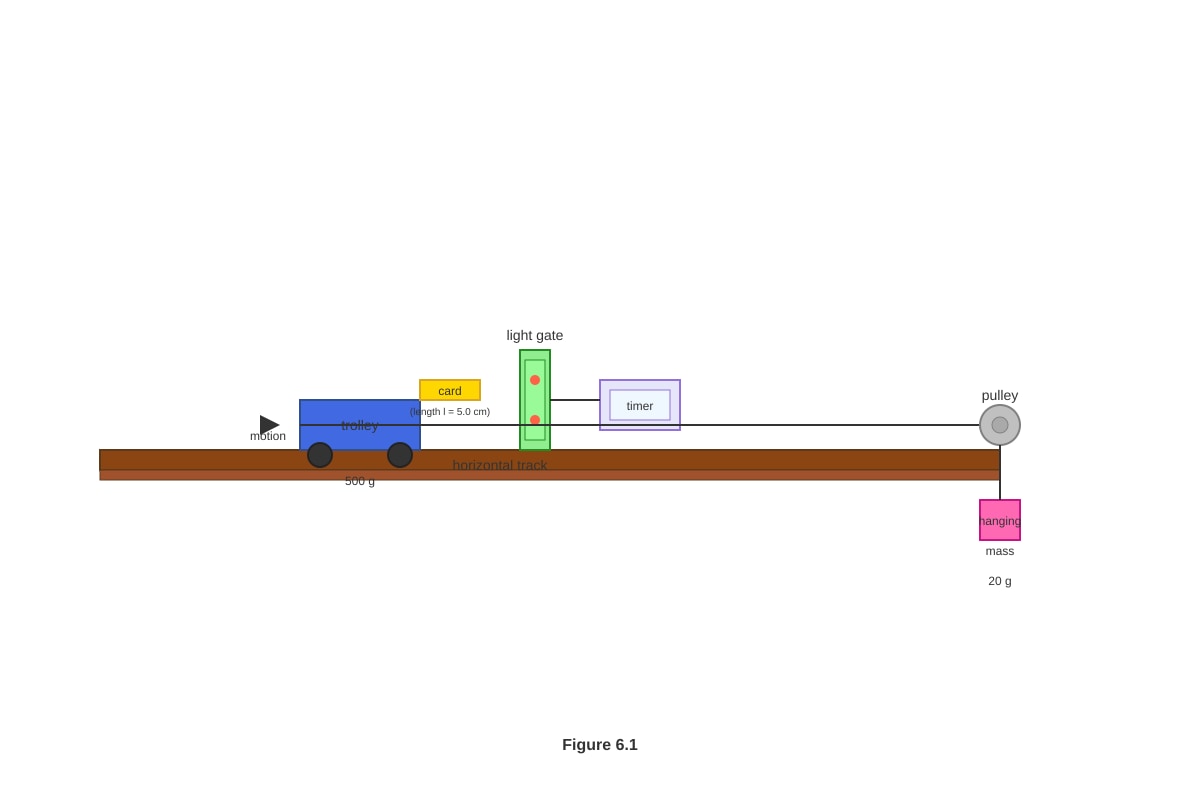
<image_placeholder> id: Q6-fig1 type: experimental_setup linked_question: Q6 description: A trolley on a horizontal track connected by a string over a pulley to a hanging mass. A card of known length is attached to the trolley and passes through a light gate connected to a timer. labels: trolley, string, pulley, hanging mass, card (length l), light gate, timer, horizontal track values: card length l = 5.0 cm, hanging mass = 20 g, trolley mass = 500 g must_show: The trolley on the horizontal track, the string running over the pulley at the edge of the track, the hanging mass suspended vertically, the card mounted on the trolley passing through the light gate positioned along the track, and the timer connected to the light gate. </image_placeholder>

Figure 6.1 shows a student using a light gate to measure the speed of a trolley pulled by a hanging mass.

Explain how the student can determine the speed of the trolley as it passes through the light gate.

.......................................................................................................................

.......................................................................................................................

.......................................................................................................................


Question 7 [2 marks]

A force of 15 N15 \text{ N} acts on an object and displaces it by 4.0 m4.0 \text{ m} in the direction of the force. Calculate the work done by the force.

.......................................................................................................................

.......................................................................................................................


Question 8 [2 marks]

Distinguish between scalar and vector quantities. Give one example of each.

.......................................................................................................................

.......................................................................................................................

.......................................................................................................................


Question 9 [2 marks]

State the condition for an object to be in translational equilibrium.

.......................................................................................................................

.......................................................................................................................

.......................................................................................................................


Question 10 [2 marks]

A 2.0 kg2.0 \text{ kg} object moving at 6.0 m s16.0 \text{ m s}^{-1} collides with a stationary 4.0 kg4.0 \text{ kg} object. After the collision, the two objects stick together. Calculate their common velocity after the collision.

.......................................................................................................................

.......................................................................................................................

.......................................................................................................................


Section B: Structured and Calculation Questions

[Questions 11–16: 20 marks total]


Question 11 [4 marks]

(a) Define power. [1]

.......................................................................................................................

(b) A motor lifts a load of mass 50 kg50 \text{ kg} vertically at a constant speed of 2.0 m s12.0 \text{ m s}^{-1}. Calculate:

(i) the tension in the cable, [1]

.......................................................................................................................

(ii) the power output of the motor. [2]

.......................................................................................................................

.......................................................................................................................

.......................................................................................................................


Question 12 [3 marks]

A projectile is launched horizontally from a cliff 45 m45 \text{ m} above level ground with an initial horizontal speed of 15 m s115 \text{ m s}^{-1}. (Take g=9.81 m s2g = 9.81 \text{ m s}^{-2}.)

(a) Calculate the time taken for the projectile to reach the ground. [1]

.......................................................................................................................

(b) Calculate the horizontal distance from the base of the cliff where the projectile lands. [2]

.......................................................................................................................

.......................................................................................................................


Question 13 [3 marks]

State Newton's second law of motion in terms of momentum.

.......................................................................................................................

.......................................................................................................................

A 0.16 kg0.16 \text{ kg} tennis ball strikes a racket with a speed of 28 m s128 \text{ m s}^{-1} and rebounds with a speed of 22 m s122 \text{ m s}^{-1} in the opposite direction. The contact time is 0.0050 s0.0050 \text{ s}.

Calculate the average force exerted by the racket on the ball.

.......................................................................................................................

.......................................................................................................................

.......................................................................................................................


Question 14 [3 marks]

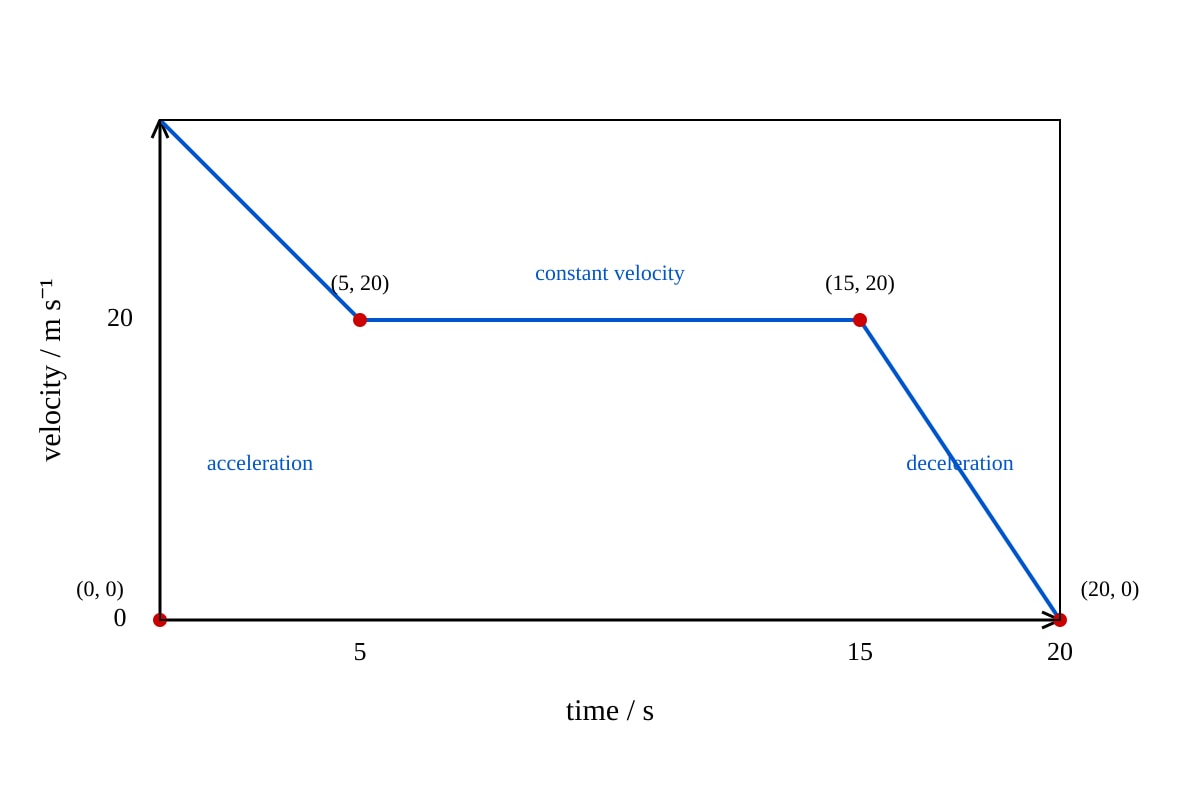
<image_placeholder> id: Q14-fig1 type: graph linked_question: Q14 description: A velocity-time graph for a car moving along a straight horizontal road. The graph shows velocity on the y-axis (m/s) and time on the x-axis (s). The graph starts at v = 0 at t = 0, increases linearly to v = 20 m/s at t = 5 s, remains constant at 20 m/s from t = 5 s to t = 15 s, then decreases linearly to v = 0 at t = 20 s. labels: y-axis: velocity / m s⁻¹, x-axis: time / s, key points: (0,0), (5,20), (15,20), (20,0) values: maximum velocity = 20 m/s, acceleration phase = 0–5 s, constant velocity phase = 5–15 s, deceleration phase = 15–20 s must_show: The three distinct regions clearly visible: a straight line with positive gradient from origin to (5,20), a horizontal line from (5,20) to (15,20), and a straight line with negative gradient from (15,20) to (20,0). Axes labelled with quantities and units. </image_placeholder>

Figure 14.1 shows the velocity-time graph for a car travelling along a straight road.

(a) Determine the total distance travelled by the car. [2]

.......................................................................................................................

.......................................................................................................................

.......................................................................................................................

(b) Determine the average speed of the car over the entire journey. [1]

.......................................................................................................................


Question 15 [4 marks]

A 60 kg60 \text{ kg} student stands in a lift.

(a) Calculate the apparent weight of the student when the lift is: [2]

(i) accelerating upward at 1.5 m s21.5 \text{ m s}^{-2},

.......................................................................................................................

.......................................................................................................................

(ii) moving downward at constant velocity.

.......................................................................................................................

(b) Explain, using Newton's laws, why the apparent weight changes when the lift accelerates upward. [2]

.......................................................................................................................

.......................................................................................................................

.......................................................................................................................


Question 16 [3 marks]

A 3.0 kg3.0 \text{ kg} block slides down a rough inclined plane that makes an angle of 30°30° with the horizontal. The block starts from rest and reaches the bottom with a speed of 4.0 m s14.0 \text{ m s}^{-1}. The vertical height of the incline is 2.0 m2.0 \text{ m}. (Take g=9.81 m s2g = 9.81 \text{ m s}^{-2}.)

(a) Calculate the gravitational potential energy lost by the block. [1]

.......................................................................................................................

(b) Calculate the kinetic energy gained by the block. [1]

.......................................................................................................................

(c) Determine the work done against friction. [1]

.......................................................................................................................


Section C: Extended Response

[Questions 17–20: 10 marks total]


Question 17 [3 marks]

Explain what is meant by an elastic collision and an inelastic collision. In each case, state which quantities are conserved.

.......................................................................................................................

.......................................................................................................................

.......................................................................................................................

.......................................................................................................................

.......................................................................................................................


Question 18 [2 marks]

A 0.50 kg0.50 \text{ kg} ball is dropped from a height of 10 m10 \text{ m} above the ground. It rebounds to a height of 6.4 m6.4 \text{ m}. (Take g=9.81 m s2g = 9.81 \text{ m s}^{-2}.)

Calculate the speed of the ball just before it hits the ground.

.......................................................................................................................

.......................................................................................................................

.......................................................................................................................


Question 19 [3 marks]

<image_placeholder> id: Q19-fig1 type: diagram linked_question: Q19 description: A free-body diagram showing a block of mass m resting on a rough inclined plane at angle θ to the horizontal. Three forces are shown: weight mg acting vertically downward, normal reaction R perpendicular to the plane, and frictional force f acting up the plane. The angle between the weight vector and the perpendicular to the plane is labelled θ. labels: block mass m, inclined plane at angle θ, weight (mg, vertically downward), normal reaction R (perpendicular to plane), friction f (up the plane), angle θ between weight direction and normal values: mass m = 5.0 kg, angle θ = 25° must_show: The inclined plane sloping upward to the right, the block on the plane, the three force vectors with labels, and the angle θ clearly marked between the normal and the weight vector (or equivalently between the plane and horizontal). </image_placeholder>

Figure 19.1 shows a 5.0 kg5.0 \text{ kg} block at rest on a rough inclined plane that makes an angle of 25°25° with the horizontal.

(a) Draw a free-body diagram showing all the forces acting on the block. [1]

(b) Calculate the component of the weight acting parallel to the incline. [1]

.......................................................................................................................

(c) If the block remains at rest, determine the magnitude of the frictional force. [1]

.......................................................................................................................


Question 20 [2 marks]

A 1200 kg1200 \text{ kg} car travelling at 20 m s120 \text{ m s}^{-1} is brought to rest by a constant braking force over a distance of 50 m50 \text{ m}.

(a) Calculate the initial kinetic energy of the car. [1]

.......................................................................................................................

.......................................................................................................................

(b) Calculate the magnitude of the braking force. [1]

.......................................................................................................................

.......................................................................................................................


End of Paper

Total Marks: 50

SectionMarks
A: Questions 1–1020
B: Questions 11–1620
C: Questions 17–2010
Total50

Answers

<!-- TuitionGoWhere generation metadata: stage=3-1; model=openrouter/owl-alpha; model_label=Owl Alpha; generated=2026-06-06; Sources: Stage 2-1 real exam-derived templates and Stage 2-2 exam-enriched syllabus. -->

A-Level Physics H1 — Practice Paper (Version 5)

Answer Key: Mechanics


Section A: Short-Answer and Structured Questions


Question 1 [2 marks]

Answer:

The principle of conservation of linear momentum states that the total momentum of a closed (isolated) system remains constant, provided that no external forces act on the system.

Equivalently: the total momentum before an interaction equals the total momentum after the interaction.

Marking:

  • [B1] For stating that total momentum remains constant / is conserved / momentum before = momentum after.
  • [B1] For stating the condition: no external forces / closed or isolated system.

Teaching notes: A "closed system" means no mass enters or leaves, and no external net force acts. This principle applies to all collisions and explosions. Students often forget to mention the "no external forces" condition, which is essential for full marks.


Question 2 [2 marks]

(a) [1]

Using a=vuta = \frac{v - u}{t}:

a=2508.0=3.1253.1 m s2a = \frac{25 - 0}{8.0} = 3.125 \approx 3.1 \text{ m s}^{-2}

Answer: a=3.1 m s2a = 3.1 \text{ m s}^{-2}

(b) [1]

Using s=(u+v)2×ts = \frac{(u + v)}{2} \times t:

s=(0+25)2×8.0=100 ms = \frac{(0 + 25)}{2} \times 8.0 = 100 \text{ m}

Alternatively, s=ut+12at2=0+12(3.125)(8.0)2=100 ms = ut + \frac{1}{2}at^2 = 0 + \frac{1}{2}(3.125)(8.0)^2 = 100 \text{ m}

Answer: s=100 ms = 100 \text{ m}

Marking:

  • (a) [1] Correct answer with unit.
  • (b) [1] Correct answer with unit.

Teaching notes: These are standard uniform acceleration problems. Students should identify which kinematic equation to use based on the given quantities. Always include units in the final answer.


Question 3 [2 marks]

Answer:

Work done by a constant force is defined as the product of the magnitude of the force and the displacement of the object in the direction of the force.

W=FscosθW = F \cdot s \cdot \cos\theta

where FF is the magnitude of the force, ss is the displacement, and θ\theta is the angle between the force and displacement vectors.

For a force acting in the direction of displacement: W=FsW = Fs.

Marking:

  • [B1] For stating work = force × displacement (in the direction of the force).
  • [B1] For mentioning the directional component or giving the formula with cos θ.

Teaching notes: Work is a scalar quantity measured in joules (J). One joule is the work done when a force of 1 N moves an object 1 m in the direction of the force. Students should understand that if the force is perpendicular to displacement, no work is done by that force.


Question 4 [2 marks]

Using conservation of energy:

At maximum height, all kinetic energy is converted to gravitational potential energy.

12mv2=mgh\frac{1}{2}mv^2 = mgh

h=v22g=(12)22×9.81=14419.62=7.34 mh = \frac{v^2}{2g} = \frac{(12)^2}{2 \times 9.81} = \frac{144}{19.62} = 7.34 \text{ m}

Answer: h=7.3 mh = 7.3 \text{ m} (to 2 s.f.)

Marking:

  • [1] Correct formula or method shown (energy conservation or kinematic equation).
  • [1] Correct answer with unit.

Teaching notes: The mass cancels out, so the maximum height is independent of mass. Students could also use v2=u2+2asv^2 = u^2 + 2as with v=0v = 0, a=ga = -g. Both methods are acceptable.


Question 5 [2 marks]

Answer:

Newton's first law of motion states that an object remains at rest or continues to move at a constant velocity (in a straight line) unless acted upon by a resultant (net) external force.

Marking:

  • [B1] For stating the object remains at rest or moves with constant velocity.
  • [B1] For stating "unless acted upon by a resultant force" or equivalent.

Teaching notes: This law is also called the law of inertia. "Constant velocity" includes both speed and direction — so an object moving in a straight line at constant speed has no resultant force. Students sometimes say "unless a force acts" without specifying "resultant" force, which can lose the second mark.


Question 6 [2 marks]

Answer:

The light gate measures the time interval Δt\Delta t for the card of known length ll to pass through it. The speed of the trolley is calculated using:

v=lΔtv = \frac{l}{\Delta t}

where ll is the length of the card and Δt\Delta t is the time recorded by the timer.

Marking:

  • [B1] For stating that the timer records the time for the card to pass through the light gate.
  • [B1] For stating speed = length of card ÷ time taken.

Teaching notes: This gives the average speed of the trolley as the card passes through. If the card is short, this approximates the instantaneous speed. The card interrupts a light beam, and the timer records how long the beam is blocked.


Question 7 [2 marks]

W=F×s=15×4.0=60 JW = F \times s = 15 \times 4.0 = 60 \text{ J}

Answer: W=60 JW = 60 \text{ J}

Marking:

  • [1] Correct formula W=FsW = Fs.
  • [1] Correct answer with unit (J).

Teaching notes: Since the force and displacement are in the same direction, θ=0°\theta = 0° and cos0°=1\cos 0° = 1, so W=FsW = Fs directly. Always express the answer in joules.


Question 8 [2 marks]

Answer:

A scalar quantity has only magnitude (size) and no direction. Example: mass, speed, energy, time, temperature.

A vector quantity has both magnitude and direction. Example: velocity, force, displacement, acceleration, momentum.

Marking:

  • [B1] Correct distinction between scalar (magnitude only) and vector (magnitude and direction).
  • [B1] One correct example of each.

Teaching notes: Students commonly confuse speed (scalar) with velocity (vector), and distance (scalar) with displacement (vector). The key test: does the quantity need a direction to be fully described?


Question 9 [2 marks]

Answer:

An object is in translational equilibrium when the resultant (net) force acting on the object is zero.

This means the vector sum of all forces acting on the object equals zero:

F=0\sum \vec{F} = 0

As a result, the object is either at rest or moving with constant velocity.

Marking:

  • [B1] For stating the resultant/net force is zero.
  • [B1] For stating the consequence (at rest or constant velocity) or equivalent.

Teaching notes: Translational equilibrium means no acceleration. This is different from rotational equilibrium (which involves torques). Students should be precise: it is the resultant force that must be zero, not that no forces act at all.


Question 10 [2 marks]

Using conservation of linear momentum:

m1u1+m2u2=(m1+m2)vm_1 u_1 + m_2 u_2 = (m_1 + m_2)v

(2.0)(6.0)+(4.0)(0)=(2.0+4.0)v(2.0)(6.0) + (4.0)(0) = (2.0 + 4.0)v

12.0=6.0v12.0 = 6.0v

v=2.0 m s1v = 2.0 \text{ m s}^{-1}

Answer: v=2.0 m s1v = 2.0 \text{ m s}^{-1}

Marking:

  • [1] Correct conservation of momentum equation set up.
  • [1] Correct answer with unit.

Teaching notes: This is a perfectly inelastic collision (objects stick together). Kinetic energy is NOT conserved in this type of collision, but momentum is always conserved in a closed system. The second object is initially stationary, so its initial momentum is zero.


Section B: Structured and Calculation Questions


Question 11 [4 marks]

(a) [1]

Power is defined as the rate of doing work (or the rate of energy transfer).

P=Wt=ΔEtP = \frac{W}{t} = \frac{\Delta E}{t}

The SI unit of power is the watt (W), where 1 W=1 J s11 \text{ W} = 1 \text{ J s}^{-1}.

(b)(i) [1]

Since the load moves at constant speed, the acceleration is zero. By Newton's first law:

T=mg=50×9.81=490.5491 NT = mg = 50 \times 9.81 = 490.5 \approx 491 \text{ N}

Answer: T=491 NT = 491 \text{ N} (or 490 N490 \text{ N} if using g=9.8g = 9.8)

(b)(ii) [2]

P=T×v=490.5×2.0=981 WP = T \times v = 490.5 \times 2.0 = 981 \text{ W}

Answer: P=981 WP = 981 \text{ W} (or 980 W980 \text{ W})

Marking:

  • (a) [1] Correct definition.
  • (b)(i) [1] Correct tension with unit.
  • (b)(ii) [1] Correct formula P=TvP = Tv or P=FvP = Fv. [1] Correct answer with unit.

Teaching notes: At constant velocity, the net force is zero, so tension equals weight. Power = Fv is derived from P = W/t = Fs/t = Fv. Students should use the tension (not just mg × v conceptually, though numerically they are the same here) to show understanding.


Question 12 [3 marks]

(a) [1]

Vertical motion (initial vertical velocity = 0):

h=12gt2h = \frac{1}{2}gt^2

45=12(9.81)t245 = \frac{1}{2}(9.81)t^2

t2=909.81=9.174t^2 = \frac{90}{9.81} = 9.174

t=3.03 st = 3.03 \text{ s}

Answer: t=3.0 st = 3.0 \text{ s} (to 2 s.f.)

(b) [2]

Horizontal motion (constant velocity):

R=vx×t=15×3.03=45.4 mR = v_x \times t = 15 \times 3.03 = 45.4 \text{ m}

Answer: R=45 mR = 45 \text{ m} (to 2 s.f.)

Marking:

  • (a) [1] Correct time with unit.
  • (b) [1] Correct method/formula. [1] Correct answer with unit.

Teaching notes: For horizontal projectile motion, the vertical and horizontal motions are independent. The time of flight is determined entirely by the vertical drop. The horizontal velocity remains constant (no horizontal acceleration, ignoring air resistance).


Question 13 [3 marks]

Newton's second law in terms of momentum:

The resultant force acting on an object is equal to the rate of change of its momentum.

F=ΔpΔt=mvmuΔtF = \frac{\Delta p}{\Delta t} = \frac{mv - mu}{\Delta t}

Calculation:

Taking the initial direction of the ball as positive:

Initial momentum: pi=0.16×28=4.48 kg m s1p_i = 0.16 \times 28 = 4.48 \text{ kg m s}^{-1}

Final momentum: pf=0.16×(22)=3.52 kg m s1p_f = 0.16 \times (-22) = -3.52 \text{ kg m s}^{-1} (negative because direction reverses)

Change in momentum:

Δp=pfpi=3.524.48=8.0 kg m s1\Delta p = p_f - p_i = -3.52 - 4.48 = -8.0 \text{ kg m s}^{-1}

Average force:

F=ΔpΔt=8.00.0050=1600 NF = \frac{\Delta p}{\Delta t} = \frac{-8.0}{0.0050} = -1600 \text{ N}

The magnitude of the average force is 1600 N1600 \text{ N}.

Answer: F=1600 NF = 1600 \text{ N} (or 1.6×10³ N1.6 \times 10^3 \text{ N})

Marking:

  • [1] Correct statement of Newton's second law in terms of momentum.
  • [1] Correct calculation of change in momentum (with sign convention).
  • [1] Correct final answer with unit.

Teaching notes: The sign convention is crucial. Students must choose a positive direction and be consistent. The negative sign on the force indicates it acts opposite to the initial direction of the ball (which makes sense — the racket pushes the ball back). The question asks for the magnitude, so the final answer is positive.


Question 14 [3 marks]

(a) [2]

The total distance is the area under the velocity-time graph.

The graph forms a trapezium (or can be split into three regions):

Region 1 (acceleration, t=0t = 0 to 5 s5 \text{ s}): triangle s1=12×5×20=50 ms_1 = \frac{1}{2} \times 5 \times 20 = 50 \text{ m}

Region 2 (constant velocity, t=5t = 5 to 15 s15 \text{ s}): rectangle s2=20×10=200 ms_2 = 20 \times 10 = 200 \text{ m}

Region 3 (deceleration, t=15t = 15 to 20 s20 \text{ s}): triangle s3=12×5×20=50 ms_3 = \frac{1}{2} \times 5 \times 20 = 50 \text{ m}

Total distance:

s=50+200+50=300 ms = 50 + 200 + 50 = 300 \text{ m}

Answer: Total distance = 300 m300 \text{ m}

(b) [1]

Average speed=total distancetotal time=30020=15 m s1\text{Average speed} = \frac{\text{total distance}}{\text{total time}} = \frac{300}{20} = 15 \text{ m s}^{-1}

Answer: Average speed = 15 m s115 \text{ m s}^{-1}

Marking:

  • (a) [1] Correct method (area under graph). [1] Correct answer.
  • (b) [1] Correct answer with unit.

Teaching notes: The area under a v-t graph gives displacement (or distance if no change in direction). Students should be comfortable splitting complex shapes into triangles and rectangles. Average speed = total distance / total time, not the average of the velocities.


Question 15 [4 marks]

(a)(i) [1]

When accelerating upward, the apparent weight (normal reaction) is:

R=m(g+a)=60×(9.81+1.5)=60×11.31=678.6 NR = m(g + a) = 60 \times (9.81 + 1.5) = 60 \times 11.31 = 678.6 \text{ N}

Answer: Apparent weight = 679 N679 \text{ N} (or 690 N690 \text{ N} if using g=10g = 10)

(a)(ii) [1]

At constant velocity, acceleration = 0:

R=mg=60×9.81=588.6 NR = mg = 60 \times 9.81 = 588.6 \text{ N}

Answer: Apparent weight = 589 N589 \text{ N} (or 600 N600 \text{ N} if using g=10g = 10)

(b) [2]

When the lift accelerates upward, by Newton's second law, there must be a resultant upward force on the student. The forces acting on the student are the normal reaction RR (upward, from the floor) and the weight mgmg (downward). For upward acceleration:

Rmg=maR - mg = ma

R=m(g+a)R = m(g + a)

Since R>mgR > mg, the floor pushes up on the student with a force greater than their weight. By Newton's third law, the student pushes down on the floor with an equal and opposite force, so the student feels heavier. The apparent weight (the normal reaction) is therefore greater than the actual weight.

Marking:

  • (a)(i) [1] Correct answer with unit.
  • (a)(ii) [1] Correct answer with unit.
  • (b) [1] For applying Newton's second law correctly (Rmg=maR - mg = ma). [1] For explaining that R>mgR > mg means the student feels heavier / apparent weight increases.

Teaching notes: "Apparent weight" is the normal force exerted by the surface supporting the object. When accelerating upward, the apparent weight increases; when accelerating downward, it decreases. In free fall (a=ga = g), apparent weight is zero (weightlessness).


Question 16 [3 marks]

(a) [1]

GPE lost=mgh=3.0×9.81×2.0=58.86 J\text{GPE lost} = mgh = 3.0 \times 9.81 \times 2.0 = 58.86 \text{ J}

Answer: GPE lost = 58.9 J58.9 \text{ J} (or 59 J59 \text{ J})

(b) [1]

KE gained=12mv2=12×3.0×(4.0)2=24.0 J\text{KE gained} = \frac{1}{2}mv^2 = \frac{1}{2} \times 3.0 \times (4.0)^2 = 24.0 \text{ J}

Answer: KE gained = 24 J24 \text{ J}

(c) [1]

By conservation of energy:

GPE lost=KE gained+work done against friction\text{GPE lost} = \text{KE gained} + \text{work done against friction}

Wfriction=58.8624.0=34.86 JW_{\text{friction}} = 58.86 - 24.0 = 34.86 \text{ J}

Answer: Work done against friction = 34.9 J34.9 \text{ J} (or 35 J35 \text{ J})

Marking:

  • (a) [1] Correct answer with unit.
  • (b) [1] Correct answer with unit.
  • (c) [1] Correct answer with unit.

Teaching notes: Not all the gravitational potential energy is converted to kinetic energy because friction does negative work on the block. The "missing" energy is converted to thermal energy (heat). This is a common exam question testing the work-energy principle.


Section C: Extended Response


Question 17 [3 marks]

Answer:

Elastic collision:

  • A collision in which both kinetic energy and linear momentum are conserved.
  • The total kinetic energy before the collision equals the total kinetic energy after the collision.
  • Objects separate after the collision and may deform temporarily but return to their original shape.

Inelastic collision:

  • A collision in which linear momentum is conserved but kinetic energy is not conserved.
  • Some kinetic energy is transformed into other forms of energy (e.g., thermal energy, sound, deformation energy).
  • In a perfectly inelastic collision, the objects stick together after impact, and the maximum possible kinetic energy is lost (while still conserving momentum).

Marking:

  • [1] Correct definition of elastic collision (KE conserved).
  • [1] Correct definition of inelastic collision (KE not conserved, momentum conserved).
  • [1] Clear distinction between the two, mentioning what is/isn't conserved in each.

Teaching notes: In ALL collisions (in a closed system), momentum is conserved. The distinction is whether kinetic energy is also conserved. In real-world collisions, some kinetic energy is almost always lost, so perfectly elastic collisions are idealised situations (e.g., between gas molecules or subatomic particles).


Question 18 [2 marks]

Using conservation of energy (or kinematics):

v2=u2+2ghv^2 = u^2 + 2gh

v2=0+2×9.81×10=196.2v^2 = 0 + 2 \times 9.81 \times 10 = 196.2

v=196.2=14.0 m s1v = \sqrt{196.2} = 14.0 \text{ m s}^{-1}

Answer: Speed just before impact = 14 m s114 \text{ m s}^{-1}

Marking:

  • [1] Correct method (energy conservation or v2=u2+2asv^2 = u^2 + 2as).
  • [1] Correct answer with unit.

Teaching notes: The rebound height (6.4 m) is extra information not needed for this part — it would be used in a follow-up question about the coefficient of restitution or energy lost during impact. Students should identify which information is relevant to the specific question asked.


Question 19 [3 marks]

(a) [1]

The free-body diagram should show:

  • Weight (mgmg) acting vertically downward from the centre of the block.
  • Normal reaction (RR) perpendicular to the surface of the incline.
  • Frictional force (ff) acting up the plane (opposing the tendency to slide down).

Marking: [1] All three forces correctly drawn and labelled with correct directions.

(b) [1]

Component of weight parallel to the incline:

F=mgsinθ=5.0×9.81×sin25°F_{\parallel} = mg\sin\theta = 5.0 \times 9.81 \times \sin 25°

F=49.05×0.4226=20.7 NF_{\parallel} = 49.05 \times 0.4226 = 20.7 \text{ N}

Answer: F=20.7 NF_{\parallel} = 20.7 \text{ N} (or 21 N21 \text{ N})

(c) [1]

Since the block is at rest (in equilibrium), the net force along the incline is zero:

f=F=20.7 Nf = F_{\parallel} = 20.7 \text{ N}

Answer: f=20.7 Nf = 20.7 \text{ N} (or 21 N21 \text{ N})

Marking:

  • (a) [1] Correct free-body diagram with all three forces.
  • (b) [1] Correct calculation with unit.
  • (c] [1] Correct answer (equal to parallel component) with unit.

Teaching notes: On an inclined plane, the weight is resolved into two components: mgsinθmg\sin\theta parallel to the plane (down the slope) and mgcosθmg\cos\theta perpendicular to the plane. The normal reaction equals mgcosθmg\cos\theta (not mgmg!). Students frequently make this error. The friction acts up the plane because the block would tend to slide down.


Question 20 [2 marks]

(a) [1]

KE=12mv2=12×1200×(20)2=12×1200×400=240,000 JKE = \frac{1}{2}mv^2 = \frac{1}{2} \times 1200 \times (20)^2 = \frac{1}{2} \times 1200 \times 400 = 240{,}000 \text{ J}

Answer: KE=2.4×10⁵ JKE = 2.4 \times 10^5 \text{ J} (or 240 kJ240 \text{ kJ})

(b) [1]

By the work-energy principle, the work done by the braking force equals the change in kinetic energy:

F×d=KEF \times d = KE

F=KEd=240,00050=4800 NF = \frac{KE}{d} = \frac{240{,}000}{50} = 4800 \text{ N}

Answer: Braking force = 4800 N4800 \text{ N} (or 4.8×10³ N4.8 \times 10^3 \text{ N})

Marking:

  • (a) [1] Correct answer with unit.
  • (b) [1] Correct answer with unit.

Teaching notes: The braking force does negative work on the car, reducing its kinetic energy to zero. The work-energy theorem provides a convenient method when force and distance are involved. Alternatively, students could find the deceleration using v2=u2+2asv^2 = u^2 + 2as and then use F=maF = ma.


Mark Summary

QuestionMarks
12
22
32
42
52
62
72
82
92
102
114
123
133
143
154
163
173
182
193
202
Total50