From Real Exams Exam Paper
A Level H1 Physics Practice Paper 5
Free A Level H1 Physics Practice Paper 5, HY3 Exam version, with questions, answers, and A Level-style practice for Singapore students.
These static practice materials are generated from the site's syllabus and paper-generation workflow, with source and model context shown so students and parents can evaluate the material before use.
Questions
TuitionGoWhere Practice Paper - Physics H1 A-Level
TuitionGoWhere Exam Practice (AI)
Subject: Physics H1
Level: A-Level
Paper: Practice Paper (Version 5 of 5)
Duration: 1 hour 30 minutes
Total Marks: 60
Name: ___________________________
Class: ___________________________
Date: ___________________________
Instructions:
- Answer all questions in Sections A, B, and C.
- Show all working clearly where calculation is required.
- Use SI units unless otherwise stated.
- An approved calculator may be used.
Section A: Foundations of Mechanics (Questions 1–8) [24 marks]
1. State the principle of conservation of linear momentum. [2]
2. Write down expressions, in terms of mass m and velocity v, for:
(a) linear momentum p, [1]
(b) kinetic energy Ek. [1]
(a) _________________________
(b) _________________________
3. A drone has a horizontal momentum of 12 N⋅s and kinetic energy of 24 J. Calculate its mass and speed. [3]
4. Define the moment of a force about a point. [2]
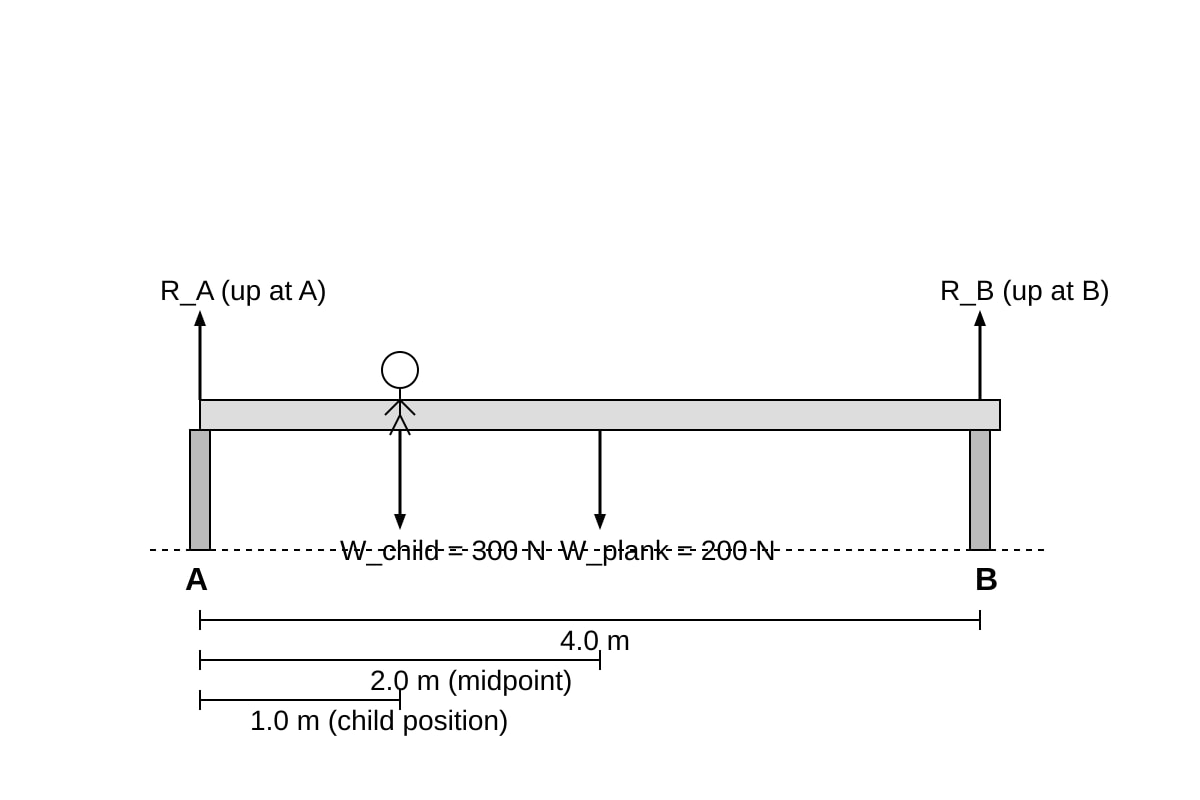
5. A uniform plank AB has length 4.0 m and weight 200 N. It rests on two supports at A and B. A child of weight 300 N stands 1.0 m from A.
Draw a labelled diagram showing all forces acting on the plank. [3]
Image pending generation: diagram for Q5.
6. For the plank in Q5, calculate the reaction force at support B. [3]
7. A car accelerates from rest to 20 m s−1 in 10 s. Calculate its average acceleration. [2]
8. Sketch a velocity–time graph for an object moving with constant deceleration from 15 m s−1 to rest in 5 s. Label axes with units. [2]
Section B: Motion and Forces (Questions 9–14) [20 marks]
9. A ball is thrown vertically upward with initial speed 20 m s−1. Using g=9.8 m s−2, calculate the maximum height reached. [3]
10. Describe how the gradient of a displacement–time graph is related to the motion of an object. [2]
11. A block of mass 5.0 kg is pulled along a horizontal surface by a force of 30 N and experiences friction of 5 N. Calculate the acceleration of the block. [3]
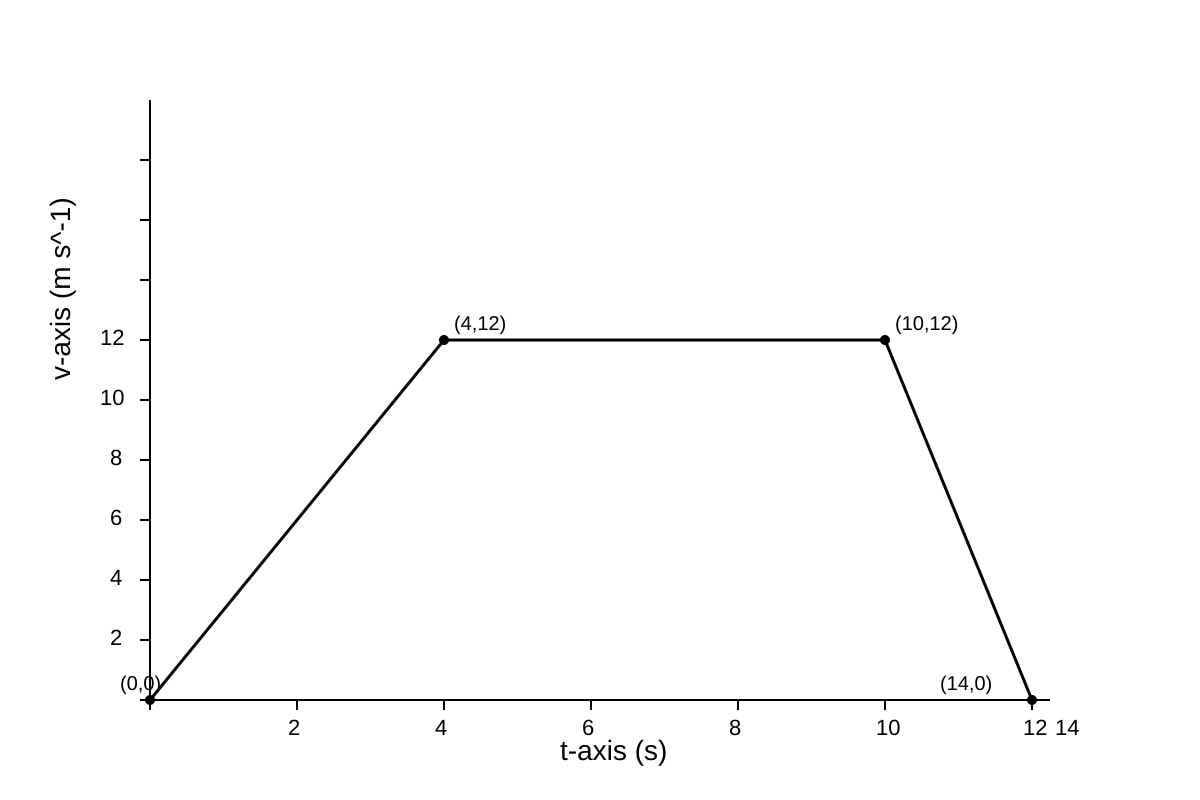
12.
Image pending generation: graph for Q12.
Using the graph in Q12-fig1, determine:
(a) the acceleration during the first 4 s, [2]
(b) the total distance travelled. [2]
(a) _________________________
(b) _________________________
13. State Newton’s first law of motion. [2]
14. A projectile is launched horizontally from a cliff of height 45 m with speed 30 m s−1. Calculate the time taken to reach the ground. (g=9.8 m s−2) [3]
Section C: Energy, Collisions and Circular Motion (Questions 15–20) [16 marks]
15. A 2.0 kg object moving at 4.0 m s−1 collides with a stationary 3.0 kg object. They stick together. Calculate their common final speed. [3]
16. Explain the difference between an elastic and an inelastic collision in terms of kinetic energy. [2]
17. A mass of 0.50 kg is whirled in a horizontal circle of radius 1.2 m at 3.0 rev s−1. Calculate the centripetal force. [3]
18. A crane lifts a 500 kg load through 20 m in 10 s. Calculate the useful power output. (g=9.8 m s−2) [3]
19. State what is meant by gravitational field strength at a point. [2]
20. A satellite orbits Earth at constant speed in a circular path. Explain why it is accelerating even though its speed is constant. [3]
End of Paper
Answers
TuitionGoWhere Practice Paper - Physics H1 A-Level (Version 5) Answer Key
Total Marks: 60
Section A
Q1. [2]
Principle: In a closed (or isolated) system, the total linear momentum remains constant provided no net external force acts.
Marking: B1 for "total momentum constant / before = after"; B1 for "closed system / no external force".
Teaching: Momentum is conserved vectorially; external impulses change total momentum.
Q2. [2]
(a) p=mv [1]
(b) Ek=21mv2 [1]
Teaching: Momentum is vector, KE is scalar; do not omit ½.
Q3. [3]
Given p=12 N⋅s, Ek=24 J.
Use Ek=2mp2⇒m=2Ekp2=2×24122=48144=3.0 kg [M1+A1]
v=p/m=12/3.0=4.0 m s−1 [M1]
Answer: mass 3.0 kg, speed 4.0 m s−1.
Q4. [2]
Moment = force × perpendicular distance from point to line of action.
B1 definition, B1 perpendicular distance.
Q5. [3]
Forces: RA up at A, RB up at B, 200 N down at 2.0 m from A, 300 N down at 1.0 m from A.
Marking: 1 each for correct four forces with positions; deduct if weight at centre omitted.
Q6. [3]
Take moments about A:
RB×4.0=200×2.0+300×1.0 [M1]
RB×4=400+300=700 [M1]
RB=175 N [A1]
Teaching: Plank uniform → weight at midpoint.
Q7. [2]
a=tΔv=1020−0=2.0 m s−2 [2]
Q8. [2]
Straight line from (0,15) to (5,0); axes labelled v (m s⁻¹) and t (s). [2]
Section B
Q9. [3]
v2=u2+2as, at top v=0, a=−9.8:
0=202−2(9.8)h⇒h=400/19.6=20.4 m [3]
Q10. [2]
Gradient = velocity (rate of change of displacement with time). [2]
Q11. [3]
Net force = 30−5=25 N [M1]
a=F/m=25/5.0=5.0 m s−2 [M1+A1]
Q12. [4]
(a) a=(12−0)/4=3.0 m s−2 [2]
(b) Area = triangle + rectangle + triangle = ½×4×12 + 6×12 + ½×4×12 = 24+72+24 = 120 m [2]
Q13. [2]
Body remains at rest or uniform motion unless acted by net external force. [2]
Q14. [3]
Vertical: s=½gt2⇒45=½(9.8)t2 [M1]
t2=90/9.8=9.18⇒t=3.03 s [M1+A1]
Section C
Q15. [3]
Momentum before = 2.0×4.0=8.0 kg m s−1 [M1]
After: (2.0+3.0)v=8.0⇒v=1.6 m s−1 [M1+A1]
Q16. [2]
Elastic: total KE conserved. Inelastic: KE not conserved (some lost). [2]
Q17. [3]
ω=2πf=2π×3.0=18.85 rad s−1 [M1]
F=mω2r=0.50×(18.85)2×1.2=213 N [M1+A1]
Q18. [3]
Work = mgh=500×9.8×20=98000 J [M1]
Power = 98000/10=9800 W [M1+A1]
Q19. [2]
Gravitational force per unit mass at point. [2]
Q20. [3]
Direction of velocity changes continuously; acceleration is towards centre (centripetal). [3]
Free quiz and exam paper access
Enter your details to view this paper
Your access is remembered on this device.