From Real Exams Exam Paper
A Level H1 Physics Practice Paper 4
Free A Level H1 Physics Practice Paper 4, LongCat Exam version, with questions, answers, and A Level-style practice for Singapore students.
These static practice materials are generated from the site's syllabus and paper-generation workflow, with source and model context shown so students and parents can evaluate the material before use.
Questions
Free quiz and exam paper access
Enter your details to view this paper
Your access is remembered on this device.
Answers
A-Level Physics H1 Quiz - Mechanics
Answer Key
Section A: Multiple Choice [15 marks]
1. D. Displacement
Displacement is a vector quantity because it has both magnitude and direction. Speed, distance, and energy are scalar quantities — they have magnitude only.
Common mistake: Students often confuse speed (scalar) with velocity (vector), or distance (scalar) with displacement (vector).
2. B.
At the highest point, the ball's velocity is momentarily zero, but its acceleration is still due to gravity throughout the flight. Taking upward as positive, gravitational acceleration is .
Common mistake: Students incorrectly assume acceleration is zero when velocity is zero.
3. B.
Using : , so .
Using : .
Alternatively, average speed = , distance = .
4. B.
By conservation of momentum:
This is a perfectly inelastic collision — the objects stick together.
5. B.
Using Newton's Second Law:
6. B. Action and reaction forces are equal in magnitude and opposite in direction.
Newton's Third Law states that for every action, there is an equal and opposite reaction. These forces act on different bodies, so they do not cancel each other out. They can be contact or non-contact (e.g., gravitational) forces.
Common mistake: Students think action-reaction pairs act on the same body or cancel out.
7. C.
The normal contact force balances the weight of the block: .
Common mistake: Students forget to multiply by and simply write the mass value.
8. B. (or )
Horizontal component: .
Note: Both B and C are numerically equivalent, but B is the exact form. In an exam, either would be accepted.
9. C.
Taking the initial direction as positive:
Initial momentum =
Final momentum =
Change in momentum = final − initial =
Magnitude =
Common mistake: Students subtract speeds instead of momenta, or forget to account for the direction change.
10. C. Energy and work
Both energy and work have the unit joule (J). Work is the transfer of energy.
- Work and force: work is in joules (J), force is in newtons (N) — different.
- Power and momentum: power is in watts (W), momentum is in kg m s⁻¹ — different.
- Impulse and energy: impulse is in N s (or kg m s⁻¹), energy is in joules (J) — different.
11. B.
Centripetal force:
12. D.
Elastic potential energy:
13. B.
By conservation of energy: loss in gravitational potential energy = gain in kinetic energy
Common mistake: Students use and then but make arithmetic errors.
14. A. The net force on the object is zero.
By Newton's First Law, an object moving with constant velocity (which includes being at rest) has zero net force acting on it. This does not mean no forces act — it means the forces are balanced.
Common mistake: Students confuse "no net force" with "no forces at all."
15. C.
Work done against gravity:
Common mistake: Students forget to include in the calculation.
Section B: Structured Questions [35 marks]
16. (a) [2 marks]
The principle of conservation of linear momentum states that the total momentum of a closed/isolated system remains constant, provided that no external forces act on the system.
Equivalently: the total momentum before an interaction equals the total momentum after the interaction.
Marking: [B1] for "total momentum is constant/unchanged"; [B1] for "no external forces" or "closed/isolated system" qualifier.
(b) (i) [2 marks]
Taking the initial direction of motion as positive:
Initial momentum =
Final momentum =
Change in momentum = final − initial =
Magnitude of change in momentum = (or to 2 s.f.)
Marking: [M1] for correct substitution into momentum change formula; [A1] for correct answer with unit.
(b) (ii) [2 marks]
Using the impulse-momentum theorem:
Marking: [M1] for using ; [A1] for correct answer.
(b) (iii) [1 mark]
The force exerted by the wall on the ball is in the opposite direction to the initial motion of the ball (i.e., away from the wall).
This is because the wall pushes the ball back, causing it to rebound.
Marking: [B1] for correct direction stated.
17. (a) [2 marks]
Using :
Marking: [M1] for correct substitution; [A1] for correct answer with unit.
(b) [2 marks]
Using :
Marking: [M1] for correct method; [A1] for correct answer.
(c) [2 marks]
Work done = force × distance =
Alternatively, work done = change in kinetic energy =
Marking: [M1] for correct method; [A1] for correct answer.
(d) [2 marks]
Average power =
Alternatively,
Marking: [M1] for correct method; [A1] for correct answer.
18. (a) [1 mark]
Marking: [B1] for correct answer.
(b) [1 mark]
Marking: [B1] for correct answer.
(c) [2 marks]
At maximum height, vertical velocity = 0.
Using :
Marking: [M1] for correct method; [A1] for correct answer.
(d) [2 marks]
Time of flight:
Range:
Alternatively, using
Marking: [M1] for correct method; [A1] for correct answer.
(e) [2 marks]
Air resistance would decrease the range.
Reason: Air resistance opposes the motion of the ball, reducing both the horizontal and vertical components of velocity throughout the flight. This reduces the horizontal speed (shortening the range) and also reduces the maximum height and time of flight.
Marking: [B1] for "decrease"; [B1] for valid reason involving opposition to motion/energy loss.
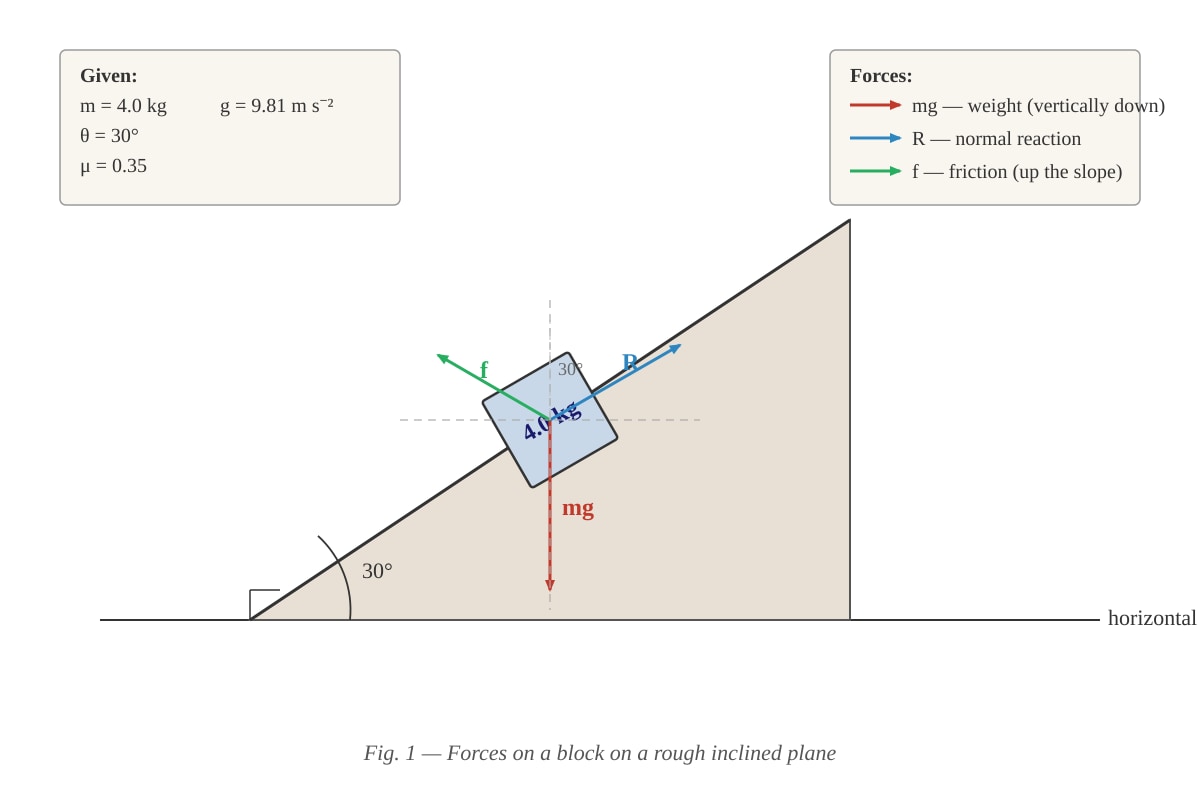
19. (a) [2 marks]
The free-body diagram should show:
- Weight () acting vertically downward from the centre of the block
- Normal reaction () acting perpendicular to the surface, away from the surface
- Frictional force () acting up the slope (opposing the direction of motion/tendency to slide)
Marking: [B1] for weight and normal reaction correctly drawn; [B1] for friction correctly drawn in the correct direction.
(b) [1 mark]
Component of weight down the slope =
Marking: [B1] for correct answer.
(c) [1 mark]
Normal reaction =
Marking: [B1] for correct answer.
(d) [1 mark]
Frictional force =
Marking: [B1] for correct answer.
(e) [2 marks]
The component of weight down the slope () is greater than the maximum frictional force ().
Therefore, there is a net force down the slope, and the block will slide down.
Net force down slope =
Marking: [M1] for comparing the two forces; [A1] for correct conclusion that the block will slide.
Section C: Free Response [30 marks]
20. (a) [2 marks]
Centripetal acceleration is the acceleration directed towards the centre of the circular path. It is responsible for changing the direction of the velocity (not the speed) of an object moving in a circle. Its magnitude is given by or .
Marking: [B1] for "towards the centre"; [B1] for "changes direction of velocity" or equivalent.
(b) (i) [2 marks]
Marking: [M1] for correct substitution; [A1] for correct answer with unit.
(b) (ii) [2 marks]
At the lowest point, the tension acts upward and weight acts downward. The net force towards the centre (upward) provides the centripetal force:
Marking: [M1] for correct equation ; [A1] for correct answer.
(c) (i) [2 marks]
At the highest point, for the string to remain taut with minimum tension (T = 0), the weight alone provides the centripetal force:
Marking: [M1] for setting ; [A1] for correct answer.
(c) (ii) [3 marks]
Using conservation of energy between the lowest and highest points:
The height difference between lowest and highest point =
Marking: [M1] for correct energy conservation equation; [M1] for correct substitution of values; [A1] for correct final answer.
(d) [2 marks]
The tension varies because the weight of the sphere has a component that either adds to or subtracts from the tension depending on the position in the circle:
- At the lowest point: tension must support the weight AND provide the centripetal force, so (maximum tension).
- At the highest point: weight acts towards the centre, so (minimum tension).
- At intermediate positions: the radial component of weight varies as , causing the tension to vary continuously.
Additionally, the speed varies with height due to energy conservation, which also affects the tension.
Marking: [B1] for explaining that weight's radial component varies with position; [B1] for explaining the difference between top and bottom positions.
End of Answer Key
Total: 80 marks