From Real Exams Exam Paper
A Level H1 Physics Practice Paper 4
Free A Level H1 Physics Practice Paper 4, HY3 Exam version, with questions, answers, and A Level-style practice for Singapore students.
These static practice materials are generated from the site's syllabus and paper-generation workflow, with source and model context shown so students and parents can evaluate the material before use.
Questions

Free quiz and exam paper access
Enter your details to view this paper
Your access is remembered on this device.
Answers
TuitionGoWhere Exam Practice (AI) - Physics H1 A-Level
Mechanics Practice Paper (Version 4 of 5) — Answer Key
Total Marks: 60
Section A: 21 marks
Section B: 24 marks
Section C: 15 marks
Section A: Short Answer
1. [2] State the principle of conservation of linear momentum.
Answer: In a closed (or isolated) system, the total linear momentum remains constant provided no external net force acts. [B1 for "total momentum constant in closed system"; B1 for "no external forces / net external force zero"]
Teaching note: Momentum is a vector (). The qualifier "closed system" is essential; external forces like friction would change total momentum. Common trap: confusing with energy conservation.
2. [2 total]
(a) [1]
(b) [1]
Teaching note: Momentum is mass × velocity; kinetic energy has the factor. Trap: writing omits the half.
3. [1] Resultant force = (or zero).
Teaching note: Newton’s first law: constant velocity means zero acceleration, so net force zero.
4. [2] The moment of a force about a point is the product of the force and the perpendicular distance from the point to the line of action of the force. () [B1 definition, B1 for perpendicular distance]
Teaching note: Moment is a turning effect; distance must be perpendicular, not along the force.
5. [2] A body remains at rest or in uniform motion in a straight line unless acted upon by a net external force. [B1 rest/uniform motion, B1 net force condition]
Teaching note: This is Newton’s first law; introduces inertia.
6. [1] (zero).
Teaching note: Without air resistance, no horizontal force → no horizontal acceleration.
7. [2] Centripetal force is the resultant force acting on a body moving in a circle, directed toward the centre. [B1 resultant force, B1 towards centre]
Teaching note: It is not a new force but the net force causing circular motion.
Section B: Structured Calculation
8. [3] Given , .
[M1 formula, M1 substitution, A1 mass]
[A1 velocity]
Teaching note: Use both equations; do not confuse formula. Units: N·s = kg m s⁻¹.
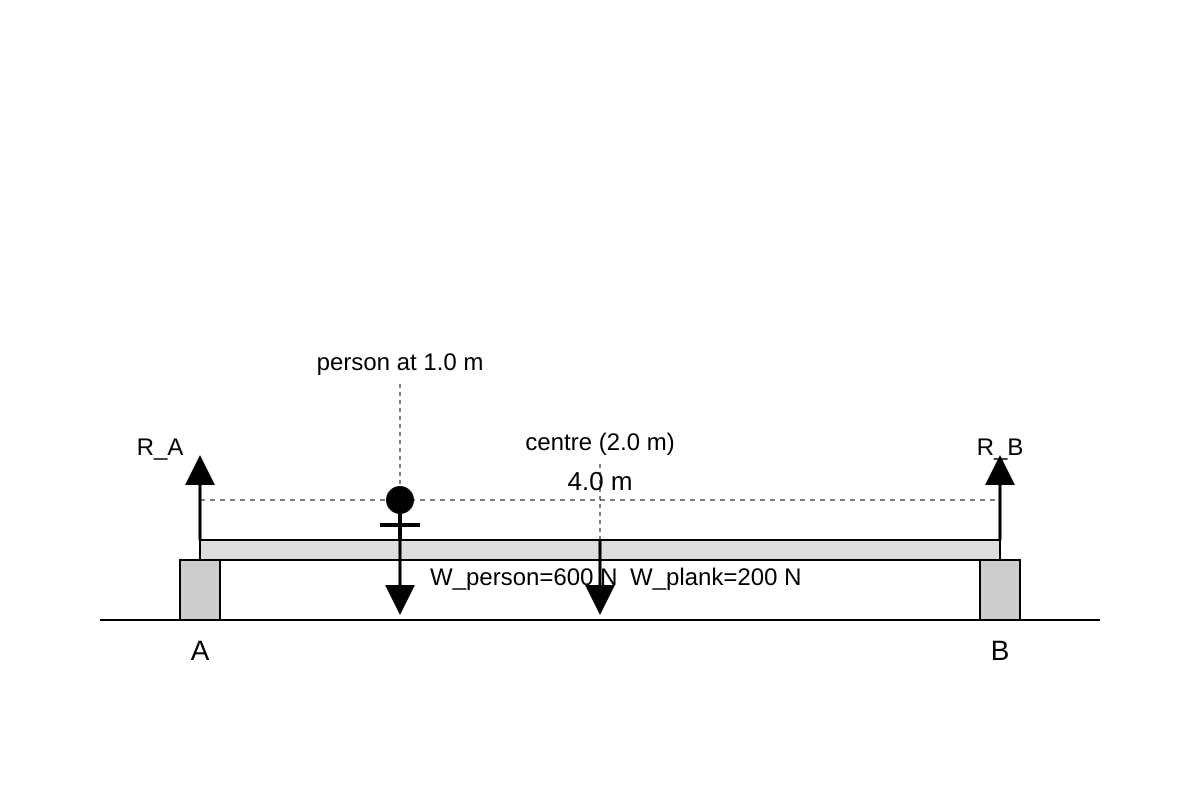
9. [4] Plank length 4.0 m, weight 200 N at 2.0 m; person 600 N at 1.0 m from A.
Take moments about A:
[M1 setup]
[M1]
[A1]
Check: [M1]
Teaching note: Uniform plank → weight at centre. Reaction at B found via moments about A to eliminate R_A.
10. [3] , , ,
[M1]
[M1]
[A1 for final answer with unit]
Teaching note: Average net force from Newton’s second law.
11. [3] , , at top,
[M1]
[M1 calc, A1]
Teaching note: At max height v=0; acceleration downward.
12. [2] [M1 formula, A1]
Teaching note: Hooke’s law linear; extension in metres.
13. [3] , ,
[M1 formula, M1 sub, A1]
Teaching note: Centripetal force toward centre.
14. [3] Inelastic collision, stick together.
[M1]
[M1]
[A1]
Teaching note: Momentum conserved; kinetic energy not.
Section C: Data Interpretation & Extended Response
15. [4 total]
(a) [2] [M1, A1]
(b) [2] Area = triangle (0-4): ; rectangle (4-8): ; triangle (8-10): ; total = [M1 parts, A1 total]
Teaching note: Gradient = acceleration; area = distance.
16. [3] When car brakes, net force acts backward on car (Newton’s 2nd law). Passenger’s body tends to continue forward at original velocity due to inertia (Newton’s 1st law). Seatbelt provides backward force to decelerate passenger. [B1 inertia, B1 car decel, B1 seatbelt force]
Teaching note: Distinguish car’s and passenger’s motion.
17. [2] Speed constant but direction changes continuously, so velocity changes; acceleration = rate of change of velocity, directed toward centre (centripetal). [B1 direction change, B1 acceleration centre]
Teaching note: Vector nature of velocity.
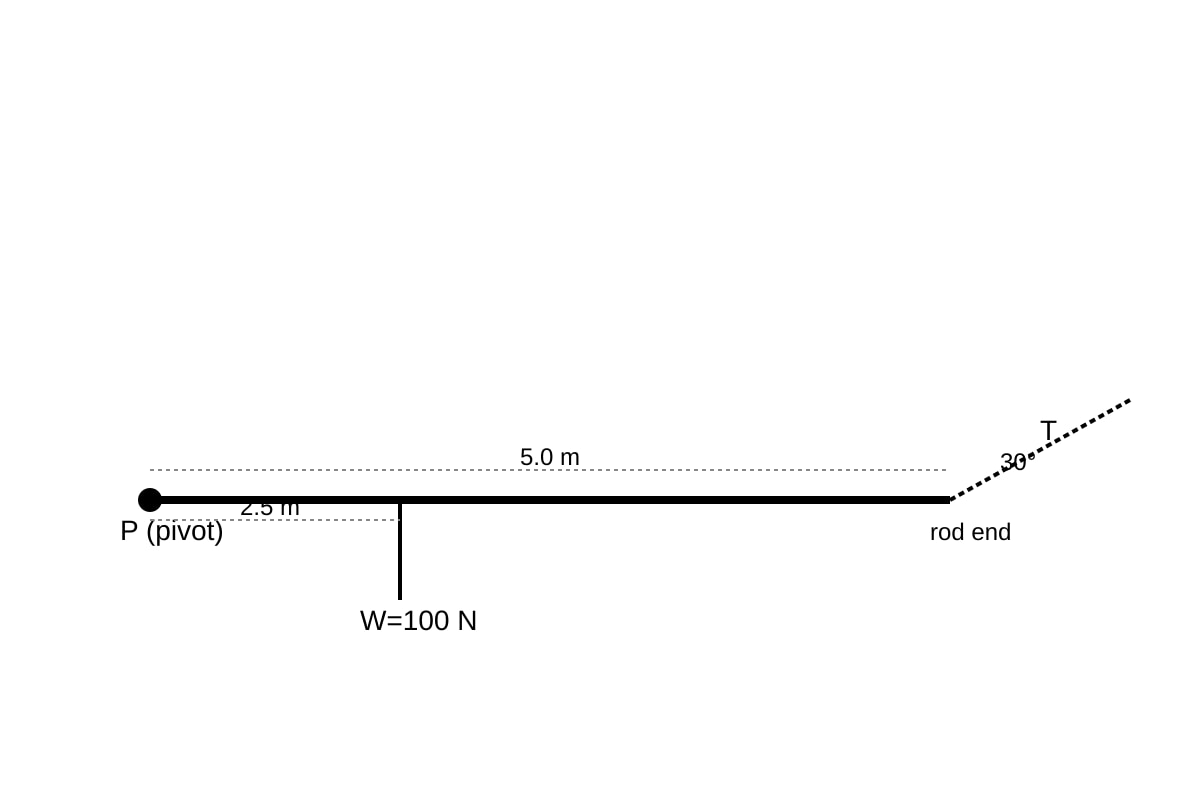
18. [4] Rod length 5.0 m, weight 100 N at 2.5 m, cable at 30° at end.
Moments about P: [M1]
[M1]
[A1]
Vertical component of T balances moment of weight. [M1]
Teaching note: Only vertical component of tension gives moment about pivot.
19. [3] Elastic: momentum conserved, total KE conserved. Inelastic: momentum conserved, total KE not conserved (some lost as heat/sound). [B1 momentum both, B1 KE elastic, B1 KE inelastic]
Teaching note: Momentum always conserved in closed system collisions.
20. [3] , , frictionless.
[M1]
[M1, A1]
Teaching note: PE → KE; mass cancels.