From Real Exams Exam Paper
A Level H1 Physics Practice Paper 3
Free A Level H1 Physics Practice Paper 3, HY3 Exam version, with questions, answers, and A Level-style practice for Singapore students.
These static practice materials are generated from the site's syllabus and paper-generation workflow, with source and model context shown so students and parents can evaluate the material before use.
Questions
TuitionGoWhere Exam Practice (AI) — Physics H1 A-Level
Practice Paper: Mechanics (Version 3 of 5)
School: TuitionGoWhere Exam Practice (AI)
Subject: Physics H1
Level: A-Level
Paper: Practice Paper (Mechanics Topic Quiz)
Version: 3
Duration: 75 minutes
Total Marks: 60
Name: ___________________________
Class: ___________________________
Date: ___________________________
Instructions:
- This practice paper contains 20 questions on Mechanics only.
- Section A (Q1–5): Short structured recall and definition (12 marks)
- Section B (Q6–13): Calculation and proof (24 marks)
- Section C (Q14–20): Data interpretation and extended response (24 marks)
- Show all working clearly. Use SI units.
- Write answers in the spaces provided.
Section A (12 marks)
1. State the principle of conservation of linear momentum. [2]
2. Write down, in terms of mass m and velocity v:
(a) the linear momentum p; [1]
(b) the kinetic energy Ek. [1]
(a) ___________________
(b) ___________________
3. A body moves with constant velocity. State the resultant force acting on it. [1]
4. Define the moment of a force about a point. [2]
5. State Newton’s first law of motion. [2]
Section B (24 marks)
6. A drone has a horizontal momentum of 12 N⋅s and kinetic energy of 24 J. Calculate the mass and speed of the drone. [3]
7. A car of mass 950 kg accelerates from rest to 25 m s−1 in 10 s. Calculate the average resultant force on the car. [3]
8. A ball is thrown vertically upward with initial speed 18 m s−1. Using g=9.8 m s−2, calculate the maximum height reached. [3]
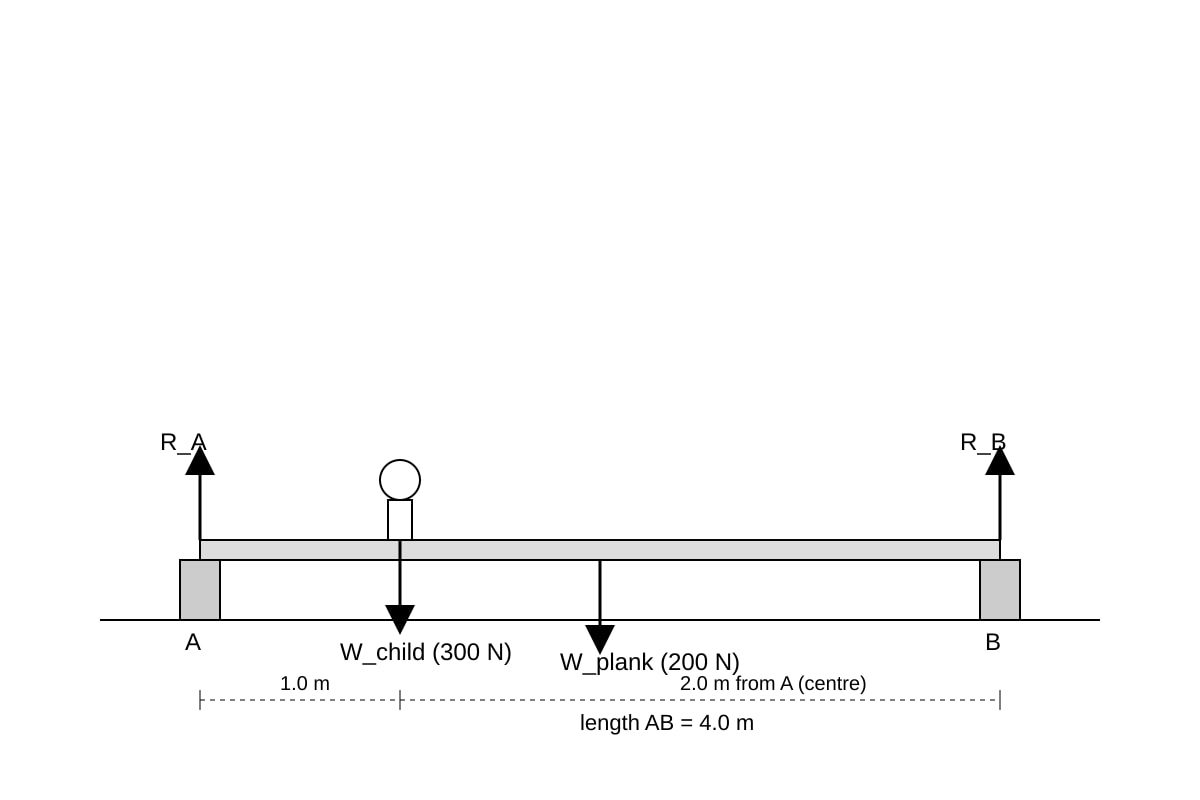
9. A uniform plank AB of length 4.0 m and weight 200 N rests on two supports at A and B. A child of weight 300 N stands 1.0 m from A.
(a) Draw a labelled diagram showing all forces on the plank. [2]
(b) Calculate the reaction force at support B. [3]
(a)
Image pending generation: diagram for Q9.
(b) ___________________________________________________________
10. A projectile is fired at 30∘ above horizontal with speed 40 m s−1. Calculate the horizontal range ignoring air resistance. Use g=9.8 m s−2. [4]
11. A 0.15 kg ball moving at 8.0 m s−1 collides head-on with a stationary 0.10 kg ball. After collision the 0.15 kg ball moves at 2.0 m s−1 in same direction. Calculate the velocity of the second ball. [3]
12. A mass of 2.0 kg is whirled in a horizontal circle of radius 1.5 m at constant speed 6.0 m s−1. Calculate the centripetal force. [3]
13. A crane lifts a 500 kg load vertically at constant speed 0.20 m s−1. Calculate the useful power output. Use g=9.8 m s−2. [3]
Section C (24 marks)
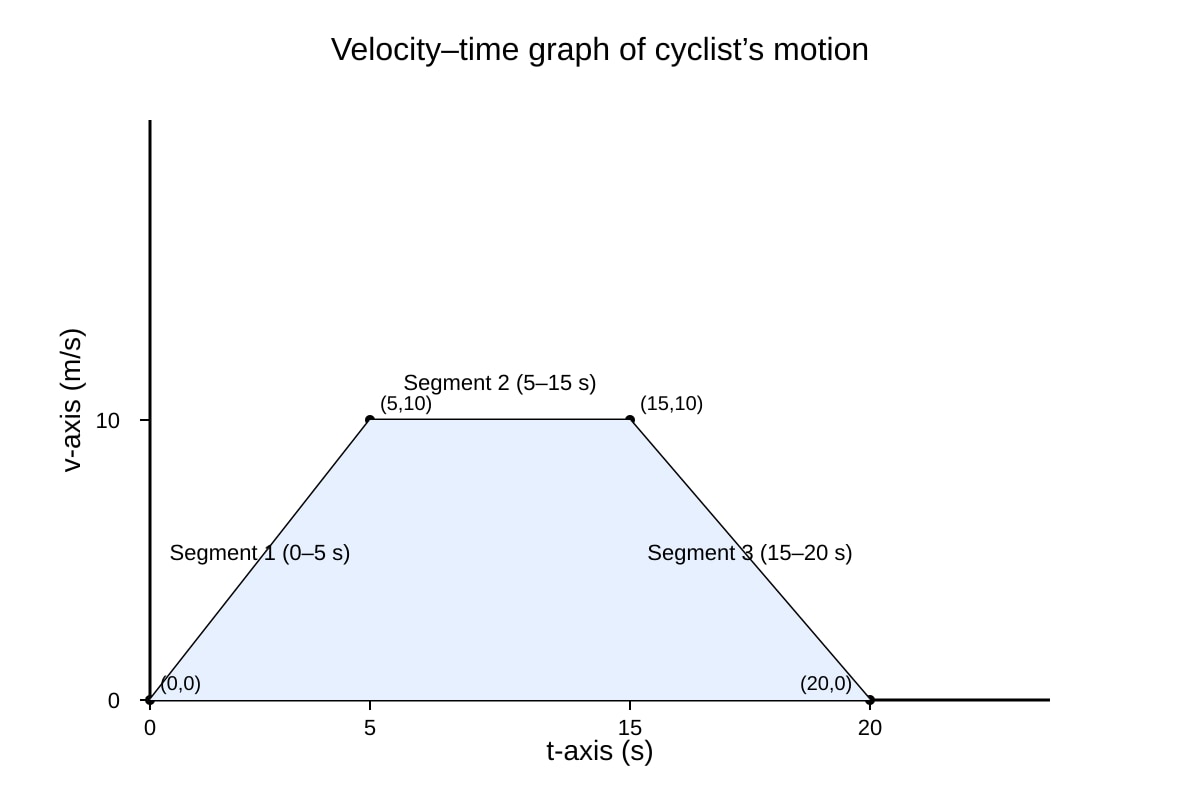
14. The velocity–time graph below shows a cyclist’s motion.
Image pending generation: graph for Q14.
(a) Calculate the total displacement. [2]
(b) State the acceleration during 0–5 s. [1]
(a) ___________________
(b) ___________________
15. Explain why a falling object reaches terminal velocity. [3]
16. A satellite orbits Earth at radius r with speed v. Show that v=rGM. [3]
17. A 2.0 kg block is pushed 3.0 m up a smooth incline of angle 30∘ at constant speed. Calculate work done against gravity. Use g=9.8 m s−2. [3]
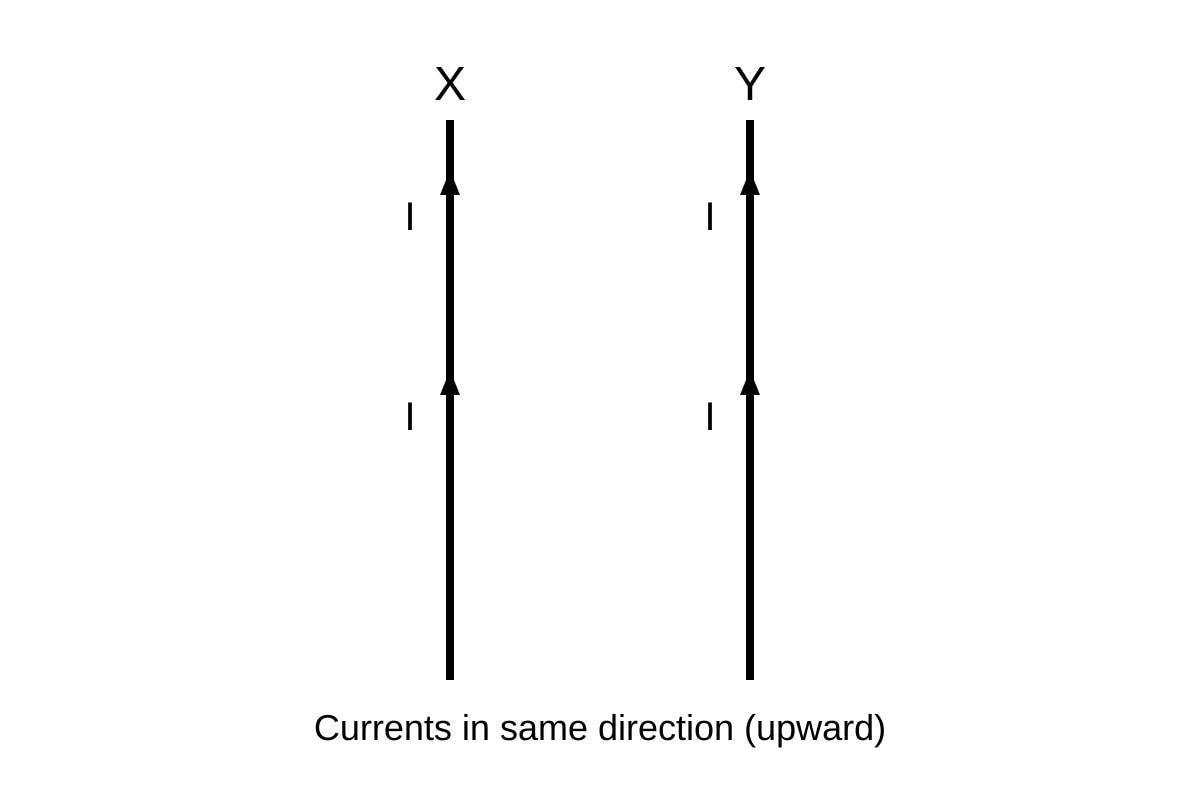
18. Two wires X and Y are parallel and carry currents in the same direction.
Image pending generation: diagram for Q18.
Draw arrows on each wire to show the magnetic force due to the other. [2]
19. A student claims: “In an inelastic collision, both momentum and kinetic energy are conserved.” Discuss this statement. [4]
20. A ball of mass 0.20 kg is dropped from height 5.0 m and rebounds to 3.2 m. Calculate the energy lost and the impulse of the ground on the ball. Use g=9.8 m s−2. [5]
Answers
TuitionGoWhere Exam Practice (AI) — Physics H1 A-Level
Practice Paper: Mechanics (Version 3) — Answer Key
Total Marks: 60
Topic: Mechanics
Section A
1. [2 marks]
State the principle of conservation of linear momentum.
Answer: In a closed (or isolated) system, the total linear momentum remains constant provided no net external force acts.
Teaching note: Momentum before = momentum after. Must include “closed/isolated system” and “no external force” for both marks. Common trap: confusing with energy conservation.
2. [2 marks]
(a) p=mv [1]
(b) Ek=21mv2 [1]
Teaching note: Kinetic energy has the 21 factor; omitting it is a common error.
3. [1 mark]
Resultant force = 0 N (or zero).
Teaching note: Constant velocity ⇒ acceleration zero ⇒ Fnet=ma=0.
4. [2 marks]
The moment of a force about a point is the product of the force and the perpendicular distance from the point to the line of action of the force. (M=F×d⊥)
Teaching note: Award [B1] for product of force and perpendicular distance, [B1] for correct definition wording.
5. [2 marks]
A body remains at rest or in uniform motion in a straight line unless acted upon by a net external force.
Teaching note: This is Newton’s first law; mention both rest and uniform motion.
Section B
6. [3 marks]
Given p=12 N⋅s, Ek=24 J.
p=mv⇒v=p/m
Ek=21mv2=2mp2⇒m=2Ekp2=2×24122=48144=3.0 kg [M1+ A1]
v=p/m=12/3.0=4.0 m s−1 [M1+ A1]
Answer: mass = 3.0 kg, speed = 4.0 m s−1.
7. [3 marks]
a=(v−u)/t=(25−0)/10=2.5 m s−2 [M1]
F=ma=950×2.5=2375 N [M1]
Answer: 2.38×10³ N (or 2375 N) [A1]
8. [3 marks]
At max height, v=0. v2=u2−2gh⇒h=u2/(2g) [M1]
h=182/(2×9.8)=324/19.6=16.5 m [M1+A1]
Answer: 16.5 m
9. [5 marks]
(a) [2] Diagram: plank horizontal, RA up at A, RB up at B, 200 N down at centre (2.0 m), 300 N down at 1.0 m from A.
(b) [3] Take moments about A:
RB×4.0=200×2.0+300×1.0 [M1]
RB×4=400+300=700 [M1]
RB=175 N [A1]
Answer: 175 N
10. [4 marks]
ux=40cos30∘=34.64 m s−1, uy=40sin30∘=20 m s−1 [M1]
Time of flight T=2uy/g=40/9.8=4.08 s [M1]
Range R=uxT=34.64×4.08=141 m [M1+A1]
Answer: 141 m
11. [3 marks]
Conservation of momentum: 0.15×8+0=0.15×2+0.10×v [M1]
1.2=0.30+0.10v⇒0.10v=0.90 [M1]
v=9.0 m s−1 [A1]
Answer: 9.0 m s−1 same direction.
12. [3 marks]
Fc=mv2/r=2.0×6.02/1.5=2.0×36/1.5=48 N [M2+A1]
Answer: 48 N
13. [3 marks]
Force = weight = mg=500×9.8=4900 N [M1]
Power P=Fv=4900×0.20=980 W [M1+A1]
Answer: 980 W
Section C
14. [3 marks]
(a) Area = triangle(0–5) + rectangle(5–15) + triangle(15–20)
=21×5×10+10×10+21×5×10=25+100+25=150 m [M1+A1]
(b) a=(10−0)/5=2.0 m s−2 [A1]
Answer: (a) 150 m (b) 2.0 m s−2
15. [3 marks]
As object falls, air resistance increases with speed. When air resistance equals weight, net force is zero, acceleration zero, speed constant = terminal velocity. [B1 for increasing resistance, B1 for equality of forces, B1 for constant speed]
16. [3 marks]
Gravitational force provides centripetal force: r2GMm=rmv2 [M1]
Cancel m and one r: rGM=v2 [M1]
v=rGM [A1]
Answer: shown.
17. [3 marks]
Vertical height gain h=3.0sin30∘=1.5 m [M1]
Work = mgh=2.0×9.8×1.5=29.4 J [M1+A1]
Answer: 29.4 J
18. [2 marks]
Parallel currents attract: arrow on X toward Y, arrow on Y toward X (horizontal). [B1 each]
19. [4 marks]
Momentum conserved in all collisions (closed system) [B1]. Kinetic energy NOT conserved in inelastic collisions; some converted to heat/sound/deformation [B2]. Statement false because KE not conserved [B1].
20. [5 marks]
Initial PE = mgh1=0.20×9.8×5.0=9.8 J [M1]
Rebound PE = 0.20×9.8×3.2=6.272 J [M1]
Energy lost = 9.8−6.272=3.53 J [A1]
Speed before impact u=2gh1=98=9.90 m s−1 down [M1]
Speed after v=2gh2=62.72=7.92 m s−1 up [M1]
Impulse = Δp=m(v−(−u))=0.20(7.92+9.90)=3.56 N⋅s up [A1]
Answer: Energy lost 3.53 J, impulse 3.56 N⋅s upward.
Free quiz and exam paper access
Enter your details to view this paper
Your access is remembered on this device.