From Real Exams Exam Paper

A Level H1 Physics Practice Paper 2

Free Exam-Derived Owl Alpha A Level H1 Physics Practice Paper 2 practice paper with questions and answers for Singapore students. This page is rendered as a direct URL so the questions and answers can be discovered without pressing in-page buttons.

These static practice materials are generated from the site's syllabus and paper-generation workflow, with source and model context shown so students and parents can evaluate the material before use.

A Level H1 Physics From Real Exams Generated by Owl Alpha Updated 2026-06-07

Questions

<!-- TuitionGoWhere generation metadata: stage=3-1; model=openrouter/owl-alpha; model_label=Owl Alpha; generated=2026-06-06; Sources: Stage 2-1 real exam-derived templates and Stage 2-2 exam-enriched syllabus. -->

TuitionGoWhere Practice Paper - Physics H1 A-Level

TuitionGoWhere Secondary School (AI)


FieldDetails
Subject:Physics
Level:A-Level H1
Paper:Practice Paper — Mechanics & Associated Topics
Version:2 of 5
Duration:1 hour 30 minutes
Total Marks:60

Name: ___________________________ Class: ___________ Date: _______________


Instructions to Candidates

  1. Write your name, class, and date in the spaces provided above.
  2. Answer ALL questions in the spaces provided.
  3. Write in dark blue or black pen.
  4. You may use a pencil for any diagrams, graphs, or working.
  5. Non-programmable calculators are permitted.
  6. The total mark for this paper is 60.
  7. The number of marks for each question or part question is shown in brackets [ ].
  8. You are reminded of the need for clear presentation in your answers.

Section A: Multiple Choice [10 marks]

Questions 1–10: Each question is worth 1 mark. Choose the one best answer.


1. A ball is thrown vertically upwards. At the highest point of its trajectory, which of the following is correct?

A. Velocity is zero and acceleration is zero. B. Velocity is zero and acceleration is 9.8 m s29.8 \text{ m s}^{-2} downwards. C. Velocity is maximum and acceleration is 9.8 m s29.8 \text{ m s}^{-2} upwards. D. Velocity is maximum and acceleration is zero.


2. A car accelerates uniformly from rest to 24 m s124 \text{ m s}^{-1} in 8.0 s8.0 \text{ s}. What distance does it travel in this time?

A. 48 m48 \text{ m} B. 96 m96 \text{ m} C. 144 m144 \text{ m} D. 192 m192 \text{ m}


3. Which of the following is a vector quantity?

A. Energy B. Power C. Speed D. Momentum


4. A 2.0 kg2.0 \text{ kg} object moving at 3.0 m s13.0 \text{ m s}^{-1} collides with a stationary 4.0 kg4.0 \text{ kg} object. After the collision, the two objects stick together. What is their common velocity?

A. 0.5 m s10.5 \text{ m s}^{-1} B. 1.0 m s11.0 \text{ m s}^{-1} C. 1.5 m s11.5 \text{ m s}^{-1} D. 2.0 m s12.0 \text{ m s}^{-1}


5. A force of 12 N12 \text{ N} acts on an object and displaces it by 5.0 m5.0 \text{ m} in the direction of the force. The work done by the force is:

A. 2.4 J2.4 \text{ J} B. 17 J17 \text{ J} C. 60 J60 \text{ J} D. 120 J120 \text{ J}


6. A projectile is launched horizontally from a cliff at 15 m s115 \text{ m s}^{-1}. Ignoring air resistance, which statement about its motion is correct?

A. Its horizontal velocity increases. B. Its horizontal velocity decreases. C. Its horizontal velocity remains constant. D. Its vertical acceleration increases.


7. A uniform beam of weight 40 N40 \text{ N} is supported at both ends. A 20 N20 \text{ N} load is placed at the centre of the beam. What is the reaction force at each support?

A. 10 N10 \text{ N} B. 20 N20 \text{ N} C. 30 N30 \text{ N} D. 40 N40 \text{ N}


8. A car of mass 1000 kg1000 \text{ kg} travelling at 20 m s120 \text{ m s}^{-1} is brought to rest by a constant braking force over a distance of 50 m50 \text{ m}. The magnitude of the braking force is:

A. 2000 N2000 \text{ N} B. 4000 N4000 \text{ N} C. 6000 N6000 \text{ N} D. 8000 N8000 \text{ N}


9. An object of mass 5.0 kg5.0 \text{ kg} is raised vertically through a height of 10 m10 \text{ m}. The gain in gravitational potential energy is: (Take g=9.8 m s2g = 9.8 \text{ m s}^{-2})

A. 49 J49 \text{ J} B. 98 J98 \text{ J} C. 490 J490 \text{ J} D. 980 J980 \text{ J}


10. A 0.50 kg0.50 \text{ kg} ball moving at 6.0 m s16.0 \text{ m s}^{-1} strikes a wall and rebounds at 4.0 m s14.0 \text{ m s}^{-1}. The magnitude of the change in momentum of the ball is:

A. 1.0 kg m s11.0 \text{ kg m s}^{-1} B. 3.0 kg m s13.0 \text{ kg m s}^{-1} C. 5.0 kg m s15.0 \text{ kg m s}^{-1} D. 7.0 kg m s17.0 \text{ kg m s}^{-1}


Section B: Structured Questions [30 marks]

Answer ALL questions. Show your working clearly.


11. (a) State Newton's first law of motion. [2]

..................................................................................................................................

..................................................................................................................................

(b) A book of mass 1.5 kg1.5 \text{ kg} rests on a horizontal table. Draw a free-body diagram showing all the forces acting on the book. Label each force clearly. [2]

(c) Explain, using Newton's first law, why the book remains at rest. [1]

..................................................................................................................................

..................................................................................................................................

[Total: 5 marks]


12. A car starts from rest and accelerates uniformly at 2.5 m s22.5 \text{ m s}^{-2} for 10 s10 \text{ s}.

(a) Calculate the final velocity of the car. [2]

(b) Calculate the distance travelled by the car during this time. [2]

(c) The car then travels at constant velocity for a further 20 s20 \text{ s}. Calculate the total distance travelled over the entire 30 s30 \text{ s} period. [2]

[Total: 6 marks]


13. (a) State the principle of conservation of linear momentum. [2]

..................................................................................................................................

..................................................................................................................................

(b) A 0.060 kg0.060 \text{ kg} tennis ball moving horizontally at 25 m s125 \text{ m s}^{-1} is struck by a racket. The ball moves off in the opposite direction at 30 m s130 \text{ m s}^{-1}. The contact time between the ball and racket is 0.0050 s0.0050 \text{ s}.

(i) Calculate the change in momentum of the ball. [2]

(ii) Calculate the average force exerted by the racket on the ball. [2]

[Total: 6 marks]


14. A ball is projected from ground level at an angle of 35°35° above the horizontal with an initial speed of 20 m s120 \text{ m s}^{-1}. Air resistance is negligible. Take g=9.8 m s2g = 9.8 \text{ m s}^{-2}.

(a) Show that the horizontal component of the initial velocity is 16.4 m s116.4 \text{ m s}^{-1}. [1]

(b) Calculate the vertical component of the initial velocity. [1]

(c) Calculate the maximum height reached by the ball. [3]

(d) Calculate the horizontal range of the projectile. [3]

[Total: 8 marks]


15. A crane lifts a load of mass 500 kg500 \text{ kg} vertically upwards at constant speed through a height of 12 m12 \text{ m} in 15 s15 \text{ s}. Take g=9.8 m s2g = 9.8 \text{ m s}^{-2}.

(a) Calculate the weight of the load. [1]

(b) Calculate the work done by the crane in lifting the load. [2]

(c) Calculate the power output of the crane. [2]

(d) State the gain in gravitational potential energy of the load. Explain why this is equal to the work done by the crane. [2]

..................................................................................................................................

..................................................................................................................................

..................................................................................................................................

[Total: 7 marks]


Section C: Data Interpretation & Extended Response [20 marks]

Answer ALL questions.


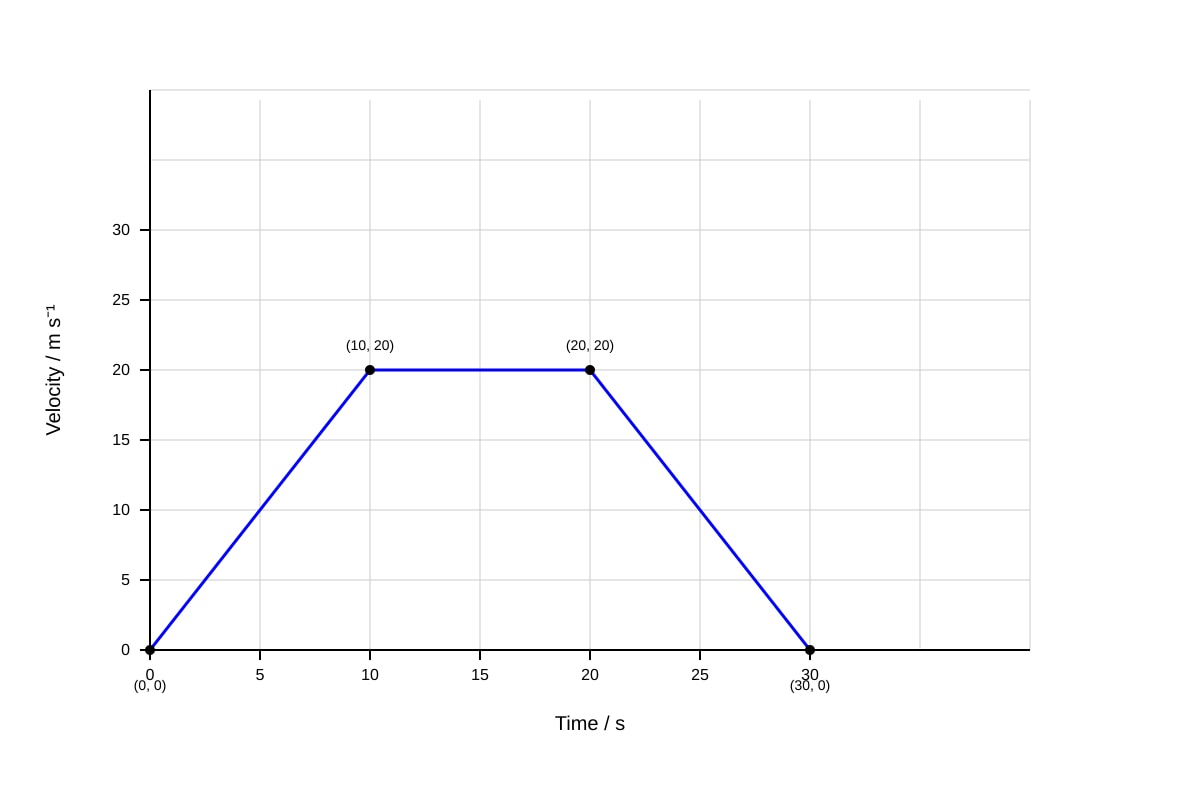
16. The velocity–time graph below shows the motion of a car along a straight road.

<image_placeholder> id: Q16-fig1 type: graph linked_question: Q16 description: Velocity-time graph for a car. Time axis from 0 to 30 s in 5 s intervals. Velocity axis from 0 to 30 m/s in 5 m/s intervals. The graph consists of three segments: (1) a straight line from (0,0) to (10,20) — uniform acceleration, (2) a horizontal line from (10,20) to (20,20) — constant velocity, (3) a straight line from (20,20) to (30,0) — uniform deceleration to rest. labels: Time / s (horizontal axis), Velocity / m s⁻¹ (vertical axis) values: Segment 1: (0 s, 0 m/s) to (10 s, 20 m/s); Segment 2: (10 s, 20 m/s) to (20 s, 20 m/s); Segment 3: (20 s, 20 m/s) to (30 s, 0 m/s) must_show: All three line segments clearly drawn, axes labelled with units, key points (0,0), (10,20), (20,20), (30,0) marked, grid lines visible </image_placeholder>

(a) Describe the motion of the car during the first 10 s10 \text{ s}. [1]

..................................................................................................................................

(b) Calculate the acceleration of the car during the first 10 s10 \text{ s}. [2]

(c) Calculate the total distance travelled by the car in the 30 s30 \text{ s} period. [3]

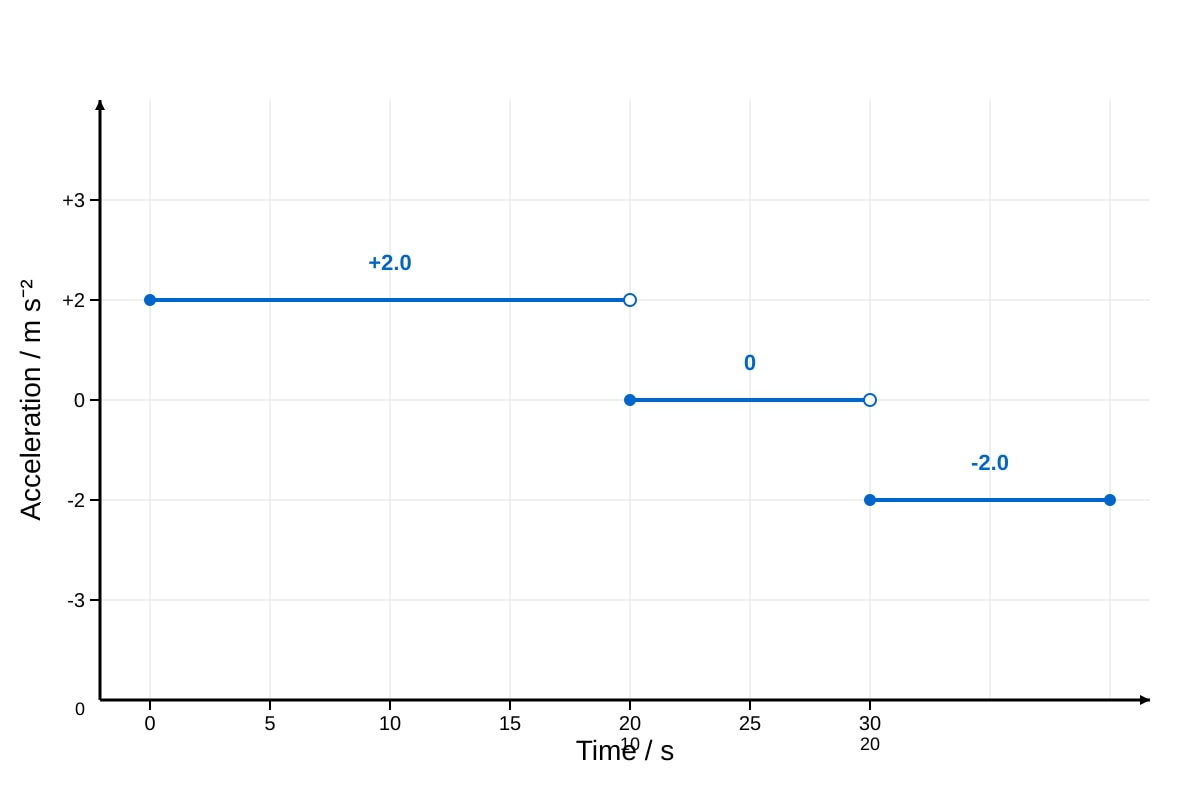
(d) Sketch an acceleration–time graph for the entire 30 s30 \text{ s} motion. Show numerical values on both axes. [3]

<image_placeholder> id: Q16-fig2 type: graph linked_question: Q16d description: Acceleration-time graph with time axis 0 to 30 s and acceleration axis from -3 to +3 m/s². Three horizontal segments: (1) a horizontal line at +2.0 m/s² from t=0 to t=10 s, (2) a horizontal line at 0 m/s² from t=10 to t=20 s, (3) a horizontal line at -2.0 m/s² from t=20 to t=30 s. labels: Time / s (horizontal axis), Acceleration / m s⁻² (vertical axis) values: a = +2.0 m/s² for 0–10 s; a = 0 for 10–20 s; a = -2.0 m/s² for 20–30 s must_show: Three distinct horizontal segments, axes labelled with units, acceleration values clearly marked, discontinuities at t=10 s and t=20 s shown </image_placeholder>

[Total: 9 marks]


17. A student investigates the motion of a trolley along a friction-compensated slope. The student releases the trolley from rest and uses a motion sensor to record its velocity at various times. The results are shown in the table below.

Time tt / s0.00.51.01.52.02.53.0
Velocity vv / m s1\text{m s}^{-1}0.000.400.801.201.602.002.40

(a) State what type of motion the data suggests. Justify your answer. [2]

..................................................................................................................................

..................................................................................................................................

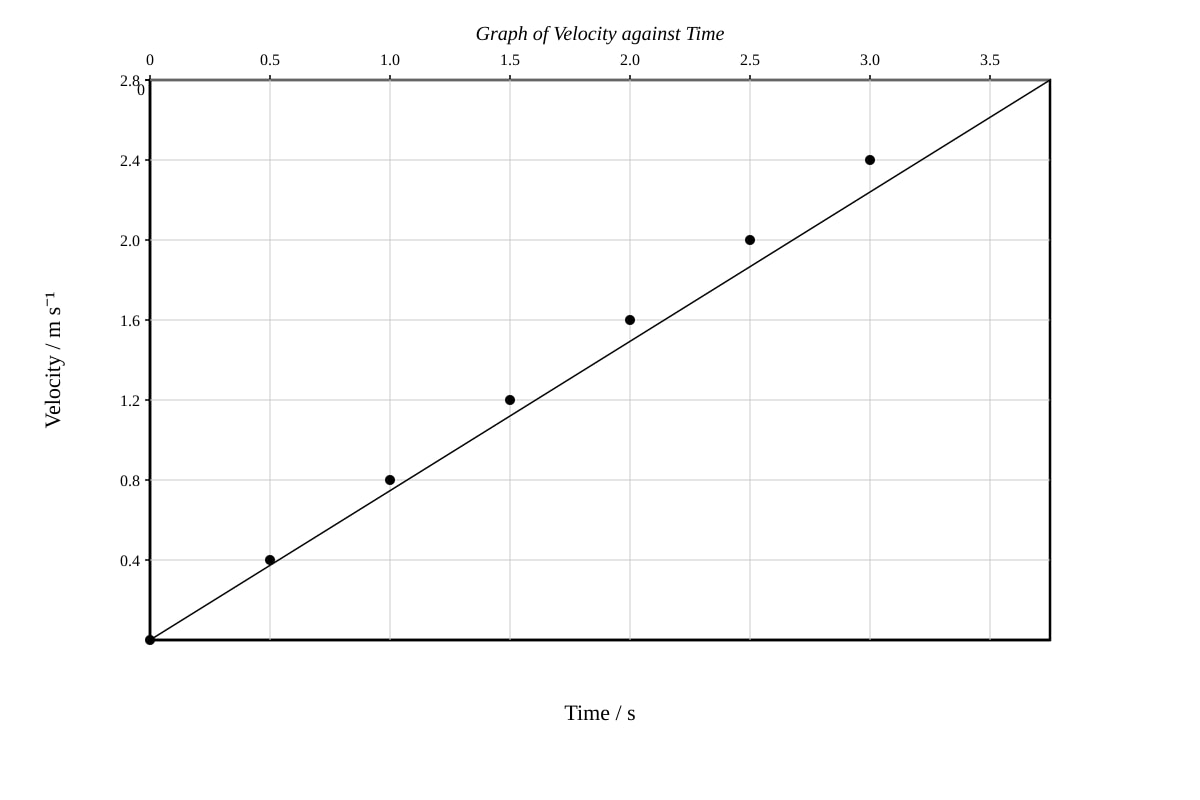
(b) Plot a graph of velocity (vertical axis) against time (horizontal axis) on the grid provided. [3]

<image_placeholder> id: Q17-fig1 type: graph linked_question: Q17b description: Blank graph grid for student to plot velocity vs time. Horizontal axis: Time / s, range 0 to 3.5 s, scale: 1 cm = 0.5 s. Vertical axis: Velocity / m s⁻¹, range 0 to 2.8 m s⁻¹, scale: 1 cm = 0.4 m s⁻¹. Grid lines at 0.5 s intervals horizontally and 0.4 m/s intervals vertically. Seven data points to be plotted: (0.0, 0.00), (0.5, 0.40), (1.0, 0.80), (1.5, 1.20), (2.0, 1.60), (2.5, 2.00), (3.0, 2.40). A straight best-fit line through the origin should be drawn. labels: Time / s (horizontal axis), Velocity / m s⁻¹ (vertical axis) values: Data points as listed in table above must_show: Axes with labels and units, appropriate scales, grid lines, space for student to plot points and draw best-fit line </image_placeholder>

(c) Determine the acceleration of the trolley from your graph. Show clearly how you obtained your answer. [2]

(d) The student now doubles the mass of the trolley and repeats the experiment, keeping the slope angle the same. State and explain whether the acceleration will change. [2]

..................................................................................................................................

..................................................................................................................................

..................................................................................................................................

[Total: 9 marks]


18. (a) Define the term work done by a force. [1]

..................................................................................................................................

(b) A box of mass 8.0 kg8.0 \text{ kg} is pulled along a rough horizontal floor by a force of 50 N50 \text{ N} applied at an angle of 25°25° above the horizontal. The box moves a distance of 6.0 m6.0 \text{ m}. The frictional force acting on the box is 18 N18 \text{ N}.

(i) Calculate the work done by the applied force. [2]

(ii) Calculate the work done against friction. [1]

(iii) Using the work-energy principle, calculate the final speed of the box if it started from rest. [3]

..................................................................................................................................

..................................................................................................................................

..................................................................................................................................

[Total: 7 marks]


END OF PAPER

Total: 60 marks

Answers

<!-- TuitionGoWhere generation metadata: stage=3-1; model=openrouter/owl-alpha; model_label=Owl Alpha; generated=2026-06-06; Sources: Stage 2-1 real exam-derived templates and Stage 2-2 exam-enriched syllabus. -->

TuitionGoWhere Practice Paper — Physics H1 A-Level

Answer Key — Version 2 of 5


Section A: Multiple Choice [10 marks]

1. Answer: B

At the highest point of a vertical trajectory, the ball momentarily stops (velocity = 0), but gravity still acts on it, giving a downward acceleration of 9.8 m s29.8 \text{ m s}^{-2}. Acceleration due to gravity is constant throughout the motion (ignoring air resistance).

Common mistake: Choosing A — students often assume that if velocity is zero, acceleration must also be zero. Acceleration is the rate of change of velocity, not dependent on the instantaneous velocity itself.

[1 mark]


2. Answer: B

Using s=12(u+v)ts = \frac{1}{2}(u + v)t: s=12(0+24)(8.0)=12(24)(8.0)=96 ms = \frac{1}{2}(0 + 24)(8.0) = \frac{1}{2}(24)(8.0) = 96 \text{ m}

Alternatively, using a=vut=248.0=3.0 m s2a = \frac{v - u}{t} = \frac{24}{8.0} = 3.0 \text{ m s}^{-2}, then s=ut+12at2=0+12(3.0)(64)=96 ms = ut + \frac{1}{2}at^2 = 0 + \frac{1}{2}(3.0)(64) = 96 \text{ m}.

[1 mark]


3. Answer: D

Momentum (p=mvp = mv) is a vector quantity because it has both magnitude and direction (the direction of velocity). Energy, power, and speed are all scalar quantities — they have magnitude only.

[1 mark]


4. Answer: B

Using conservation of linear momentum (perfectly inelastic collision): m1u1+m2u2=(m1+m2)vm_1 u_1 + m_2 u_2 = (m_1 + m_2)v (2.0)(3.0)+(4.0)(0)=(2.0+4.0)v(2.0)(3.0) + (4.0)(0) = (2.0 + 4.0)v 6.0=6.0v6.0 = 6.0v v=1.0 m s1v = 1.0 \text{ m s}^{-1}

[1 mark]


5. Answer: C

Work done: W=F×d=12×5.0=60 JW = F \times d = 12 \times 5.0 = 60 \text{ J}

Work done is the product of force and displacement in the direction of the force.

[1 mark]


6. Answer: C

In projectile motion (ignoring air resistance), there is no horizontal force, so the horizontal velocity remains constant. The vertical acceleration is always g=9.8 m s2g = 9.8 \text{ m s}^{-2} downwards and does not change.

[1 mark]


7. Answer: C

Total downward force = weight of beam + load = 40+20=60 N40 + 20 = 60 \text{ N}

By symmetry (uniform beam, load at centre), each support carries half: Reaction at each support=602=30 N\text{Reaction at each support} = \frac{60}{2} = 30 \text{ N}

[1 mark]


8. Answer: B

First, find the deceleration using v2=u2+2asv^2 = u^2 + 2as: 0=(20)2+2a(50)0 = (20)^2 + 2a(50) 0=400+100a0 = 400 + 100a a=4.0 m s2a = -4.0 \text{ m s}^{-2}

Then, using F=maF = ma: F=1000×4.0=4000 NF = 1000 \times 4.0 = 4000 \text{ N}

[1 mark]


9. Answer: C

Gain in gravitational potential energy: ΔEp=mgh=5.0×9.8×10=490 J\Delta E_p = mgh = 5.0 \times 9.8 \times 10 = 490 \text{ J}

[1 mark]


10. Answer: C

Taking the initial direction as positive: Initial momentum=0.50×6.0=3.0 kg m s1\text{Initial momentum} = 0.50 \times 6.0 = 3.0 \text{ kg m s}^{-1} Final momentum=0.50×(4.0)=2.0 kg m s1\text{Final momentum} = 0.50 \times (-4.0) = -2.0 \text{ kg m s}^{-1}

Change in momentum: Δp=pfinalpinitial=(2.0)(3.0)=5.0 kg m s1\Delta p = p_{\text{final}} - p_{\text{initial}} = (-2.0) - (3.0) = -5.0 \text{ kg m s}^{-1}

Magnitude of change in momentum = 5.0 kg m s15.0 \text{ kg m s}^{-1}

Common mistake: Students may subtract speeds directly (6.04.0=2.06.0 - 4.0 = 2.0) and multiply by mass to get 1.01.0, which is incorrect. Momentum is a vector; direction matters.

[1 mark]


Section B: Structured Questions [30 marks]


11. (a) [B1] Newton's first law: An object remains at rest or continues to move at constant velocity [B1] unless acted upon by a resultant (net) external force.

Teaching note: This is also called the law of inertia. The key idea is that a resultant force is needed to change motion, not to maintain it.

[2 marks]

(b) Free-body diagram should show:

  • Weight (WW) acting vertically downward from the centre of the book, labelled W=mgW = mg or "weight"
  • Normal reaction force (NN or RR) acting vertically upward from the bottom surface of the book, labelled "normal reaction" or "NN"

[B1] for correct downward force (weight), correctly labelled [B1] for correct upward force (normal reaction), correctly labelled, approximately equal in length to weight arrow

Note: The two arrows should be approximately equal in length since the book is in equilibrium.

[2 marks]

(c) The book remains at rest because the resultant force on it is zero — the weight is balanced by the normal reaction. By Newton's first law, since there is no resultant force, the book remains in its state of rest.

[1 mark]


12. (a) Using v=u+atv = u + at: v=0+(2.5)(10)=25 m s1v = 0 + (2.5)(10) = 25 \text{ m s}^{-1}

[B1] for correct equation or method [B1] for correct answer with unit: 25 m s125 \text{ m s}^{-1}

[2 marks]

(b) Using s=ut+12at2s = ut + \frac{1}{2}at^2: s=0+12(2.5)(10)2=12(2.5)(100)=125 ms = 0 + \frac{1}{2}(2.5)(10)^2 = \frac{1}{2}(2.5)(100) = 125 \text{ m}

Alternatively, s=12(u+v)t=12(0+25)(10)=125 ms = \frac{1}{2}(u + v)t = \frac{1}{2}(0 + 25)(10) = 125 \text{ m}

[B1] for correct equation or method [B1] for correct answer with unit: 125 m125 \text{ m}

[2 marks]

(c) Distance during constant velocity phase: s2=v×t=25×20=500 ms_2 = v \times t = 25 \times 20 = 500 \text{ m}

Total distance: stotal=125+500=625 ms_{\text{total}} = 125 + 500 = 625 \text{ m}

[B1] for calculating distance during constant velocity phase [B1] for correct total distance with unit: 625 m625 \text{ m}

[2 marks]


13. (a) [B1] In a closed/isolated system, the total momentum remains constant [B1] provided no external forces act on the system.

Teaching note: A "closed system" means no mass enters or leaves, and "no external forces" means the net external force is zero. Both conditions are needed for momentum conservation.

[2 marks]

(b) Taking the initial direction of the ball as positive:

(i) Initial momentum: pi=0.060×25=1.50 kg m s1p_i = 0.060 \times 25 = 1.50 \text{ kg m s}^{-1}

Final momentum: pf=0.060×(30)=1.80 kg m s1p_f = 0.060 \times (-30) = -1.80 \text{ kg m s}^{-1}

Change in momentum: Δp=pfpi=(1.80)(1.50)=3.30 kg m s1\Delta p = p_f - p_i = (-1.80) - (1.50) = -3.30 \text{ kg m s}^{-1}

Magnitude = 3.30 kg m s13.30 \text{ kg m s}^{-1}

[B1] for correct substitution into momentum change formula [B1] for correct answer: 3.30 kg m s13.30 \text{ kg m s}^{-1} (or 3.3 kg m s13.3 \text{ kg m s}^{-1})

[2 marks]

(ii) Using the impulse-momentum theorem: FΔt=ΔpF \Delta t = \Delta p F=ΔpΔt=3.300.0050=660 NF = \frac{|\Delta p|}{\Delta t} = \frac{3.30}{0.0050} = 660 \text{ N}

[B1] for correct use of F=ΔpΔtF = \frac{\Delta p}{\Delta t} [B1] for correct answer with unit: 660 N660 \text{ N}

[2 marks]


14. (a) Horizontal component: vx=vcosθ=20cos35°=20×0.8192=16.4 m s1 (to 3 s.f.)v_x = v \cos\theta = 20 \cos 35° = 20 \times 0.8192 = 16.4 \text{ m s}^{-1} \text{ (to 3 s.f.)}

[B1] for correct working shown

[1 mark]

(b) Vertical component: vy=vsinθ=20sin35°=20×0.5736=11.5 m s1 (to 3 s.f.)v_y = v \sin\theta = 20 \sin 35° = 20 \times 0.5736 = 11.5 \text{ m s}^{-1} \text{ (to 3 s.f.)}

[B1] for correct answer: 11.5 m s111.5 \text{ m s}^{-1}

[1 mark]

(c) At maximum height, vertical velocity vy=0v_y = 0. Using v2=u2+2asv^2 = u^2 + 2as vertically: 0=(11.5)2+2(9.8)h0 = (11.5)^2 + 2(-9.8)h 0=132.2519.6h0 = 132.25 - 19.6h h=132.2519.6=6.75 mh = \frac{132.25}{19.6} = 6.75 \text{ m}

[B1] for correct equation [B1] for correct substitution [B1] for correct answer: 6.75 m6.75 \text{ m} (or 6.7 m6.7 \text{ m} to 2 s.f.)

[3 marks]

(d) Time of flight: Using v=u+atv = u + at for the upward phase: 0=11.59.8tup0 = 11.5 - 9.8t_{\text{up}} tup=11.59.8=1.173 st_{\text{up}} = \frac{11.5}{9.8} = 1.173 \text{ s}

Total time of flight: T=2×tup=2×1.173=2.347 sT = 2 \times t_{\text{up}} = 2 \times 1.173 = 2.347 \text{ s}

Horizontal range: R=vx×T=16.4×2.347=38.5 mR = v_x \times T = 16.4 \times 2.347 = 38.5 \text{ m}

Alternatively, using the range formula: R=v2sin2θg=(20)2sin70°9.8=400×0.93979.8=38.4 mR = \frac{v^2 \sin 2\theta}{g} = \frac{(20)^2 \sin 70°}{9.8} = \frac{400 \times 0.9397}{9.8} = 38.4 \text{ m}

[B1] for finding time of flight (or using range formula) [B1] for correct substitution [B1] for correct answer: 38.4 m38.4 \text{ m} or 38.5 m38.5 \text{ m} (accept 38 m38 \text{ m} to 2 s.f.)

[3 marks]


15. (a) Weight: W=mg=500×9.8=4900 NW = mg = 500 \times 9.8 = 4900 \text{ N}

[B1] for correct answer with unit: 4900 N4900 \text{ N}

[1 mark]

(b) Since the load moves at constant speed, the tension in the cable equals the weight. Work done: W=F×d=4900×12=58800 J=58.8 kJW = F \times d = 4900 \times 12 = 58\,800 \text{ J} = 58.8 \text{ kJ}

[B1] for correct force (equal to weight since constant speed) [B1] for correct answer: 58800 J58\,800 \text{ J} or 58.8 kJ58.8 \text{ kJ}

[2 marks]

(c) Power: P=Wt=5880015=3920 W=3.92 kWP = \frac{W}{t} = \frac{58\,800}{15} = 3920 \text{ W} = 3.92 \text{ kW}

[B1] for correct formula [B1] for correct answer: 3920 W3920 \text{ W} or 3.92 kW3.92 \text{ kW}

[2 marks]

(d) Gain in gravitational potential energy: ΔEp=mgh=500×9.8×12=58800 J\Delta E_p = mgh = 500 \times 9.8 \times 12 = 58\,800 \text{ J}

This is equal to the work done by the crane because the load moves at constant speed (no change in kinetic energy). By the work-energy principle, all the work done by the crane goes into increasing the gravitational potential energy of the load.

[B1] for correct value of GPE gain: 58800 J58\,800 \text{ J} [B1] for correct explanation linking constant speed (no ΔKE\Delta KE) to work done = GPE gain

[2 marks]


Section C: Data Interpretation & Extended Response [20 marks]


16. (a) The car accelerates uniformly from rest, reaching a velocity of 20 m s120 \text{ m s}^{-1} in 10 s10 \text{ s}.

[B1] for stating uniform/increasing velocity/acceleration from rest

[1 mark]

(b) Acceleration = gradient of velocity–time graph: a=ΔvΔt=200100=2010=2.0 m s2a = \frac{\Delta v}{\Delta t} = \frac{20 - 0}{10 - 0} = \frac{20}{10} = 2.0 \text{ m s}^{-2}

[B1] for correct method (gradient or a=ΔvΔta = \frac{\Delta v}{\Delta t}) [B1] for correct answer with unit: 2.0 m s22.0 \text{ m s}^{-2}

[2 marks]

(c) Total distance = area under the velocity–time graph.

The graph forms a trapezium (or can be split into a triangle + rectangle + triangle):

  • Area of triangle (0–10 s): 12×10×20=100 m\frac{1}{2} \times 10 \times 20 = 100 \text{ m}
  • Area of rectangle (10–20 s): 10×20=200 m10 \times 20 = 200 \text{ m}
  • Area of triangle (20–30 s): 12×10×20=100 m\frac{1}{2} \times 10 \times 20 = 100 \text{ m}

Total distance: 100+200+100=400 m100 + 200 + 100 = 400 \text{ m}

Alternatively, using the trapezium formula: s=12(20+30)×20=12(50)(20)=500 ms = \frac{1}{2}(20 + 30) \times 20 = \frac{1}{2}(50)(20) = 500 \text{ m}

Wait — let me recalculate. The total time is 30 s. The shape is a trapezium with parallel sides of 20 s (at v=20v = 20) and 0 s... Actually, it's simpler to use the three regions:

  • Triangle: 12×10×20=100 m\frac{1}{2} \times 10 \times 20 = 100 \text{ m}
  • Rectangle: 10×20=200 m10 \times 20 = 200 \text{ m}
  • Triangle: 12×10×20=100 m\frac{1}{2} \times 10 \times 20 = 100 \text{ m}

Total: 100+200+100=400 m100 + 200 + 100 = 400 \text{ m}

[B1] for identifying area under graph as distance [B1] for correct calculation of at least two areas [B1] for correct total: 400 m400 \text{ m}

[3 marks]

(d) Acceleration–time graph:

  • 00 to 10 s10 \text{ s}: a=+2.0 m s2a = +2.0 \text{ m s}^{-2} (uniform acceleration)
  • 1010 to 20 s20 \text{ s}: a=0a = 0 (constant velocity)
  • 2020 to 30 s30 \text{ s}: a=02010=2.0 m s2a = \frac{0 - 20}{10} = -2.0 \text{ m s}^{-2} (uniform deceleration)

[B1] for correct shape (three horizontal segments) [B1] for correct values (+2.0+2.0, 00, 2.0 m s2-2.0 \text{ m s}^{-2}) [B1] for correct time intervals (001010, 10102020, 20203030 s)

[3 marks]


17. (a) The data suggests uniform acceleration (constant acceleration). Justification: the velocity increases by 0.40 m s10.40 \text{ m s}^{-1} in every 0.5 s0.5 \text{ s} interval, i.e., the rate of change of velocity is constant. Alternatively, velocity is directly proportional to time (vtv \propto t), which is characteristic of uniform acceleration from rest.

[B1] for identifying uniform/constant acceleration [B1] for valid justification (equal velocity increments in equal time intervals, or vtv \propto t)

[2 marks]

(b) Graph requirements:

  • Axes correctly labelled with units: "Time / s" (horizontal), "Velocity / m s⁻¹" (vertical)
  • Suitable scales used (e.g., 1 cm = 0.5 s horizontally, 1 cm = 0.4 m s⁻¹ vertically)
  • All 7 points plotted correctly to within ±½ small square
  • Straight best-fit line drawn through the origin

[B1] for correct axes labels and units with suitable scales [B1] for correct plotting of points (allow ±½ small square) [B1] for correct best-fit straight line through origin

[3 marks]

(c) Acceleration = gradient of vvtt graph.

Using two points on the best-fit line, e.g., (0,0)(0, 0) and (3.0,2.40)(3.0, 2.40): a=ΔvΔt=2.4003.00=2.403.0=0.80 m s2a = \frac{\Delta v}{\Delta t} = \frac{2.40 - 0}{3.0 - 0} = \frac{2.40}{3.0} = 0.80 \text{ m s}^{-2}

[B1] for correct method (gradient calculation shown) [B1] for correct answer: 0.80 m s20.80 \text{ m s}^{-2}

[2 marks]

(d) The acceleration will not change. On a friction-compensated slope, the component of gravitational force along the slope is mgsinθmg\sin\theta. By Newton's second law, ma=mgsinθma = mg\sin\theta, so a=gsinθa = g\sin\theta. The acceleration is independent of mass — it depends only on gg and the slope angle θ\theta. Since neither changes, the acceleration remains the same.

[B1] for stating that acceleration does not change [B1] for correct explanation (a=gsinθa = g\sin\theta, independent of mass)

[2 marks]


18. (a) Work done by a force is defined as the product of the force and the displacement of the object in the direction of the force. Equivalently, work done = force × displacement × cosθ\cos\theta, where θ\theta is the angle between the force and displacement.

Accept: W=FdcosθW = Fd\cos\theta with explanation of symbols.

[1 mark]

(b) (i) Horizontal component of applied force: Fx=50cos25°=50×0.9063=45.3 NF_x = 50 \cos 25° = 50 \times 0.9063 = 45.3 \text{ N}

Work done by applied force: W=Fx×d=45.3×6.0=272 JW = F_x \times d = 45.3 \times 6.0 = 272 \text{ J}

Or directly: W=Fdcosθ=50×6.0×cos25°=300×0.9063=272 JW = Fd\cos\theta = 50 \times 6.0 \times \cos 25° = 300 \times 0.9063 = 272 \text{ J}

[B1] for correct method (W=FdcosθW = Fd\cos\theta or resolving force) [B1] for correct answer: 272 J272 \text{ J} (or 270 J270 \text{ J} to 2 s.f.)

[2 marks]

(ii) Work done against friction: Wf=f×d=18×6.0=108 JW_f = f \times d = 18 \times 6.0 = 108 \text{ J}

[B1] for correct answer: 108 J108 \text{ J}

[1 mark]

(iii) By the work-energy principle, the net work done on the box equals the change in kinetic energy:

Wnet=ΔKEW_{\text{net}} = \Delta KE WappliedWfriction=12mv212mu2W_{\text{applied}} - W_{\text{friction}} = \frac{1}{2}mv^2 - \frac{1}{2}mu^2

Since the box starts from rest, u=0u = 0: 272108=12(8.0)v2272 - 108 = \frac{1}{2}(8.0)v^2 164=4.0v2164 = 4.0v^2 v2=41v^2 = 41 v=41=6.4 m s1v = \sqrt{41} = 6.4 \text{ m s}^{-1}

[B1] for correct application of work-energy principle [B1] for correct substitution [B1] for correct answer: 6.4 m s16.4 \text{ m s}^{-1}

[3 marks]


END OF ANSWER KEY

Total: 60 marks