From Real Exams Exam Paper
A Level H1 Physics Practice Paper 2
Free A Level H1 Physics Practice Paper 2, HY3 Exam version, with questions, answers, and A Level-style practice for Singapore students.
These static practice materials are generated from the site's syllabus and paper-generation workflow, with source and model context shown so students and parents can evaluate the material before use.
Questions
TuitionGoWhere Exam Practice (AI) — Physics H1 A-Level
Practice Paper: Mechanics (Version 2 of 5)
School: TuitionGoWhere Exam Practice (AI)
Subject: Physics H1
Level: A-Level
Paper: Practice Paper 2 (Mechanics Topic Focus)
Version: 2
Duration: 1 hour 15 minutes
Total Marks: 60
Name: ___________________________
Class: ___________________________
Date: ___________________________
Instructions
- Answer all questions in the spaces provided.
- Show all working clearly. Use SI units.
- Marks allocated are shown in brackets [ ].
- An approved calculator may be used.
Section A: Kinematics & Dynamics (Questions 1–8) [24 marks]
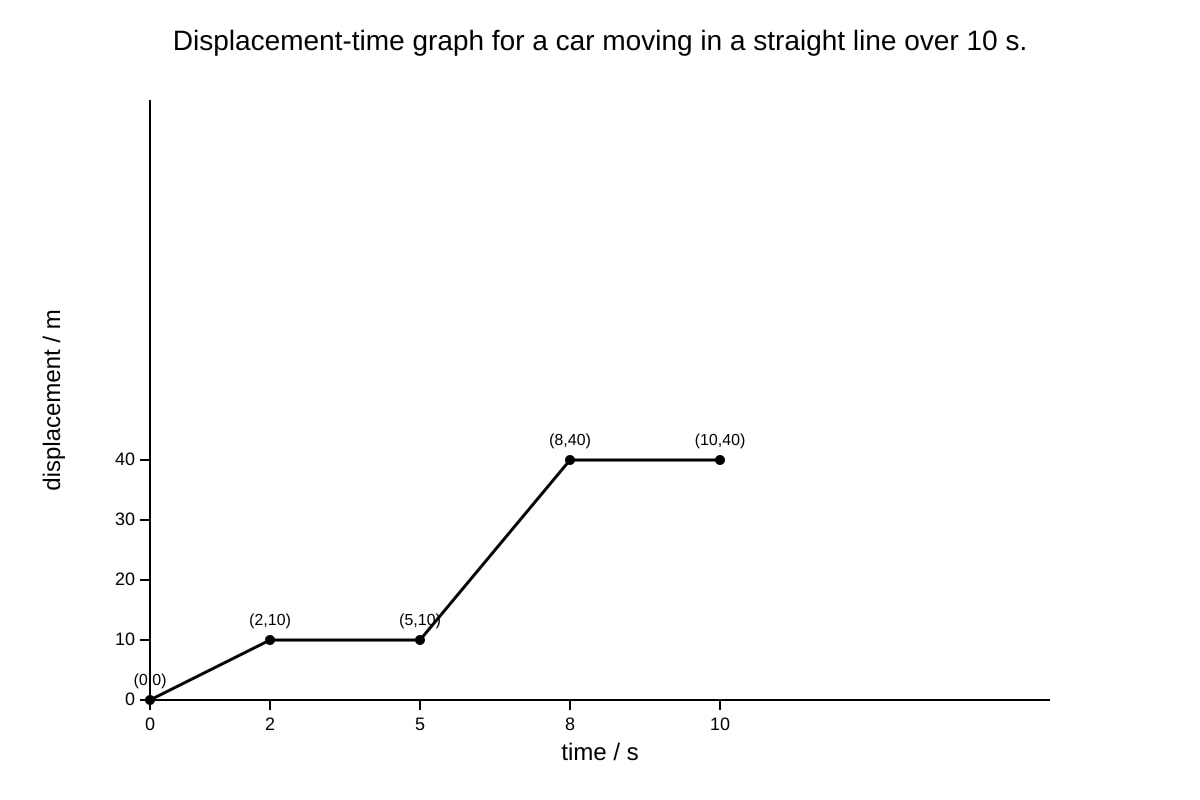
1. A car travels along a straight road. Its displacement–time graph is shown below.
Image pending generation: graph for Q1.
(a) State the displacement of the car at t=5 s. [1]
(b) Calculate the average velocity between t=5 s and t=8 s. [2]
2. Define acceleration. [1]
3. A ball is released from rest and falls freely with acceleration g=9.8 m s−2. Calculate the distance fallen after 3.0 s. [2]
4. A train accelerates uniformly from 10 m s−1 to 25 m s−1 over 30 s. Determine the acceleration. [2]
5. State Newton’s first law of motion. [1]
6. A block of mass 4.0 kg is pulled horizontally by a force of 20 N on a smooth surface. Calculate the acceleration of the block. [2]
7. Describe the motion of an object when the net force acting on it is zero. [2]
8. A resultant force of 12 N acts on a 3.0 kg mass for 4.0 s. The mass is initially at rest.
(a) Calculate the final velocity. [2]
(b) Calculate the momentum gained. [2]
Section B: Energy, Work & Power (Questions 9–14) [18 marks]
9. Write down the equation for kinetic energy in terms of mass m and speed v. [1]
10. A 2.0 kg object moves at 6.0 m s−1. Calculate its kinetic energy. [2]
11. Define work done by a force. [1]
12. A crane lifts a 500 N load vertically by 12 m in 20 s.
(a) Calculate the work done. [2]
(b) Calculate the power output. [2]
13. A spring obeys Hooke’s law with spring constant k=80 N m−1. It is stretched by 0.10 m. Calculate the elastic potential energy stored. [2]
14. Explain why the efficiency of a real machine is always less than 100%. [2]
Section C: Moments, Momentum & Circular Motion (Questions 15–20) [18 marks]
15. State the principle of conservation of linear momentum. [2]
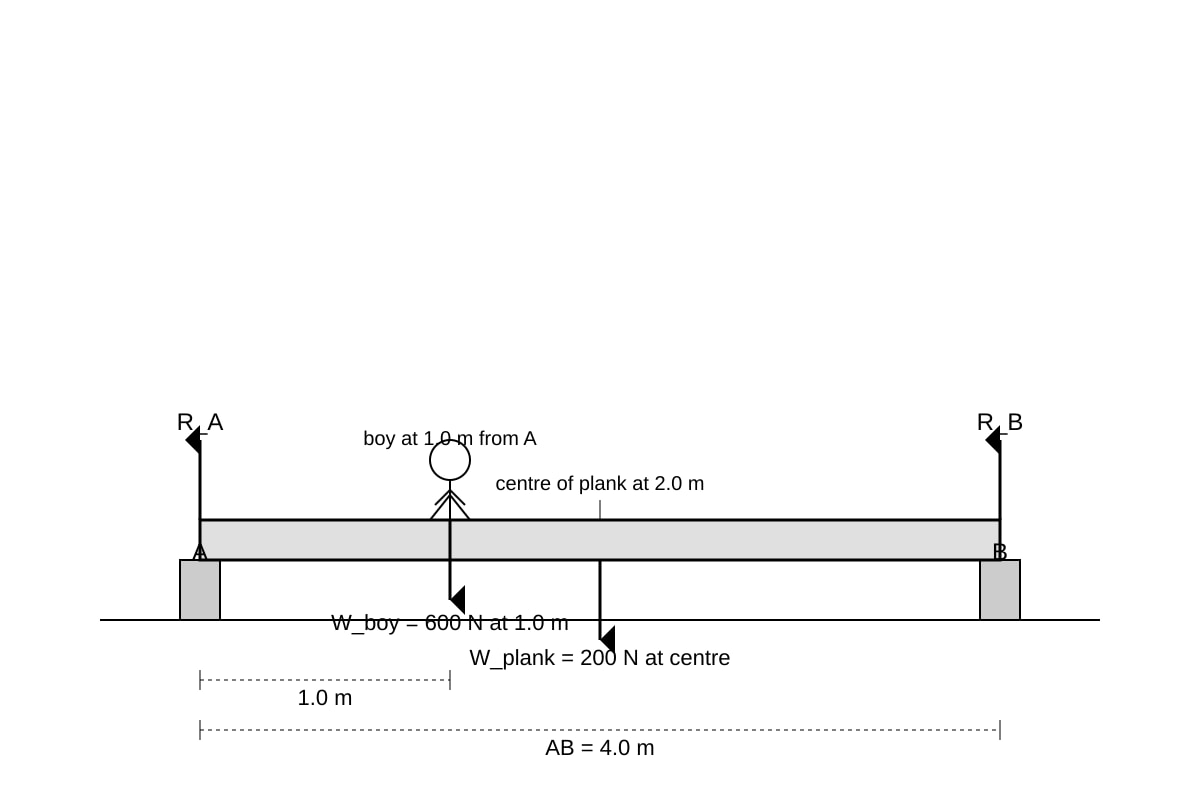
16. A uniform plank AB of length 4.0 m and weight 200 N rests on two supports at A and B. A boy of weight 600 N stands 1.0 m from A.
Image pending generation: diagram for Q16.
(a) Draw and label all forces acting on the plank. [2]
(b) Calculate the reaction force at support B. [3]
17. A 0.20 kg ball moving at 5.0 m s−1 collides with a stationary 0.30 kg ball. After collision the 0.20 kg ball moves at 2.0 m s−1 in the same direction. Calculate the velocity of the 0.30 kg ball after collision. [3]
18. Distinguish between elastic and inelastic collisions. [2]
19. A mass of 0.50 kg is whirled in a horizontal circle of radius 0.80 m at constant speed 4.0 m s−1. Calculate the centripetal force required. [3]
20. A satellite orbits Earth at constant speed in a circular path. Explain why it is accelerating even though its speed is constant. [2]
Answers
TuitionGoWhere Exam Practice (AI) — Physics H1 A-Level
Practice Paper: Mechanics (Version 2 of 5) — Answer Key
Total Marks: 60
Duration: 1 hour 15 minutes
Section A: Kinematics & Dynamics
1. (a) Displacement at t=5 s is 10 m. [1]
Teaching note: From graph flat section between 2 s and 5 s at 10 m.
(b) Average velocity = timedisplacement change = 8−540−10 = 330 = 10 m s−1. [2]
M1 for correct formula, M1 for correct value with unit.
2. Acceleration is the rate of change of velocity with time. [1]
Accept: a=dtdv.
3. s=21gt2 = 21(9.8)(3.0)2 = 44.1 m. [2]
M1 formula, M1 substitution & answer.
4. a=tv−u = 3025−10 = 0.50 m s−2. [2]
5. An object remains at rest or in uniform motion in a straight line unless acted on by a resultant external force. [1]
6. a=mF = 4.020 = 5.0 m s−2. [2]
7. It remains at rest or continues to move with constant velocity (no acceleration). [2]
B1 constant speed, B1 straight line / no change in motion.
8. (a) v=u+at, a=F/m=12/3=4 m s−2, v=0+4×4=16 m s−1. [2]
(b) Δp=mv−0=3.0×16=48 kg m s−1 (or N·s). [2]
Section B: Energy, Work & Power
9. Ek=21mv2. [1]
10. Ek=21(2.0)(6.0)2 = 36 J. [2]
11. Work done = force × displacement in direction of force. [1]
12. (a) W=Fd=500×12=6000 J. [2]
(b) P=W/t=6000/20=300 W. [2]
13. E=21kx2 = 21(80)(0.10)2 = 0.40 J. [2]
14. Some input energy is dissipated as heat/ sound due to friction/ air resistance, so useful output < input. [2]
Section C: Moments, Momentum & Circular Motion
15. In a closed system with no external force, total linear momentum is conserved (constant). [2]
B1 closed/isolated system, B1 momentum constant.
16. (a) Forces: RA up at A, RB up at B, 200 N down at centre (2.0 m), 600 N down at 1.0 m from A. [2]
(b) Take moments about A:
RB×4.0=200×2.0+600×1.0
RB=(400+600)/4=250 N. [3]
M1 moments equation, M1 substitution, M1 answer.
17. Conservation of momentum:
0.20×5.0=0.20×2.0+0.30×v
1.0=0.4+0.30v⇒v=2.0 m s−1. [3]
18. Elastic: KE conserved; inelastic: KE not conserved (some lost). [2]
19. F=rmv2 = 0.800.50×(4.0)2 = 10 N. [3]
20. Direction of velocity changes continuously, so velocity changes → acceleration exists (centripetal). [2]
Mark totals: Section A 24, B 18, C 18 → Total 60. All questions answered, notations SI, images specified.
Free quiz and exam paper access
Enter your details to view this paper
Your access is remembered on this device.