From Real Exams Exam Paper
A Level H1 Physics Practice Paper 1
Free A Level H1 Physics Practice Paper 1, HY3 Exam version, with questions, answers, and A Level-style practice for Singapore students.
These static practice materials are generated from the site's syllabus and paper-generation workflow, with source and model context shown so students and parents can evaluate the material before use.
Questions
TuitionGoWhere Exam Practice (AI) — Physics H1 A-Level
Practice Paper: Mechanics (Version 1 of 5)
School: TuitionGoWhere Exam Practice (AI)
Subject: Physics H1
Level: A-Level
Paper: Practice Paper (Mechanics Topic Quiz)
Version: 1 of 5
Duration: 75 minutes
Total Marks: 60
Name: ________________________
Class: ________________________
Date: ________________________
Instructions:
- Answer all questions in the spaces provided.
- Show all working clearly. Use SI units and appropriate notation.
- For calculation questions, unsupported final answers may receive reduced credit.
- Section A: Short structured questions (1–10). Section B: Data and graph interpretation (11–15). Section C: Extended mechanics reasoning (16–20).
Section A: Short Structured Questions (22 marks)
1. State the principle of conservation of linear momentum. [2]
2. Write down, in terms of mass m and velocity v: (a) the linear momentum p; [1] (b) the kinetic energy K. [1]
(a) ____________________
(b) ____________________
3. A drone has a horizontal momentum of 12 N⋅s and kinetic energy of 24 J. Calculate the mass and speed of the drone. [3]
4. Define the moment of a force about a point. [2]
5. A uniform rod AB of length 4.0 m and weight 80 N rests on two smooth supports at A and B. A child of weight 40 N stands 1.0 m from A. Draw a labelled diagram showing all forces acting on the rod. [3]
6. A car accelerates uniformly from rest to 20 m s−1 in 10 s. Calculate its acceleration. [2]
7. State Newton’s first law of motion. [2]
8. A block of mass 2.0 kg is pulled along a horizontal surface by a constant force of 10 N. If frictional resistance is 4.0 N, calculate the acceleration of the block. [2]
9. A projectile is launched horizontally from a cliff of height 45 m with speed 30 m s−1. Calculate the time taken to reach the ground. (Use g=9.8 m s−2.) [2]
10. State the condition for a body to be in translational equilibrium. [2]
Section B: Data and Graph Interpretation (18 marks)
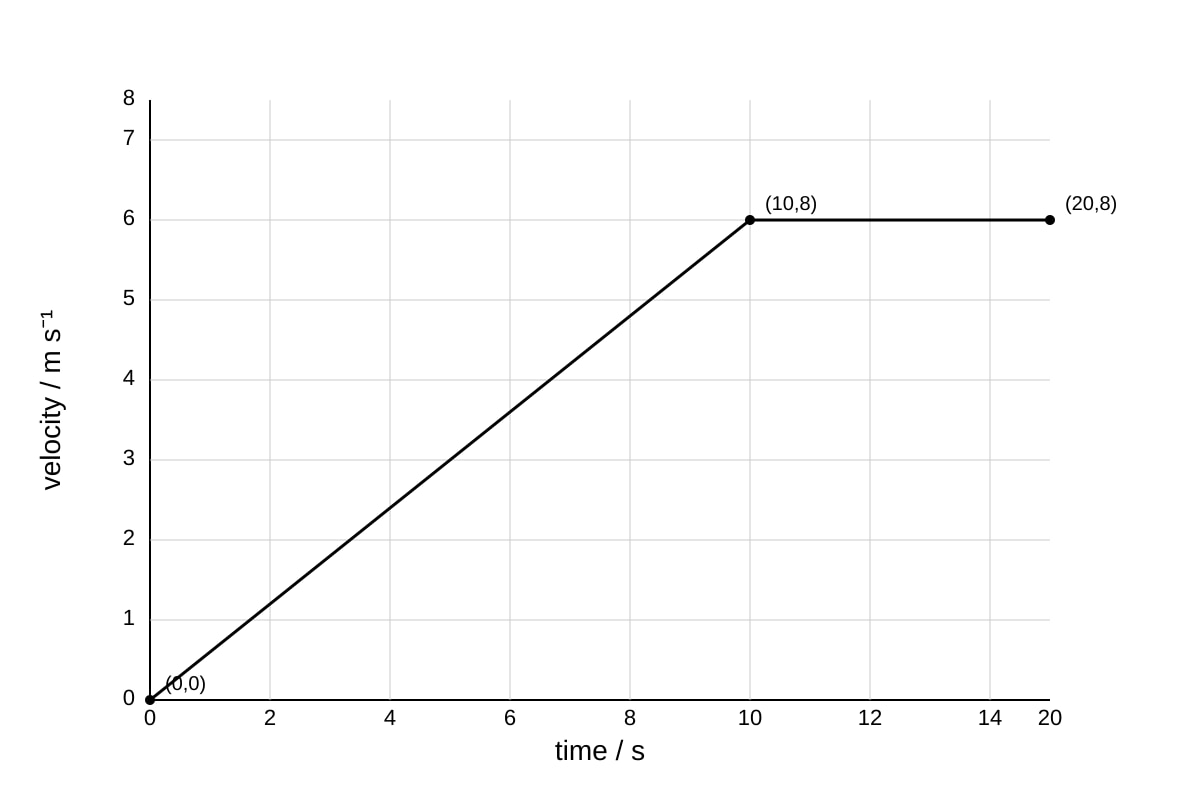
11. The velocity–time graph below shows the motion of a cyclist.
Image pending generation: graph for Q11.
(a) Calculate the acceleration during the first 10 s. [2]
(b) Determine the total distance travelled in 20 s. [2]
(a) ____________________
(b) ____________________
12. A ball of mass 0.50 kg moving at 6.0 m s−1 collides head-on with a stationary ball of mass 0.30 kg. After collision the 0.50 kg ball moves at 2.0 m s−1 in the same direction. Calculate the velocity of the 0.30 kg ball after collision. [3]
13. The table shows force F against extension x for a spring.
| x / mm | 0 | 10 | 20 | 30 | 40 |
|---|---|---|---|---|---|
| F / N | 0 | 2 | 4 | 6 | 8 |
(a) State Hooke’s law as applied to this spring. [1]
(b) Determine the spring constant k in N m−1. [2]
(a) ____________________
(b) ____________________
14. A uniform plank of length 5.0 m and weight 100 N is supported at its ends. A box of weight 50 N is placed 2.0 m from the left support. Calculate the reaction force at the right support. [3]
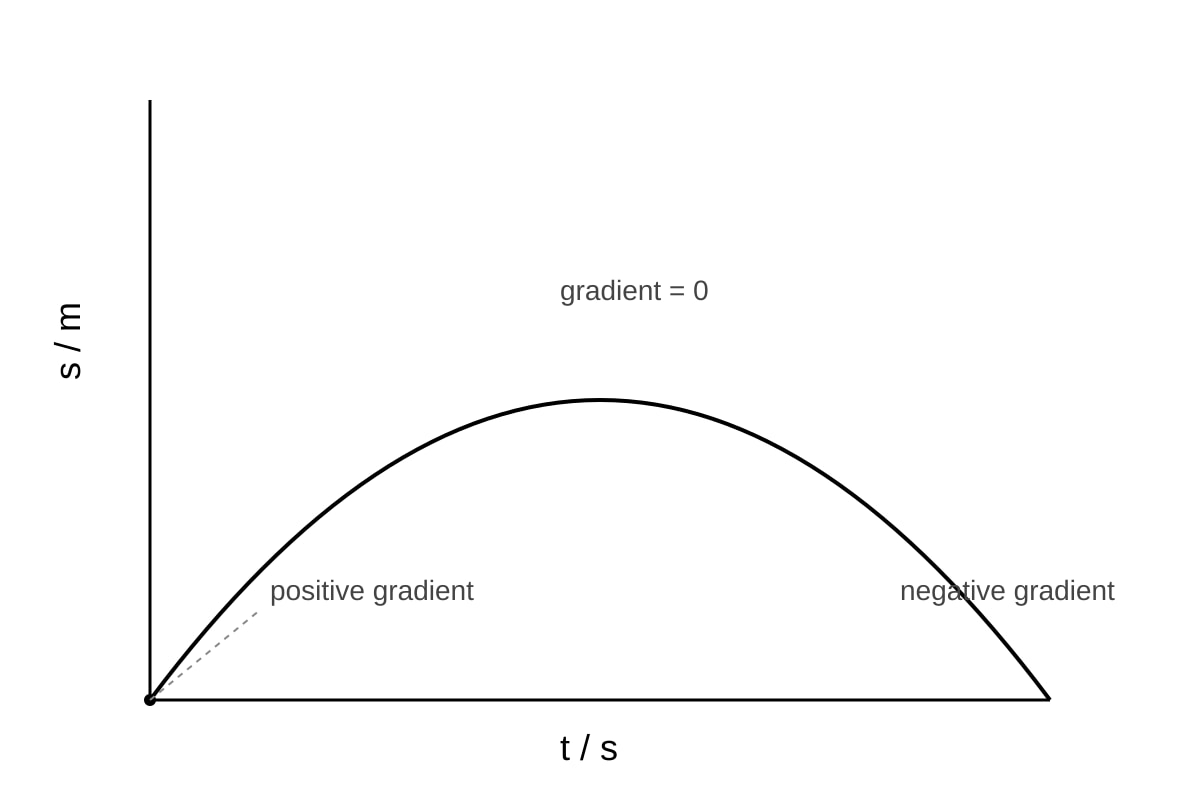
15. Sketch a displacement–time graph for an object moving with constant negative acceleration from an initial positive velocity. [3]
Image pending generation: graph for Q15.
Section C: Extended Mechanics Reasoning (20 marks)
16. Explain why a person jumping from a boat causes the boat to move backwards, using the principle of conservation of momentum. [4]
17. A car of mass 1200 kg travelling at 15 m s−1 is brought to rest by a constant braking force of 3000 N. (a) Calculate the deceleration. [2] (b) Calculate the stopping distance. [2] (c) State one assumption made. [1]
(a) ____________________
(b) ____________________
(c) ____________________
18. Describe how you would determine the centre of gravity of an irregular lamina using a plumb line. [4]
19. A satellite orbits Earth at constant speed in a circular path. Explain why its velocity is changing even though its speed is constant, and name the force providing the centripetal acceleration. [4]
20. A block of mass m is released from rest at the top of a frictionless incline of height h. Derive an expression for its speed at the bottom using conservation of energy. [5]
Answers
TuitionGoWhere Exam Practice (AI) — Physics H1 A-Level
Practice Paper: Mechanics (Version 1 of 5) — Answer Key
Total Marks: 60
Section A Answers (22 marks)
Q1. [2]
Principle: In a closed (or isolated) system, the total linear momentum remains constant. [B1]
Provided no net external force acts on the system. [B1]
Teaching note: Momentum is a vector; "closed system" means no external forces. Do not confuse with energy conservation.
Q2. [2 total: (a) 1, (b) 1]
(a) p=mv [1]
(b) K=21mv2 [1]
Common trap: Omitting 21 in kinetic energy.
Q3. [3]
Given p=12 N⋅s, K=24 J.
Use K=2mp2⇒m=2Kp2=2×24122=48144=3.0 kg [M1+ A1]
Then v=mp=3.012=4.0 m s−1 [M1+ A1]
Marking: 1 for correct formula rearrangement, 1 for mass, 1 for velocity.
Q4. [2]
The moment of a force about a point is the product of the force and the perpendicular distance from the point to the line of action of the force. [B1]
Unit: N·m. [B1]
Note: Must mention perpendicular distance.
Q5. [3]
Forces: weight of rod 80 N downward at centre (2.0 m from A); weight of child 40 N downward at 1.0 m from A; reaction RA upward at A; reaction RB upward at B. [3]
Marking: 1 for rod weight at centre, 1 for child weight position, 1 for two reactions.
Q6. [2]
a=tv−u=1020−0=2.0 m s−2 [2]
Working: substitution and answer.
Q7. [2]
A body remains at rest or in uniform motion in a straight line unless acted upon by a net external force. [2]
Q8. [2]
Net force = 10−4=6 N.
a=mF=2.06=3.0 m s−2 [2]
Q9. [2]
Vertical motion: s=21gt2⇒45=21(9.8)t2⇒t2=9.890=9.18⇒t=3.0 s [2]
Q10. [2]
The resultant force on the body is zero (vector sum of all forces = 0). [2]
Section B Answers (18 marks)
Q11. [4 total: (a) 2, (b) 2]
(a) a=ΔtΔv=108−0=0.8 m s−2 [2]
(b) Distance = area under graph = triangle + rectangle = 21(10)(8)+(10)(8)=40+80=120 m [2]
Image needed: graph with axes as described; area calculation verified visually.
Q12. [3]
Conservation of momentum: m1u1+m2u2=m1v1+m2v2
0.50(6.0)+0=0.50(2.0)+0.30v2
3.0=1.0+0.30v2⇒0.30v2=2.0⇒v2=6.67 m s−1 [3]
Marking: 1 equation, 1 substitution, 1 answer.
Q13. [3 total: (a) 1, (b) 2]
(a) Extension proportional to force applied (within limit). [1]
(b) k=xF=0.010 m2 N=200 N m−1 (using any point). [2]
Q14. [3]
Take moments about left support: RR×5.0=100×2.5+50×2.0
RR×5=250+100=350⇒RR=70 N [3]
Marking: 1 moments eqn, 1 calc, 1 answer.
Q15. [3]
Sketch: downward-opening parabola, starts at origin with positive slope, reaches max then decreases. Axes labelled t and s. [3]
Image: see placeholder; shape must show decreasing gradient to zero then negative.
Section C Answers (20 marks)
Q16. [4]
Initially total momentum = 0. [1]
Person pushes boat backward as they jump forward. [1]
Momentum before = momentum after: mpvp+mbvb=0. [1]
Hence boat gains opposite momentum. [1]
Q17. [5 total: (a) 2, (b) 2, (c) 1]
(a) a=mF=1200−3000=−2.5 m s−2 (deceleration 2.5). [2]
(b) v2=u2+2as⇒0=152+2(−2.5)s⇒s=45 m. [2]
(c) e.g. constant braking force, level road. [1]
Q18. [4]
Suspend lamina from a point, mark vertical line via plumb line. [1]
Repeat from another point. [1]
Intersection of lines is centre of gravity. [1]
State rationale: body balances at CoG. [1]
Q19. [4]
Velocity changes because direction changes continuously. [2]
Force: gravitational (or gravity). [2]
Q20. [5]
PE at top = mgh. [1]
KE at bottom = 21mv2. [1]
Conservation: mgh=21mv2. [1]
Cancel m: gh=21v2. [1]
v=2gh. [1]
Free quiz and exam paper access
Enter your details to view this paper
Your access is remembered on this device.