AI Generated Quiz
A Level H2 Mathematics Geometry Trigonometry Quiz
Free A Level H2 Maths Geometry Trigonometry quiz, AI version, with questions, answers, and A Level-style practice for Singapore students.
These static practice materials are generated from the site's syllabus and paper-generation workflow, with source and model context shown so students and parents can evaluate the material before use.
Questions
Free quiz and exam paper access
Enter your details to view this paper
Your access is remembered on this device.
Answers
A-Level Maths H2 Quiz - Geometry Trigonometry: Answer Key
Total Marks: 100
Section A: Trigonometric Functions and Identities (Questions 1–5, 25 marks)
1. [5 marks] (a) Amplitude = 3, Period = π. (b) Range: -2 ≤ f(x) ≤ 4. (c) 3 sin(2x) + 1 = 4 ⇒ sin(2x) = 1 ⇒ 2x = π/2 + 2nπ ⇒ x = π/4 + nπ. Smallest positive value: x = π/4.
Marking Notes:
- (a) 1 mark for amplitude, 1 mark for period.
- (b) 1 mark for correct range.
- (c) 1 mark for correct equation, 1 mark for correct smallest positive value.
Teaching Notes:
- The amplitude of a sin(bx) + c is |a|. The period is 2π/|b|.
- The range is [c - |a|, c + |a|].
- To solve f(x) = 4, set 3 sin(2x) + 1 = 4, then sin(2x) = 1. The general solution for sin θ = 1 is θ = π/2 + 2nπ. Here θ = 2x, so x = π/4 + nπ. The smallest positive value is π/4.
2. [5 marks] Proof: [ \frac{\sin 2\theta}{1 + \cos 2\theta} = \frac{2\sin\theta\cos\theta}{1 + (2\cos^2\theta - 1)} = \frac{2\sin\theta\cos\theta}{2\cos^2\theta} = \frac{\sin\theta}{\cos\theta} = \tan\theta ]
Marking Notes:
- 1 mark for using sin 2θ = 2 sin θ cos θ.
- 1 mark for using cos 2θ = 2 cos²θ - 1.
- 1 mark for correct simplification of denominator.
- 1 mark for cancelling 2 cos θ.
- 1 mark for concluding tan θ.
Teaching Notes:
- Key double-angle identities: sin 2θ = 2 sin θ cos θ, cos 2θ = 2 cos²θ - 1 = 1 - 2 sin²θ.
- The denominator 1 + cos 2θ becomes 1 + (2 cos²θ - 1) = 2 cos²θ.
- Then the fraction simplifies to (2 sin θ cos θ) / (2 cos²θ) = sin θ / cos θ = tan θ.
3. [5 marks] 2 cos²x + 3 sin x = 3 2(1 - sin²x) + 3 sin x = 3 2 - 2 sin²x + 3 sin x = 3 -2 sin²x + 3 sin x - 1 = 0 2 sin²x - 3 sin x + 1 = 0 (2 sin x - 1)(sin x - 1) = 0 sin x = 1/2 or sin x = 1 For sin x = 1/2: x = 30°, 150° For sin x = 1: x = 90° Solutions: x = 30°, 90°, 150°
Marking Notes:
- 1 mark for using cos²x = 1 - sin²x.
- 1 mark for forming quadratic in sin x.
- 1 mark for solving quadratic correctly.
- 1 mark for finding sin x = 1/2 and sin x = 1.
- 1 mark for all three correct solutions.
Teaching Notes:
- Use the identity cos²x + sin²x = 1 to replace cos²x.
- Rearrange to get a quadratic equation in sin x.
- Factorise or use the quadratic formula.
- Solve sin x = 1/2 and sin x = 1 for x in the given range.
- Remember that sin x = 1/2 has two solutions in 0° to 360°: 30° and 150°.
4. [5 marks] R = √(5² + 12²) = √(25 + 144) = √169 = 13 α = tan⁻¹(12/5) ≈ 67.38° So 5 cos θ - 12 sin θ = 13 cos(θ + 67.38°) Equation: 13 cos(θ + 67.38°) = 13 ⇒ cos(θ + 67.38°) = 1 θ + 67.38° = 360°n ⇒ θ = 360°n - 67.38° For 0° ≤ θ ≤ 360°: θ = 292.6° (when n = 1)
Marking Notes:
- 1 mark for correct R.
- 1 mark for correct α.
- 1 mark for correct expression.
- 1 mark for solving cos(θ + α) = 1.
- 1 mark for correct solution in range.
Teaching Notes:
- The form R cos(θ + α) is used when the expression is a cos θ - b sin θ.
- R = √(a² + b²) and α = tan⁻¹(b/a).
- The equation becomes R cos(θ + α) = 13, so cos(θ + α) = 1.
- The general solution for cos θ = 1 is θ = 360°n.
- Find the value of n that gives a solution in the required range.
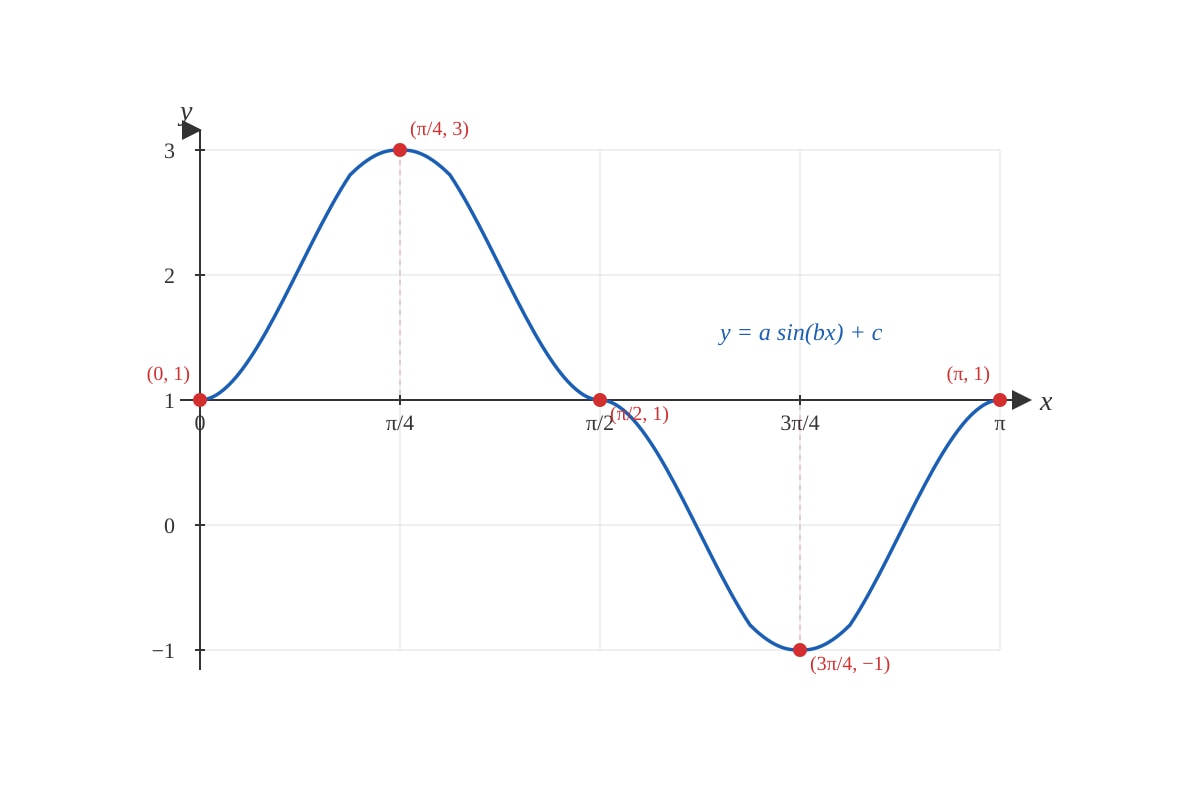
5. [5 marks] From the graph:
- Maximum = 3, minimum = -1.
- Amplitude a = (3 - (-1))/2 = 2.
- Vertical shift c = (3 + (-1))/2 = 1.
- Period = π, so 2π/b = π ⇒ b = 2. Therefore, a = 2, b = 2, c = 1.
Marking Notes:
- 1 mark for identifying amplitude.
- 1 mark for correct a.
- 1 mark for correct c.
- 1 mark for identifying period.
- 1 mark for correct b.
Teaching Notes:
- The amplitude is half the difference between the maximum and minimum values.
- The vertical shift is the average of the maximum and minimum values.
- The period is the horizontal distance between two consecutive peaks or troughs.
- The period of a sin(bx) + c is 2π/b.
Section B: Trigonometric Equations and Applications (Questions 6–10, 25 marks)
6. [5 marks] tan 2x = √3 2x = 60° + 180°n x = 30° + 90°n For 0° ≤ x ≤ 180°: x = 30°, 120°
Marking Notes:
- 1 mark for finding the basic angle.
- 1 mark for general solution of tan.
- 1 mark for dividing by 2.
- 1 mark for x = 30°.
- 1 mark for x = 120°.
Teaching Notes:
- The general solution for tan θ = k is θ = tan⁻¹(k) + 180°n.
- Here θ = 2x, so 2x = 60° + 180°n.
- Divide by 2: x = 30° + 90°n.
- Substitute n = 0, 1, 2, ... to find solutions in the given range.
7. [5 marks] The auxiliary equation is m² + 4 = 0 ⇒ m = ±2i. General solution: y = A cos 2x + B sin 2x. Given y(0) = 2: A = 2. y' = -2A sin 2x + 2B cos 2x. Given y'(0) = 4: 2B = 4 ⇒ B = 2. Therefore, y = 2 cos 2x + 2 sin 2x.
Marking Notes:
- 1 mark for correct auxiliary equation.
- 1 mark for correct general solution.
- 1 mark for using y(0) = 2.
- 1 mark for differentiating correctly.
- 1 mark for using y'(0) = 4.
Teaching Notes:
- For a second-order linear differential equation d²y/dx² + ω²y = 0, the auxiliary equation is m² + ω² = 0.
- The roots are complex: m = ±iω.
- The general solution is y = A cos ωx + B sin ωx.
- Use the initial conditions to find A and B.
8. [5 marks] (a) R = √(3² + 4²) = 5. α = tan⁻¹(4/3) ≈ 0.9273 rad. So s = 5 cos(2t - 0.9273). (b) Maximum displacement = R = 5 m.
Marking Notes:
- 1 mark for correct R.
- 1 mark for correct α.
- 1 mark for correct expression.
- 1 mark for identifying maximum as R.
- 1 mark for correct answer.
Teaching Notes:
- The form R cos(2t - α) is used for a cos 2t + b sin 2t.
- R = √(a² + b²) and α = tan⁻¹(b/a).
- The maximum value of R cos(θ) is R, which occurs when cos(θ) = 1.
9. [5 marks] Proof: [ \cot A - \tan A = \frac{\cos A}{\sin A} - \frac{\sin A}{\cos A} = \frac{\cos^2 A - \sin^2 A}{\sin A \cos A} = \frac{\cos 2A}{\frac{1}{2}\sin 2A} = 2\cot 2A ]
Marking Notes:
- 1 mark for writing in terms of sin and cos.
- 1 mark for combining fractions.
- 1 mark for using cos²A - sin²A = cos 2A.
- 1 mark for using sin A cos A = (1/2) sin 2A.
- 1 mark for simplifying to 2 cot 2A.
Teaching Notes:
- Write cot A = cos A / sin A and tan A = sin A / cos A.
- Combine the fractions over a common denominator.
- Use the double-angle identities: cos²A - sin²A = cos 2A and 2 sin A cos A = sin 2A.
- Simplify to get 2 cot 2A.
10. [5 marks] 3 sin²x - 2 cos x - 2 = 0 3(1 - cos²x) - 2 cos x - 2 = 0 3 - 3 cos²x - 2 cos x - 2 = 0 -3 cos²x - 2 cos x + 1 = 0 3 cos²x + 2 cos x - 1 = 0 (3 cos x - 1)(cos x + 1) = 0 cos x = 1/3 or cos x = -1 For cos x = 1/3: x = 70.5°, 289.5° For cos x = -1: x = 180° Solutions: x = 70.5°, 180°, 289.5°
Marking Notes:
- 1 mark for using sin²x = 1 - cos²x.
- 1 mark for forming quadratic in cos x.
- 1 mark for solving quadratic correctly.
- 1 mark for finding cos x = 1/3 and cos x = -1.
- 1 mark for all three correct solutions.
Teaching Notes:
- Use the identity sin²x + cos²x = 1 to replace sin²x.
- Rearrange to get a quadratic equation in cos x.
- Factorise or use the quadratic formula.
- Solve cos x = 1/3 and cos x = -1 for x in the given range.
- Remember that cos x = 1/3 has two solutions in 0° to 360°: one in the first quadrant and one in the fourth quadrant.
Section C: Geometry of Triangles and Circles (Questions 11–15, 25 marks)
11. [5 marks] Using the cosine rule: AC² = AB² + BC² - 2(AB)(BC) cos(∠ABC) AC² = 8² + 10² - 2(8)(10) cos 60° AC² = 64 + 100 - 160(1/2) AC² = 164 - 80 = 84 AC = √84 = 2√21 ≈ 9.17 cm
Marking Notes:
- 1 mark for correct formula.
- 1 mark for correct substitution.
- 1 mark for correct calculation.
- 1 mark for correct simplification.
- 1 mark for correct final answer.
Teaching Notes:
- The cosine rule: a² = b² + c² - 2bc cos A, where a is the side opposite angle A.
- Here, AC is opposite angle B, so AC² = AB² + BC² - 2(AB)(BC) cos B.
- cos 60° = 1/2.
12. [5 marks] Using Heron's formula: s = (12 + 15 + 20)/2 = 47/2 = 23.5 cm Area = √[s(s-a)(s-b)(s-c)] Area = √[23.5(23.5-12)(23.5-15)(23.5-20)] Area = √[23.5 × 11.5 × 8.5 × 3.5] Area = √(23.5 × 11.5 × 8.5 × 3.5) Area = √(8043.4375) ≈ 89.7 cm²
Marking Notes:
- 1 mark for correct semi-perimeter.
- 1 mark for correct formula.
- 1 mark for correct substitution.
- 1 mark for correct calculation.
- 1 mark for correct final answer.
Teaching Notes:
- Heron's formula: Area = √[s(s-a)(s-b)(s-c)], where s = (a+b+c)/2.
- This is useful when you know all three sides of a triangle but no angles.
- Alternatively, you could use the cosine rule to find an angle and then use Area = (1/2)ab sin C.
13. [5 marks] Using the chord length formula: Chord length = 2r sin(θ/2) Chord length = 2(5) sin(120°/2) Chord length = 10 sin 60° Chord length = 10(√3/2) = 5√3 ≈ 8.66 cm
Marking Notes:
- 1 mark for correct formula.
- 1 mark for correct substitution.
- 1 mark for correct angle.
- 1 mark for correct calculation.
- 1 mark for correct final answer.
Teaching Notes:
- The length of a chord subtending an angle θ at the centre of a circle of radius r is 2r sin(θ/2).
- This comes from the isosceles triangle formed by the two radii and the chord.
- sin 60° = √3/2.
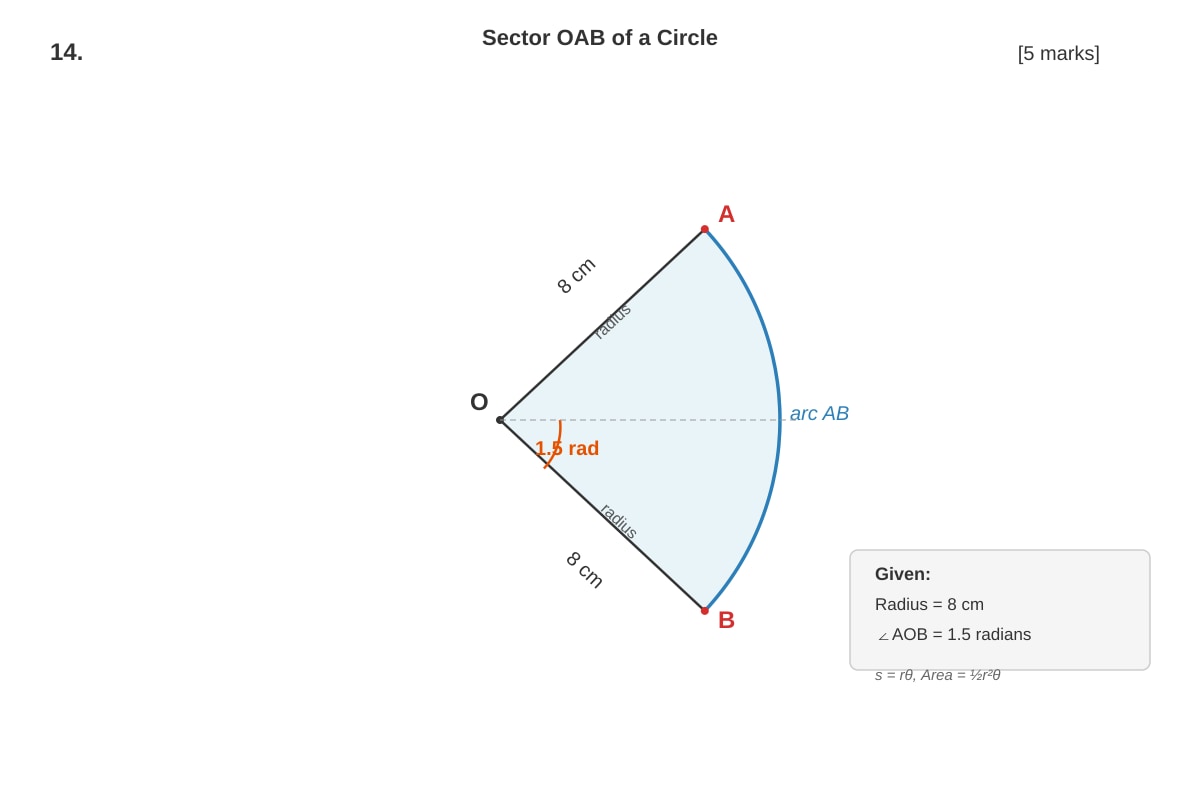
14. [5 marks] (a) Arc length = rθ = 8 × 1.5 = 12 cm. (b) Area of sector = (1/2)r²θ = (1/2)(8²)(1.5) = (1/2)(64)(1.5) = 48 cm².
Marking Notes:
- (a) 2 marks for correct formula and answer.
- (b) 3 marks for correct formula and answer.
Teaching Notes:
- For a sector with angle θ radians: arc length = rθ, area = (1/2)r²θ.
- These formulas are simpler than the degree versions because radians are natural units for circular measure.
- Always check that the angle is in radians when using these formulas.
15. [5 marks] Angle Z = 180° - 40° - 70° = 70°. Using the sine rule: XZ / sin Y = XY / sin Z XZ / sin 70° = 10 / sin 70° XZ = 10 cm
Marking Notes:
- 1 mark for finding angle Z.
- 1 mark for correct sine rule formula.
- 1 mark for correct substitution.
- 1 mark for correct calculation.
- 1 mark for correct final answer.
Teaching Notes:
- The sum of angles in a triangle is 180°.
- The sine rule: a/sin A = b/sin B = c/sin C.
- Here, XZ is opposite angle Y (70°), and XY is opposite angle Z (70°). Since the angles are equal, the sides are equal.
Section D: Advanced Trigonometry and Geometry (Questions 16–20, 25 marks)
16. [5 marks] sin 3x = cos 2x sin 3x = sin(90° - 2x) 3x = 90° - 2x + 360°n or 3x = 180° - (90° - 2x) + 360°n 5x = 90° + 360°n or 3x = 90° + 2x + 360°n x = 18° + 72°n or x = 90° + 360°n For 0° ≤ x ≤ 360°: From x = 18° + 72°n: x = 18°, 90°, 162°, 234°, 306° From x = 90° + 360°n: x = 90° Solutions: x = 18°, 90°, 162°, 234°, 306°
Marking Notes:
- 1 mark for converting cos to sin.
- 1 mark for first general solution.
- 1 mark for second general solution.
- 1 mark for finding all solutions from first set.
- 1 mark for correct final set.
Teaching Notes:
- Use the identity cos θ = sin(90° - θ).
- The general solution for sin A = sin B is A = B + 360°n or A = 180° - B + 360°n.
- Solve each equation for x.
- Find all values of x in the given range.
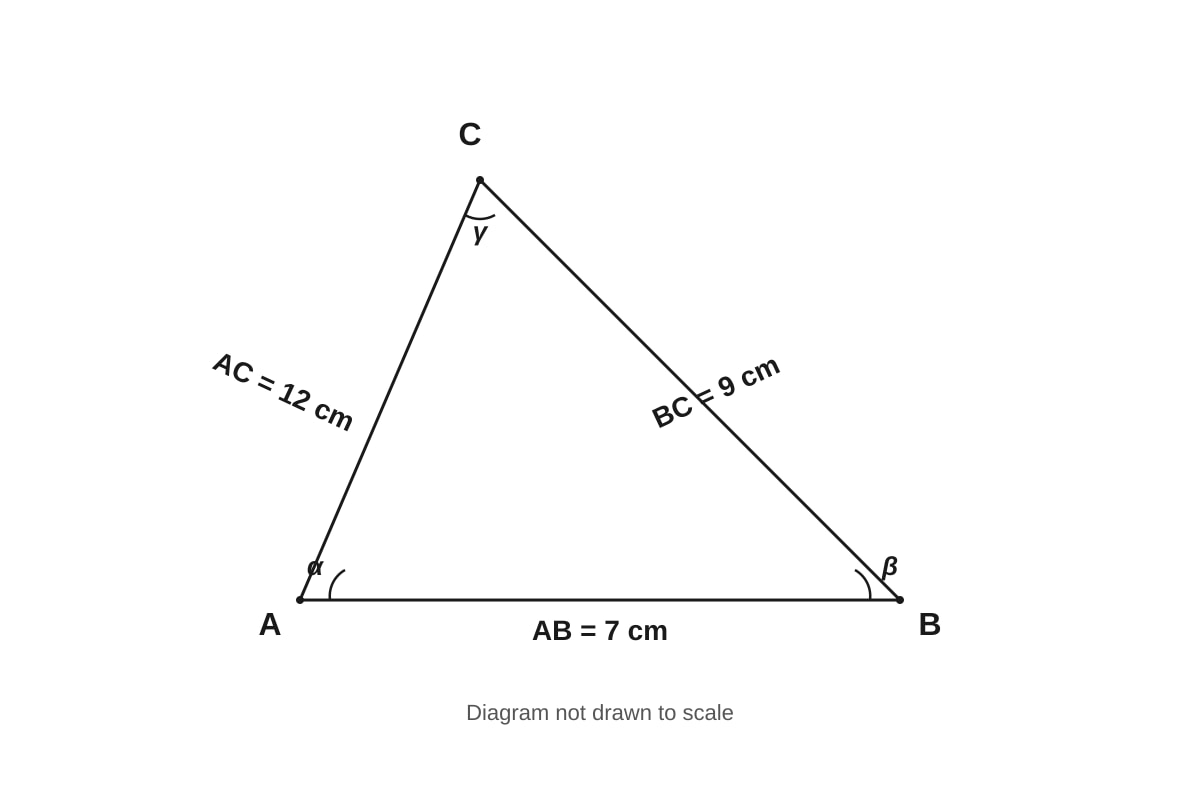
17. [5 marks] The largest angle is opposite the longest side, which is AC = 12 cm. Using the cosine rule: cos B = (AB² + BC² - AC²) / (2 × AB × BC) cos B = (7² + 9² - 12²) / (2 × 7 × 9) cos B = (49 + 81 - 144) / 126 cos B = (-14) / 126 = -1/9 B = cos⁻¹(-1/9) ≈ 96.4°
Marking Notes:
- 1 mark for identifying the largest angle.
- 1 mark for correct cosine rule formula.
- 1 mark for correct substitution.
- 1 mark for correct calculation.
- 1 mark for correct final answer.
Teaching Notes:
- The largest angle is opposite the longest side.
- The cosine rule: cos A = (b² + c² - a²) / 2bc, where a is the side opposite angle A.
- A negative cosine indicates an obtuse angle (> 90°).
18. [5 marks] Proof: [ \frac{\sin 3A}{\sin A} - \frac{\cos 3A}{\cos A} = \frac{\sin 3A \cos A - \cos 3A \sin A}{\sin A \cos A} = \frac{\sin(3A - A)}{\sin A \cos A} = \frac{\sin 2A}{\frac{1}{2}\sin 2A} = 2 ]
Marking Notes:
- 1 mark for combining fractions.
- 1 mark for using sin(A-B) formula.
- 1 mark for simplifying numerator.
- 1 mark for using sin A cos A = (1/2) sin 2A.
- 1 mark for final simplification.
Teaching Notes:
- Combine the fractions over a common denominator.
- The numerator is sin 3A cos A - cos 3A sin A = sin(3A - A) = sin 2A.
- The denominator is sin A cos A = (1/2) sin 2A.
- The sin 2A cancels, leaving 2.
19. [5 marks] The tangent to a circle is perpendicular to the radius at the point of tangency. So triangle OPQ is right-angled at P. OP = 10 cm (radius), OQ = 26 cm. Using Pythagoras' theorem: PQ² = OQ² - OP² PQ² = 26² - 10² PQ² = 676 - 100 = 576 PQ = √576 = 24 cm
Marking Notes:
- 1 mark for identifying right angle.
- 1 mark for correct Pythagoras formula.
- 1 mark for correct substitution.
- 1 mark for correct calculation.
- 1 mark for correct final answer.
Teaching Notes:
- The tangent to a circle is perpendicular to the radius at the point of tangency.
- This creates a right-angled triangle with the radius and the tangent as the two shorter sides, and the line from the centre to the external point as the hypotenuse.
- Use Pythagoras' theorem to find the missing side.
20. [5 marks] cos 2x = sin x cos 2x = cos(90° - x) 2x = 90° - x + 360°n or 2x = -(90° - x) + 360°n 3x = 90° + 360°n or 2x = -90° + x + 360°n x = 30° + 120°n or x = -90° + 360°n General solution: x = 30° + 120°n or x = 360°n - 90°
Marking Notes:
- 1 mark for converting sin to cos.
- 1 mark for first general solution.
- 1 mark for second general solution.
- 1 mark for simplifying first equation.
- 1 mark for simplifying second equation.
Teaching Notes:
- Use the identity sin x = cos(90° - x).
- The general solution for cos A = cos B is A = B + 360°n or A = -B + 360°n.
- Solve each equation for x.
- The general solution gives all possible values of x.
End of Answer Key