From Real Exams Quiz
A Level H2 Mathematics Graphs Coordinate Geometry Quiz
Free A Level H2 Maths Graphs Geometry quiz, DeepSeek Exam version, with questions, answers, and A Level-style practice for Singapore students.
These static practice materials are generated from the site's syllabus and paper-generation workflow, with source and model context shown so students and parents can evaluate the material before use.
Questions
Free quiz and exam paper access
Enter your details to view this paper
Your access is remembered on this device.
Answers
A-Level Maths H2 Quiz - Graphs Coordinate Geometry
ANSWER KEY AND MARKING SCHEME
Total Marks: 60
Section A: Graphs and Sketching (Questions 1–5)
1. (y = \dfrac{2x+1}{x-3})
(a) Asymptotes:
Vertical: (x = 3) ✓ [1 mark]
Horizontal: (y = 2) (since (\lim_{x \to \pm\infty} \frac{2x+1}{x-3} = 2)) ✓ [1 mark]
(b) Intercepts:
(y)-intercept: set (x = 0), (y = \frac{1}{-3} = -\frac{1}{3}) → ((0, -\frac{1}{3})) ✓ [1 mark]
(x)-intercept: set (y = 0), (2x + 1 = 0) → (x = -\frac{1}{2}) → ((-\frac{1}{2}, 0)) ✓ [1 mark]
(c) Sketch:
- Vertical asymptote (x = 3) (dashed line) ✓
- Horizontal asymptote (y = 2) (dashed line) ✓
- Intercepts ((0, -\frac{1}{3})) and ((-\frac{1}{2}, 0)) labelled ✓
- Correct shape: two branches, approaching asymptotes correctly ✓ [3 marks]
2. (f(x) = \ln(2x+5)), (x > -\frac{5}{2})
(a) Range: As (x \to -\frac{5}{2}^+), (2x+5 \to 0^+), so (\ln(2x+5) \to -\infty).
As (x \to \infty), (\ln(2x+5) \to \infty).
Range = (\mathbb{R}) or ((-\infty, \infty)) ✓ [1 mark]
(b) Transformations from (y = f(x)) to (y = 2f(x-1)):
- Translation by vector (\begin{pmatrix} 1 \ 0 \end{pmatrix}) (shift right by 1 unit) ✓ [1 mark]
- Stretch parallel to (y)-axis with scale factor 2 ✓ [1 mark]
(c) (x)-intercept of (y = 2f(x-1)):
Set (2f(x-1) = 0) → (f(x-1) = 0)
(\ln(2(x-1)+5) = 0) → (2x - 2 + 5 = 1) → (2x + 3 = 1) → (2x = -2) → (x = -1) ✓
Coordinates: ((-1, 0)) ✓ [2 marks]
3. (x = t^2 - 1), (y = 2t + 1)
(a) From (y = 2t + 1): (t = \frac{y-1}{2}) ✓
Substitute: (x = \left(\frac{y-1}{2}\right)^2 - 1 = \frac{(y-1)^2}{4} - 1) ✓
Multiply by 4: (4x = (y-1)^2 - 4) → ((y-1)^2 = 4x + 4 = 4(x+1))
(y - 1 = \pm 2\sqrt{x+1}) → (y = 1 \pm 2\sqrt{x+1}) ✓ [2 marks]
(b) Domain: (x = t^2 - 1 \geq -1) for all (t \in \mathbb{R}).
Domain: (x \geq -1) ✓ [1 mark]
(c) Sketch:
- Parabola opening to the right, vertex at ((-1, 1)) ✓
- (y)-intercepts: set (x = 0), ((y-1)^2 = 4) → (y-1 = \pm 2) → (y = 3) or (y = -1)
Points: ((0, 3)) and ((0, -1)) ✓ - (x)-intercept: set (y = 0), (1 \pm 2\sqrt{x+1} = 0) → (2\sqrt{x+1} = 1) or (-1) (reject negative)
(\sqrt{x+1} = \frac{1}{2}) → (x+1 = \frac{1}{4}) → (x = -\frac{3}{4})
Point: ((-\frac{3}{4}, 0)) ✓ - Correct shape with both branches ✓ [3 marks]
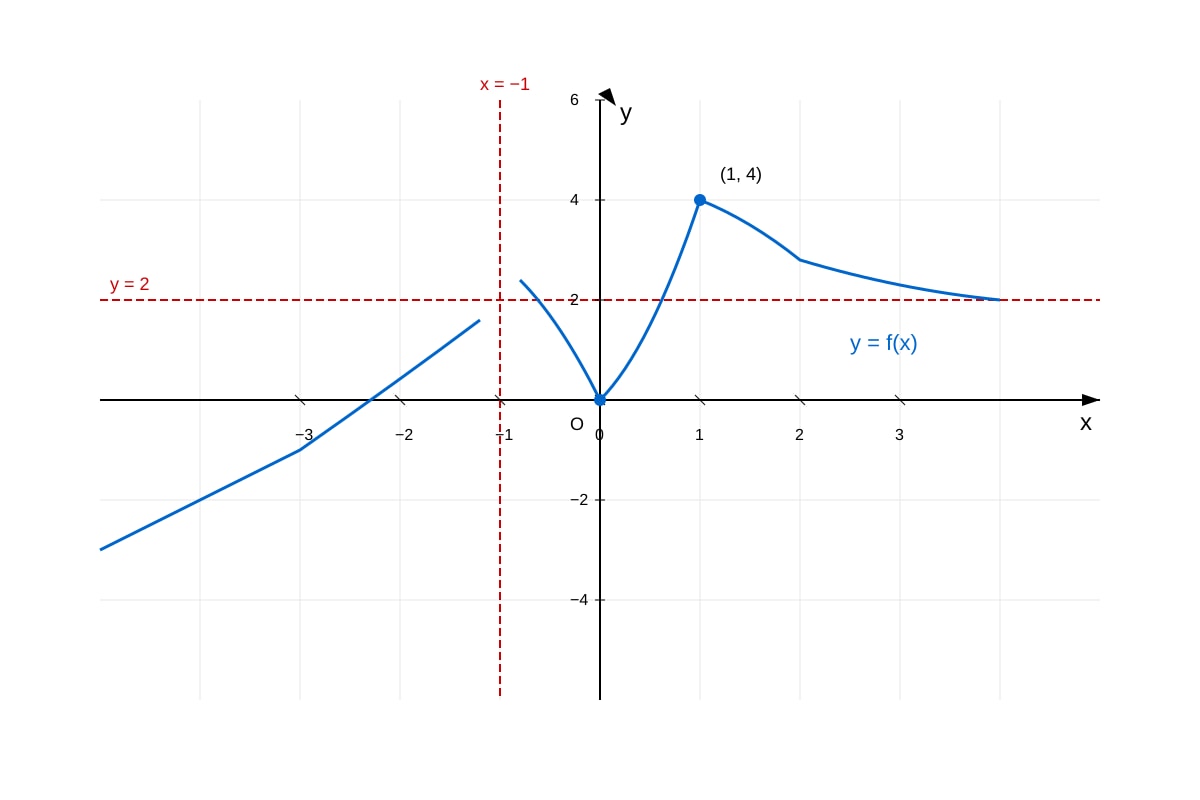
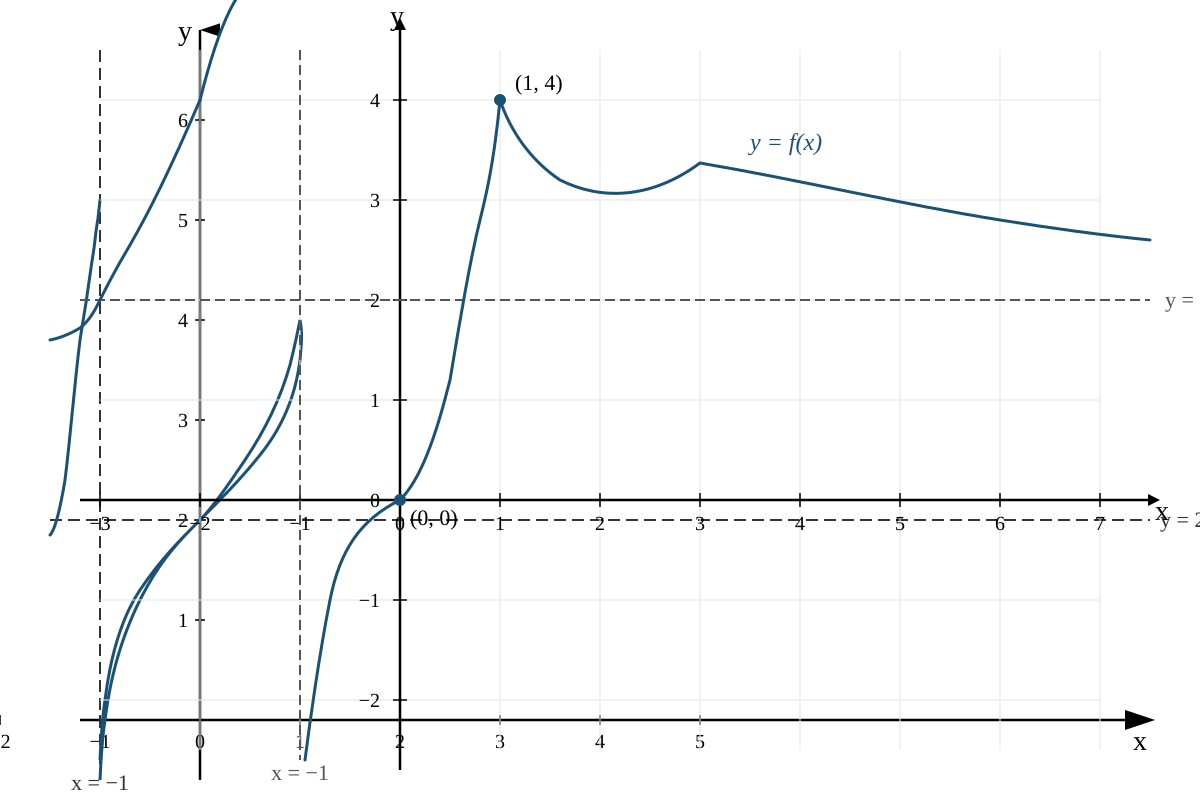
4. Original graph (y = f(x)): max at ((1, 4)), passes through ((0, 0)), asymptotes (x = -1) and (y = 2).
(a) (y = f(x+2)):
- Translation 2 units left ✓
- Max moves to ((-1, 4)) ✓
- Vertical asymptote moves to (x = -3)
- Horizontal asymptote unchanged: (y = 2)
- Passes through ((-2, 0))
- Correct sketch with labels ✓ [2 marks]
(b) (y = |f(x)|):
- Parts of (f(x)) below (x)-axis are reflected above ✓
- Max at ((1, 4)) unchanged
- Asymptotes unchanged: (x = -1), (y = 2)
- Where (f(x)) crosses (x)-axis, (|f(x)|) touches axis (cusp) ✓
- Correct sketch with labels ✓ [2 marks]
5. (y = x^3 - 3x^2 + 2)
(a) (\dfrac{dy}{dx} = 3x^2 - 6x = 3x(x - 2)) ✓
Stationary points when (\dfrac{dy}{dx} = 0): (x = 0) or (x = 2) ✓
At (x = 0): (y = 0^3 - 3(0)^2 + 2 = 2) → ((0, 2)) ✓
(\dfrac{d^2y}{dx^2} = 6x - 6)
At (x = 0): (\dfrac{d^2y}{dx^2} = -6 < 0) → maximum ✓
At (x = 2): (y = 8 - 12 + 2 = -2) → ((2, -2)) ✓
At (x = 2): (\dfrac{d^2y}{dx^2} = 12 - 6 = 6 > 0) → minimum ✓ [5 marks]
(b) Sketch:
- (y)-intercept: ((0, 2)) (also maximum point) ✓
- (x)-intercepts: solve (x^3 - 3x^2 + 2 = 0)
Try (x = 1): (1 - 3 + 2 = 0) ✓ → ((x - 1)) is a factor
(x^3 - 3x^2 + 2 = (x-1)(x^2 - 2x - 2))
(x^2 - 2x - 2 = 0) → (x = \frac{2 \pm \sqrt{4+8}}{2} = 1 \pm \sqrt{3})
Intercepts: ((1, 0)), ((1+\sqrt{3}, 0)), ((1-\sqrt{3}, 0)) - Maximum at ((0, 2)), minimum at ((2, -2)) ✓
- Correct cubic shape with labelled points ✓ [2 marks]
Section B: Coordinate Geometry (Questions 6–10)
6. (A(-2, 5)), (B(4, -1))
(a) Midpoint of (AB): (M = \left(\frac{-2+4}{2}, \frac{5+(-1)}{2}\right) = (1, 2)) ✓ [1 mark]
Gradient of (AB): (m_{AB} = \frac{-1-5}{4-(-2)} = \frac{-6}{6} = -1) ✓ [1 mark]
Gradient of perpendicular bisector: (m_{\perp} = 1) (negative reciprocal) ✓
Equation: (y - 2 = 1(x - 1)) → (y - 2 = x - 1) → (y = x + 1)
In required form: (x - y + 1 = 0) ✓ [2 marks]
(b) Meets (y)-axis: set (x = 0) → (0 - y + 1 = 0) → (y = 1)
(P = (0, 1)) ✓ [1 mark]
7. (L_1: 2x - y + 3 = 0)
(a) Gradient of (L_1): (2x - y + 3 = 0) → (y = 2x + 3), so (m_1 = 2) ✓
Gradient of (L_2) (perpendicular): (m_2 = -\frac{1}{2}) ✓
(L_2) passes through ((1, -2)): (y - (-2) = -\frac{1}{2}(x - 1))
(y + 2 = -\frac{1}{2}x + \frac{1}{2}) → (2y + 4 = -x + 1) → (x + 2y + 3 = 0) ✓ [3 marks]
(b) Intersection: solve simultaneously
(2x - y + 3 = 0) ... (1)
(x + 2y + 3 = 0) ... (2)
From (1): (y = 2x + 3) ✓
Substitute into (2): (x + 2(2x + 3) + 3 = 0) → (x + 4x + 6 + 3 = 0) → (5x + 9 = 0) → (x = -\frac{9}{5})
(y = 2(-\frac{9}{5}) + 3 = -\frac{18}{5} + \frac{15}{5} = -\frac{3}{5})
Intersection: (\left(-\frac{9}{5}, -\frac{3}{5}\right)) ✓ [2 marks]
8. (C_1: x^2 + y^2 - 6x + 4y - 12 = 0)
(a) Complete the square:
((x^2 - 6x) + (y^2 + 4y) = 12)
((x - 3)^2 - 9 + (y + 2)^2 - 4 = 12) ✓
((x - 3)^2 + (y + 2)^2 = 25) ✓
Centre: ((3, -2)), Radius: (5) ✓ [3 marks]
(b) Distance from ((5, 1)) to centre ((3, -2)):
(d = \sqrt{(5-3)^2 + (1-(-2))^2} = \sqrt{4 + 9} = \sqrt{13} \approx 3.61) ✓
Since (\sqrt{13} < 5), the point lies inside the circle. ✓ [1 mark]
9. (L_3: y = 2x - 1) → (2x - y - 1 = 0)
Point: ((3, 4))
Perpendicular distance = (\dfrac{|2(3) - 1(4) - 1|}{\sqrt{2^2 + (-1)^2}} = \dfrac{|6 - 4 - 1|}{\sqrt{5}} = \dfrac{1}{\sqrt{5}} = \dfrac{\sqrt{5}}{5}) ✓ [3 marks]
10. (C(1, 2)), (D(5, 8)), (CE : ED = 2 : 1)
Using section formula: (E = \left(\dfrac{1(1) + 2(5)}{1+2}, \dfrac{1(2) + 2(8)}{1+2}\right) = \left(\dfrac{1+10}{3}, \dfrac{2+16}{3}\right) = \left(\dfrac{11}{3}, 6\right)) ✓ [2 marks]
Section C: Inequalities and Modulus (Questions 11–15)
11. (\dfrac{x+2}{x-1} \geq 3), (x \neq 1)
(\dfrac{x+2}{x-1} - 3 \geq 0) → (\dfrac{x+2 - 3(x-1)}{x-1} \geq 0) ✓
(\dfrac{x+2 - 3x + 3}{x-1} \geq 0) → (\dfrac{-2x + 5}{x-1} \geq 0) → (\dfrac{2x - 5}{x-1} \leq 0) ✓
Critical values: (x = 1), (x = \frac{5}{2}) ✓
Sign analysis:
- (x < 1): numerator negative, denominator negative → fraction positive (not ≤ 0)
- (1 < x < \frac{5}{2}): numerator negative, denominator positive → fraction negative ✓
- (x > \frac{5}{2}): numerator positive, denominator positive → fraction positive (not ≤ 0)
Solution: (1 < x \leq \frac{5}{2}) ✓ [4 marks]
12. (|2x - 3| < 5)
(-5 < 2x - 3 < 5) ✓
(-5 + 3 < 2x < 5 + 3) → (-2 < 2x < 8) ✓
(-1 < x < 4) ✓ [3 marks]
13. (f(x) = |x - 2|), (g(x) = x + 1)
(a) (fg(x) = f(g(x)) = |(x+1) - 2| = |x - 1|) ✓ [1 mark]
(b) (|x - 1| = 3)
(x - 1 = 3) or (x - 1 = -3) ✓
(x = 4) or (x = -2) ✓ [3 marks]
(c) (y = |x - 1|) for (-4 \leq x \leq 4):
- Vertex at ((1, 0)) ✓
- (y)-intercept: (x = 0), (y = |0-1| = 1) → ((0, 1)) ✓
- (x)-intercept: ((1, 0)) ✓
- V-shape, symmetric about (x = 1)
- At (x = -4): (y = |-4-1| = 5) → ((-4, 5))
- At (x = 4): (y = |4-1| = 3) → ((4, 3))
- Correct sketch with labelled points ✓ [3 marks]
14. (|x + 1| \leq 2|x - 3|)
Square both sides: ((x+1)^2 \leq 4(x-3)^2) ✓
(x^2 + 2x + 1 \leq 4(x^2 - 6x + 9))
(x^2 + 2x + 1 \leq 4x^2 - 24x + 36)
(0 \leq 3x^2 - 26x + 35) ✓
(3x^2 - 26x + 35 \geq 0)
((3x - 5)(x - 7) \geq 0) ✓
Critical values: (x = \frac{5}{3}), (x = 7)
Solution: (x \leq \frac{5}{3}) or (x \geq 7) ✓ [4 marks]
15. (h(x) = |2x - 1| - 3 > 0)
(|2x - 1| > 3) ✓
(2x - 1 < -3) or (2x - 1 > 3) ✓
(2x < -2) or (2x > 4)
(x < -1) or (x > 2) ✓ [3 marks]
Section D: Applications and Problem Solving (Questions 16–20)
16. Original graph (y = f(x)): max at ((1, 4)), passes through ((0, 0)), asymptotes (x = -1) and (y = 2).
(y = \dfrac{1}{f(x)}):
- Vertical asymptotes where (f(x) = 0) (at (x = 0)) ✓
- Horizontal asymptote: as (f(x) \to 2), (\frac{1}{f(x)} \to \frac{1}{2}) ✓
- Where (f(x)) has vertical asymptote (x = -1), (\frac{1}{f(x)} \to 0) (horizontal intercept/asymptote)
- Max of (f(x)) at ((1, 4)) becomes min of (\frac{1}{f(x)}) at ((1, \frac{1}{4})) ✓
- Correct sketch with labels ✓ [3 marks]
17. (y = \dfrac{x^2 - 4}{x - 1})
(a) Asymptotes:
Vertical: (x = 1) ✓
Oblique: Perform division: (x^2 - 4 = (x-1)(x+1) - 3)
(y = x + 1 - \dfrac{3}{x-1})
As (x \to \pm\infty), (y \to x + 1) → Oblique asymptote: (y = x + 1) ✓ [2 marks]
(b) (\dfrac{dy}{dx} = \dfrac{(x-1)(2x) - (x^2-4)(1)}{(x-1)^2} = \dfrac{2x^2 - 2x - x^2 + 4}{(x-1)^2} = \dfrac{x^2 - 2x + 4}{(x-1)^2}) ✓
Stationary points when (x^2 - 2x + 4 = 0)
Discriminant = (4 - 16 = -12 < 0) → No stationary points ✓ [4 marks]
(c) Sketch:
- Vertical asymptote (x = 1) ✓
- Oblique asymptote (y = x + 1) ✓
- Intercepts: (x = 0) → (y = 4); (y = 0) → (x^2 - 4 = 0) → (x = \pm 2)
- Correct shape with labelled asymptotes and intercepts ✓ [2 marks]
18. Circle (x^2 + y^2 = 25), tangent at ((3, 4))
Radius to point of tangency has gradient (\frac{4}{3}) ✓
Tangent is perpendicular: gradient (m = -\frac{3}{4}) ✓
Equation: (y - 4 = -\frac{3}{4}(x - 3))
(y = -\frac{3}{4}x + \frac{9}{4} + 4 = -\frac{3}{4}x + \frac{25}{4})
(m = -\frac{3}{4}), (c = \frac{25}{4}) ✓ [3 marks]
19. (P(2, -1)), (Q(-4, 7))
Centre = midpoint of (PQ): (\left(\frac{2-4}{2}, \frac{-1+7}{2}\right) = (-1, 3)) ✓
Radius = (\frac{1}{2}PQ = \frac{1}{2}\sqrt{(-4-2)^2 + (7-(-1))^2} = \frac{1}{2}\sqrt{36 + 64} = \frac{1}{2}(10) = 5) ✓
Equation: ((x + 1)^2 + (y - 3)^2 = 25) ✓ [3 marks]
20. (x = 2\cos\theta), (y = 3\sin\theta)
(a) (\cos\theta = \frac{x}{2}), (\sin\theta = \frac{y}{3})
(\cos^2\theta + \sin^2\theta = 1) → (\left(\frac{x}{2}\right)^2 + \left(\frac{y}{3}\right)^2 = 1)
(\frac{x^2}{4} + \frac{y^2}{9} = 1) ✓ [1 mark]
(b) Sketch:
- Ellipse centred at origin ✓
- (x)-intercepts: (y = 0) → (\frac{x^2}{4} = 1) → (x = \pm 2) → ((2, 0)), ((-2, 0))
- (y)-intercepts: (x = 0) → (\frac{y^2}{9} = 1) → (y = \pm 3) → ((0, 3)), ((0, -3))
- Correct shape with labelled intercepts ✓ [2 marks]
END OF ANSWER KEY