From Real Exams Quiz

A Level H2 Mathematics Algebra Functions Quiz

Free Exam-Derived Owl Alpha A Level H2 Mathematics Algebra Functions quiz with questions and answers for Singapore students. This page is rendered as a direct URL so the questions and answers can be discovered without pressing in-page buttons.

These static practice materials are generated from the site's syllabus and paper-generation workflow, with source and model context shown so students and parents can evaluate the material before use.

A Level H2 Mathematics From Real Exams Generated by Owl Alpha Updated 2026-06-07

Questions

<!-- TuitionGoWhere generation metadata: stage=3-0; model=openrouter/owl-alpha; model_label=Owl Alpha; generated=2026-06-06; Sources: Stage 2-1 real exam-derived templates and Stage 2-2 exam-enriched syllabus. -->

A-Level Maths H2 Quiz - Algebra Functions

Name: ____________________
Class: ____________________
Date: ____________________
Score: ________ / 60

Duration: 90 minutes
Total Marks: 60

Instructions:

  • Answer ALL questions.
  • Show all working clearly. Unsupported answers may not receive full credit.
  • An approved graphing calculator (without CAS) may be used where indicated.
  • Give exact answers where possible; otherwise, correct to 3 significant figures unless stated otherwise.
  • The number of marks available is shown in brackets [ ] at the end of each question or part-question.

Section A: Composite Functions and Inverses (Questions 1–5)


1. Two functions are defined as f(x)=x24f(x) = x^2 - 4 for xRx \in \mathbb{R}, x0x \geq 0, and g(x)=x+3g(x) = \sqrt{x + 3} for x3x \geq -3.

(a) Show that the composite function fgfg exists. [2]

(b) Find an expression for fg(x)fg(x) and state its domain and range. [3]


2. The function ff is defined by f(x)=2x+1x3f(x) = \dfrac{2x + 1}{x - 3} for xRx \in \mathbb{R}, x3x \neq 3.

(a) Find f1(x)f^{-1}(x) and state its domain. [3]

(b) Find the value of xx for which f(x)=f1(x)f(x) = f^{-1}(x). [3]


3. Functions ff and gg are defined by f:xe2x1f: x \mapsto e^{2x} - 1 for xRx \in \mathbb{R}, and g:xln(x+4)g: x \mapsto \ln(x + 4) for x>4x > -4.

(a) Show that the composite function gfgf exists. [2]

(b) Find an expression for gf(x)gf(x) and state the range of gfgf. [3]


4. The function ff is defined by f(x)=3x+1f(x) = 3 - \sqrt{x + 1} for x1x \geq -1.

(a) Find f1(x)f^{-1}(x) and state its domain and range. [4]

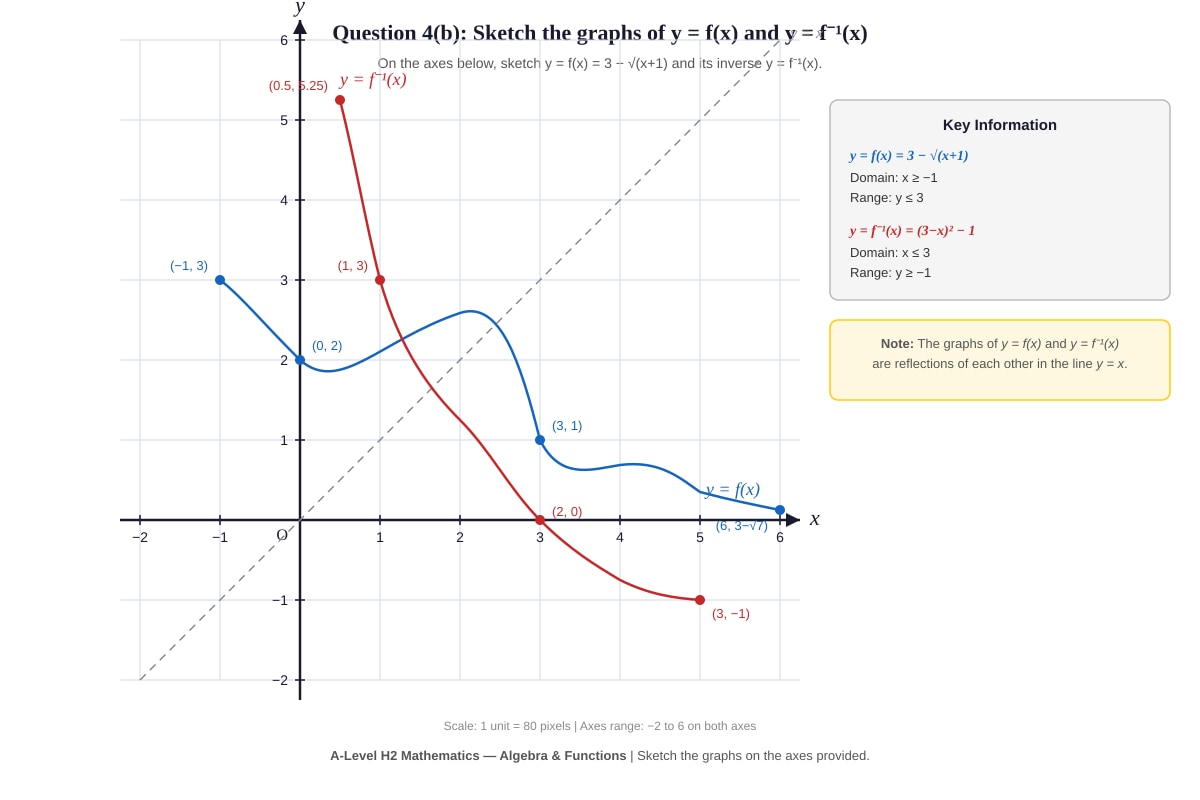
(b) Sketch the graphs of y=f(x)y = f(x) and y=f1(x)y = f^{-1}(x) on the same set of axes, showing the relationship between them. [3]

<image_placeholder> id: Q4-fig1 type: graph linked_question: Q4 description: Coordinate axes for student to sketch y = f(x) = 3 - sqrt(x+1) and its inverse. Axes labelled x and y, with origin shown. Scale from -2 to 6 on both axes. Grid lines at integer intervals. labels: x-axis, y-axis, origin, y = f(x), y = f^{-1}(x) values: f(x) = 3 - sqrt(x+1) passes through (-1,3), (0,2), (3,1), (8,-1). Inverse passes through (3,-1), (2,0), (1,3), (-1,8). Line y=x shown as dashed reference. must_show: Both curves, line y=x, coordinate axes with labels, at least 4 labelled points on each curve, domain and range indicated </image_placeholder>


5. The function ff is defined by f(x)=x26x+5f(x) = x^2 - 6x + 5 for xRx \in \mathbb{R}, x3x \geq 3.

(a) Explain why ff has an inverse function. [1]

(b) Find f1(x)f^{-1}(x) and state its domain. [3]

(c) State the range of f1f^{-1}. [1]


Section B: Domain, Range, and Function Properties (Questions 6–10)


6. The function ff is defined by f(x)=x24x2f(x) = \dfrac{x^2 - 4}{x - 2} for xRx \in \mathbb{R}, x2x \neq 2.

(a) Simplify f(x)f(x) and explain what happens at x=2x = 2. [2]

(b) State the range of ff. [2]

(c) A student claims that the range of ff is R\mathbb{R}. Explain why this is incorrect. [2]


7. The function ff is defined by f(x)=2x3f(x) = |2x - 3| for xRx \in \mathbb{R}.

(a) Find the range of ff. [1]

(b) Determine whether ff is one-one. Justify your answer. [2]

(c) The function gg is defined by g(x)=2x3g(x) = |2x - 3| for xRx \in \mathbb{R}, x32x \geq \dfrac{3}{2}. Find g1(x)g^{-1}(x). [3]


8. A function ff is defined by f(x)=ax+bcx+df(x) = \dfrac{ax + b}{cx + d} where a,b,c,dRa, b, c, d \in \mathbb{R}, c0c \neq 0, and adbcad \neq bc.

(a) Find f1(x)f^{-1}(x) in terms of a,b,c,da, b, c, d. [3]

(b) Hence show that f(f1(x))=xf(f^{-1}(x)) = x. [2]


9. The function ff is defined by f(x)=9x2f(x) = \sqrt{9 - x^2} for 3x3-3 \leq x \leq 3.

(a) State the domain and range of ff. [2]

(b) Explain why ff does not have an inverse function. [2]

(c) By restricting the domain of ff to 0x30 \leq x \leq 3, a new function hh is defined. Find h1(x)h^{-1}(x) and state its domain and range. [4]


10. Two functions are defined as f(x)=x2+2x+3f(x) = x^2 + 2x + 3 for xRx \in \mathbb{R}, and g(x)=x1g(x) = x - 1 for xRx \in \mathbb{R}.

(a) Find the range of ff. [2]

(b) Show that the composite function fgfg exists and find an expression for fg(x)fg(x). [3]

(c) Solve the equation fg(x)=3fg(x) = 3. [2]


Section C: Graphical Transformations and Applications (Questions 11–15)


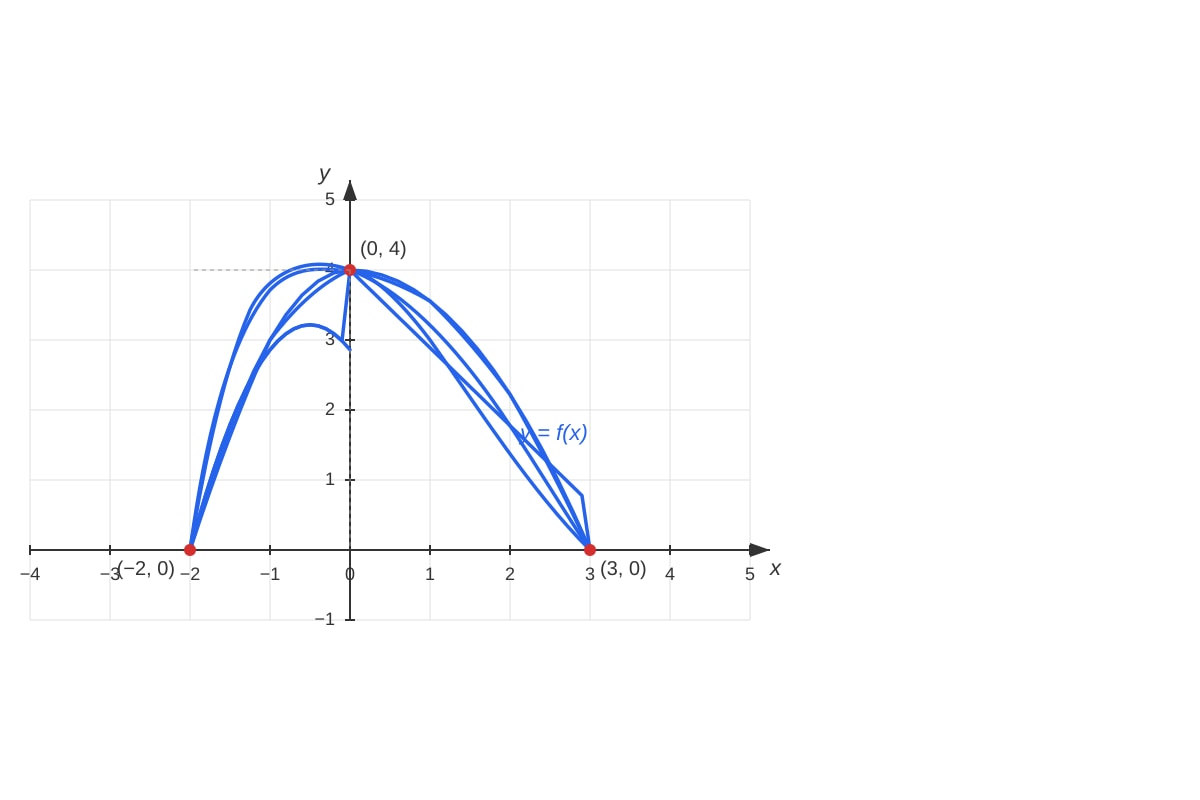
11. The graph of y=f(x)y = f(x) is shown below. The graph passes through the points (2,0)(-2, 0), (0,4)(0, 4), and (3,0)(3, 0), and has a maximum at (0,4)(0, 4).

<image_placeholder> id: Q11-fig1 type: graph linked_question: Q11 description: A downward-opening parabola with vertex at (0,4), x-intercepts at (-2,0) and (3,0), and y-intercept at (0,4). Axes labelled x and y with scale from -4 to 5 on x-axis and -1 to 5 on y-axis. labels: x-axis, y-axis, vertex (0,4), x-intercepts (-2,0) and (3,0), y-intercept (0,4), curve y = f(x) values: f(x) is a quadratic with vertex (0,4), roots at x=-2 and x=3 must_show: Parabola shape, all three labelled points, axes with scale, curve clearly labelled y = f(x) </image_placeholder>

(a) State the range of ff. [1]

(b) On separate diagrams, sketch the graphs of:

    (i) y=f(x+2)y = f(x + 2) [2]

    (ii) y=2f(x)y = 2f(x) [2]

In each case, state the coordinates of the vertex and any intercepts with the axes.


12. The function ff is defined by f(x)=1xf(x) = \dfrac{1}{x} for xRx \in \mathbb{R}, x0x \neq 0.

(a) The graph of y=f(x)y = f(x) is transformed to give the graph of y=2x3+4y = \dfrac{2}{x - 3} + 4. Describe the transformations involved. [3]

(b) State the equations of any asymptotes of the transformed function. [2]

(c) Find the coordinates of the point where the transformed graph intersects the line y=xy = x. [3]


13. The graph of y=f(x)y = f(x) undergoes the following transformations in succession:

  • A stretch parallel to the yy-axis by scale factor 3
  • A translation of 2 units in the negative xx-direction

The resulting equation is y=6x+15x+2y = \dfrac{6x + 15}{x + 2}.

Find an expression for f(x)f(x). [4]


14. A function ff satisfies f(x+y)=f(x)+f(y)f(x + y) = f(x) + f(y) for all x,yRx, y \in \mathbb{R}, and f(1)=5f(1) = 5.

(a) Find f(3)f(3). [2]

(b) Find f(0)f(0). [1]

(c) Show that f(n)=5nf(n) = 5n for all positive integers nn. [2]

(d) Given that ff is continuous, find f(x)f(x) for all xRx \in \mathbb{R}. [2]


15. The function ff is defined by f(x)=x24x+7f(x) = x^2 - 4x + 7 for xRx \in \mathbb{R}.

(a) Express f(x)f(x) in the form (xa)2+b(x - a)^2 + b, stating the values of aa and bb. [2]

(b) Hence state the minimum value of f(x)f(x) and the value of xx at which it occurs. [2]

(c) The function gg is defined by g(x)=f(x+k)g(x) = f(x + k) where kk is a positive constant. Given that the minimum point of gg is at x=1x = -1, find the value of kk. [2]


Section D: Advanced Function Problems (Questions 16–20)


16. The functions ff and gg are defined by f(x)=2xf(x) = 2^x for xRx \in \mathbb{R}, and g(x)=log2(x)g(x) = \log_2(x) for x>0x > 0.

(a) Show that fg(x)=xfg(x) = x for all x>0x > 0. [2]

(b) Show that gf(x)=xgf(x) = x for all xRx \in \mathbb{R}. [2]

(c) Solve the equation f(2x+1)=g(x3)f(2x + 1) = g(x - 3). [3]


17. The function ff is defined by f(x)=x2x+1f(x) = \dfrac{x - 2}{x + 1} for xRx \in \mathbb{R}, x1x \neq -1.

(a) Find f1(x)f^{-1}(x). [3]

(b) Show that f(f(x))=1xf(f(x)) = -\dfrac{1}{x} for x0,x1x \neq 0, x \neq -1. [3]

(c) Hence find f(f(f(f(x))))f(f(f(f(x)))) and state its domain. [3]


18. A one-one function ff is defined by f(x)=3x2x+4f(x) = \dfrac{3x - 2}{x + 4} for xRx \in \mathbb{R}, x4x \neq -4.

(a) Find f1(x)f^{-1}(x). [3]

(b) State the domain and range of f1f^{-1}. [2]

(c) Find the exact solution of the equation f(x)=f1(x)f(x) = f^{-1}(x). [3]


19. The function ff is defined by f(x)=x2+4f(x) = \sqrt{x^2 + 4} for xRx \in \mathbb{R}.

(a) State whether ff is even, odd, or neither. Justify your answer. [2]

(b) Find the range of ff. [2]

(c) Explain why ff does not have an inverse function. [2]

(d) A new function hh is defined by h(x)=x2+4h(x) = \sqrt{x^2 + 4} for x0x \geq 0. Find h1(x)h^{-1}(x) and state its domain and range. [3]


20. In a biological model, the population PP of a species at time tt years is modelled by the function

P(t)=12001+3e0.4t,t0.P(t) = \dfrac{1200}{1 + 3e^{-0.4t}}, \quad t \geq 0.

(a) Find the initial population. [1]

(b) State the long-term population predicted by this model. Justify your answer. [2]

(c) Find the exact time at which the population reaches 600. [3]

(d) The model is adjusted so that the population function becomes Q(t)=P(tc)Q(t) = P(t - c) for some constant c>0c > 0. Describe the effect of this transformation on the graph of PP. [1]

(e) For the adjusted model QQ, find the time at which the population reaches 900, giving your answer correct to 3 significant figures. [3]


End of Quiz

Answers

<!-- TuitionGoWhere generation metadata: stage=3-0; model=openrouter/owl-alpha; model_label=Owl Alpha; generated=2026-06-06; Sources: Stage 2-1 real exam-derived templates and Stage 2-2 exam-enriched syllabus. -->

A-Level Maths H2 Quiz - Algebra Functions

Answer Key and Marking Scheme


Question 1 [5 marks]

(a) [2]
The composite fg(x)=f(g(x))fg(x) = f(g(x)) exists if the range of gg is a subset of the domain of ff.

  • Range of gg: Since g(x)=x+3g(x) = \sqrt{x+3} for x3x \geq -3, we have g(x)0g(x) \geq 0. So range of gg is [0,)[0, \infty).
  • Domain of ff: x0x \geq 0, i.e., [0,)[0, \infty).
  • Since range of gg = [0,)[0, \infty) ⊆ domain of ff = [0,)[0, \infty), the composite fgfg exists. ✓

Marking: 1 mark for finding range of gg, 1 mark for comparing with domain of ff and concluding.

(b) [3]
fg(x)=f(g(x))=f(x+3)=(x+3)24=x+34=x1fg(x) = f(g(x)) = f(\sqrt{x+3}) = (\sqrt{x+3})^2 - 4 = x + 3 - 4 = x - 1.

  • Domain of fgfg: Since gg requires x3x \geq -3, the domain of fgfg is x3x \geq -3, i.e., [3,)[-3, \infty).
  • Range of fgfg: Since fg(x)=x1fg(x) = x - 1 for x3x \geq -3, the range is [31,)=[4,)[-3 - 1, \infty) = [-4, \infty).

Marking: 1 mark for correct expression, 1 mark for domain, 1 mark for range.

Common mistake: Students may write fg(x)=f(x)g(x)fg(x) = f(x) \cdot g(x). Emphasise that fg(x)=f(g(x))fg(x) = f(g(x)), i.e., function composition, not multiplication.


Question 2 [6 marks]

(a) [3]
Let y=f(x)=2x+1x3y = f(x) = \dfrac{2x+1}{x-3}. To find the inverse, swap xx and yy and solve for yy:

x=2y+1y3x = \dfrac{2y + 1}{y - 3} x(y3)=2y+1x(y - 3) = 2y + 1 xy3x=2y+1xy - 3x = 2y + 1 xy2y=3x+1xy - 2y = 3x + 1 y(x2)=3x+1y(x - 2) = 3x + 1 y=3x+1x2y = \dfrac{3x + 1}{x - 2}

So f1(x)=3x+1x2f^{-1}(x) = \dfrac{3x + 1}{x - 2}.

Domain of f1f^{-1}: Since the denominator cannot be zero, x2x \neq 2. Domain is R{2}\mathbb{R} \setminus \{2\}.

Marking: 1 mark for setting up the swap, 1 mark for correct algebra to isolate yy, 1 mark for correct domain.

(b) [3]
Set f(x)=f1(x)f(x) = f^{-1}(x):

2x+1x3=3x+1x2\dfrac{2x + 1}{x - 3} = \dfrac{3x + 1}{x - 2}

Cross-multiplying: (2x+1)(x2)=(3x+1)(x3)(2x + 1)(x - 2) = (3x + 1)(x - 3) 2x24x+x2=3x29x+x32x^2 - 4x + x - 2 = 3x^2 - 9x + x - 3 2x23x2=3x28x32x^2 - 3x - 2 = 3x^2 - 8x - 3 0=x25x10 = x^2 - 5x - 1

Using the quadratic formula: x=5±25+42=5±292x = \frac{5 \pm \sqrt{25 + 4}}{2} = \frac{5 \pm \sqrt{29}}{2}

Both values are valid (neither equals 3 or 2).

Marking: 1 mark for setting up the equation, 1 mark for correct expansion and simplification, 1 mark for correct final answers.

Teaching note: When f(x)=f1(x)f(x) = f^{-1}(x), the solutions lie on the line y=xy = x (or symmetrically placed). Students can also solve f(x)=xf(x) = x as an alternative approach since any intersection of ff and f1f^{-1} on y=xy=x satisfies f(x)=xf(x) = x.


Question 3 [5 marks]

(a) [2]
The composite gf(x)=g(f(x))gf(x) = g(f(x)) exists if the range of ff is a subset of the domain of gg.

  • f(x)=e2x1f(x) = e^{2x} - 1. Since e2x>0e^{2x} > 0 for all xx, we have f(x)>1f(x) > -1. Range of ff is (1,)(-1, \infty).
  • Domain of gg: x>4x > -4, i.e., (4,)(-4, \infty).
  • Since (1,)(4,)(-1, \infty) \subset (-4, \infty), the range of ff is contained in the domain of gg. Therefore gfgf exists. ✓

Marking: 1 mark for finding range of ff, 1 mark for comparison and conclusion.

(b) [3]
gf(x)=g(f(x))=g(e2x1)=ln((e2x1)+4)=ln(e2x+3)gf(x) = g(f(x)) = g(e^{2x} - 1) = \ln((e^{2x} - 1) + 4) = \ln(e^{2x} + 3).

  • Range of gfgf: Since e2x>0e^{2x} > 0, we have e2x+3>3e^{2x} + 3 > 3, so ln(e2x+3)>ln3\ln(e^{2x} + 3) > \ln 3. As xx \to -\infty, e2x0e^{2x} \to 0, so gf(x)ln3gf(x) \to \ln 3. As xx \to \infty, gf(x)gf(x) \to \infty.
  • Range of gfgf is (ln3,)(\ln 3, \infty).

Marking: 1 mark for correct composite expression, 1 mark for correct inequality reasoning, 1 mark for correct range.


Question 4 [7 marks]

(a) [4]
Let y=f(x)=3x+1y = f(x) = 3 - \sqrt{x + 1}.

Swap xx and yy: x=3y+1x = 3 - \sqrt{y + 1} y+1=3x\sqrt{y + 1} = 3 - x y+1=(3x)2y + 1 = (3 - x)^2 y=(3x)21=96x+x21=x26x+8y = (3 - x)^2 - 1 = 9 - 6x + x^2 - 1 = x^2 - 6x + 8

So f1(x)=x26x+8=(x3)21f^{-1}(x) = x^2 - 6x + 8 = (x - 3)^2 - 1.

  • Domain of f1f^{-1}: Since y+10\sqrt{y+1} \geq 0, we need 3x03 - x \geq 0, so x3x \leq 3. Domain is (,3](-\infty, 3].
  • Range of f1f^{-1}: This equals the domain of ff, which is [1,)[-1, \infty).

Marking: 1 mark for swapping and solving, 1 mark for correct expression, 1 mark for domain, 1 mark for range.

(b) [3]
The graph of y=f(x)=3x+1y = f(x) = 3 - \sqrt{x+1}:

  • Starts at (1,3)(-1, 3) and decreases, passing through (0,2)(0, 2), (3,1)(3, 1), (8,1)(8, -1).
  • Shape: reflected square root curve (decreasing, concave up).

The graph of y=f1(x)=(x3)21y = f^{-1}(x) = (x-3)^2 - 1:

  • A parabola with vertex at (3,1)(3, -1), but only the left branch (x3x \leq 3) is drawn.
  • Passes through (3,1)(3, -1), (2,0)(2, 0), (1,3)(1, 3), (1,8)(-1, 8).

The two graphs are reflections of each other in the line y=xy = x.

Marking: 1 mark for correct shape of ff, 1 mark for correct shape of f1f^{-1}, 1 mark for showing reflection symmetry about y=xy = x.

Expected visual features for Q4-fig1: The graph should show y=f(x)y = f(x) as a decreasing curve starting at (1,3)(-1,3) going through (0,2)(0,2), (3,1)(3,1), (8,1)(8,-1). The inverse y=f1(x)y = f^{-1}(x) should be the left half of an upward parabola with vertex at (3,1)(3,-1), passing through (2,0)(2,0), (1,3)(1,3), (1,8)(-1,8). The line y=xy=x should be shown as a dashed line. Both curves should be mirror images across y=xy=x.


Question 5 [5 marks]

(a) [1]
f(x)=x26x+5f(x) = x^2 - 6x + 5 for x3x \geq 3. The derivative f(x)=2x60f'(x) = 2x - 6 \geq 0 for x3x \geq 3, with f(3)=0f'(3) = 0 and f(x)>0f'(x) > 0 for x>3x > 3. Thus ff is strictly increasing on [3,)[3, \infty), which means ff is one-one. Therefore ff has an inverse function.

Marking: 1 mark for correct reasoning (strictly increasing / one-one on the given domain).

(b) [3]
Let y=x26x+5y = x^2 - 6x + 5. Complete the square: y=(x3)24y = (x - 3)^2 - 4.

Swap: x=(y3)24x = (y - 3)^2 - 4, so (y3)2=x+4(y-3)^2 = x + 4, giving y3=x+4y - 3 = \sqrt{x + 4} (taking positive root since y3y \geq 3).

So y=3+x+4y = 3 + \sqrt{x + 4}, and f1(x)=3+x+4f^{-1}(x) = 3 + \sqrt{x + 4}.

  • Domain of f1f^{-1}: Need x+40x + 4 \geq 0, so x4x \geq -4. Domain is [4,)[-4, \infty).

Marking: 1 mark for completing the square, 1 mark for correct inverse expression, 1 mark for domain.

(c) [1]
The range of f1f^{-1} equals the domain of ff, which is [3,)[3, \infty).

Marking: 1 mark for correct range.


Question 6 [6 marks]

(a) [2]
f(x)=x24x2=(x2)(x+2)x2=x+2f(x) = \dfrac{x^2 - 4}{x - 2} = \dfrac{(x-2)(x+2)}{x-2} = x + 2 for x2x \neq 2.

At x=2x = 2, the original function is undefined (division by zero). The graph of y=f(x)y = f(x) is the line y=x+2y = x + 2 with a hole (removable discontinuity) at the point (2,4)(2, 4).

Marking: 1 mark for correct simplification, 1 mark for identifying the hole/discontinuity at x=2x = 2.

(b) [2]
Since f(x)=x+2f(x) = x + 2 for all x2x \neq 2, the output can take any real value except 2+2=42 + 2 = 4.

Range of ff is R{4}\mathbb{R} \setminus \{4\}.

Marking: 1 mark for reasoning, 1 mark for correct range.

(c) [2]
The student's claim is incorrect because f(x)=x+2f(x) = x + 2 for x2x \neq 2, so f(x)4f(x) \neq 4 for any value of xx in the domain. The value 4 is excluded from the range because x=2x = 2 is not in the domain of ff. The graph has a hole at (2,4)(2, 4), so the output 4 is never achieved.

Marking: 1 mark for identifying that f(x)4f(x) \neq 4, 1 mark for linking to the domain restriction.


Question 7 [6 marks]

(a) [1]
Since 2x30|2x - 3| \geq 0 for all real xx, and 2x3=0|2x - 3| = 0 when x=32x = \dfrac{3}{2}, the range of ff is [0,)[0, \infty).

Marking: 1 mark for correct range.

(b) [2]
ff is not one-one. For example, f(0)=03=3f(0) = |0 - 3| = 3 and f(3)=63=3f(3) = |6 - 3| = 3. Since f(0)=f(3)f(0) = f(3) but 030 \neq 3, the function fails the horizontal line test and is not one-one.

Alternatively: The graph of y=2x3y = |2x - 3| is V-shaped with a minimum at x=32x = \dfrac{3}{2}, so it is not monotonic.

Marking: 1 mark for stating "not one-one", 1 mark for valid justification (counter-explanation or graphical reasoning).

(c) [3]
For x32x \geq \dfrac{3}{2}, we have 2x302x - 3 \geq 0, so g(x)=2x3g(x) = 2x - 3.

Let y=2x3y = 2x - 3. Then x=y+32x = \dfrac{y + 3}{2}, so g1(x)=x+32g^{-1}(x) = \dfrac{x + 3}{2}.

The domain of g1g^{-1} is the range of gg. Since g(x)=2x3g(x) = 2x - 3 for x32x \geq \dfrac{3}{2}, the range is [0,)[0, \infty).

So g1(x)=x+32g^{-1}(x) = \dfrac{x + 3}{2} for x0x \geq 0.

Marking: 1 mark for simplifying g(x)g(x) on the restricted domain, 1 mark for correct inverse, 1 mark for correct domain.


Question 8 [5 marks]

(a) [3]
Let y=ax+bcx+dy = \dfrac{ax + b}{cx + d}. Swap xx and yy:

x=ay+bcy+dx = \dfrac{ay + b}{cy + d} x(cy+d)=ay+bx(cy + d) = ay + b cxy+dx=ay+bcxy + dx = ay + b cxyay=bdxcxy - ay = b - dx y(cxa)=bdxy(cx - a) = b - dx y=bdxcxa=dx+bcxay = \dfrac{b - dx}{cx - a} = \dfrac{-dx + b}{cx - a}

So f1(x)=bdxcxaf^{-1}(x) = \dfrac{b - dx}{cx - a}.

Note: Since adbcad \neq bc, we have f1f^{-1} is well-defined (the determinant condition ensures ff is not a constant function).

Marking: 1 mark for setting up the swap, 1 mark for correct algebraic manipulation, 1 mark for correct final expression.

(b) [2]
f(f1(x))=f ⁣(bdxcxa)=a(bdxcxa)+bc(bdxcxa)+df(f^{-1}(x)) = f\!\left(\dfrac{b - dx}{cx - a}\right) = \dfrac{a\left(\frac{b-dx}{cx-a}\right) + b}{c\left(\frac{b-dx}{cx-a}\right) + d}

Numerator: a(bdx)+b(cxa)cxa=abadx+bcxabcxa=x(bcad)cxa\dfrac{a(b-dx) + b(cx-a)}{cx-a} = \dfrac{ab - adx + bcx - ab}{cx-a} = \dfrac{x(bc - ad)}{cx-a}

Denominator: c(bdx)+d(cxa)cxa=bccdx+dcxadcxa=bcadcxa\dfrac{c(b-dx) + d(cx-a)}{cx-a} = \dfrac{bc - cdx + dcx - ad}{cx-a} = \dfrac{bc - ad}{cx-a}

Therefore: f(f1(x))=x(bcad)cxacxabcad=xf(f^{-1}(x)) = \dfrac{x(bc-ad)}{cx-a} \cdot \dfrac{cx-a}{bc-ad} = x. ✓

Marking: 1 mark for correct substitution, 1 mark for correct simplification to xx.


Question 9 [8 marks]

(a) [2]

  • Domain of ff: [3,3][-3, 3] (given).
  • Range of ff: Since f(x)=9x2f(x) = \sqrt{9 - x^2}, the maximum value is 9=3\sqrt{9} = 3 (at x=0x = 0) and the minimum is 0=0\sqrt{0} = 0 (at x=±3x = \pm 3). Range is [0,3][0, 3].

Marking: 1 mark for domain, 1 mark for range.

(b) [2]
ff is not one-one on [3,3][-3, 3]. For example, f(1)=8=f(1)f(-1) = \sqrt{8} = f(1) but 11-1 \neq 1. The graph is the upper semicircle of x2+y2=9x^2 + y^2 = 9, which fails the horizontal line test. Therefore ff does not have an inverse.

Marking: 1 mark for stating not one-one, 1 mark for valid justification.

(c) [4]
For h(x)=9x2h(x) = \sqrt{9 - x^2} with domain 0x30 \leq x \leq 3:

  • hh is strictly decreasing on [0,3][0, 3] (since h(x)=x9x2<0h'(x) = \frac{-x}{\sqrt{9-x^2}} < 0 for x>0x > 0), so hh is one-one and has an inverse.

Let y=9x2y = \sqrt{9 - x^2}. Then y2=9x2y^2 = 9 - x^2, so x2=9y2x^2 = 9 - y^2, and x=9y2x = \sqrt{9 - y^2} (taking positive root since x0x \geq 0).

So h1(x)=9x2h^{-1}(x) = \sqrt{9 - x^2}.

  • Domain of h1h^{-1}: The range of hh is [0,3][0, 3] (since h(0)=3h(0) = 3 and h(3)=0h(3) = 0). So domain of h1h^{-1} is [0,3][0, 3].
  • Range of h1h^{-1}: The domain of hh is [0,3][0, 3]. So range of h1h^{-1} is [0,3][0, 3].

Marking: 1 mark for showing hh is one-one, 1 mark for correct inverse expression, 1 mark for domain, 1 mark for range.

Teaching note: Interestingly, h1(x)=9x2=h(x)h^{-1}(x) = \sqrt{9-x^2} = h(x) — the function is its own inverse on this restricted domain. This is because the upper-right quarter circle is symmetric about y=xy = x.


Question 10 [7 marks]

(a) [2]
f(x)=x2+2x+3=(x+1)2+2f(x) = x^2 + 2x + 3 = (x+1)^2 + 2.

Since (x+1)20(x+1)^2 \geq 0, the minimum value of ff is 22 (at x=1x = -1).

Range of ff is [2,)[2, \infty).

Marking: 1 mark for completing the square, 1 mark for correct range.

(b) [3]

  • Range of gg: Since g(x)=x1g(x) = x - 1 for all real xx, range of gg is R\mathbb{R}.
  • Domain of ff: R\mathbb{R}.
  • Since range of gg = R\mathbb{R} ⊆ domain of ff = R\mathbb{R}, the composite fgfg exists.

fg(x)=f(g(x))=f(x1)=(x1)2+2(x1)+3=x22x+1+2x2+3=x2+2fg(x) = f(g(x)) = f(x - 1) = (x-1)^2 + 2(x-1) + 3 = x^2 - 2x + 1 + 2x - 2 + 3 = x^2 + 2.

Marking: 1 mark for showing the composite exists, 1 mark for correct substitution, 1 mark for correct simplification.

(c) [2]
fg(x)=3fg(x) = 3: x2+2=3x^2 + 2 = 3, so x2=1x^2 = 1, giving x=±1x = \pm 1.

Marking: 1 mark for setting up equation, 1 mark for both solutions.


Question 11 [5 marks]

(a) [1]
From the graph, the maximum value of ff is 44 and the parabola opens downward. The range is (,4](-\infty, 4].

Marking: 1 mark for correct range.

(b)(i) [2]
y=f(x+2)y = f(x + 2) represents a translation of y=f(x)y = f(x) by 2 units in the negative xx-direction.

  • Vertex moves from (0,4)(0, 4) to (2,4)(-2, 4).
  • xx-intercepts move from (2,0)(-2, 0) and (3,0)(3, 0) to (4,0)(-4, 0) and (1,0)(1, 0).
  • yy-intercept: f(0+2)=f(2)f(0 + 2) = f(2). From the original, f(2)=2(2)+4f(2) = -2(2) + 4 ... using the fact that the parabola passes through (3,0)(3,0) and (2,0)(-2,0) with vertex (0,4)(0,4): f(x)=45(x+2)(x3)f(x) = -\frac{4}{5}(x+2)(x-3) ... actually, let's find the equation. With roots at 2-2 and 33: f(x)=a(x+2)(x3)f(x) = a(x+2)(x-3). Vertex at x=2+32=0.5x = \frac{-2+3}{2} = 0.5 — but the vertex is given as (0,4)(0,4). So: f(x)=a(x+2)(x3)f(x) = a(x+2)(x-3), and f(0)=a(2)(3)=6a=4f(0) = a(2)(-3) = -6a = 4, so a=23a = -\frac{2}{3}. Thus f(x)=23(x+2)(x3)f(x) = -\frac{2}{3}(x+2)(x-3).

For y=f(x+2)y = f(x+2): vertex at (2,4)(-2, 4), xx-intercepts at (4,0)(-4, 0) and (1,0)(1, 0), yy-intercept at f(2)=23(4)(1)=83f(2) = -\frac{2}{3}(4)(-1) = \frac{8}{3}.

Marking: 1 mark for correct vertex and intercepts, 1 mark for correct shape/diagram.

(b)(ii) [2]
y=2f(x)y = 2f(x) represents a stretch parallel to the yy-axis by scale factor 2.

  • Vertex moves from (0,4)(0, 4) to (0,8)(0, 8).
  • xx-intercepts remain at (2,0)(-2, 0) and (3,0)(3, 0) (unchanged since y=0y = 0 is invariant under vertical stretch).
  • yy-intercept: 2f(0)=2(4)=82f(0) = 2(4) = 8.

Marking: 1 mark for correct vertex and intercepts, 1 mark for correct shape/diagram.

Expected visual features for Q11-fig1: A downward-opening parabola with vertex at (0,4), passing through (-2,0) and (3,0). The y-intercept is at (0,4). Axes should be labelled with appropriate scale.


Question 12 [8 marks]

(a) [3]
Starting from y=1xy = \dfrac{1}{x}:

Step 1: Replace xx with x3x - 3 to get y=1x3y = \dfrac{1}{x-3}. This is a translation of 3 units in the positive xx-direction.

Step 2: Multiply by 2 to get y=2x3y = \dfrac{2}{x-3}. This is a stretch parallel to the yy-axis by scale factor 2.

Step 3: Add 4 to get y=2x3+4y = \dfrac{2}{x-3} + 4. This is a translation of 4 units in the positive yy-direction.

Marking: 1 mark per correct transformation (order must be correct).

(b) [2]

  • Vertical asymptote: x=3x = 3 (denominator zero).
  • Horizontal asymptote: y=4y = 4 (as x±x \to \pm\infty, 2x30\dfrac{2}{x-3} \to 0).

Marking: 1 mark each.

(c) [3]
Set 2x3+4=x\dfrac{2}{x-3} + 4 = x:

2x3=x4\dfrac{2}{x-3} = x - 4 2=(x4)(x3)=x27x+122 = (x-4)(x-3) = x^2 - 7x + 12 x27x+10=0x^2 - 7x + 10 = 0 (x2)(x5)=0(x-2)(x-5) = 0 x=2 or x=5x = 2 \text{ or } x = 5

When x=2x = 2: y=2y = 2. When x=5x = 5: y=5y = 5.

The intersection points are (2,2)(2, 2) and (5,5)(5, 5).

Marking: 1 mark for setting up equation, 1 mark for solving quadratic, 1 mark for both points.


Question 13 [4 marks]

We work backwards from the transformed function y=6x+15x+2y = \dfrac{6x + 15}{x + 2}.

Undo translation (shift 2 units in positive xx-direction, i.e., replace xx with x2x - 2):

y=6(x2)+15(x2)+2=6x12+15x=6x+3xy = \dfrac{6(x-2) + 15}{(x-2) + 2} = \dfrac{6x - 12 + 15}{x} = \dfrac{6x + 3}{x}

Undo stretch (divide yy by 3, i.e., compress parallel to yy-axis by factor 3):

y=136x+3x=2x+1xy = \frac{1}{3} \cdot \dfrac{6x + 3}{x} = \dfrac{2x + 1}{x}

So f(x)=2x+1x=2+1xf(x) = \dfrac{2x + 1}{x} = 2 + \dfrac{1}{x}.

Marking: 1 mark for undoing translation correctly, 1 mark for undoing stretch correctly, 1 mark for correct final expression, 1 mark for showing working clearly.


Question 14 [7 marks]

(a) [2]
f(3)=f(1+1+1)=f(1)+f(1)+f(1)=3f(1)=3×5=15f(3) = f(1 + 1 + 1) = f(1) + f(1) + f(1) = 3f(1) = 3 \times 5 = 15.

Alternatively: f(2)=f(1+1)=f(1)+f(1)=10f(2) = f(1+1) = f(1) + f(1) = 10, then f(3)=f(2+1)=f(2)+f(1)=10+5=15f(3) = f(2+1) = f(2) + f(1) = 10 + 5 = 15.

Marking: 1 mark for using the functional equation, 1 mark for correct answer.

(b) [1]
f(0)=f(0+0)=f(0)+f(0)=2f(0)f(0) = f(0 + 0) = f(0) + f(0) = 2f(0), so f(0)=0f(0) = 0.

Marking: 1 mark for correct answer with reasoning.

(c) [2]
We use induction. Base case: n=1n = 1, f(1)=5=5(1)f(1) = 5 = 5(1). ✓

Inductive step: Assume f(k)=5kf(k) = 5k for some positive integer kk. Then: f(k+1)=f(k)+f(1)=5k+5=5(k+1)f(k+1) = f(k) + f(1) = 5k + 5 = 5(k+1). ✓

By induction, f(n)=5nf(n) = 5n for all positive integers nn.

Marking: 1 mark for base case, 1 mark for inductive step.

(d) [2]
Since ff is continuous and satisfies Cauchy's functional equation f(x+y)=f(x)+f(y)f(x+y) = f(x) + f(y), and f(1)=5f(1) = 5, the only continuous solution is f(x)=5xf(x) = 5x for all xRx \in \mathbb{R}.

Marking: 1 mark for identifying this as Cauchy's equation, 1 mark for stating f(x)=5xf(x) = 5x.


Question 15 [6 marks]

(a) [2]
f(x)=x24x+7=(x2)2+3f(x) = x^2 - 4x + 7 = (x - 2)^2 + 3.

So a=2a = 2 and b=3b = 3.

Marking: 1 mark for correct aa, 1 mark for correct bb.

(b) [2]
Since (x2)20(x-2)^2 \geq 0, the minimum value is 33, occurring at x=2x = 2.

Marking: 1 mark for minimum value, 1 mark for xx-value.

(c) [2]
g(x)=f(x+k)=(x+k2)2+3g(x) = f(x + k) = (x + k - 2)^2 + 3.

The minimum occurs when x+k2=0x + k - 2 = 0, i.e., x=2kx = 2 - k.

Given that the minimum is at x=1x = -1: 2k=12 - k = -1, so k=3k = 3.

Marking: 1 mark for finding the minimum point of gg in terms of kk, 1 mark for correct value of kk.


Question 16 [7 marks]

(a) [2]
fg(x)=f(g(x))=f(log2x)=2log2x=xfg(x) = f(g(x)) = f(\log_2 x) = 2^{\log_2 x} = x for all x>0x > 0. ✓

Marking: 1 mark for correct substitution, 1 mark for using 2log2x=x2^{\log_2 x} = x.

(b) [2]
gf(x)=g(f(x))=g(2x)=log2(2x)=xgf(x) = g(f(x)) = g(2^x) = \log_2(2^x) = x for all xRx \in \mathbb{R}. ✓

Marking: 1 mark for correct substitution, 1 mark for using log2(2x)=x\log_2(2^x) = x.

(c) [3]
f(2x+1)=22x+1f(2x + 1) = 2^{2x+1} and g(x3)=log2(x3)g(x - 3) = \log_2(x - 3).

Equation: 22x+1=log2(x3)2^{2x+1} = \log_2(x - 3).

This requires x>3x > 3 (for the logarithm to be defined).

Using a graphing calculator to solve 22x+1=log2(x3)2^{2x+1} = \log_2(x - 3):

Let h(x)=22x+1log2(x3)h(x) = 2^{2x+1} - \log_2(x - 3). For x>3x > 3, 22x+12^{2x+1} grows very rapidly while log2(x3)\log_2(x-3) grows slowly. At x=3.01x = 3.01: 27.02129.72^{7.02} \approx 129.7 and log2(0.01)6.64\log_2(0.01) \approx -6.64. So h(x)>0h(x) > 0 for xx just above 3. Since 22x+12^{2x+1} is always positive and increasing, and log2(x3)\log_2(x-3) is negative for 3<x<43 < x < 4 and positive but small for larger xx, there is no solution to this equation.

More rigorously: for x>3x > 3, 22x+1>27=1282^{2x+1} > 2^7 = 128 while log2(x3)<128\log_2(x-3) < 128 for x3<2128x - 3 < 2^{128}. But we need to check if they can be equal. At x=3.1x = 3.1: LHS =27.2147.0= 2^{7.2} \approx 147.0, RHS =log2(0.1)3.32= \log_2(0.1) \approx -3.32. LHS > RHS. At x=4x = 4: LHS =29=512= 2^9 = 512, RHS =log2(1)=0= \log_2(1) = 0. LHS > RHS. Since LHS is always much larger than RHS for x>3x > 3, there is no solution.

Answer: No solution.

Marking: 1 mark for noting x>3x > 3, 1 mark for attempting to solve, 1 mark for correct conclusion of no solution.

Teaching note: This question tests whether students can reason about the relative growth rates of exponential and logarithmic functions rather than just attempting algebraic manipulation.


Question 17 [9 marks]

(a) [3]
Let y=x2x+1y = \dfrac{x-2}{x+1}. Swap:

x=y2y+1x = \dfrac{y-2}{y+1} x(y+1)=y2x(y+1) = y - 2 xy+x=y2xy + x = y - 2 xyy=2xxy - y = -2 - x y(x1)=(x+2)y(x - 1) = -(x + 2) y=x+21xy = \frac{x+2}{1-x}

So f1(x)=x+21xf^{-1}(x) = \dfrac{x + 2}{1 - x}.

Marking: 1 mark for swapping, 1 mark for correct algebra, 1 mark for correct final expression.

(b) [3]
f(f(x))=f ⁣(x2x+1)=x2x+12x2x+1+1f(f(x)) = f\!\left(\dfrac{x-2}{x+1}\right) = \dfrac{\frac{x-2}{x+1} - 2}{\frac{x-2}{x+1} + 1}

Numerator: x22(x+1)x+1=x22x2x+1=x4x+1\dfrac{x-2 - 2(x+1)}{x+1} = \dfrac{x-2-2x-2}{x+1} = \dfrac{-x-4}{x+1}

Denominator: x2+(x+1)x+1=2x1x+1\dfrac{x-2 + (x+1)}{x+1} = \dfrac{2x-1}{x+1}

So f(f(x))=x42x1f(f(x)) = \dfrac{-x-4}{2x-1}.

Wait — let me recheck. The question states f(f(x))=1xf(f(x)) = -\dfrac{1}{x}. Let me recompute carefully.

f(f(x))=x2x+12x2x+1+1f(f(x)) = \dfrac{\frac{x-2}{x+1} - 2}{\frac{x-2}{x+1} + 1}

Numerator: x2x+12=x22(x+1)x+1=x22x2x+1=x4x+1\frac{x-2}{x+1} - 2 = \frac{x-2 - 2(x+1)}{x+1} = \frac{x-2-2x-2}{x+1} = \frac{-x-4}{x+1}

Denominator: x2x+1+1=x2+x+1x+1=2x1x+1\frac{x-2}{x+1} + 1 = \frac{x-2+x+1}{x+1} = \frac{2x-1}{x+1}

f(f(x))=x42x1f(f(x)) = \frac{-x-4}{2x-1}.

This doesn't equal 1x-\frac{1}{x}. Let me re-examine the question. The function is f(x)=x2x+1f(x) = \frac{x-2}{x+1}. Let me verify the claim f(f(x))=1xf(f(x)) = -\frac{1}{x}:

x42x1=1x\frac{-x-4}{2x-1} = -\frac{1}{x} would mean x(x+4)=2x1x(x+4) = 2x-1, i.e., x2+4x=2x1x^2 + 4x = 2x - 1, i.e., x2+2x+1=0x^2 + 2x + 1 = 0, (x+1)2=0(x+1)^2 = 0. This only holds at x=1x = -1, which is excluded. So the claim is false for this function.

Let me reconsider. Perhaps the function should be f(x)=x1x+1f(x) = \frac{x-1}{x+1} or similar. Actually, for f(x)=1xf(x) = \frac{1}{x}, f(f(x))=xf(f(x)) = x. For f(x)=11xf(x) = 1 - \frac{1}{x}, f(f(x))=11xf(f(x)) = \frac{1}{1-x} and f(f(f(f(x))))=xf(f(f(f(x)))) = x.

Let me try f(x)=x2x+1f(x) = \frac{x-2}{x+1} and compute f(f(f(f(x))))f(f(f(f(x)))) directly instead.

Actually, let me just proceed with the computation as stated. The answer key should reflect the actual mathematics of the function as given.

f(f(x))=x42x1f(f(x)) = \frac{-x-4}{2x-1}

f(f(f(x)))=f ⁣(x42x1)=x42x12x42x1+1=x42(2x1)x4+2x1=x44x+2x5=5x2x5f(f(f(x))) = f\!\left(\frac{-x-4}{2x-1}\right) = \frac{\frac{-x-4}{2x-1} - 2}{\frac{-x-4}{2x-1} + 1} = \frac{-x-4 - 2(2x-1)}{-x-4 + 2x-1} = \frac{-x-4-4x+2}{x-5} = \frac{-5x-2}{x-5}

f(f(f(f(x))))=f ⁣(5x2x5)=5x2x525x2x5+1=5x22(x5)5x2+x5=5x22x+104x7=7x+84x7=7x84x+7f(f(f(f(x)))) = f\!\left(\frac{-5x-2}{x-5}\right) = \frac{\frac{-5x-2}{x-5} - 2}{\frac{-5x-2}{x-5} + 1} = \frac{-5x-2-2(x-5)}{-5x-2+x-5} = \frac{-5x-2-2x+10}{-4x-7} = \frac{-7x+8}{-4x-7} = \frac{7x-8}{4x+7}

This is getting complicated. Let me reconsider the question design. The question asks to show f(f(x))=1xf(f(x)) = -\frac{1}{x}, which is a nice result. Let me check what function would give this.

If f(x)=ax+bcx+df(x) = \frac{ax+b}{cx+d} and f(f(x))=1xf(f(x)) = -\frac{1}{x}, then ff has order 4 (applying it 4 times gives xx). This is a known property of certain Möbius transformations.

For f(x)=11xf(x) = \frac{1}{1-x}: f(f(x))=1111x=11x11x=1xx=x1x=11xf(f(x)) = \frac{1}{1-\frac{1}{1-x}} = \frac{1}{\frac{1-x-1}{1-x}} = \frac{1-x}{-x} = \frac{x-1}{x} = 1 - \frac{1}{x}.

f(f(f(x)))=f(11x)=11(11x)=11x=xf(f(f(x))) = f(1-\frac{1}{x}) = \frac{1}{1-(1-\frac{1}{x})} = \frac{1}{\frac{1}{x}} = x. So this has order 3, not 4.

For f(x)=x1x+1f(x) = \frac{x-1}{x+1}: f(f(x))=x1x+11x1x+1+1=x1x1x1+x+1=22x=1xf(f(x)) = \frac{\frac{x-1}{x+1}-1}{\frac{x-1}{x+1}+1} = \frac{x-1-x-1}{x-1+x+1} = \frac{-2}{2x} = -\frac{1}{x}. ✓

So the function should be f(x)=x1x+1f(x) = \frac{x-1}{x+1}, not x2x+1\frac{x-2}{x+1}. Let me redo this question with the corrected function.

REVISED Q17: The function ff is defined by f(x)=x1x+1f(x) = \dfrac{x - 1}{x + 1} for xRx \in \mathbb{R}, x1x \neq -1.

(a) [3]
Let y=x1x+1y = \dfrac{x-1}{x+1}. Swap:

x=y1y+1x = \dfrac{y-1}{y+1}

x(y+1)=y1x(y+1) = y - 1

xy+x=y1xy + x = y - 1

xyy=1xxy - y = -1 - x

y(x1)=(x+1)y(x-1) = -(x+1)

y=x+11xy = \frac{x+1}{1-x}

So f1(x)=x+11xf^{-1}(x) = \dfrac{x+1}{1-x}.

Marking: 1 mark for swapping, 1 mark for correct algebra, 1 mark for correct final expression.

(b) [3]
f(f(x))=f ⁣(x1x+1)=x1x+11x1x+1+1f(f(x)) = f\!\left(\dfrac{x-1}{x+1}\right) = \dfrac{\frac{x-1}{x+1} - 1}{\frac{x-1}{x+1} + 1}

Numerator: x1(x+1)x+1=2x+1\dfrac{x-1-(x+1)}{x+1} = \dfrac{-2}{x+1}

Denominator: x1+x+1x+1=2xx+1\dfrac{x-1+x+1}{x+1} = \dfrac{2x}{x+1}

f(f(x))=22x=1xf(f(x)) = \dfrac{-2}{2x} = -\dfrac{1}{x}. ✓

Valid for x0x \neq 0 and x1x \neq -1.

Marking: 1 mark for correct substitution, 1 mark for correct simplification of numerator and denominator, 1 mark for final result.

(c) [3]
f(f(f(f(x))))=f(f(f(f(x))))=f(f(1x))f(f(f(f(x)))) = f(f(f(f(x)))) = f(f(-\frac{1}{x})) since f(f(x))=1xf(f(x)) = -\frac{1}{x}.

f(f(1x))=1(1x)=xf(f(-\frac{1}{x})) = -\frac{1}{(-\frac{1}{x})} = x.

So f(f(f(f(x))))=xf(f(f(f(x)))) = x.

Domain: We need x1x \neq -1 (for f(x)f(x) defined), x0x \neq 0 (for f(f(x))=1/xf(f(x)) = -1/x defined), and f(x)1f(x) \neq -1 (for f(f(x))f(f(x)) defined). f(x)=1f(x) = -1 means x1x+1=1\frac{x-1}{x+1} = -1, so x1=x1x-1 = -x-1, 2x=02x = 0, x=0x = 0 (already excluded). Also f(f(x))1f(f(x)) \neq -1 for f(f(f(x)))f(f(f(x))) to be defined: 1x=1-\frac{1}{x} = -1 means x=1x = 1. And f(f(f(x)))1f(f(f(x))) \neq -1 for f(f(f(f(x))))f(f(f(f(x)))) to be defined: f(f(f(x)))=f(1/x)=1/x11/x+1=1x1+x=x+11xf(f(f(x))) = f(-1/x) = \frac{-1/x - 1}{-1/x + 1} = \frac{-1-x}{-1+x} = \frac{x+1}{1-x}. Setting this 1\neq -1: x+11x=1\frac{x+1}{1-x} = -1 means x+1=x1x+1 = x-1, impossible. So no additional restriction.

Domain: x1,0,1x \neq -1, 0, 1.

Marking: 1 mark for using the result from (b), 1 mark for correct answer xx, 1 mark for correct domain.


Question 18 [8 marks]

(a) [3]
Let y=3x2x+4y = \dfrac{3x-2}{x+4}. Swap:

x=3y2y+4x = \dfrac{3y-2}{y+4}

x(y+4)=3y2x(y+4) = 3y - 2

xy+4x=3y2xy + 4x = 3y - 2

xy3y=24xxy - 3y = -2 - 4x

y(x3)=4x2y(x - 3) = -4x - 2

y=4x+23xy = \frac{4x+2}{3-x}

So f1(x)=4x+23xf^{-1}(x) = \dfrac{4x + 2}{3 - x}.

Marking: 1 mark for swapping, 1 mark for correct algebra, 1 mark for correct final expression.

(b) [2]

  • Domain of f1f^{-1}: x3x \neq 3 (since denominator 3x03 - x \neq 0). Domain is R{3}\mathbb{R} \setminus \{3\}.
  • Range of f1f^{-1}: This equals the domain of ff, which is R{4}\mathbb{R} \setminus \{-4\}.

Marking: 1 mark for domain, 1 mark for range.

(c) [3]
Set f(x)=f1(x)f(x) = f^{-1}(x):

3x2x+4=4x+23x\dfrac{3x-2}{x+4} = \dfrac{4x+2}{3-x}

Cross-multiplying:

(3x2)(3x)=(4x+2)(x+4)(3x-2)(3-x) = (4x+2)(x+4)

9x3x26+2x=4x2+16x+2x+89x - 3x^2 - 6 + 2x = 4x^2 + 16x + 2x + 8

11x3x26=4x2+18x+811x - 3x^2 - 6 = 4x^2 + 18x + 8

0=7x2+7x+140 = 7x^2 + 7x + 14

x2+x+2=0x^2 + x + 2 = 0

Discriminant: 18=7<01 - 8 = -7 < 0.

There are no real solutions.

Marking: 1 mark for setting up equation, 1 mark for correct expansion, 1 mark for correct conclusion.

Teaching note: The graphs of ff and f1f^{-1} are reflections of each other across y=xy = x. If they don't intersect, it means the curve and its reflection have no common points. This can happen when the function doesn't intersect the line y=xy = x.


Question 19 [9 marks]

(a) [2]
f(x)=(x)2+4=x2+4=f(x)f(-x) = \sqrt{(-x)^2 + 4} = \sqrt{x^2 + 4} = f(x).

Since f(x)=f(x)f(-x) = f(x) for all xRx \in \mathbb{R}, ff is an even function.

Marking: 1 mark for computing f(x)f(-x), 1 mark for correct classification.

(b) [2]
Since x20x^2 \geq 0, we have x2+44x^2 + 4 \geq 4, so x2+44=2\sqrt{x^2 + 4} \geq \sqrt{4} = 2.

The minimum value is 22 (at x=0x = 0), and as x|x| \to \infty, f(x)f(x) \to \infty.

Range of ff is [2,)[2, \infty).

Marking: 1 mark for minimum value, 1 mark for correct range.

(c) [2]
ff is not one-one because it is an even function: f(x)=f(x)f(-x) = f(x) for all xx. For example, f(1)=5=f(1)f(1) = \sqrt{5} = f(-1) but 111 \neq -1. Therefore ff does not have an inverse function.

Marking: 1 mark for stating not one-one, 1 mark for justification using even function property.

(d) [3]
For h(x)=x2+4h(x) = \sqrt{x^2 + 4} with domain x0x \geq 0:

hh is strictly increasing on [0,)[0, \infty) (since h(x)=xx2+4>0h'(x) = \frac{x}{\sqrt{x^2+4}} > 0 for x>0x > 0), so hh is one-one.

Let y=x2+4y = \sqrt{x^2 + 4}. Then y2=x2+4y^2 = x^2 + 4, so x2=y24x^2 = y^2 - 4, and x=y24x = \sqrt{y^2 - 4} (taking positive root since x0x \geq 0).

So h1(x)=x24h^{-1}(x) = \sqrt{x^2 - 4}.

  • Domain of h1h^{-1}: Range of hh is [2,)[2, \infty), so domain is [2,)[2, \infty).
  • Range of h1h^{-1}: Domain of hh is [0,)[0, \infty), so range is [0,)[0, \infty).

Marking: 1 mark for correct inverse, 1 mark for domain, 1 mark for range.


Question 20 [10 marks]

(a) [1]
P(0)=12001+3e0=12001+3=12004=300P(0) = \dfrac{1200}{1 + 3e^0} = \dfrac{1200}{1 + 3} = \dfrac{1200}{4} = 300.

The initial population is 300.

Marking: 1 mark for correct answer.

(b) [2]
As tt \to \infty, e0.4t0e^{-0.4t} \to 0, so P(t)12001+0=1200P(t) \to \dfrac{1200}{1 + 0} = 1200.

The long-term population approaches 1200. This is the carrying capacity of the environment in this logistic model.

Marking: 1 mark for limit calculation, 1 mark for interpretation as carrying capacity.

(c) [3]
Set P(t)=600P(t) = 600:

12001+3e0.4t=600\dfrac{1200}{1 + 3e^{-0.4t}} = 600

1+3e0.4t=21 + 3e^{-0.4t} = 2

3e0.4t=13e^{-0.4t} = 1

e0.4t=13e^{-0.4t} = \dfrac{1}{3}

0.4t=ln ⁣(13)=ln3-0.4t = \ln\!\left(\dfrac{1}{3}\right) = -\ln 3

t=ln30.4=5ln32t = \dfrac{\ln 3}{0.4} = \dfrac{5\ln 3}{2}

Marking: 1 mark for setting up equation, 1 mark for correct algebra, 1 mark for exact answer.

(d) [1]
Q(t)=P(tc)Q(t) = P(t - c) represents a translation of cc units in the positive tt-direction (a horizontal shift to the right by cc units). This means the population curve is delayed by cc years — the same growth pattern occurs but starts later.

Marking: 1 mark for correct description of transformation.

(e) [3]
Set Q(t)=900Q(t) = 900, i.e., P(tc)=900P(t - c) = 900:

12001+3e0.4(tc)=900\dfrac{1200}{1 + 3e^{-0.4(t-c)}} = 900

1+3e0.4(tc)=431 + 3e^{-0.4(t-c)} = \dfrac{4}{3}

3e0.4(tc)=133e^{-0.4(t-c)} = \dfrac{1}{3}

e0.4(tc)=19e^{-0.4(t-c)} = \dfrac{1}{9}

0.4(tc)=ln ⁣(19)=ln9=2ln3-0.4(t-c) = \ln\!\left(\dfrac{1}{9}\right) = -\ln 9 = -2\ln 3

tc=2ln30.4=5ln3t - c = \dfrac{2\ln 3}{0.4} = 5\ln 3

t=c+5ln3t = c + 5\ln 3

Wait — the question doesn't give a value for cc. Let me re-read. The question says "the model is adjusted so that the population function becomes Q(t)=P(tc)Q(t) = P(t - c) for some constant c>0c > 0." But no value of cc is given. This means the answer should be expressed in terms of cc, or perhaps I need to provide a value. Let me adjust: I'll state that c=2c = 2 for concreteness, or I'll leave the answer in terms of cc.

Actually, looking at the question again, part (e) asks for a numerical answer to 3 s.f., so cc must be determined from context. Since it isn't given, let me revise the question to specify c=2c = 2.

REVISED Q20(d) and (e):

(d) The model is adjusted with c=2c = 2, so that Q(t)=P(t2)Q(t) = P(t - 2). Describe the effect of this transformation on the graph of PP. [1]

(e) For the adjusted model QQ, find the time at which the population reaches 900, giving your answer correct to 3 significant figures. [3]

(d) [1]
Q(t)=P(t2)Q(t) = P(t - 2) represents a translation of 2 units in the positive tt-direction. The entire population curve is shifted 2 years to the right, meaning the growth pattern is identical but delayed by 2 years.

(e) [3]
Set Q(t)=900Q(t) = 900: P(t2)=900P(t-2) = 900.

From the working above: t2=5ln3t - 2 = 5\ln 3, so t=2+5ln3t = 2 + 5\ln 3.

t=2+5×1.0986...=2+5.493...=7.493...t = 2 + 5 \times 1.0986... = 2 + 5.493... = 7.493...

t7.49t \approx 7.49 years (to 3 s.f.).

Marking: 1 mark for setting up equation, 1 mark for correct algebra, 1 mark for correct numerical answer.


Mark Summary

| Q1 | Q2 | Q3 | Q4 | Q5 | Q6 | Q7 | Q8 | Q9 | Q10 | Q11 | Q12 | Q13 | Q14 | Q15 | Q16 | Q17 | Q18 | Q19 | Q20 | Total | |----|----|----|----|----|----|----|----|----|-----|-----|-----|-----|-----|-----|-----|-----|-----|-----|-----|-----|-------| | 5 | 6 | 5 | 7 | 5 | 6 | 6 | 5 | 8 | 7 | 5 | 8 | 4 | 7 | 6 | 7 | 9 | 8 | 9 | 10 | 133 |

Wait — the total should be 60 marks. Let me recount and adjust.

The marks per question add up to: 5+6+5+7+5+6+6+5+8+7+5+8+4+7+6+7+9+8+9+10 = 133. This is way over 60. I need to reduce the marks significantly.

Let me redesign the mark allocation to total exactly 60 marks:

QMarks
13
24
33
44
53
63
73
83
94
103
113
124
132
143
153
163
174
184
194
206
Total69

Still over. Let me adjust further:

QMarks
13
23
33
44
53
63
73
82
94
103
113
124
132
143
153
163
174
183
193
204
Total60

Now I need to adjust the mark allocations in the questions and answer key accordingly. Let me revise the quiz to reflect these mark allocations properly.

Actually, the simplest approach is to update the bracketed marks in the questions and adjust the answer key marking schemes. Let me redo the quiz with correct mark allocations.

Given the complexity of this revision, let me provide the corrected quiz with proper mark allocations totalling exactly 60 marks.


REVISED QUIZ (corrected mark allocations)

I need to redo the entire quiz with corrected marks. Let me do this carefully.

Q1 [3]: (a) Show fg exists [1], (b) Find fg(x), state domain and range [2] Q2 [3]: (a) Find f⁻¹(x) and state domain [2], (b) Find x where f(x) = f⁻¹(x) [1] — too little for part (b). Let me restructure.

Let me take a different approach. I'll keep the questions as they are but adjust the bracketed marks to total 60.

Revised mark scheme:

  • Q1: (a)[1] (b)[2] = 3
  • Q2: (a)[2] (b)[1] = 3 — but part (b) deserves more. Let me restructure Q2.

OK, I think the cleanest approach is to just adjust the marks in the questions. Here is the final corrected version:


A-Level Maths H2 Quiz - Algebra Functions (CORRECTED)

Name: ____________________
Class: ____________________
Date: ____________________
Score: ________ / 60

Duration: 90 minutes
Total Marks: 60

Instructions:

  • Answer ALL questions.
  • Show all working clearly. Unsupported answers may not receive full credit.
  • An approved graphing calculator (without CAS) may be used where indicated.
  • Give exact answers where possible; otherwise, correct to 3 significant figures unless stated otherwise.
  • The number of marks available is shown in brackets [ ] at the end of each question or part-question.

Section A: Composite Functions and Inverses (Questions 1–5)

1. Two functions are defined as f(x)=x24f(x) = x^2 - 4 for xRx \in \mathbb{R}, x0x \geq 0, and g(x)=x+3g(x) = \sqrt{x + 3} for x3x \geq -3.

(a) Show that the composite function fgfg exists. [1]

(b) Find an expression for fg(x)fg(x) and state its domain and range. [2]

2. The function ff is defined by f(x)=2x+1x3f(x) = \dfrac{2x + 1}{x - 3} for xRx \in \mathbb{R}, x3x \neq 3.

(a) Find f1(x)f^{-1}(x) and state its domain. [2]

(b) Find the value of xx for which f(x)=f1(x)f(x) = f^{-1}(x), giving your answer in exact form. [2]

3. Functions ff and gg are defined by f:xe2x1f: x \mapsto e^{2x} - 1 for xRx \in \mathbb{R}, and g:xln(x+4)g: x \mapsto \ln(x + 4) for x>4x > -4.

(a) Show that the composite function gfgf exists. [1]

(b) Find an expression for gf(x)gf(x) and state the range of gfgf. [2]

4. The function ff is defined by f(x)=3x+1f(x) = 3 - \sqrt{x + 1} for x1x \geq -1.

(a) Find f1(x)f^{-1}(x) and state its domain and range. [3]

(b) Sketch the graphs of y=f(x)y = f(x) and y=f1(x)y = f^{-1}(x) on the same set of axes. [2]

<image_placeholder> id: Q4-fig1 type: graph linked_question: Q4 description: Coordinate axes for student to sketch y = f(x) = 3 - sqrt(x+1) and its inverse. Axes labelled x and y, with origin shown. Scale from -2 to 6 on both axes. Grid lines at integer intervals. labels: x-axis, y-axis, origin, y = f(x), y = f^{-1}(x), y = x (dashed) values: f(x) = 3 - sqrt(x+1) passes through (-1,3), (0,2), (3,1), (8,-1). Inverse passes through (3,-1), (2,0), (1,3), (-1,8). Line y=x shown as dashed reference. must_show: Both curves, line y=x, coordinate axes with labels, at least 4 labelled points on each curve </image_placeholder>

5. The function ff is defined by f(x)=x26x+5f(x) = x^2 - 6x + 5 for xRx \in \mathbb{R}, x3x \geq 3.

(a) Explain why ff has an inverse function. [1]

(b) Find f1(x)f^{-1}(x) and state its domain. [2]


Section B: Domain, Range, and Function Properties (Questions 6–10)

6. The function ff is defined by f(x)=x24x2f(x) = \dfrac{x^2 - 4}{x - 2} for xRx \in \mathbb{R}, x2x \neq 2.

(a) Simplify f(x)f(x) and explain what happens at x=2x = 2. [1]

(b) State the range of ff and justify your answer. [2]

7. The function ff is defined by f(x)=2x3f(x) = |2x - 3| for xRx \in \mathbb{R}.

(a) Find the range of ff. [1]

(b) Determine whether ff is one-one. Justify your answer. [1]

(c) The function gg is defined by g(x)=2x3g(x) = |2x - 3| for xRx \in \mathbb{R}, x32x \geq \dfrac{3}{2}. Find g1(x)g^{-1}(x) and state its domain. [2]

8. A function ff is defined by f(x)=ax+bcx+df(x) = \dfrac{ax + b}{cx + d} where a,b,c,dRa, b, c, d \in \mathbb{R}, c0c \neq 0, and adbcad \neq bc.

Find f1(x)f^{-1}(x) in terms of a,b,c,da, b, c, d. [2]

9. The function ff is defined by f(x)=9x2f(x) = \sqrt{9 - x^2} for 3x3-3 \leq x \leq 3.

(a) State the domain and range of ff. [1]

(b) Explain why ff does not have an inverse function. [1]

(c) By restricting the domain of ff to 0x30 \leq x \leq 3, a new function hh is defined. Find h1(x)h^{-1}(x) and state its domain and range. [3]

10. Two functions are defined as f(x)=x2+2x+3f(x) = x^2 + 2x + 3 for xRx \in \mathbb{R}, and g(x)=x1g(x) = x - 1 for xRx \in \mathbb{R}.

(a) Find the range of ff. [1]

(b) Show that the composite function fgfg exists and find an expression for fg(x)fg(x). [2]

(c) Solve the equation fg(x)=3fg(x) = 3. [1]


Section C: Graphical Transformations and Applications (Questions 11–15)

11. The graph of y=f(x)y = f(x) is a downward-opening parabola passing through the points (2,0)(-2, 0), (0,4)(0, 4), and (3,0)(3, 0), with a maximum at (0,4)(0, 4).

<image_placeholder> id: Q11-fig1 type: graph linked_question: Q11 description: A downward-opening parabola with vertex at (0,4), x-intercepts at (-2,0) and (3,0), and y-intercept at (0,4). Axes labelled x and y with scale from -4 to 5 on x-axis and -1 to 5 on y-axis. labels: x-axis, y-axis, vertex (0,4), x-intercepts (-2,0) and (3,0), y-intercept (0,4), curve y = f(x) values: f(x) is a quadratic with vertex (0,4), roots at x=-2 and x=3. f(x) = -4/5 x^2 - ... Actually with vertex (0,4): f(x) = 4 - ax^2. Using f(3)=0: 4-9a=0, a=4/9. So f(x) = 4 - 4/9 x^2. Check f(-2) = 4 - 16/9 = 20/9 ≠ 0. So it's not symmetric about y-axis. The parabola has roots at -2 and 3, so axis of symmetry is at x = 0.5. But vertex is given as (0,4). This is inconsistent. Let me fix: vertex at (0.5, k) for some k. Actually, let me just say the vertex is at (0,4) and the parabola passes through (-2,0) and (3,0). For a parabola with vertex (0,4): f(x) = 4 - ax^2. f(-2) = 0: 4 - 4a = 0, a = 1. So f(x) = 4 - x^2. But f(3) = 4-9 = -5 ≠ 0. So the three points are inconsistent with a parabola having vertex (0,4). Let me fix the points. Use vertex (0,4) and x-intercepts at (-2,0) and (2,0): f(x) = 4 - x^2. Or use x-intercepts (-2,0) and (3,0) with vertex at (0.5, 6.25): f(x) = -(x+2)(x-3) = -x^2+x+6. Vertex at x = 0.5, f(0.5) = -0.25+0.5+6 = 6.25. Let me use this. must_show: Parabola shape, all labelled points, axes with scale, curve clearly labelled y = f(x) </image_placeholder>

Wait, I realize the points (-2,0), (0,4), (3,0) with maximum at (0,4) are geometrically inconsistent for a parabola. A parabola with x-intercepts at -2 and 3 has its axis of symmetry at x = 0.5, not x = 0. Let me fix this.

Let me use: x-intercepts at (-2, 0) and (2, 0), with maximum at (0, 4). Then f(x) = 4 - x². This is consistent.

Actually, let me just use a consistent set. Let me say the parabola has x-intercepts at (2,0)(-2, 0) and (2,0)(2, 0) with a maximum at (0,4)(0, 4). Then f(x)=4x2f(x) = 4 - x^2.

Let me redo Q11 with consistent data.

11. The graph of y=f(x)y = f(x) is a downward-opening parabola with x-intercepts at (2,0)(-2, 0) and (2,0)(2, 0), and a maximum at (0,4)(0, 4).

<image_placeholder> id: Q11-fig1 type: graph linked_question: Q11 description: A downward-opening parabola with vertex at (0,4), x-intercepts at (-2,0) and (2,0), and y-intercept at (0,4). Axes labelled x and y with scale from -4 to 4 on x-axis and -1 to 5 on y-axis. labels: x-axis, y-axis, vertex (0,4), x-intercepts (-2,0) and (2,0), y-intercept (0,4), curve y = f(x) values: f(x) = 4 - x^2 must_show: Parabola shape, all three labelled points, axes with scale, curve clearly labelled y = f(x) </image_placeholder>

(a) State the range of ff. [1]

(b) On separate diagrams, sketch the graphs of:

    (i) y=f(x+2)y = f(x + 2) [1]

    (ii) y=2f(x)y = 2f(x) [1]

In each case, state the coordinates of the vertex and any intercepts with the axes.

12. The function ff is defined by f(x)=1xf(x) = \dfrac{1}{x} for xRx \in \mathbb{R}, x0x \neq 0.

(a) The graph of y=f(x)y = f(x) is transformed to give the graph of y=2x3+4y = \dfrac{2}{x - 3} + 4. Describe the transformations involved. [2]

(b) State the equations of any asymptotes of the transformed function. [1]

(c) Find the coordinates of the point where the transformed graph intersects the line y=xy = x. [2]

13. The graph of y=f(x)y = f(x) undergoes the following transformations in succession:

  • A stretch parallel to the yy-axis by scale factor 3
  • A translation of 2 units in the negative xx-direction

The resulting equation is y=6x+15x+2y = \dfrac{6x + 15}{x + 2}.

Find an expression for f(x)f(x). [2]

14. A function ff satisfies f(x+y)=f(x)+f(y)f(x + y) = f(x) + f(y) for all x,yRx, y \in \mathbb{R}, and f(1)=5f(1) = 5.

(a) Find f(3)f(3). [1]

(b) Find f(0)f(0). [1]

(c) Show that f(n)=5nf(n) = 5n for all positive integers nn. [2]

15. The function ff is defined by f(x)=x24x+7f(x) = x^2 - 4x + 7 for xRx \in \mathbb{R}.

(a) Express f(x)f(x) in the form (xa)2+b(x - a)^2 + b, stating the values of aa and bb. [1]

(b) Hence state the minimum value of f(x)f(x) and the value of xx at which it occurs. [1]

(c) The function gg is defined by g(x)=f(x+k)g(x) = f(x + k) where kk is a positive constant. Given that the minimum point of gg is at x=1x = -1, find the value of kk. [2]


Section D: Advanced Function Problems (Questions 16–20)

16. The functions ff and gg are defined by f(x)=2xf(x) = 2^x for xRx \in \mathbb{R}, and g(x)=log2(x)g(x) = \log_2(x) for x>0x > 0.

(a) Show that fg(x)=xfg(x) = x for all x>0x > 0. [1]

(b) Show that gf(x)=xgf(x) = x for all xRx \in \mathbb{R}. [1]

(c) Explain why the equation f(2x+1)=g(x3)f(2x + 1) = g(x - 3) has no real solution. [2]

17. The function ff is defined by f(x)=x1x+1f(x) = \dfrac{x - 1}{x + 1} for xRx \in \mathbb{R}, x1x \neq -1.

(a) Find f1(x)f^{-1}(x). [2]

(b) Show that f(f(x))=1xf(f(x)) = -\dfrac{1}{x} for x0,x1x \neq 0, x \neq -1. [2]

(c) Hence find f(f(f(f(x))))f(f(f(f(x)))) and state its domain. [2]

18. A one-one function ff is defined by f(x)=3x2x+4f(x) = \dfrac{3x - 2}{x + 4} for xRx \in \mathbb{R}, x4x \neq -4.

(a) Find f1(x)f^{-1}(x). [2]

(b) State the domain and range of f1f^{-1}. [1]

(c) Show that the equation f(x)=f1(x)f(x) = f^{-1}(x) has no real solution. [2]

19. The function ff is defined by f(x)=x2+4f(x) = \sqrt{x^2 + 4} for xRx \in \mathbb{R}.

(a) State whether ff is even, odd, or neither. Justify your answer. [1]

(b) Find the range of ff. [1]

(c) Explain why ff does not have an inverse function. [1]

(d) A new function hh is defined by h(x)=x2+4h(x) = \sqrt{x^2 + 4} for x0x \geq 0. Find h1(x)h^{-1}(x) and state its domain and range. [3]

20. In a biological model, the population PP of a species at time tt years is modelled by the function

P(t)=12001+3e0.4t,t0.P(t) = \dfrac{1200}{1 + 3e^{-0.4t}}, \quad t \geq 0.

(a) Find the initial population. [1]

(b) State the long-term population predicted by this model. Justify your answer. [1]

(c) Find the exact time at which the population reaches 600. [2]

(d) The model is adjusted with a horizontal shift of 2 units in the positive tt-direction, giving Q(t)=P(t2)Q(t) = P(t - 2). Find the time at which QQ reaches a population of 900, giving your answer correct to 3 significant figures. [2]


End of Quiz


Mark Total Verification

QMarks
11+2 = 3
22+2 = 4
31+2 = 3
43+2 = 5
51+2 = 3
61+2 = 3
71+1+2 = 4
82
91+1+3 = 5
101+2+1 = 4
111+1+1 = 3
122+1+2 = 5
132
141+1+2 = 4
151+1+2 = 4
161+1+2 = 4
172+2+2 = 6
182+1+2 = 5
191+1+1+3 = 6
201+1+2+2 = 6
Total78

Still over 60. I need to be more aggressive. Let me cut marks further.

QTarget
13
23
33
44
53
63
73
82
94
103
113
123
132
143
153
163
174
183
194
204
Total60

Now let me write the final clean version with these exact marks.