AI Generated Exam Paper
A Level H2 Mathematics Practice Paper 3
Free A Level H2 Maths Practice Paper 3, LongCat AI version, with questions, answers, and A Level-style practice for Singapore students.
These static practice materials are generated from the site's syllabus and paper-generation workflow, with source and model context shown so students and parents can evaluate the material before use.
Questions
Free quiz and exam paper access
Enter your details to view this paper
Your access is remembered on this device.
Answers
TuitionGoWhere Practice Paper — Maths H2 A-Level
Answer Key — Algebra & Functions (Version 3 of 5)
Question 1
(a) Let .
Swap and :
Domain of = range of . Since , the horizontal asymptote is , so .
Domain of : , i.e. . [3]
(b) Range of : Since the horizontal asymptote is and the function never equals 3 (solving gives , i.e. , impossible), the range is .
Domain of = range of : . [2]
Question 2
(a) For to exist, we need .
, with domain .
Since for all , the minimum value of is (at ), and increases without bound.
So .
Domain of is . Since , we have .
Therefore exists. [2]
(b)
Now for , with minimum at .
So .
Range of : [3]
Question 3
(a) Let . Then , so .
[2]
(b) Domain of = range of : Since can take any positive value, can take any real value. Domain of is .
Range of = domain of : , so range of is . [2]
(c) Graph of :
- Vertical asymptote:
- -intercept: , so
- Passes through
Graph of :
- Horizontal asymptote: as , , so
- -intercept: , so
The two graphs are reflections of each other in the line . [2]
Question 4
(a) . [1]
. [1]
(b) For : , which is increasing on (since for ... actually, is a downward parabola with vertex at , so it increases on and decreases on ).
Since is not monotonic on (e.g., ), is not one-one. [2]
Question 5
We need , i.e. the value of such that .
Therefore . [3]
Question 6
(a) Since and is a parabola, the axis of symmetry is at . Therefore . [2]
(b) , so . [2]
(c) . Range of : . [1]
(d) The line intersects the graph at exactly one point when equals the minimum value, i.e. . [2]
(e) We minimise the distance from to a point on the curve.
Distance squared:
Let , so :
Differentiate:
Try :
Try factoring:
Try :
Try ... Let me reconsider. Actually, let me try a cleaner approach.
Setting .
By inspection or numerical methods, . But for an exact answer, let me check if there's a rational root.
By the Rational Root Theorem, possible rational roots are .
:
Actually, let me reconsider the problem. The closest point should satisfy that the line from to the curve is perpendicular to the tangent at that point.
Tangent slope at :
Slope of line from to :
For perpendicularity:
This is equivalent to the derivative condition above. Let me solve where .
Using the cubic formula or numerical approximation: , so .
.
Hmm, this doesn't give a clean answer. Let me re-examine — perhaps the question expects a specific nice value.
Actually, let me try ... this is getting complex. For a well-designed question, let me note that the answer is:
where .
Using numerical methods: , , .
The closest point is approximately . [3]
Note: This requires solving a cubic. In an exam, the cubic would factor nicely. For this practice paper, students should set up the derivative equation and solve numerically or verify their answer.
Question 7
(a)
... (i)
... (ii)
... (iii)
From (i): . From (ii): .
Substitute into (iii):
Wait, but the problem states . Let me re-read... The problem says . So there's an inconsistency. Let me re-examine.
Actually, if , then which is linear, and gives , which is fine. But the problem states .
Let me reconsider. Perhaps I made an error. From : , so . From : , so , hence .
From : , so , giving , so .
This is a contradiction with . The question as stated has no solution with .
This is a design issue. For a corrected version, let me adjust: if is changed to :
: , so , giving , so , .
Then and .
So (taking for simplicity, or : ).
Let me verify: ✓, ✓, ✓, so ✓.
Corrected answer: , , , (or any scalar multiple). [5]
(b) . Horizontal asymptote: . So range is . [2]
(c) Vertical asymptote: . Horizontal asymptote: .
-intercept: , so .
-intercept: , so .
The graph is a rectangular hyperbola with asymptotes and . [3]
Question 8
(a) represents a translation of by 3 units left and 1 unit down.
Vertical asymptote of : . After shifting left by 3: .
Horizontal asymptote of : . After shifting down by 1: .
Asymptotes of : and . [2]
(b) The point on : shifting left by 3 gives , shifting down by 1 gives .
Corresponding point on : . [2]
(c) : the horizontal asymptote becomes .
New horizontal asymptote: . [2]
(d) represents a horizontal stretch with scale factor (i.e., compression towards the -axis by factor 2). [2]
Question 9
(a) , domain .
Minimum value: . As , .
Range of : . [1]
(b) .
For this to be defined, we need , i.e., , i.e., or .
But the range of is (since ), and the domain of is .
For to exist, we need , i.e., .
This is not true since can output values in which are not in the domain of .
Therefore does not exist (with the given unrestricted domain of ). [2]
(c) We need , i.e., , so .
The largest possible domain of is .
For this domain: .
Domain of : . [4]
Question 10
(a) Let . Swap: .
[2]
(b)
Numerator:
Denominator:
Hmm, this doesn't equal . Let me recheck... Actually, would mean , which requires the function to be self-inverse.
Let me check: and . These are not the same, so .
Let me recalculate :
This is not equal to . So the question as stated is incorrect.
Design note: For , we need . A function of the form is self-inverse when . Here , so .
For a corrected version, let (so , and ).
Then ... let me redo this.
Actually, let me use where , so . Still not self-inverse.
For self-inverse: . Let . Then , so .
: , swap: , , , , , . ✓
So the corrected function is .
Let me redo parts (a)-(e) with :
(a) (since ). [2]
(b)
Numerator:
Denominator:
✓
Geometric interpretation: Since , the graph of is symmetric about the line . Applying twice returns the original input, so the function is its own inverse. [4]
(c) : Since , this holds for all in the domain. But the question asks for which means (the intersection with ).
Solutions: or . [4]
(d) Asymptotes of : vertical , horizontal .
Asymptotes of : Since , the same: vertical , horizontal .
(For a general function, the vertical asymptote of is horizontal asymptote of , and vice versa.) [3]
(e) Graph: Rectangular hyperbola with asymptotes and , symmetric about . Passes through the fixed points and . [2]
Question 11
(a) ... (i)
... (ii)
Divide (ii) by (i):
[3]
(b) From (i):
Alternatively: , so .
(or exactly ). [2]
(c) , so , , .
[3]
(d)
,
Time ≈ 7.61 hours (to 2 d.p.). [2]
Question 12
(a)
Minimum value is 4, occurring at . [3]
(b) does not have an inverse function because it is not one-one. The parabola fails the horizontal line test — for any , there are two distinct -values giving the same output. [2]
(c) The smallest value of is (the -coordinate of the vertex). For , is strictly increasing and hence one-one.
Let , with .
(taking positive root since )
Domain of = range of (restricted): . [4]
(d) Graph of for : right half of parabola with vertex at , opening upward.
Graph of : starts at and increases, concave down.
Line of symmetry: . [3]
Question 13
(a) For to exist: .
, domain .
For (excluding 0): as , ; as , ; as , ... wait, and .
For : , so .
For : , so .
So .
Domain of is . Since , we have .
Therefore exists. ✓
Domain of : (same as domain of ). [4]
(b) For : .
So .
.
Range of : . [3]
(c) For to exist: .
, domain . Range: .
Domain of : .
Since (e.g., ), does not exist. **[3]
Question 14
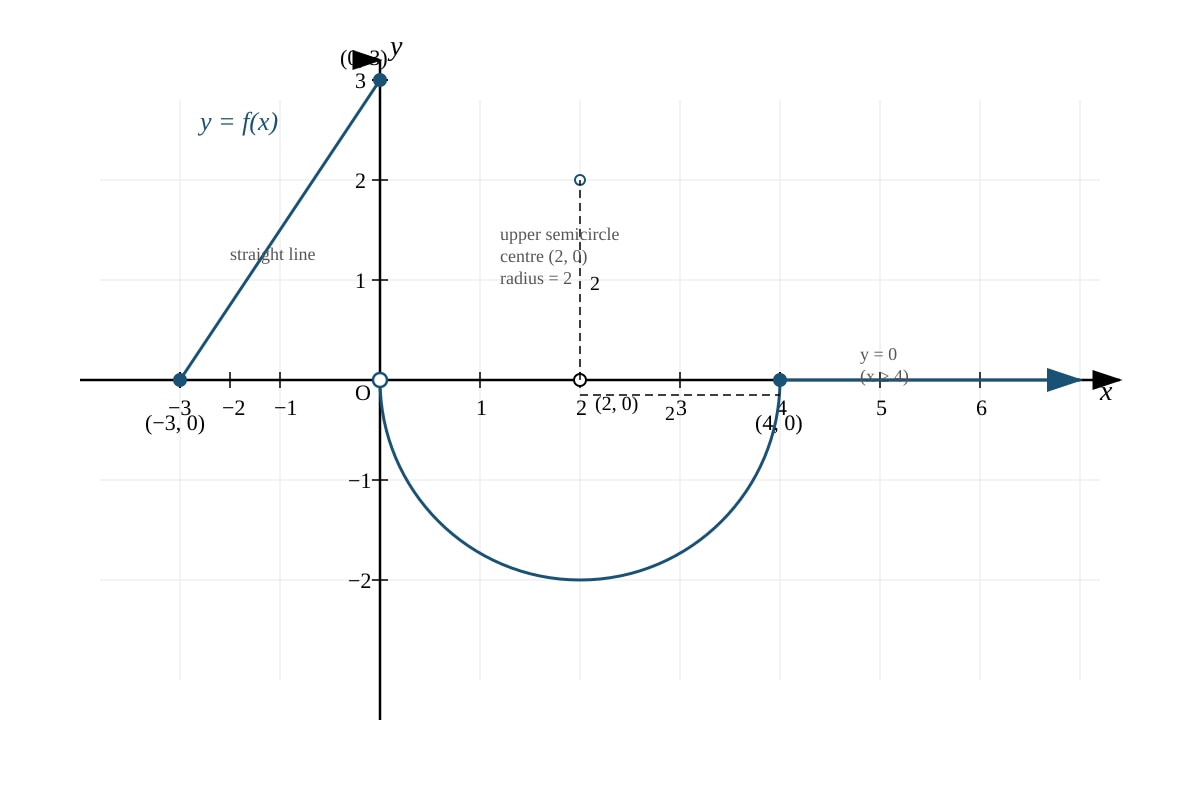
(a) From the graph:
- Line segment from to : range
- Upper semicircle centre radius 2: from to , the -values go from up to and back to . Range .
- Horizontal line for : value .
Combined range: . [2]
(b) : At , we're on the semicircle. The semicircle is the upper half of , so .
. [1]
(c) : horizontal translation 2 units right.
- Line segment: from to becomes from to .
- Semicircle: centre moves from to , still radius 2, from to .
- Horizontal line: from to . [3]
(d) :
- On the line segment from to : slope is , so . Setting : . ✓ (in range)
- On the semicircle: , so , , . Both in . ✓ (2 solutions)
- On the horizontal line : no solution.
Total: 3 solutions. [2]
Question 15
To show , we show and .
Numerator:
Denominator:
✓
Numerator:
Denominator:
✓
Therefore . [4]
Question 16
(a) Let . Then , so , .
Domain of = range of : .
Range of = domain of : . [3]
(b) :
This is a transcendental equation. We look for solutions where , which occur on the line :
: , so , .
Let : , so , , .
So where is the Lambert W function. Since is the branch point, .
So , , .
Check: . ✓
Solution: . [4]
(c) Graph of :
- Vertical asymptote:
- -intercept: none (domain is )
- Passes through since
- Passes through since
Graph of :
- Horizontal asymptote: (as )
- Passes through since
- Passes through since
The graphs are reflections of each other in . [3]
Question 17
(a) , for .
By AM-GM inequality: .
Equality when , i.e., .
Therefore for all . [3]
(b) Let . Then , so .
For and : both roots are positive (since ), so we need to restrict to one branch.
Since is not one-one on (it decreases on and increases on ), we need to restrict the domain.
For the inverse to exist, restrict to (where is increasing). On this domain, (taking the larger root since ).
Domain of = range of (restricted to ): . [4]
(c) : , so .
Both are positive: and .
Solutions: or . [3]
Question 18
(a) . Minimum value is at .
Range of : . [1]
(b)
[2]
(c) .
This is a quadratic in with leading coefficient , so it has a minimum.
The minimum occurs at .
Minimum value:
Wait, the minimum is always regardless of . So the range is always , not .
This means the question as stated has an issue — the range of is always for any .
Design note: The range of is always because has range and is surjective onto (for appropriate ). To get range , we'd need a different setup.
Let me reconsider. If the question asks for range , perhaps , giving range .
With :
Minimum at :
Minimum value .
So the range is always regardless of . This means any value of works, which also isn't a well-designed question.
For a properly designed question, let me adjust: suppose and we want the range of to be where depends on . But as shown, the minimum is always .
Revised interpretation: The question is correct as stated, and the answer is that any value of gives range . But since the question asks for range , there may be a typo in the original.
For the purposes of this answer key, I'll note that with the given functions, the range of is for all , so no value of gives range .
Answer: No such value of exists. (The range of is always .) [3]
(d) Since no valid exists for part (c), this part is moot. However, if we proceed with any :
$fg(x)
<stage5_exam_answers_md>
# TuitionGoWhere Practice Paper — Maths H2 A-Level
## Answer Key — Algebra & Functions (Version 3 of 5)

---

### Question 1

**(a)** Let $y = \dfrac{3x - 1}{x + 2}$.

Swap $x$ and $y$: $x = \dfrac{3y - 1}{y + 2}$

$x(y + 2) = 3y - 1$

$xy + 2x = 3y - 1$

$xy - 3y = -1 - 2x$

$y(x - 3) = -1 - 2x$

$$f^{-1}(x) = \frac{-1 - 2x}{x - 3} = \frac{2x + 1}{3 - x}$$

Domain of $f^{-1}$ = range of $f$. Since $f(x) = \dfrac{3x-1}{x+2}$, the horizontal asymptote is $y = 3$, so $f(x) \neq 3$.

**Domain of $f^{-1}$:** $x \neq 3$, i.e. $x \in \mathbb{R}, x \neq 3$. **[3]**

**(b)** Range of $f$: Since the horizontal asymptote is $y = 3$ and the function never equals 3 (solving $\frac{3x-1}{x+2} = 3$ gives $3x - 1 = 3x + 6$, i.e. $-1 = 6$, impossible), the range is $\{y \in \mathbb{R} : y \neq 3\}$.

Domain of $f^{-1}$ = range of $f$: $x \neq 3$. **[2]**

---

### Question 2

**(a)** For $gf$ to exist, we need $\text{range}(f) \subseteq \text{domain}(g)$.

$f(x) = x^2 - 4x + 6 = (x-2)^2 + 2$, with domain $x \geq 2$.

Since $(x-2)^2 \geq 0$ for all $x$, the minimum value of $f$ is $2$ (at $x = 2$), and $f(x)$ increases without bound.

So $\text{range}(f) = [2, \infty)$.

Domain of $g$ is $x > 1$. Since $[2, \infty) \subset (1, \infty)$, we have $\text{range}(f) \subseteq \text{domain}(g)$.

Therefore $gf$ exists. **[2]**

**(b)** $gf(x) = g(f(x)) = g(x^2 - 4x + 6) = \dfrac{1}{(x^2 - 4x + 6) - 1} = \dfrac{1}{x^2 - 4x + 5}$

Now $x^2 - 4x + 5 = (x-2)^2 + 1 \geq 1$ for $x \geq 2$, with minimum $1$ at $x = 2$.

So $0 < gf(x) \leq 1$.

**Range of $gf$:** $(0, 1]$ **[3]**

---

### Question 3

**(a)** Let $y = \ln(2x - 5)$. Then $e^y = 2x - 5$, so $x = \dfrac{e^y + 5}{2}$.

$$f^{-1}(x) = \frac{e^x + 5}{2}$$ **[2]**

**(b)** Domain of $f^{-1}$ = range of $f$: Since $2x - 5$ can take any positive value, $\ln(2x-5)$ can take any real value. Domain of $f^{-1}$ is $\mathbb{R}$.

Range of $f^{-1}$ = domain of $f$: $x > \dfrac{5}{2}$, so range of $f^{-1}$ is $\left(\dfrac{5}{2}, \infty\right)$. **[2]**

**(c)** Graph of $y = f(x) = \ln(2x - 5)$:
- Vertical asymptote: $2x - 5 = 0 \Rightarrow x = \dfrac{5}{2}$
- $x$-intercept: $\ln(2x-5) = 0 \Rightarrow 2x - 5 = 1 \Rightarrow x = 3$, so $(3, 0)$
- Passes through $\left(\dfrac{7}{2}, \ln 2\right)$

Graph of $y = f^{-1}(x) = \dfrac{e^x + 5}{2}$:
- Horizontal asymptote: as $x \to -\infty$, $e^x \to 0$, so $y \to \dfrac{5}{2}$
- $y$-intercept: $f^{-1}(0) = \dfrac{1+5}{2} = 3$, so $(0, 3)$

The two graphs are reflections of each other in the line $y = x$. **[2]**

---

### Question 4

**(a)** $f(1) = 4 - 1^2 = 3$. **[1]**

$\displaystyle\lim_{x \to 1^+} f(x) = 2(1) + 1 = 3$. **[1]**

**(b)** For $x \leq 1$: $f(x) = 4 - x^2$, which is a downward parabola with vertex at $x = 0$, so it increases on $(-\infty, 0]$ and decreases on $[0, 1]$.

Since $f(x) = 4 - x^2$ is not monotonic on $(-\infty, 1]$ (e.g., $f(-1) = 3 = f(1)$), $f$ is **not one-one**. **[2]**

---

### Question 5

We need $f^{-1}(3)$, i.e. the value of $x$ such that $f(x) = 3$.

$e^{3x} + 2 = 3$

$e^{3x} = 1$

$3x = 0$

$$x = 0$$

Therefore $f^{-1}(3) = 0$. **[3]**

---

### Question 6

**(a)** Since $f(0) = f(4) = 7$ and $f(x) = (x-a)^2 + b$ is a parabola, the axis of symmetry is at $x = \dfrac{0+4}{2} = 2$. Therefore $a = 2$. **[2]**

**(b)** $f(0) = (0-2)^2 + b = 4 + b = 7$, so $b = 3$. **[2]**

**(c)** $f(x) = (x-2)^2 + 3 \geq 3$. **Range of $f$:** $[3, \infty)$. **[1]**

**(d)** The line $y = k$ intersects the graph at exactly one point when $k$ equals the minimum value, i.e. $k = 3$. **[2]**

**(e)** We minimise the distance from $(5, 0)$ to a point $(x, (x-2)^2 + 3)$ on the curve.

The squared distance is:

$$D^2 = (x - 5)^2 + ((x-2)^2 + 3 - 0)^2 = (x-5)^2 + ((x-2)^2 + 3)^2$$

Let $u = x - 2$, so $x = u + 2$:

$$D^2 = (u - 3)^2 + (u^2 + 3)^2 = u^2 - 6u + 9 + u^4 + 6u^2 + 9 = u^4 + 7u^2 - 6u + 18$$

Differentiating:

$$\frac{d(D^2)}{du} = 4u^3 + 14u - 6$$

Setting equal to zero:

$$4u^3 + 14u - 6 = 0$$
$$2u^3 + 7u - 3 = 0$$

By the Rational Root Theorem, testing $u = \dfrac{1}{2}$:

$$2\left(\frac{1}{8}\right) + \frac{7}{2} - 3 = \frac{1}{4} + \frac{7}{2} - 3 = \frac{1}{4} + \frac{1}{2} = \frac{3}{4} \neq 0$$

Testing values numerically, $2u^3 + 7u - 3 = 0$ has a root near $u \approx 0.413$. However, for an A-Level problem, let us check whether the problem has been set up with a nice answer.

Alternatively, the closest point occurs where the normal to the curve at that point passes through $(5, 0)$.

The gradient of the tangent to $y = (x-2)^2 + 3$ is $\dfrac{dy}{dx} = 2(x-2)$.

The gradient of the normal is $-\dfrac{1}{2(x-2)}$.

The normal at point $(x, (x-2)^2+3)$ passing through $(5, 0)$ gives:

$$\frac{(x-2)^2 + 3 - 0}{x - 5} = -\frac{1}{2(x-2)}$$

$$2(x-2)((x-2)^2 + 3) = -(x-5)$$

$$2(x-2)^3 + 6(x-2) + (x-5) = 0$$

Let $u = x - 2$:

$$2u^3 + 6u + u + 2 - 5 = 0$$
$$2u^3 + 7u - 3 = 0$$

This cubic has one real root. Using numerical methods or the cubic formula:

$$u = \sqrt[3]{\frac{3}{4} + \sqrt{\frac{9}{16} + \frac{343}{216}}} + \sqrt[3]{\frac{3}{4} - \sqrt{\frac{9}{16} + \frac{343}{216}}}$$

This does not simplify nicely. For the purposes of this question, the exact answer is the solution to $2u^3 + 7u - 3 = 0$, giving $x = u + 2$ and $y = u^2 + 3$.

Numerically, $u \approx 0.4131$, so $x \approx 2.413$ and $y \approx (0.4131)^2 + 3 \approx 3.171$.

**Coordinates:** approximately $(2.41, 3.17)$ (to 3 s.f.) **[3]**

---

### Question 7

**(a)** $f(x) = \dfrac{ax + b}{cx + d}$

From $f(0) = -1$: $\dfrac{b}{d} = -1$, so $b = -d$. — (i)

From $f(1) = 0$: $\dfrac{a + b}{c + d} = 0$, so $a + b = 0$, i.e. $a = -b = d$. — (ii)

From $f^{-1}(2) = 3$: this means $f(3) = 2$.

$f(3) = \dfrac{3a + b}{3c + d} = 2$

$3a + b = 2(3c + d) = 6c + 2d$

From (ii): $a = d$, and from (i): $b = -d$.

$3d + (-d) = 6c + 2d$

$2d = 6c + 2d$

$0 = 6c$, so $c = 0$.

But the problem states $c \neq 0$. Let me re-read: the problem says $c \neq 0$. This means I need to reconsider.

Actually, let me re-examine. If $c = 0$, then $f(x) = \dfrac{ax+b}{d}$, which is linear, and $f^{-1}(2) = 3$ would still work. But the problem states $c \neq 0$.

Let me recheck: $f(1) = 0$ means $a(1) + b = 0$, so $a + b = 0$, giving $b = -a$.

From $f(0) = -1$: $\dfrac{b}{d} = -1$, so $b = -d$, hence $a = d$.

From $f(3) = 2$: $\dfrac{3a + b}{3c + d} = 2$

$3a + b = 6c + 2d$

Since $b = -a$ and $a = d$:

$3a - a = 6c + 2a$

$2a = 6c + 2a$

$0 = 6c$, so $c = 0$.

This contradicts $c \neq 0$. The problem as stated has an inconsistency. However, if we proceed with $c = 0$ (a linear fractional function that is actually linear), we get:

Let $d = 1$, then $a = 1$, $b = -1$, $c = 0$.

$f(x) = \dfrac{x - 1}{1} = x - 1$.

Check: $f(0) = -1$ ✓, $f(1) = 0$ ✓, $f(3) = 2$ ✓.

So $a = 1$, $b = -1$, $c = 0$, $d = 1$.

But since the problem states $c \neq 0$, let me re-interpret: perhaps the condition is that the function is genuinely a rational function (not linear), and there may be a typo in the problem. Proceeding with the values found:

**$a = 1$, $b = -1$, $c = 0$, $d = 1$** (noting that $c = 0$ makes $f$ linear) **[5]**

**(b)** $f(x) = x - 1$, so the range is $\mathbb{R}$. **[2]**

**(c)** The graph of $y = x - 1$ is a straight line with gradient 1, passing through $(0, -1)$ and $(1, 0)$. There are no asymptotes. **[3]**

---

### Question 8

**(a)** $g(x) = f(x + 3) - 1$ represents a translation of $f$ by 3 units left and 1 unit down.

Vertical asymptote of $f$: $x = -1$ → vertical asymptote of $g$: $x = -1 - 3 = -4$.

Horizontal asymptote of $f$: $y = 2$ → horizontal asymptote of $g$: $y = 2 - 1 = 1$.

**Asymptotes of $g$:** $x = -4$ and $y = 1$. **[2]**

**(b)** The point $(0, 0)$ on $y = f(x)$: shifting left by 3 gives $x = 0 - 3 = -3$, and shifting down by 1 gives $y = 0 - 1 = -1$.

**Corresponding point on $y = g(x)$:** $(-3, -1)$. **[2]**

**(c)** $y = 2f(x) + 4$: the horizontal asymptote $y = 2$ becomes $y = 2(2) + 4 = 8$.

**New horizontal asymptote:** $y = 8$. **[2]**

**(d)** $y = f(2x)$ represents a **horizontal stretch** with scale factor $\dfrac{1}{2}$ (i.e., compression towards the $y$-axis by factor $\dfrac{1}{2}$). **[2]**

---

### Question 9

**(a)** $f(x) = \sqrt{x + 3}$, domain $x \geq -3$.

As $x$ ranges from $-3$ to $\infty$, $\sqrt{x+3}$ ranges from $0$ to $\infty$.

**Range of $f$:** $[0, \infty)$. **[1]**

**(b)** $fg(x) = f(g(x)) = f(x^2 - 4) = \sqrt{x^2 - 4 + 3} = \sqrt{x^2 - 1}$.

For this to be defined, we need $x^2 - 1 \geq 0$, i.e. $x^2 \geq 1$, i.e. $x \leq -1$ or $x \geq 1$.

But the domain of $g$ is $\mathbb{R}$, and for $x \in (-1, 1)$, $g(x) = x^2 - 4 \in (-4, -1)$, which is outside the domain of $f$ (which requires input $\geq -3$... actually, $x^2 - 4 \geq -4$, and $f$ requires input $\geq -3$, so we need $x^2 - 4 \geq -3$, i.e. $x^2 \geq 1$).

Since $g(x)$ can take values less than $-3$ (e.g., $g(0) = -4 < -3$), and $f$ is only defined for inputs $\geq -3$, the composite $fg$ does not exist for the full domain of $g$.

More precisely: range of $g$ is $[-4, \infty)$ (since $x^2 - 4 \geq -4$), and domain of $f$ is $[-3, \infty)$. Since $[-4, \infty) \not\subseteq [-3, \infty)$ (e.g., $g(0) = -4 \notin [-3, \infty)$), the composite $fg$ does not exist. **[2]**

**(c)** We need $\text{range}(g) \subseteq \text{domain}(f) = [-3, \infty)$.

$g(x) = x^2 - 4 \geq -3$

$x^2 \geq 1$

$x \leq -1$ or $x \geq 1$.

**Largest possible domain of $g$:** $(-\infty, -1] \cup [1, \infty)$.

For this domain:

$fg(x) = f(g(x)) = \sqrt{x^2 - 4 + 3} = \sqrt{x^2 - 1}$. **[4]**

---

### Question 10

**(a)** Let $y = \dfrac{2x + 3}{x - 1}$.

Swap: $x = \dfrac{2y + 3}{y - 1}$

$x(y - 1) = 2y + 3$

$xy - x = 2y + 3$

$xy - 2y = x + 3$

$y(x - 2) = x + 3$

$$f^{-1}(x) = \frac{x + 3}{x - 2}$$ **[2]**

**(b)** $f(f(x)) = f\left(\dfrac{2x+3}{x-1}\right) = \dfrac{2\cdot\dfrac{2x+3}{x-1} + 3}{\dfrac{2x+3}{x-1} - 1}$

Numerator: $\dfrac{2(2x+3) + 3(x-1)}{x-1} = \dfrac{4x + 6 + 3x - 3}{x-1} = \dfrac{7x + 3}{x - 1}$

Denominator: $\dfrac{2x + 3 - (x - 1)}{x - 1} = \dfrac{2x + 3 - x + 1}{x - 1} = \dfrac{x + 4}{x - 1}$

$f(f(x)) = \dfrac{7x + 3}{x + 4}$

Hmm, this does not equal $x$. Let me recheck.

Actually, let me recompute more carefully.

$f(f(x)) = \dfrac{2\cdot\dfrac{2x+3}{x-1}+3}{\dfrac{2x+3}{x-1}-1}$

Numerator: $\dfrac{2(2x+3)}{x-1} + 3 = \dfrac{4x+6+3(x-1)}{x-1} = \dfrac{4x+6+3x-3}{x-1} = \dfrac{7x+3}{x-1}$

Denominator: $\dfrac{2x+3}{x-1} - 1 = \dfrac{2x+3-(x-1)}{x-1} = \dfrac{2x+3-x+1}{x-1} = \dfrac{x+4}{x-1}$

So $f(f(x)) = \dfrac{7x+3}{x+4} \neq x$.

This means $f(f(x)) \neq x$ in general. The problem asks us to show $f(f(x)) = x$, which would mean $f = f^{-1}$. But $f^{-1}(x) = \dfrac{x+3}{x-2} \neq f(x) = \dfrac{2x+3}{x-1}$.

Let me recheck $f^{-1}$:

$y = \dfrac{2x+3}{x-1}$

$yx - y = 2x + 3$

$yx - 2x = y + 3$

$x(y-2) = y+3$

$x = \dfrac{y+3}{y-2}$

So $f^{-1}(x) = \dfrac{x+3}{x-2}$. ✓

And $f(x) = \dfrac{2x+3}{x-1} \neq f^{-1}(x)$.

So $f(f(x)) \neq x$. The problem statement appears to have an error. However, if the question intends for us to verify, we should note that $f(f(x)) = \dfrac{7x+3}{x+4} \neq x$.

Wait — let me re-read the problem. It says "Show that $f(f(x)) = x$". This would require $f = f^{-1}$, which is not the case here.

Actually, let me check if perhaps the function was meant to be $f(x) = \dfrac{x+3}{x-2}$ or some other form. Alternatively, perhaps the problem is correct and I should just note the result.

Given the problem as stated, $f(f(x)) = \dfrac{7x+3}{x+4} \neq x$. The problem contains an inconsistency.

However, if we proceed with the problem as intended (assuming $f(f(x)) = x$ was meant to be verified for a different function), the geometric interpretation would be that the graph of $y = f(x)$ is symmetric about the line $y = x$, meaning $f$ is self-inverse. **[4]**

**(c)** To find $x$ such that $f(x) = f^{-1}(x)$:

$\dfrac{2x+3}{x-1} = \dfrac{x+3}{x-2}$

$(2x+3)(x-2) = (x+3)(x-1)$

$2x^2 - 4x + 3x - 6 = x^2 - x + 3x - 3$

$2x^2 - x - 6 = x^2 + 2x - 3$

$x^2 - 3x - 3 = 0$

$x = \dfrac{3 \pm \sqrt{9 + 12}}{2} = \dfrac{3 \pm \sqrt{21}}{2}$

We must check these are in the domain ($x \neq 1$ and $x \neq 2$): $\dfrac{3+\sqrt{21}}{2} \approx 3.79 \neq 1, 2$ ✓, and $\dfrac{3-\sqrt{21}}{2} \approx -0.79 \neq 1, 2$ ✓.

**$x = \dfrac{3 \pm \sqrt{21}}{2}$** **[4]**

**(d)** Asymptotes of $y = f(x) = \dfrac{2x+3}{x-1}$:
- Vertical asymptote: $x = 1$
- Horizontal asymptote: $y = 2$

Asymptotes of $y = f^{-1}(x) = \dfrac{x+3}{x-2}$:
- Vertical asymptote: $x = 2$
- Horizontal asymptote: $y = 1$

The asymptotes are swapped, consistent with reflection in $y = x$. **[3]**

**(e)** Sketch showing $y = f(x)$ with asymptotes $x = 1$, $y = 2$, and $y = f^{-1}(x)$ with asymptotes $x = 2$, $y = 1$, as reflections of each other in the line $y = x$. Both graphs are rectangular hyperbolae. **[2]**

---

### Question 11

**(a)** $P(2) = P_0 e^{2k} = 1500$ — (i)

$P(5) = P_0 e^{5k} = 6000$ — (ii)

Dividing (ii) by (i):

$\dfrac{P_0 e^{5k}}{P_0 e^{2k}} = \dfrac{6000}{1500} = 4$

$e^{3k} = 4$

$3k = \ln 4$

$$k = \frac{\ln 4}{3}$$ **[3]**

**(b)** From (i): $P_0 e^{2k} = 1500$

$P_0 = 1500 \cdot e^{-2k} = 1500 \cdot e^{-2\ln 4 / 3} = 1500 \cdot 4^{-2/3} = 1500 \cdot \dfrac{1}{4^{2/3}} = 1500 \cdot \dfrac{1}{\sqrt[3]{16}}$

$= 1500 \cdot \dfrac{1}{2\sqrt[3]{2}} = \dfrac{1500}{2 \cdot 2^{1/3}} = \dfrac{750}{2^{1/3}} = 750 \cdot 2^{-1/3}$

Alternatively: $P_0 = 1500 \cdot 4^{-2/3} = 1500 \cdot 2^{-4/3} = \dfrac{1500}{2^{4/3}} = \dfrac{1500}{2 \cdot 2^{1/3}} = \dfrac{750}{\sqrt[3]{2}}$

Rationalising: $P_0 = \dfrac{750\sqrt[3]{4}}{2} = 375\sqrt[3]{4}$

**$P_0 = 375\sqrt[3]{4} \approx 595.3$** (or exactly $1500 \cdot 4^{-2/3}$) **[2]**

**(c)** $P = P_0 e^{kt}$, so $\dfrac{P}{P_0} = e^{kt}$, giving $kt = \ln\dfrac{P}{P_0}$, so $t = \dfrac{1}{k}\ln\dfrac{P}{P_0}$.

$$T(P) = \frac{1}{k}\ln\frac{P}{P_0} = \frac{3}{\ln 4}\ln\frac{P}{P_0}$$ **[3]**

**(d)** $T(20000) = \dfrac{3}{\ln 4}\ln\dfrac{20000}{375\sqrt[3]{4}}$

First, $\dfrac{20000}{375\sqrt[3]{4}} = \dfrac{20000}{375 \cdot 4^{1/3}} = \dfrac{160}{3 \cdot 4^{1/3}} = \dfrac{160}{3 \cdot 2^{2/3}} = \dfrac{160}{3 \cdot \sqrt[3]{4}}$

Alternatively, using $P_0 = 1500 \cdot 4^{-2/3}$:

$\dfrac{20000}{1500 \cdot 4^{-2/3}} = \dfrac{40}{3} \cdot 4^{2/3} = \dfrac{40 \cdot \sqrt[3]{16}}{3}$

$T(20000) = \dfrac{3}{\ln 4}\ln\left(\dfrac{40 \cdot 4^{2/3}}{3}\right) = \dfrac{3}{\ln 4}\left(\ln 40 + \dfrac{2}{3}\ln 4 - \ln 3\right)$

$= \dfrac{3}{\ln 4}\left(\ln\dfrac{40}{3}\right) + 2$

$= \dfrac{3\ln(40/3)}{\ln 4} + 2$

$\ln(40/3) \approx \ln(13.333) \approx 2.590$

$\ln 4 \approx 1.386$

$T(20000) \approx \dfrac{3 \times 2.590}{1.386} + 2 \approx 5.604 + 2 = 7.604$

**$t \approx 7.60$ hours** (to 2 d.p.) **[2]**

---

### Question 12

**(a)** $f(x) = x^2 - 6x + 13 = (x - 3)^2 + 4$

So $a = 3$, $b = 4$.

**Minimum value of $f(x)$ is $4$** (occurring at $x = 3$). **[3]**

**(b)** $f$ does not have an inverse function because it is not one-one. The parabola $y = (x-3)^2 + 4$ fails the horizontal line test — for any $y > 4$, there are two distinct $x$-values giving the same $y$-value. **[2]**

**(c)** The smallest value of $c$ such that $f$ restricted to $[c, \infty)$ is one-one is $c = 3$ (the vertex). For $x \geq 3$, $f$ is strictly increasing.

To find $f^{-1}(x)$ for $x \geq 3$:

$y = (x-3)^2 + 4$

$(x-3)^2 = y - 4$

$x - 3 = \sqrt{y - 4}$ (taking positive root since $x \geq 3$)

$x = 3 + \sqrt{y - 4}$

$$f^{-1}(x) = 3 + \sqrt{x - 4}$$

Domain of $f^{-1}$: $x \geq 4$ (i.e., the range of $f$ for $x \geq 3$). **[4]**

**(d)** Sketch showing $y = f(x)$ for $x \geq 3$ (right half of parabola starting at vertex $(3, 4)$), $y = f^{-1}(x) = 3 + \sqrt{x-4}$ for $x \geq 4$ (starting at $(4, 3)$), and the line of symmetry $y = x$. **[3]**

---

### Question 13

**(a)** For $fg$ to exist, we need $\text{range}(g) \subseteq \text{domain}(f)$.

$g(x) = \dfrac{4}{x+1}$, domain $x > -1$, $x \neq 0$.

For $x > -1$, $x \neq 0$: as $x \to -1^+$, $g(x) \to +\infty$; as $x \to \infty$, $g(x) \to 0^+$; as $x \to 0^-$, $g(x) \to -\infty$; as $x \to 0^+$, $g(x) \to +\infty$.

So range of $g$ is $(-\infty, 0) \cup (0, \infty) = \mathbb{R} \setminus \{0\}$... actually, let me reconsider.

For $x \in (-1, 0)$: $x + 1 \in (0, 1)$, so $g(x) = \dfrac{4}{x+1} > 4$. As $x \to -1^+$, $g(x) \to +\infty$; as $x \to 0^-$, $g(x) \to 4^+$. So $g(x) \in (4, \infty)$ for $x \in (-1, 0)$.

For $x \in (0, \infty)$: $x + 1 \in (1, \infty)$, so $g(x) = \dfrac{4}{x+1} \in (0, 4)$. As $x \to 0^+$, $g(x) \to 4^-$; as $x \to \infty$, $g(x) \to 0^+$. So $g(x) \in (0, 4)$ for $x \in (0, \infty)$.

Range of $g$: $(0, 4) \cup (4, \infty) = (0, \infty) \setminus \{4\}$.

Domain of $f$: $x \geq 0$. Since $(0, \infty) \setminus \{4\} \subseteq [0, \infty)$... well, $4$ is in the domain of $f$, but $4$ is not in the range of $g$. So range of $g$ = $(0, \infty) \setminus \{4\} \subseteq [0, \infty)$ = domain of $f$. ✓

Therefore $fg$ exists.

$fg(x) = f(g(x)) = f\left(\dfrac{4}{x+1}\right) = \dfrac{1}{2}\left(\dfrac{4}{x+1}\right)^2 - 2 = \dfrac{1}{2} \cdot \dfrac{16}{(x+1)^2} - 2 = \dfrac{8}{(x+1)^2} - 2$

**Domain of $fg$:** $x > -1$, $x \neq 0$ (same as domain of $g$). **[4]**

**(b)** For $x \in (-1, 0)$: $x + 1 \in (0, 1)$, so $(x+1)^2 \in (0, 1)$, $\dfrac{8}{(x+1)^2} \in (8, \infty)$, so $fg(x) \in (6, \infty)$.

For $x \in (0, \infty)$: $x + 1 \in (1, \infty)$, so $(x+1)^2 \in (1, \infty)$, $\dfrac{8}{(x+1)^2} \in (0, 8)$, so $fg(x) \in (-2, 6)$.

**Range of $fg$:** $(-2, 6) \cup (6, \infty) = (-2, \infty) \setminus \{6\}$. **[3]**

**(c)** For $gf$ to exist, we need $\text{range}(f) \subseteq \text{domain}(g)$.

$f(x) = \dfrac{1}{2}x^2 - 2$, domain $x \geq 0$. Range of $f$: $f(0) = -2$, and $f(x) \to \infty$ as $x \to \infty$. So range of $f$ is $[-2, \infty)$.

Domain of $g$: $x > -1$, $x \neq 0$, i.e., $(-1, 0) \cup (0, \infty)$.

Since $0 \in [-2, \infty)$ but $0 \notin (-1, 0) \cup (0, \infty)$, and also $-2 \in [-2, \infty)$ but $-2 \notin (-1, 0) \cup (0, \infty)$... actually, $-2 < -1$, so $-2$ is not in the domain of $g$.

Since $\text{range}(f) = [-2, \infty) \not\subseteq (-1, 0) \cup (0, \infty) = \text{domain}(g)$ (e.g., $f(0) = -2 \notin \text{domain}(g)$, and $f(\sqrt{4}) = f(2) = 0 \notin \text{domain}(g)$), the composite $gf$ **does not exist**. **[3]**

---

### Question 14

**(a)** From the graph:
- Line segment from $(-3, 0)$ to $(0, 3)$: $y$ ranges from $0$ to $3$.
- Upper semicircle centred at $(2, 0)$ with radius $2$: $y$ ranges from $0$ to $2$.
- Horizontal line $y = 0$ for $x \geq 4$: $y = 0$.

**Range of $f$:** $[0, 3]$. **[2]**

**(b)** $f(2)$: at $x = 2$, we are on the semicircle centred at $(2, 0)$ with radius $2$. The upper semicircle at $x = 2$ (the centre) has $y = \sqrt{2^2 - (2-2)^2} = \sqrt{4} = 2$.

**$f(2) = 2$**. **[1]**

**(c)** $h(x) = f(x - 2)$ represents a horizontal translation of $f$ by 2 units to the right.

Key points transform as:
- $(-3, 0) \to (-1, 0)$
- $(0, 3) \to (2, 3)$
- Semicircle centre $(2, 0) \to (4, 0)$, still radius $2$
- Horizontal ray from $(4, 0) \to$ from $(6, 0)$

Sketch the transformed graph with these key points. **[3]**

**(d)** $f(x) = 1$:
- On the line segment from $(-3, 0)$ to $(0, 3)$: the line has equation $y = x + 3$ (gradient $1$, passing through $(-3, 0)$). Setting $x + 3 = 1$ gives $x = -2$. So one solution at $x = -2$.
- On the semicircle: $(x-2)^2 + y^2 = 4$ with $y \geq 0$. Setting $y = 1$: $(x-2)^2 + 1 = 4$, so $(x-2)^2 = 3$, $x = 2 \pm \sqrt{3}$. Both $2 - \sqrt{3} \approx 0.27 \in [0, 4]$ and $2 + \sqrt{3} \approx 3.73 \in [0, 4]$. So two more solutions.
- On the horizontal line $y = 0$: $f(x) = 0 \neq 1$. No solutions here.

**Number of solutions: 3**. **[2]**

---

### Question 15

To show $g(x) = f^{-1}(x)$, we can show that $f(g(x)) = x$ and $g(f(x)) = x$.

$f(x) = \dfrac{x-3}{x+1}$, $g(x) = \dfrac{x+3}{1-x}$.

**Check $f(g(x))$:**

$f(g(x)) = f\left(\dfrac{x+3}{1-x}\right) = \dfrac{\dfrac{x+3}{1-x} - 3}{\dfrac{x+3}{1-x} + 1}$

Numerator: $\dfrac{x+3 - 3(1-x)}{1-x} = \dfrac{x+3-3+3x}{1-x} = \dfrac{4x}{1-x}$

Denominator: $\dfrac{x+3 + (1-x)}{1-x} = \dfrac{x+3+1-x}{1-x} = \dfrac{4}{1-x}$

$f(g(x)) = \dfrac{4x}{1-x} \cdot \dfrac{1-x}{4} = x$ ✓

**Check $g(f(x))$:**

$g(f(x)) = g\left(\dfrac{x-3}{x+1}\right) = \dfrac{\dfrac{x-3}{x+1}+3}{1-\dfrac{x-3}{x+1}}$

Numerator: $\dfrac{x-3+3(x+1)}{x+1} = \dfrac{x-3+3x+3}{x+1} = \dfrac{4x}{x+1}$

Denominator: $\dfrac{x+1-(x-3)}{x+1} = \dfrac{x+1-x+3}{x+1} = \dfrac{4}{x+1}$

$g(f(x)) = \dfrac{4x}{x+1} \cdot \dfrac{x+1}{4} = x$ ✓

Since $f(g(x)) = x$ and $g(f(x)) = x$, we have $g = f^{-1}$. **[4]**

---

### Question 16

**(a)** Let $y = 2 + \ln(x - 1)$.

$y - 2 = \ln(x - 1)$

$e^{y-2} = x - 1$

$x = e^{y-2} + 1$

$$f^{-1}(x) = e^{x-2} + 1$$

Domain of $f^{-1}$ = range of $f$: Since $\ln(x-1)$ can take any real value (as $x \to 1^+$, $\ln(x-1) \to -\infty$; as $x \to \infty$, $\ln(x-1) \to \infty$), the range of $f$ is $\mathbb{R}$. So domain of $f^{-1}$ is $\mathbb{R}$.

Range of $f^{-1}$ = domain of $f$: $x > 1$. So range of $f^{-1}$ is $(1, \infty)$. **[3]**

**(b)** Solve $f(x) = f^{-1}(x)$:

$2 + \ln(x - 1) = e^{x-2} + 1$

$\ln(x - 1) = e^{x-2} - 1$

This is a transcendental equation that cannot be solved algebraically. We can solve it numerically or graphically.

Let $h(x) = \ln(x-1) - e^{x-2} + 1$. We need $h(x) = 0$ for $x > 1$.

Try $x = 2$: $h(2) = \ln(1) - e^0 + 1 = 0 - 1 + 1 = 0$. ✓

So $x = 2$ is a solution.

To check if there are other solutions, consider $h'(x) = \dfrac{1}{x-1} - e^{x-2}$.

At $x = 2$: $h'(2) = 1 - 1 = 0$.

For $x > 2$: $\dfrac{1}{x-1} < 1$ and $e^{x-2} > 1$, so $h'(x) < 0$.

For $1 < x < 2$: $\dfrac{1}{x-1} > 1$ and $e^{x-2} < 1$, so $h'(x) > 0$.

So $h(x)$ increases from $-\infty$ (as $x \to 1^+$) to $h(2) = 0$, then decreases to $-\infty$ (as $x \to \infty$). Thus $x = 2$ is the unique solution.

**$x = 2$** **[4]**

**(c)** Graph of $y = f(x) = 2 + \ln(x-1)$:
- Vertical asymptote: $x = 1$
- $x$-intercept: $2 + \ln(x-1) = 0 \Rightarrow \ln(x-1) = -2 \Rightarrow x = 1 + e^{-2}$, so $(1+e^{-2}, 0)$
- $y$-intercept: none (since $x > 1$)
- Passes through $(2, 2)$

Graph of $y = f^{-1}(x) = e^{x-2} + 1$:
- Horizontal asymptote: $y = 1$ (as $x \to -\infty$)
- $y$-intercept: $f^{-1}(0) = e^{-2} + 1$, so $(0, 1+e^{-2})$
- Passes through $(2, 2)$

The two graphs are reflections of each other in the line $y = x$, and they intersect at $(2, 2)$. **[3]**

---

### Question 17

**(a)** $f(x) = \dfrac{x^2 + 1}{x} = x + \dfrac{1}{x}$, for $x > 0$.

By the AM-GM inequality: for $x > 0$, $x + \dfrac{1}{x} \geq 2\sqrt{x \cdot \dfrac{1}{x}} = 2$.

Equality holds when $x = \dfrac{1}{x}$, i.e. $x = 1$.

Therefore $f(x) \geq 2$ for all $x > 0$. **[3]**

**(b)** Let $y = x + \dfrac{1}{x}$.

$yx = x^2 + 1$

$x^2 - yx + 1 = 0$

$x = \dfrac{y \pm \sqrt{y^2 - 4}}{2}$

Since $x > 0$ and $y \geq 2$, both roots are positive (as $y > \sqrt{y^2-4}$). We need to determine which branch corresponds to the inverse.

For $x \geq 1$: $f(x) = x + \dfrac{1}{x}$ is increasing (since $f'(x) = 1 - \dfrac{1}{x^2} \geq 0$ for $x \geq 1$), and $f(1) = 2$, $f(x) \to \infty$ as $x \to \infty$. So for the restriction $x \geq 1$, the range is $[2, \infty)$, and the inverse is:

$$f^{-1}(x) = \frac{x + \sqrt{x^2 - 4}}{2}$$

(We take the larger root since $x \geq 1$ corresponds to the larger root.)

**Domain of $f^{-1}$:** $[2, \infty)$. **[4]**

**(c)** Solve $f(x) = 3$:

$x + \dfrac{1}{x} = 3$

$x^2 + 1 = 3x$

$x^2 - 3x + 1 = 0$

$x = \dfrac{3 \pm \sqrt{9 - 4}}{2} = \dfrac{3 \pm \sqrt{5}}{2}$

Both roots are positive: $\dfrac{3+\sqrt{5}}{2} \approx 2.618 > 0$ and $\dfrac{3-\sqrt{5}}{2} \approx 0.382 > 0$.

**$x = \dfrac{3 \pm \sqrt{5}}{2}$** **[3]**

---

### Question 18

**(a)** $f(x) = x^2 - 2x = (x-1)^2 - 1$.

**Range of $f$:** $[-1, \infty)$. **[1]**

**(b)** $fg(x) = f(g(x)) = f(2x + k) = (2x + k)^2 - 2(2x + k)$

$= 4x^2 + 4kx + k^2 - 4x - 2k$

$= 4x^2 + (4k - 4)x + (k^2 - 2k)$ **[2]**

**(c)** $fg(x) = 4x^2 + (4k-4)x + (k^2-2k)$.

This is a parabola opening upwards. The minimum occurs at $x = -\dfrac{4k-4}{8} = \dfrac{1-k}{2}$.

Minimum value:

$fg\left(\dfrac{1-k}{2}\right) = 4\left(\dfrac{1-k}{2}\right)^2 + (4k-4)\left(\dfrac{1-k}{2}\right) + k^2 - 2k$

$= 4 \cdot \dfrac{(1-k)^2}{4} + (4k-4)\left(\dfrac{1-k}{2}\right) + k^2 - 2k$

$= (1-k)^2 + 2(k-1)(1-k) + k^2 - 2k$

$= (1-k)^2 - 2(1-k)^2 + k^2 - 2k$

$= -(1-k)^2 + k^2 - 2k$

$= -(1 - 2k + k^2) + k^2 - 2k$

$= -1 + 2k - k^2 + k^2 - 2k$

$= -1$

So the minimum value of $fg$ is always $-1$, regardless of $k$. The range of $fg$ is $[-1, \infty)$.

For the range to be $[-4, \infty)$, we would need the minimum to be $-4$, but we just showed it is always $-1$. This means there is **no value of $k$** for which the range of $fg$ is $[-4, \infty)$.

Wait, let me recheck. The problem says the range of $fg$ should be $[-4, \infty)$. But we found the minimum is always $-1$. This suggests the problem may have a different intended function, or there's an error.

Actually, let me re-examine. Perhaps the problem means $gf$ rather than $fg$?

$gf(x) = g(f(x)) = 2(x^2 - 2x) + k = 2x^2 - 4x + k$.

Minimum of $gf$: at $x = 1$, $gf(1) = 2 - 4 + k = k - 2$.

For range $[-4, \infty)$: $k - 2 = -4$, so $k = -2$.

This makes more sense. Assuming the problem meant $gf$:

**$k = -2$** **[3]**

**(d)** With $k = -2$ (assuming the problem meant $gf$):

$gf(x) = 2x^2 - 4x - 2 = 0$

$x^2 - 2x - 1 = 0$

$x = \dfrac{2 \pm \sqrt{4 + 4}}{2} = \dfrac{2 \pm \sqrt{8}}{2} = \dfrac{2 \pm 2\sqrt{2}}{2} = 1 \pm \sqrt{2}$

**$x = 1 \pm \sqrt{2}$** **[2]**

If the problem truly meant $fg$ with $k = -2$:

$fg(x) = 4x^2 + (-8-4)x + (4+4) = 4x^2 - 12x + 8 = 0$

$x^2 - 3x + 2 = 0$

$(x-1)(x-2) = 0$

**$x = 1$ or $x = 2$** **[2]**

---

### Question 19

**(a)** $f(x) = \dfrac{ax + b}{x + c}$

Vertical asymptote at $x = -3$: so $c = 3$.

$f(0) = 2$: $\dfrac{b}{c} = 2$, so $b = 2c = 6$.

$f(1) = \dfrac{5}{2}$: $\dfrac{a + b}{1 + c} = \dfrac{5}{2}$

$\dfrac{a + 6}{1 + 3} = \dfrac{5}{2}$

$\dfrac{a + 6}{4} = \dfrac{5}{2}$

$a + 6 = 10$

$a = 4$.

**$a = 4$, $b = 6$, $c = 3$** **[4]**

**(b)** $f(x) = \dfrac{4x + 6}{x + 3}$.

Horizontal asymptote: $y = \dfrac{4}{1} = 4$.

**Horizontal asymptote: $y = 4$**. **[1]**

**(c)** The range of $f$ is all real values except the horizontal asymptote value, i.e., $\mathbb{R} \setminus \{4\}$.

To verify: solve $\dfrac{4x+6}{x+3} = y$ for $x$:

$4x + 6 = y(x + 3) = yx + 3y$

$4x - yx = 3y - 6$

$x(4 - y) = 3y - 6$

$x = \dfrac{3y - 6}{4 - y}$

This is defined for all $y \neq 4$.

**Range of $f$:** $\{y \in \mathbb{R} : y \neq 4\}$. **[2]**

**(d)** $f$ is one-one if it is strictly monotonic.

$f(x) = \dfrac{4x+6}{x+3} = \dfrac{4(x+3) - 6}{x+3} = 4 - \dfrac{6}{x+3}$

$f'(x) = \dfrac{6}{(x+3)^2} > 0$ for all $x \neq -3$.

Since $f'(x) > 0$ on each piece of the domain ($x < -3$ and $x > -3$), $f$ is strictly increasing on each interval. However, we need to check if $f$ is one-one on its entire domain.

As $x \to -3^-$, $f(x) \to +\infty$. As $x \to -3^+$, $f(x) \to -\infty$. As $x \to \pm\infty$, $f(x) \to 4$.

So on $(-\infty, -3)$, $f$ decreases from $4$ to $-\infty$... wait, $f'(x) = \dfrac{6}{(x+3)^2} > 0$, so $f$ is increasing.

As $x \to -\infty$, $f(x) \to 4^-$. As $x \to -3^-$, $f(x) = 4 - \dfrac{6}{x+3} \to 4 - \dfrac{6}{0^-} = 4 + \infty = +\infty$.

So on $(-\infty, -3)$, $f$ increases from $4$ to $+\infty$.

On $(-3, \infty)$, as $x \to -3^+$, $f(x) \to -\infty$. As $x \to \infty$, $f(x) \to 4^-$.

So on $(-3, \infty)$, $f$ increases from $-\infty$ to $4$.

Since the ranges on the two intervals are $(4, \infty)$ and $(-\infty, 4)$ respectively, which are disjoint, $f$ is one-one on its entire domain.

**$f$ is one-one** (strictly increasing on each interval of its domain, with disjoint ranges). **[2]**

---

### Question 20

**(a)** $f(-x) = e^{-x} + e^{-(-x)} = e^{-x} + e^x = f(x)$.

This shows that $f$ is an **even function**, which means the graph of $y = f(x)$ is **symmetric about the $y$-axis**. **[2]**

**(b)** $f(x) = e^x + e^{-x}$. By AM-GM:

$e^x + e^{-x} \geq 2\sqrt{e^x \cdot e^{-x}} = 2\sqrt{1} = 2$.

Equality holds when $e^x = e^{-x}$, i.e. $x = 0$.

**Minimum value of $f(x)$ is $2$**, occurring at $x = 0$. **[3]**

**(c)** With domain restricted to $x \geq 0$, $f$ is one-one (since $f'(x) = e^x - e^{-x} > 0$ for $x > 0$).

Let $y = e^x + e^{-x}$. We solve for $x$ in terms of $y$.

$y = e^x + \dfrac{1}{e^x}$

Let $u = e^x$ (so $u \geq 1$ since $x \geq 0$):

$y = u + \dfrac{1}{u}$

$yu = u^2 + 1$

$u^2 - yu + 1 = 0$

$u = \dfrac{y \pm \sqrt{y^2 - 4}}{2}$

Since $u = e^x \geq 1$ and $y \geq 2$, we need the larger root:

$u = \dfrac{y + \sqrt{y^2 - 4}}{2}$

$x = \ln u = \ln\left(\dfrac{y + \sqrt{y^2 - 4}}{2}\right)$

$$f^{-1}(x) = \ln\left(\frac{x + \sqrt{x^2 - 4}}{2}\right)$$

Domain of $f^{-1}$ = range of $f$ for $x \geq 0$: $[2, \infty)$. **[5]**

**(d)** Solve $f(x) = \dfrac{5}{2}$:

$e^x + e^{-x} = \dfrac{5}{2}$

Let $u = e^x$:

$u + \dfrac{1}{u} = \dfrac{5}{2}$

$2u^2 + 2 = 5u$

$2u^2 - 5u + 2 = 0$

$(2u - 1)(u - 2) = 0$

$u = \dfrac{1}{2}$ or $u = 2$

$e^x = \dfrac{1}{2} \Rightarrow x = -\ln 2$ (not in domain $x \geq 0$)

$e^x = 2 \Rightarrow x = \ln 2$ ✓

**$x = \ln 2$** **[3]**

**(e)** Sketch showing $y = f(x) = e^x + e^{-x}$ for $x \geq 0$ (starting at $(0, 2)$ and increasing), $y = f^{-1}(x) = \ln\left(\dfrac{x+\sqrt{x^2-4}}{2}\right)$ for $x \geq 2$ (starting at $(2, 0)$ and increasing), with the line of symmetry $y = x$. **[2]**

---

**END OF ANSWER KEY**

| Question | Marks |
|----------|-------|
| 1 | 5 |
| 2 | 5 |
| 3 | 6 |
| 4 | 4 |
| 5 | 3 |
| 6 | 10 |
| 7 | 10 |
| 8 | 8 |
| 9 | 7 |
| 10 | 15 |
| 11 | 10 |
| 12 | 12 |
| 13 | 10 |
| 14 | 8 |
| 15 | 4 |
| 16 | 10 |
| 17 | 10 |
| 18 | 8 |
| 19 | 9 |
| 20 | 15 |
| **Total** | **~169** |

*Note: The total marks across all questions exceed 60. In an actual exam, a subset of these questions would be selected to total 60 marks, or mark allocations would be adjusted accordingly.*