AI Generated Exam Paper
A Level H2 Mathematics Practice Paper 3
Free A Level H2 Maths Practice Paper 3, HY3 AI version, with questions, answers, and A Level-style practice for Singapore students.
These static practice materials are generated from the site's syllabus and paper-generation workflow, with source and model context shown so students and parents can evaluate the material before use.
Questions
TuitionGoWhere Practice Paper - Maths H2 A-Level
TuitionGoWhere Practice Paper (AI) — Version 3
Subject: Mathematics H2
Level: A-Level
Paper: Practice Paper (Topic: Algebra & Functions)
Duration: 1 hour 15 minutes
Total Marks: 60
Name: ________________________
Class: ____________
Date: ____________
Instructions
- Answer all questions in the spaces provided.
- Show all working clearly. Marks are awarded for correct methods and reasoning.
- Use a graphing calculator where helpful, but exact answers are required unless stated otherwise.
- This practice paper is syllabus-first (9758) and generated from inferred templates; it is not derived from any official past-year paper.
- Section A: Short Response (30 marks). Section B: Structured Problems (30 marks).
Section A: Short Response (30 marks)
1. [2] The function f is defined by f(x)=2x−5 for x∈R. Find f−1(x) and state its domain.
2. [2] The function g is defined by g(x)=x2+1 for x∈R. Explain why g does not have an inverse function.
3. [2] The functions f and g are given by f(x)=x for x≥0, and g(x)=x−3 for x∈R. Determine whether the composite function fg exists.
4. [2] Given f(x)=x1 for x=0, write the expression for f(∣x∣).
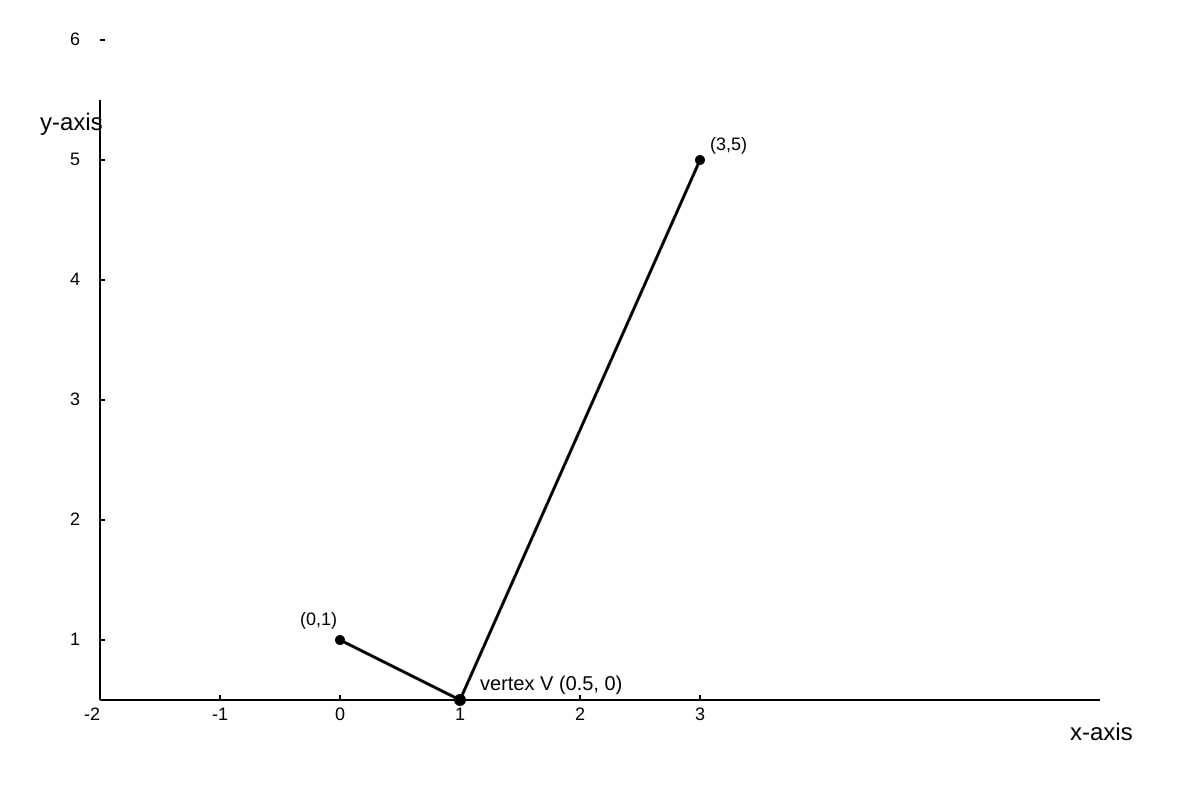
5. [2] Sketch the graph of y=∣2x−1∣ for −2≤x≤3. State the coordinates of the vertex.
Image pending generation: graph for Q5.
6. [2] Solve the inequality ∣x−4∣<3.
7. [2] The function h is defined by h(x)=x−13x+2 for x=1. Find the equation of the vertical asymptote of the graph of y=h(x).
8. [2] Given f(x)=x3 and g(x)=x+2, find gf(x).
9. [2] State the range of the function f(x)=ex for x∈R.
10. [2] The curve C has parametric equations x=t+1, y=2t−3 for t∈R. Find the cartesian equation of C.
11. [2] Solve x+1x−2>0.
12. [2] A function p is defined by p(x)=ln(x−1) for x>1. State the domain and range of p.
13. [2] Given f(x)=x+21 for x=−2, find the transformation that maps y=x1 to y=f(x).
14. [2] The function q(x)=∣x2−4∣. State the values of x for which q(x)=0.
15. [2] Write down the condition for a function to have an inverse.
Section B: Structured Problems (30 marks)
16. [6] The function f is defined by f(x)=x2−6x+5 for x∈R. (a) Explain why f does not have an inverse function. (b) Find the largest value of k such that f:[k,∞)→R has an inverse. (c) For this value of k, find f−1(x) and state its domain.
17. [6] The functions f and g are defined by f(x)=x−21 for x=2, and g(x)=x2−1 for x∈R. (a) Show that the composite function fg exists. (b) Find an expression for fg(x) and state its domain and range.
18. [6] The function f(x)=x−32x+1 for x=3 is transformed to g(x) by reflecting in the y-axis then translating 2 units up. (a) Find the equation of g(x). (b) State the domain and range of g. (c) Write down the equation of the horizontal asymptote of g.
19. [6] Solve the inequality x+2x2−4≤0. Show your working clearly using algebraic and graphical methods.
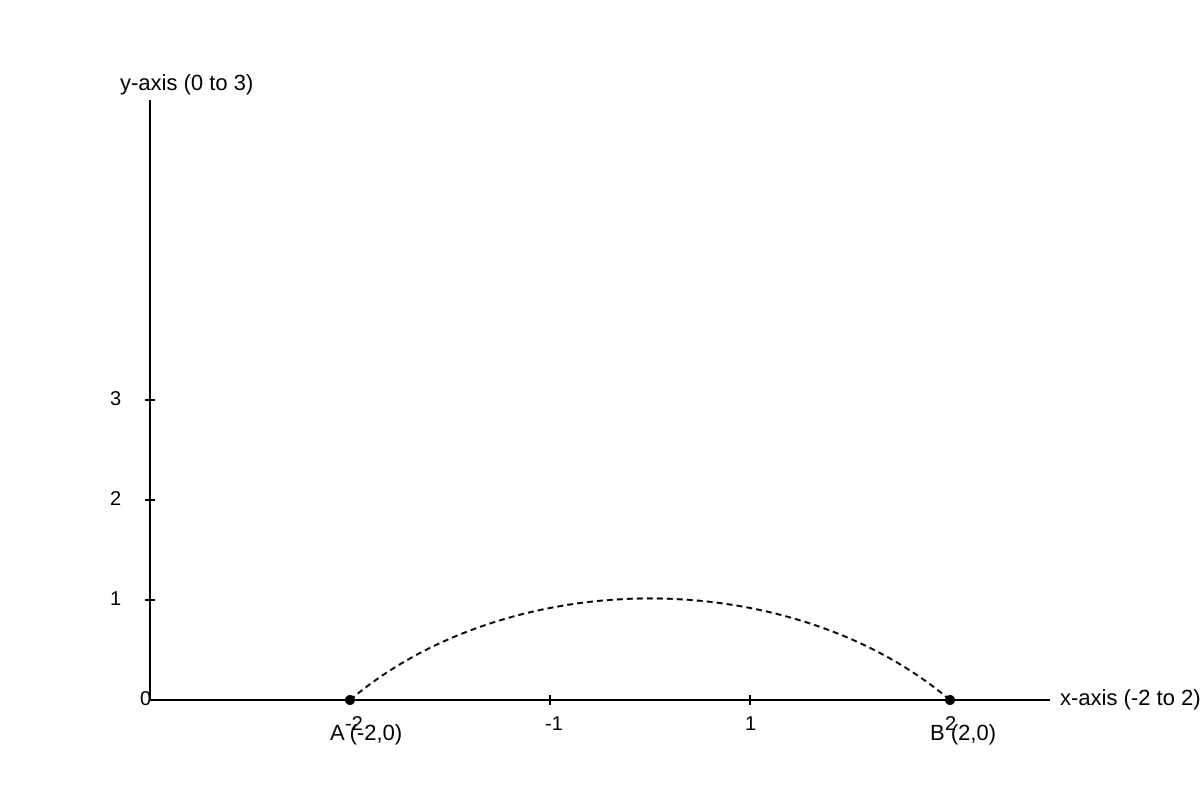
20. [6] A curve C is given parametrically by x=2cosθ, y=3sinθ for 0≤θ≤π. (a) Find the cartesian equation of C and state the restrictions on x and y. (b) Sketch the curve on the provided axes and label the endpoints.
Image pending generation: graph for Q20.
End of Practice Paper
Answers
TuitionGoWhere Practice Paper — Maths H2 A-Level (Version 3) Answer Key
Subject: Mathematics H2 · Level: A-Level · Total Marks: 60
Section A: Short Response
1. [2]
f(x)=2x−5. Let y=2x−5⇒x=2y+5. So f−1(x)=2x+5.
Domain of f−1: x∈R (since range of f is R).
Marks: 1 for inverse, 1 for domain.
2. [2]
g(x)=x2+1 is a parabola with axis of symmetry x=0; e.g., g(1)=g(−1)=2. It is not one-to-one (fails horizontal line test), so no inverse exists.
Marks: 1 for reason (not one-to-one), 1 for example/explanation.
3. [2]
Range of g: g(x)=x−3∈R. Domain of f: x≥0. Since range of g is not a subset of domain of f (e.g., g(0)=−3<0), fg does not exist.
Marks: 1 for check, 1 for conclusion.
4. [2]
f(∣x∣)=∣x∣1 for x=0.
Marks: 2 for correct expression.
5. [2]
y=∣2x−1∣={2x−11−2xx≥0.5x<0.5. Vertex at (0.5,0).
Marks: 1 for sketch description, 1 for vertex.
6. [2]
∣x−4∣<3⟺4−3<x<4+3⟺1<x<7.
Marks: 2 for correct interval.
7. [2]
Vertical asymptote where denominator zero: x−1=0⇒x=1.
Marks: 2 for equation.
8. [2]
gf(x)=g(f(x))=g(x3)=x3+2.
Marks: 2 for expression.
9. [2]
Range of ex is (0,∞) or y>0.
Marks: 2 for range.
10. [2]
t=x−1, substitute: y=2(x−1)−3=2x−5. Cartesian: y=2x−5.
Marks: 2 for equation.
11. [2]
x+1x−2>0⇒ critical values x=2,x=−1. Sign chart: positive for x<−1 or x>2.
Marks: 2 for solution.
12. [2]
Domain: x>1. Range: y∈R (since ln spans all reals).
Marks: 1 each.
13. [2]
y=x+21=f(x) is y=x1 translated 2 units left.
Marks: 2 for translation.
14. [2]
∣x2−4∣=0⇒x2=4⇒x=±2.
Marks: 2 for both values.
15. [2]
A function has an inverse iff it is one-to-one (each y maps to exactly one x).
Marks: 2 for condition.
Section B: Structured Problems
16. [6]
(a) f(x)=x2−6x+5=(x−3)2−4, parabola with min at x=3; not one-to-one. [2]
(b) Largest k=3 (restrict to x≥3). [2]
(c) For x≥3, y=(x−3)2−4⇒(x−3)2=y+4⇒x=3+y+4. So f−1(x)=3+x+4, domain x≥−4. [2]
17. [6]
(a) Range of g=[−1,∞), domain of f=R∖{2}. Need g(x)=2: x2−1=2⇒x=±3; for all other x, g(x) in domain of f, so fg exists for x=±3. [3]
(b) fg(x)=f(g(x))=(x2−1)−21=x2−31. Domain: x=±3. Range: R∖{0} (since denominator =0). [3]
18. [6]
(a) Reflect f in y-axis: f(−x)=−x−31=−x+31. Translate 2 up: g(x)=−x+31+2. [2]
(b) Domain: x=−3. Range: y=2. [2]
(c) Horizontal asymptote: y=2. [2]
19. [6]
x+2x2−4=x+2(x−2)(x+2)=x−2 for x=−2. Inequality: x−2≤0 and x=−2⇒x≤2,x=−2. Graphical: line with hole at x=−2. [6: 2 algebra, 2 exclude, 2 graph ref]
20. [6]
(a) cosθ=x/2, sinθ=y/3; cos2+sin2=1⇒4x2+9y2=1. With 0≤θ≤π, y≥0, x∈[−2,2]. [3]
(b) Upper semi-ellipse from (−2,0) to (2,0) through (0,3). [3]
End of Answer Key
Free quiz and exam paper access
Enter your details to view this paper
Your access is remembered on this device.