AI Generated Quiz
A Level H1 Mathematics Graphs Coordinate Geometry Quiz
Free A Level H1 Maths Graphs Geometry quiz, AI version, with questions, answers, and A Level-style practice for Singapore students.
These static practice materials are generated from the site's syllabus and paper-generation workflow, with source and model context shown so students and parents can evaluate the material before use.
Questions
Free quiz and exam paper access
Enter your details to view this paper
Your access is remembered on this device.
Answers
A-Level Maths H1 Quiz - Graphs Coordinate Geometry: Answer Key
Total Marks: 50
Section A: Equations and Inequalities (Questions 1–5)
Question 1 [4 marks]
Answer: or
Working:
For the quadratic equation to have two distinct real roots, the discriminant must be positive: .
Here, , , .
For two distinct real roots:
The critical values are and . Testing intervals:
- : (product of two negatives is positive, but we need negative) — No
- : — Yes
- : — No
Wait, let me recheck. We need .
- : both and are negative, product is positive. Not a solution.
- : is negative, is positive, product is negative. Solution.
- : both are positive, product is positive. Not a solution.
So the solution is .
Correction: The answer is .
Marking Notes:
- M1: Correctly identifies the discriminant condition ()
- M1: Correctly substitutes , , into the discriminant
- M1: Correctly simplifies to a quadratic inequality
- A1: Correct final range
Common Mistake: Forgetting that (if , the equation is linear, not quadratic). However, is not in the solution range anyway, so this does not affect the answer here.
Question 2 [4 marks]
Answer:
Working:
Step 1: Bring all terms to one side.
Step 2: Combine into a single fraction.
Step 3: The critical values are (where numerator is zero) and (where denominator is zero, undefined).
Step 4: Test intervals:
- : numerator negative, denominator negative, fraction positive. Not a solution.
- : numerator negative, denominator positive, fraction negative. Solution.
- : numerator positive, denominator positive, fraction positive. Not a solution.
Step 5: Include (since allows equality), exclude (undefined).
Answer:
Marking Notes:
- M1: Subtracts 1 from both sides to form a single fraction
- M1: Correctly simplifies the numerator
- M1: Identifies critical values and tests intervals correctly
- A1: Correct final answer with correct inequality signs
Common Mistake: Multiplying both sides by without considering its sign. Since can be negative, this reverses the inequality. Always bring everything to one side first.
Question 3 [4 marks]
Answer:
Working:
For to be always positive for all real :
Case 1:
If , the expression becomes , which is always positive. So is a valid solution.
Case 2:
For a quadratic to be always positive, we need:
- (the parabola opens upwards)
- Discriminant (no real roots, so it never touches the x-axis)
Discriminant:
For discriminant :
Combining with :
Combining both cases:
Marking Notes:
- M1: Considers the case separately
- M1: States conditions for always positive quadratic ( and discriminant )
- M1: Correctly computes and solves the discriminant inequality
- A1: Correct final answer
Common Mistake: Forgetting to check as a special case. Many students only consider the quadratic case.
Question 4 [4 marks]
Answer: and
Working:
Substitute into :
So or .
When : When :
Answer: and
Marking Notes:
- M1: Substitutes the linear equation into the quadratic
- M1: Rearranges to form a quadratic equation in
- M1: Factorises or solves the quadratic correctly
- A1: Both pairs of solutions correct
Common Mistake: Substituting the wrong way round, or making arithmetic errors when rearranging. Always double-check by substituting both solutions back into both original equations.
Question 5 [3 marks]
Answer:
Working:
We need :
Divide by (reversing the inequality):
Critical values: and .
Testing intervals:
- : both factors negative, product positive. Not a solution.
- : positive, negative, product negative. Solution.
- : both factors positive, product positive. Not a solution.
Answer:
Marking Notes:
- M1: Sets up the inequality
- M1: Factorises the quadratic correctly
- A1: Correct final range
Common Mistake: Forgetting to reverse the inequality sign when dividing by a negative number. This is a very common error.
Section B: Exponential and Logarithmic Functions (Questions 6–10)
Question 6 [3 marks]
Answer:
The graph of is the graph of shifted down by 2 units.
Key features:
- y-intercept: When , . So the y-intercept is .
- x-intercept: When , . So the x-intercept is .
- Horizontal asymptote: As , , so . The horizontal asymptote is .
Marking Notes:
- M1: Correct shape (exponential growth curve)
- A1: Correct y-intercept and x-intercept
- A1: Correct horizontal asymptote
Common Mistake: Forgetting the horizontal asymptote or getting the y-intercept wrong. Remember that .
Question 7 [4 marks]
Answer: or
Working:
Let . Then .
The equation becomes:
So or .
Since :
Answer: or (3 s.f.)
Marking Notes:
- M1: Substitutes to form a quadratic in
- M1: Factorises the quadratic correctly
- M1: Takes natural logs of both solutions
- A1: Both answers correct to 3 s.f.
Common Mistake: Trying to take logs of the original equation directly. The substitution method is essential here.
Question 8 [4 marks]
Answer:
Working:
Using the product rule of logarithms:
Since is a one-to-one function:
So or .
Check domain: We need and , i.e., and . So .
does not satisfy , so it is rejected.
Answer:
Marking Notes:
- M1: Applies the product rule for logarithms
- M1: Equates the arguments (since is one-to-one)
- M1: Solves the quadratic and checks the domain
- A1: Correct final answer
Common Mistake: Forgetting to check the domain of the logarithmic function. is an extraneous solution because and would be undefined (or have undefined arguments).
Question 9 [2 marks]
Answer: The graph of is transformed to by:
- A horizontal stretch by a scale factor of (i.e., a horizontal compression)
- A vertical translation upwards by 1 unit
Working:
Starting from :
- : This is a horizontal stretch by factor (the graph is compressed horizontally). This is because replacing with compresses the graph horizontally.
- : This is a vertical translation upwards by 1 unit.
Marking Notes:
- A1: Correct horizontal transformation (stretch by factor )
- A1: Correct vertical transformation (translation up by 1 unit)
Common Mistake: Confusing horizontal stretch factors. compresses the graph by factor , not stretches by factor 3.
Question 10 [3 marks]
Answer: hours (1 d.p.)
Working:
We need :
Answer: hours (1 d.p.)
Marking Notes:
- M1: Sets up the equation
- M1: Takes natural logs of both sides
- A1: Correct answer to 1 d.p.
Common Mistake: Forgetting to divide by 500 first before taking logs. Always isolate the exponential term first.
Section C: Graphing Techniques (Questions 11–15)
Question 11 [4 marks]
Answer:
The graph of is a rectangular hyperbola.
Key features:
- Vertical asymptote: (where the denominator is zero)
- Horizontal asymptote: (as , )
- x-intercept: Set : . So the x-intercept is .
- y-intercept: Set : . So the y-intercept is .
Marking Notes:
- M1: Correct shape (two branches of a hyperbola)
- A1: Correct vertical asymptote and horizontal asymptote
- A1: Correct x-intercept
- A1: Correct y-intercept
Common Mistake: Getting the horizontal asymptote wrong. The shifts the graph up, so the horizontal asymptote is , not .
Question 12 [1 mark]
Answer:
Working:
The transformation is a vertical translation upwards by 3 units. This means every point on the graph moves up by 3 units.
The maximum point becomes .
Marking Notes:
- A1: Correct answer
Common Mistake: Adding 3 to the x-coordinate instead of the y-coordinate. Vertical translations affect y-coordinates only.
Question 13 [4 marks]
Answer:
(a) : This is a horizontal translation to the right by 1 unit. Every point on the graph moves right by 1 unit.
- Maximum:
- Minimum:
- x-intercepts: and
- y-intercept:
(b) : This is a reflection in the x-axis. Every point on the graph is reflected across the x-axis.
- Maximum: (becomes a minimum)
- Minimum: (becomes a maximum)
- x-intercepts: and (unchanged)
- y-intercept:
Marking Notes:
- (a) M1: Correct horizontal shift right by 1 unit, A1: Correct new coordinates
- (b) M1: Correct reflection in x-axis, A1: Correct new coordinates
Common Mistake: Confusing with . shifts right, shifts left.
Question 14 [2 marks]
Answer: Vertical asymptote: ; Horizontal asymptote:
Working:
The transformation is a vertical translation upwards by 2 units.
- The vertical asymptote is unaffected by vertical translations (it moves with the graph horizontally, but there's no horizontal shift here).
- The horizontal asymptote moves up by 2 units to become .
Marking Notes:
- A1: Correct vertical asymptote
- A1: Correct horizontal asymptote
Common Mistake: Thinking the vertical asymptote also shifts. Vertical translations only affect horizontal asymptotes.
Question 15 [3 marks]
Answer:
Factorising:
- x-intercepts: and , i.e., and
- y-intercept: , i.e.,
- Turning point: Complete the square: . So the minimum point is .
Marking Notes:
- M1: Correct shape (U-shaped parabola opening upwards)
- A1: Correct x-intercepts and , and y-intercept
- A1: Correct turning point
Common Mistake: Getting the sign of the turning point wrong. When completing the square, gives minimum at .
Section D: Applications and Problem Solving (Questions 16–20)
Question 16 [3 marks]
Answer: Equilibrium price dollars, equilibrium quantity units.
Working:
At equilibrium, demand equals supply:
Substitute into either equation:
Answer: ,
Marking Notes:
- M1: Equates the demand and supply functions
- M1: Solves for
- A1: Correct equilibrium price
Common Mistake: Substituting back into the wrong equation or making arithmetic errors. Always check: . ✓
Question 17 [3 marks]
Answer: (a) (b) Minimum point:
Working:
(a) Complete the square:
(b) The minimum point of is .
So the minimum point is .
Marking Notes:
- (a) M1: Correctly completes the square, A1: Correct form
- (b) A1: Correct minimum point
Common Mistake: Getting the sign wrong in the completed square form. means the minimum is at , not .
Question 18 [3 marks]
Answer: (a) fish (b) fish
Working:
(a) At :
(b) At :
Marking Notes:
- (a) A1: Correct answer
- (b) M1: Correct substitution of , A1: Correct answer to nearest whole number
Common Mistake: Forgetting that , so . Also, rounding errors — keep full precision until the final step.
Question 19 [5 marks]
Answer: (a) Stationary point: (b) Minimum point
Working:
(a) Find the derivative:
At a stationary point, :
When :
Stationary point:
(b) Find the second derivative:
At :
Since the second derivative is positive, the stationary point is a minimum.
Marking Notes:
- (a) M1: Correct differentiation, M1: Sets derivative to zero and solves, A1: Correct coordinates
- (b) M1: Correct second derivative, A1: Correct conclusion (minimum)
Common Mistake: Forgetting to find the y-coordinate of the stationary point. Also, confusing the first and second derivative tests.
Question 20 [1 mark]
Answer: 2 real roots
Working:
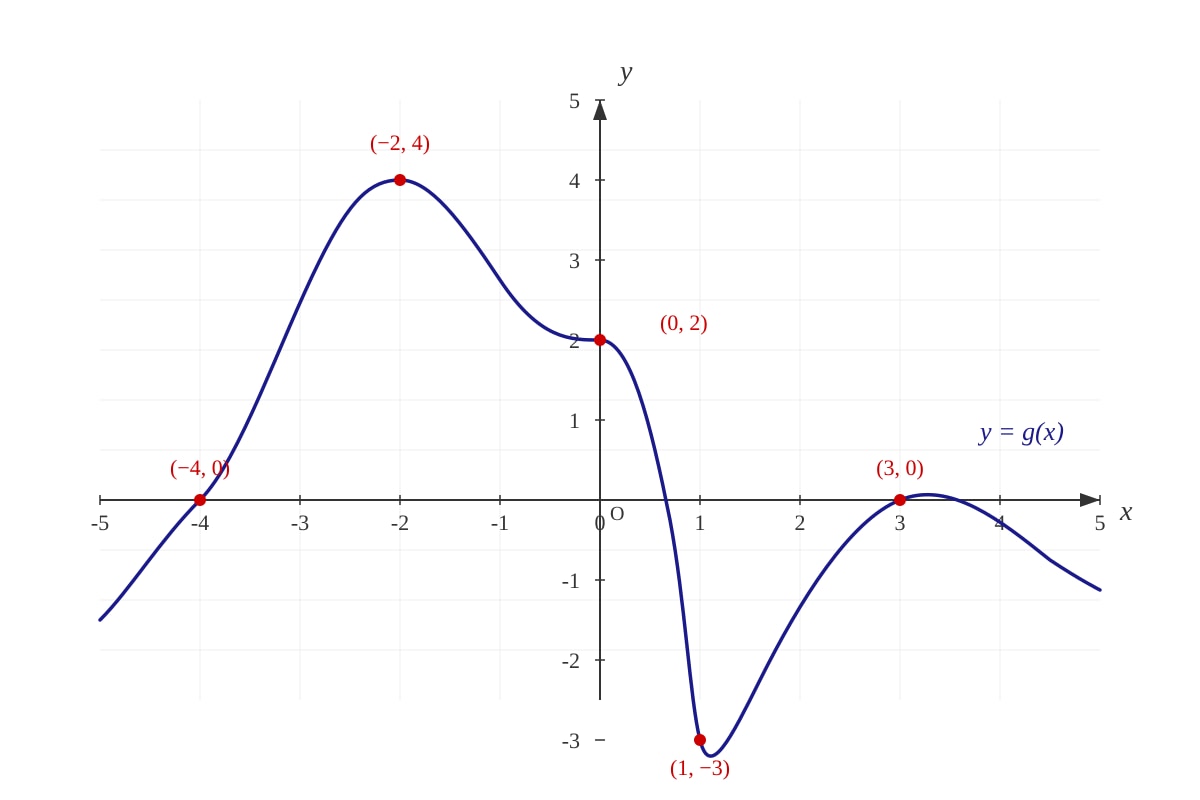
The equation has real roots where the graph crosses the x-axis. From the graph, the curve crosses the x-axis at and .
Therefore, there are 2 real roots.
Marking Notes:
- A1: Correct answer (2)
Common Mistake: Counting the turning points instead of the x-intercepts. The roots of are the x-intercepts of the graph.
END OF ANSWER KEY