AI Generated Quiz

A Level H1 Mathematics Geometry Trigonometry Quiz

Free A Level H1 Maths Geometry Trigonometry quiz, HY3 AI version, with questions, answers, and A Level-style practice for Singapore students.

These static practice materials are generated from the site's syllabus and paper-generation workflow, with source and model context shown so students and parents can evaluate the material before use.

A Level H1 Mathematics AI Generated Generated by Tencent HY3 Free Updated 2026-08-17

Questions

Free quiz and exam paper access

Enter your details to view this paper

Your access is remembered on this device.

Answers

A-Level Maths H1 Quiz - Geometry Trigonometry (Answer Key)

Total Marks: 50
Topic: Geometry & Trigonometry (syllabus-first; complements exam-derived patterns, not claimed as past-year)


Section A: Basic Trigonometry

Q1. [2 marks]
Given sinθ=3/5\sin\theta = 3/5, acute θ\theta.
Using sin2θ+cos2θ=1\sin^2\theta + \cos^2\theta = 1:
cosθ=1(3/5)2=19/25=16/25=4/5\cos\theta = \sqrt{1 - (3/5)^2} = \sqrt{1 - 9/25} = \sqrt{16/25} = 4/5.
Since θ\theta acute, cosθ>0\cos\theta > 0.
Answer: cosθ=45\cos\theta = \frac{4}{5}.
Teaching note: Acute angle → all trig ratios positive. Pythagorean identity is key.

Q2. [2 marks]
sinA=opp/hyp=7/14=0.5\sin A = \text{opp}/\text{hyp} = 7/14 = 0.5.
A=sin1(0.5)=30A = \sin^{-1}(0.5) = 30^\circ.
Answer: 3030^\circ.
Common mistake: using cos or tan incorrectly.

Q3. [2 marks]
cosθ=2.4/5=0.48\cos\theta = 2.4/5 = 0.48.
θ=cos1(0.48)61.361\theta = \cos^{-1}(0.48) \approx 61.3^\circ \to 61^\circ.
Answer: 6161^\circ (nearest degree).

Q4. [2 marks]
tan45=1\tan45^\circ = 1, cos60=0.5\cos60^\circ = 0.5.
Sum = 1+0.5=1.5=321 + 0.5 = 1.5 = \frac{3}{2}.
Answer: 32\frac{3}{2} or 1.51.5.

Q5. [2 marks]
By Pythagoras: AC=82+152=64+225=289=17AC = \sqrt{8^2 + 15^2} = \sqrt{64+225} = \sqrt{289} = 17 cm.
Answer: 1717 cm.


Section B: Trigonometric Equations and Identities

Q6. [2 marks]
sinx=0.5\sin x = 0.5x=30x = 30^\circ or 18030=150180^\circ - 30^\circ = 150^\circ.
Answer: x=30,150x = 30^\circ, 150^\circ.

Q7. [2 marks]
sinθ=1(5/13)2=12/13\sin\theta = \sqrt{1 - (5/13)^2} = 12/13.
tanθ=sin/cos=(12/13)/(5/13)=12/5\tan\theta = \sin/\cos = (12/13)/(5/13) = 12/5.
Answer: 125\frac{12}{5}.

Q8. [2 marks]
2cosx1=0cosx=1/22\cos x - 1 = 0 \Rightarrow \cos x = 1/2.
In [0,2π][0,2\pi]: x=π/3,5π/3x = \pi/3, 5\pi/3.
Answer: x=π3,5π3x = \frac{\pi}{3}, \frac{5\pi}{3}.

Q9. [2 marks]
In right triangle, sinθ=opp/hyp\sin\theta = \text{opp}/\text{hyp}, cosθ=adj/hyp\cos\theta = \text{adj}/\text{hyp}.
sinθ/cosθ=opp/adj=tanθ\sin\theta / \cos\theta = \text{opp}/\text{adj} = \tan\theta.
Answer: Shown.

Q10. [2 marks]
tanx=3\tan x = \sqrt{3}x=60x = 60^\circ or 180+60=240180^\circ+60^\circ = 240^\circ.
Answer: 60,24060^\circ, 240^\circ.


Section C: Geometry with Trigonometry

Q11. [3 marks]
Cosine rule: PR2=PQ2+QR22(PQ)(QR)cos60PR^2 = PQ^2 + QR^2 - 2(PQ)(QR)\cos60^\circ
=100+492(10)(7)(0.5)=14970=79= 100 + 49 - 2(10)(7)(0.5) = 149 - 70 = 79.
PR=798.89PR = \sqrt{79} \approx 8.89 cm.
Answer: 79\sqrt{79} cm or 8.898.89 cm.

Q12. [3 marks]
Cosine rule for C\angle C (opposite c=15):
cosC=(a2+b2c2)/(2ab)=(81+144225)/(216)=0/216=0\cos C = (a^2+b^2-c^2)/(2ab) = (81+144-225)/(216) = 0/216 = 0.
C=90C = 90^\circ.
Answer: 9090^\circ.

Q13. [3 marks]
Area = 12absinC=0.5(8)(10)sin45=40(2/2)=20228.3\frac{1}{2}ab\sin C = 0.5(8)(10)\sin45^\circ = 40(\sqrt{2}/2) = 20\sqrt{2} \approx 28.3 cm².
Answer: 20220\sqrt{2} cm².

Q14. [3 marks]
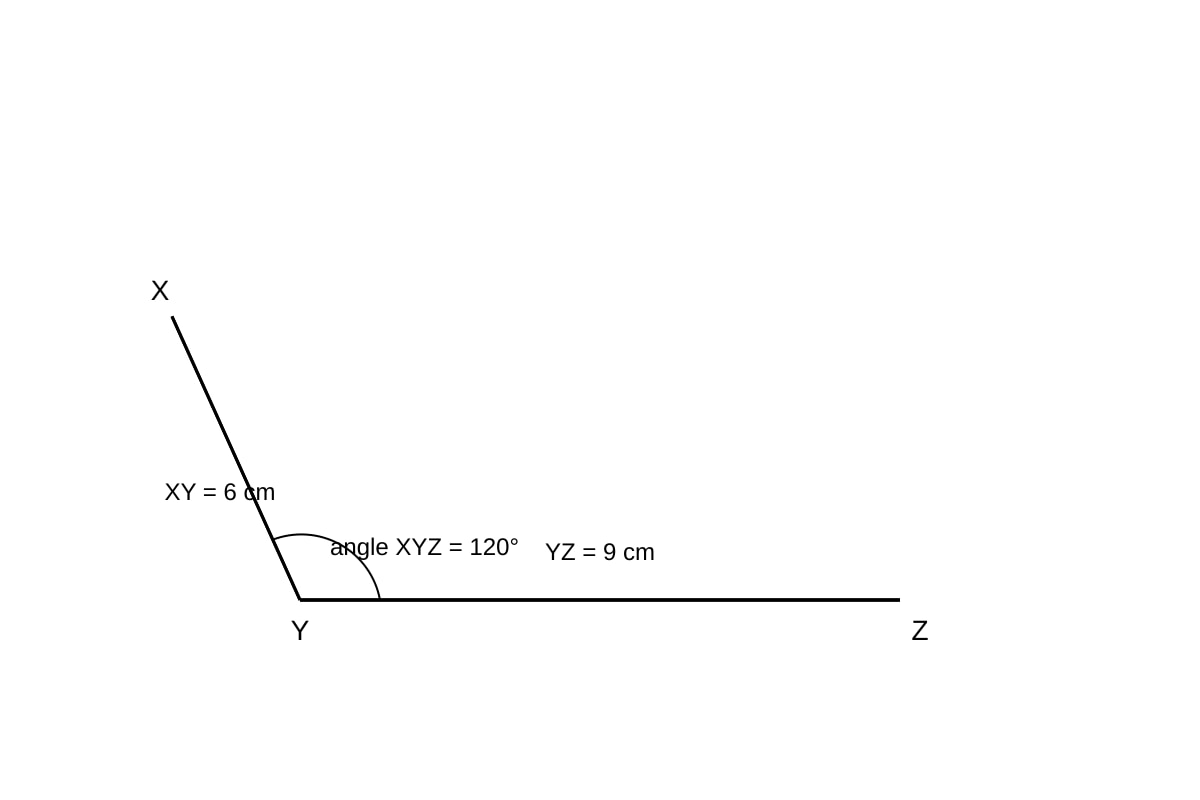
Using diagram: XZ2=62+922(6)(9)cos120XZ^2 = 6^2 + 9^2 - 2(6)(9)\cos120^\circ.
cos120=0.5\cos120^\circ = -0.5.
XZ2=36+81108(0.5)=117+54=171XZ^2 = 36+81 -108(-0.5) = 117+54 = 171.
XZ=17113.08XZ = \sqrt{171} \approx 13.08 cm.
Answer: 171\sqrt{171} cm.
Image note: Triangle with XY=6, YZ=9, angle Y=120°; XZ computed.

Q15. [3 marks]
Chord length = 2rsin(θ/2)=2(14)sin4028(0.6428)=18.02r\sin(\theta/2) = 2(14)\sin40^\circ \approx 28(0.6428) = 18.0 cm.
Answer: 18.018.0 cm.


Section D: Applications and Problem Solving

Q16. [3 marks]
tan32=h/50h=50tan3250(0.6249)=31.2\tan32^\circ = h/50 \Rightarrow h = 50\tan32^\circ \approx 50(0.6249) = 31.2 m.
Answer: 31.231.2 m.

Q17. [4 marks]
Angle between bearings = 13040=90130^\circ - 40^\circ = 90^\circ.
By cosine rule (or Pythagoras): d2=202+3022(20)(30)cos90=400+9000=1300d^2 = 20^2 + 30^2 - 2(20)(30)\cos90^\circ = 400+900-0 = 1300.
d=130036.1d = \sqrt{1300} \approx 36.1 km.
Answer: 36.136.1 km.

Q18. [4 marks]
Largest angle opposite longest side (10 cm).
cosC=(52+72102)/(257)=(25+49100)/70=26/70=0.3714\cos C = (5^2+7^2-10^2)/(2\cdot5\cdot7) = (25+49-100)/70 = -26/70 = -0.3714.
C=cos1(0.3714)111.8C = \cos^{-1}(-0.3714) \approx 111.8^\circ.
Answer: 111.8111.8^\circ.

Q19. [4 marks]
Regular hexagon: opposite vertices = 2×2 \times side ×cos30×2\times \cos30^\circ \times 2? Actually distance = 2×12×cos302 \times 12 \times \cos30^\circ? Correct: composed of equilateral triangles; distance = 2×12×sin602 \times 12 \times \sin60^\circ? Simpler: span = 2×12×cos30=24(3/2)=12320.82 \times 12 \times \cos30^\circ = 24(\sqrt{3}/2)=12\sqrt{3} \approx 20.8 cm. Wait: opposite vertices = 2×2 \times side length? For hexagon side s, distance = 2s=242s = 24 if across flats? Actually opposite vertices = 2s=242s = 24 cm (since central angle 120°, triangle is isosceles with sides s,s and included 120°, distance = 2ssin60=s3×?2s\sin60^\circ = s\sqrt{3}\times?). Let's compute: vertices through centre: 2r2r, r=s=12r = s = 12, so 2424 cm.
Answer: 2424 cm.
Note: Regular hexagon side equals circumradius.

Q20. [4 marks]
Cosine rule: AB2=802+10022(80)(100)cos65AB^2 = 80^2 + 100^2 - 2(80)(100)\cos65^\circ.
=6400+1000016000(0.4226)=164006761.6=9638.4= 6400+10000 - 16000(0.4226) = 16400 - 6761.6 = 9638.4.
AB=9638.498.2AB = \sqrt{9638.4} \approx 98.2 m.
Answer: 98.298.2 m.