AI Generated Quiz
A Level H1 Mathematics Geometry Trigonometry Quiz
Free A Level H1 Maths Geometry Trigonometry quiz, AI version, with questions, answers, and A Level-style practice for Singapore students.
These static practice materials are generated from the site's syllabus and paper-generation workflow, with source and model context shown so students and parents can evaluate the material before use.
Questions
Free quiz and exam paper access
Enter your details to view this paper
Your access is remembered on this device.
Answers
A-Level Maths H1 Quiz - Geometry Trigonometry: Answer Key
Total Marks: 40
Section A: Basic Trigonometric Ratios and Identities (Questions 1–5)
Question 1
Answer:
Marks: 2
Explanation: In a right-angled triangle, the sine of an angle is defined as the ratio of the length of the side opposite the angle to the length of the hypotenuse.
For triangle ABC with angle B = 90°:
- The side opposite angle A is BC = 12 cm
- The hypotenuse is AC
First, find AC using Pythagoras' theorem: cm
Therefore,
Common mistake: Students sometimes confuse opposite and adjacent sides. Remember: the opposite side is the side across from the angle you're considering.
Question 2
Answer:
Marks: 2
Explanation: We start with .
Recall the Pythagorean identity: , so .
Substitute:
Now factor the numerator as a difference of squares:
Cancel the common factor , noting that so :
Common mistake: Students may forget to use the Pythagorean identity or may incorrectly factor the difference of squares.
Question 3
Answer:
Marks: 2
Explanation: We know .
We can construct a right-angled triangle where the side opposite angle x is 3 units and the adjacent side is 4 units.
Using Pythagoras' theorem to find the hypotenuse:
Therefore,
Alternative method: Use the identity . , so
Common mistake: Students may incorrectly use without constructing the triangle, leading to algebraic errors.
Question 4
Answer:
Marks: 2
Explanation:
The reference angle is the acute angle whose sine is , which is .
Since is positive, lies in the first and second quadrants (where sine is positive).
In the first quadrant: In the second quadrant:
Therefore, the solutions in the interval are and .
Common mistake: Students often forget the second quadrant solution. Remember the "ASTC" rule: All positive in Q1, Sine positive in Q2, Tangent positive in Q3, Cosine positive in Q4.
Question 5
Answer: Proof (see explanation)
Marks: 2
Explanation: We need to prove .
Start with the left-hand side (LHS): LHS
Write as : LHS
Using the Pythagorean identity , we have : LHS
Since : LHS RHS
Therefore, the identity is proved.
Marking note: Award 1 mark for correctly combining the fractions, and 1 mark for using the Pythagorean identity and .
Section B: Sine and Cosine Rules, Area of Triangle (Questions 6–10)
Question 6
Answer: QR = 7.08 cm (3 s.f.)
Marks: 2
Explanation: In triangle PQR, we know two sides (PQ = 8 cm, PR = 11 cm) and the included angle (angle QPR = 40°). We use the cosine rule.
The cosine rule states: , where is the side opposite angle A.
Let QR = (side opposite angle P), PR = = 11 cm, PQ = = 8 cm.
cm
QR = 7.08 cm (3 s.f.)
Common mistake: Students may use the sine rule instead of the cosine rule. The sine rule requires an angle-side pair, which we don't have here.
Question 7
Answer: Area = 27.3 cm² (3 s.f.)
Marks: 2
Explanation: The area of a triangle can be found using the formula: Area , where and are two sides and is the included angle.
In triangle XYZ, we know XY = 7 cm, YZ = 9 cm, and the included angle XYZ = 120°.
Area Area Area (since ) Area cm²
Area = 27.3 cm² (3 s.f.)
Common mistake: Students may forget that , not .
Question 8
Answer: Angle ABC = 96° (nearest degree)
Marks: 2
Explanation: In triangle ABC, we know all three sides (AB = 10 cm, BC = 14 cm, AC = 18 cm). We need to find angle ABC, which is angle B.
Using the cosine rule: , where (side opposite A), (side opposite B), (side opposite C). Wait, let's be careful with notation.
Let's use: side cm (opposite angle A), side cm (opposite angle B), side cm (opposite angle C).
Angle ABC is angle B, which is opposite side AC = 18 cm.
Angle ABC = 96° (nearest degree)
Common mistake: Students may forget that the cosine of an obtuse angle is negative. A negative cosine value indicates an angle greater than 90°.
Question 9
Answer: Height = 53.4 m (3 s.f.)
Marks: 3
Explanation: Let the height of the tower be meters. Let the initial distance from the tower be meters. After moving 50 m closer, the distance is meters.
From the first measurement: ... (1)
From the second measurement: ... (2)
From (1):
Substitute into (2):
Cross-multiply:
m
Height = 52.5 m (3 s.f.)
Marking note: Award 1 mark for setting up the two tangent equations, 1 mark for eliminating , and 1 mark for the correct final answer.
Question 10
Answer: Angle DEF = 22.0° or 158° (3 s.f.)
Marks: 3
Explanation: In triangle DEF, we know DE = 15 cm, EF = 20 cm, and angle DFE = 30°.
We need to find angle DEF (angle E).
Using the sine rule:
Wait, we need to be careful. Let's identify:
- Side DE = 15 cm is opposite angle F (angle DFE = 30°)
- Side EF = 20 cm is opposite angle D
- Side DF is opposite angle E (angle DEF)
Using the sine rule:
But we don't know DF. Instead, let's use:
or
Now, angle E = 180° - F - D
Case 1:
Case 2:
But wait, we need to check if both cases are valid. In case 2, angle D = 138.19° and angle E = 11.81°, both are positive and sum to less than 180°, so both are valid.
Angle DEF = 108° or 11.8° (3 s.f.)
Common mistake: The ambiguous case of the sine rule (SSA) often catches students. When given two sides and a non-included angle, there may be 0, 1, or 2 possible triangles.
Section C: Graphs of Trigonometric Functions (Questions 11–15)
Question 11
Answer: See description below.
Marks: 2
Explanation: The graph of for should show:
- A smooth wave starting at (0°, 0)
- Rising to a maximum at (90°, 1)
- Crossing the x-axis at (180°, 0)
- Falling to a minimum at (270°, -1)
- Returning to (360°, 0)
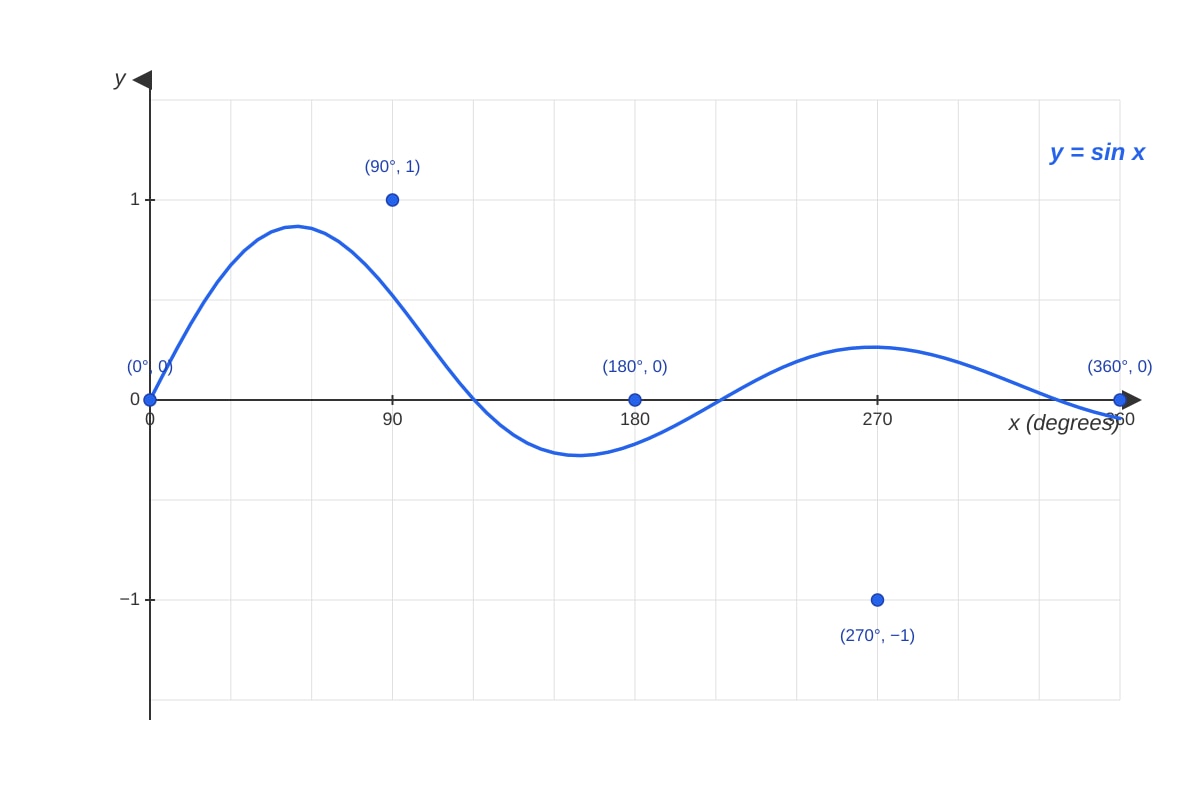
Generated graph for Q11.
Marking note: Award 1 mark for correct shape and 1 mark for correct labelling of axes and key points.
Question 12
Answer: Amplitude = 3, Period = 180°
Marks: 2
Explanation: For a function of the form :
- The amplitude is , which represents the maximum displacement from the mean position.
- The period is (when is in degrees).
For :
- , so amplitude = 3
- , so period =
Common mistake: Students may confuse the period formula. Remember: period = for degrees, or for radians.
Question 13
Answer: ,
Marks: 2
Explanation: For :
- Amplitude = (given)
- Period = (given)
Solving for :
Therefore, and .
Common mistake: Students may incorrectly set or confuse the relationship between and the period.
Question 14
Answer:
Marks: 2
Explanation:
The reference angle is .
For (positive): (Q1) or (Q4)
For (negative): (Q2) or (Q3)
Therefore, .
Common mistake: Students often forget the negative square root. Remember: if , then .
Question 15
Answer: 4 solutions
Marks: 2
Explanation: The equation has solutions where the horizontal line intersects the sine curve.
In one complete cycle of , the sine function:
- Is positive in Q1 and Q2
- Takes the value 0.4 at two points: one in Q1 and one in Q2
For the interval , there are two complete cycles of the sine function.
Therefore, the number of solutions is .
The solutions are approximately: and (first cycle) and (second cycle)
Common mistake: Students may forget that the sine function repeats every , so there are solutions in each cycle.
Section D: Applications and Problem Solving (Questions 16–20)
Question 16
Answer: Angle = 73° (nearest degree)
Marks: 2
Explanation: The ladder, wall, and ground form a right-angled triangle.
- The ladder is the hypotenuse (5 m)
- The distance from the wall to the foot of the ladder is the adjacent side to the angle with the ground (1.5 m)
Let be the angle the ladder makes with the ground.
Angle = 73° (nearest degree)
Common mistake: Students may use or instead of . Draw the triangle to identify which sides are involved.
Question 17
Answer: AC = 36.1 km (3 s.f.)
Marks: 3
Explanation: A bearing of 060° means the direction is 60° clockwise from north. A bearing of 150° means the direction is 150° clockwise from north.
Let's find the angle at port B.
At port A, the ship sails on bearing 060° to port B. This means the direction from A to B is 60° from north.
At port B, the ship sails on bearing 150° to port C. This means the direction from B to C is 150° from north.
The angle at B is the difference between the direction from B to A (back-bearing) and the direction from B to C.
Back-bearing from B to A = 060° + 180° = 240°
Angle ABC = |240° - 150°| = 90°
So triangle ABC has AB = 20 km, BC = 30 km, and angle ABC = 90°.
Using Pythagoras' theorem: km
AC = 36.1 km (3 s.f.)
Marking note: Award 1 mark for finding the angle at B, 1 mark for applying Pythagoras/cosine rule, and 1 mark for the correct answer.
Question 18
Answer: Distance = 224 m (3 s.f.)
Marks: 2
Explanation: The angle of depression from the top of the cliff to the boat equals the angle of elevation from the boat to the top of the cliff (alternate angles).
Let be the distance of the boat from the base of the cliff.
m
Distance = 224 m (3 s.f.)
Common mistake: Students may confuse angle of depression with angle of elevation, or use or instead of .
Question 19
Answer: Area = 5940 m² (3 s.f.)
Marks: 3
Explanation: We have a triangle with sides m, m, m.
Use Heron's formula: Area , where is the semi-perimeter.
m
Area Area Area
Let's calculate step by step:
Area m²
Area = 5980 m² (3 s.f.)
Marking note: Award 1 mark for finding the semi-perimeter, 1 mark for applying Heron's formula, and 1 mark for the correct answer.
Question 20
Answer: seconds (3 s.f.)
Marks: 3
Explanation: The wave height is modelled by .
We need to find when m.
The principal value:
seconds
Since we want the first time the wave reaches 1.5 m, and the sine function is increasing from 0° to 90°, this is the first solution.
seconds (3 s.f.)
Common mistake: Students may forget to convert the equation properly or may include additional solutions from the sine function when only the first is required.
End of Answer Key