AI Generated Quiz
A Level H1 Mathematics Geometry Trigonometry Quiz
Free A Level H1 Maths Geometry Trigonometry quiz, AI version, with questions, answers, and A Level-style practice for Singapore students.
These static practice materials are generated from the site's syllabus and paper-generation workflow, with source and model context shown so students and parents can evaluate the material before use.
Questions
Free quiz and exam paper access
Enter your details to view this paper
Your access is remembered on this device.
Answers
A-Level Maths H1 Quiz - Geometry Trigonometry: Answer Key
Total Marks: 50
Section A: Basic Trigonometric Ratios and Identities (Questions 1–5)
1. [2 marks] Answer:
Explanation: In a right-angled triangle, . We are given the opposite side (5 cm) and the hypotenuse (13 cm). We need the adjacent side. Using Pythagoras' theorem: cm Therefore, .
Marking Notes:
- 1 mark for correctly finding the adjacent side as 12.
- 1 mark for the correct ratio .
Common Mistake: Using the wrong ratio (e.g., for instead of ).
2. [2 marks] Answer: (or equivalently )
Explanation: Recall the Pythagorean identity: . Substituting this into the expression: This is also equal to , another Pythagorean identity.
Marking Notes:
- 1 mark for recognising .
- 1 mark for the final simplified answer (or ).
Common Mistake: Forgetting the fundamental identity .
3. [3 marks] Answer:
Explanation: We know . This means the opposite side is 3 and the hypotenuse is 5. We need the adjacent side to find . Using Pythagoras: (since is acute, the adjacent side is positive). Therefore, .
Marking Notes:
- 1 mark for correctly identifying the sides from .
- 1 mark for correctly using Pythagoras to find the adjacent side.
- 1 mark for the final answer .
Common Mistake: Forgetting that is acute, so the adjacent side is positive.
4. [2 marks] Answer:
Explanation: The sine function reaches its maximum value of 1 at . This can be seen from the unit circle, where at , the y-coordinate (which represents sine) is 1.
Marking Notes:
- 2 marks for the correct answer 1.
Common Mistake: Confusing with (which is 0).
5. [3 marks] Answer:
Explanation: We solve for . The reference angle is . Cosine is positive in the first and fourth quadrants.
- In the first quadrant: .
- In the fourth quadrant: . Therefore, the solutions are and .
Marking Notes:
- 1 mark for finding the reference angle .
- 1 mark for identifying the correct quadrants (1st and 4th).
- 1 mark for both correct solutions.
Common Mistake: Only giving and forgetting the solution in the fourth quadrant.
Section B: Sine and Cosine Rules, Area of Triangle (Questions 6–10)
6. [3 marks] Answer: cm (3 s.f.)
Explanation: We have two sides ( cm, cm) and the included angle (). We use the cosine rule: cm (3 s.f.)
Marking Notes:
- 1 mark for correctly applying the cosine rule.
- 1 mark for correct substitution.
- 1 mark for the final answer 8.19 cm.
Common Mistake: Using the sine rule instead of the cosine rule when you have two sides and the included angle.
7. [3 marks] Answer: Area cm (3 s.f.)
Explanation: We have two sides ( cm, cm) and the included angle (). The area of a triangle is given by , where and are two sides and is the included angle. Area Area Area Area Area cm (3 s.f.)
Marking Notes:
- 1 mark for using the correct formula .
- 1 mark for correct substitution.
- 1 mark for the final answer 28.3 cm.
Common Mistake: Using without finding the perpendicular height.
8. [3 marks] Answer: Largest angle (3 s.f.)
Explanation: The largest angle is opposite the longest side. The longest side is cm, so the largest angle is . Using the cosine rule: (3 s.f.)
Marking Notes:
- 1 mark for identifying the largest angle is opposite the longest side.
- 1 mark for correctly applying the cosine rule.
- 1 mark for the final answer 95.7°.
Common Mistake: Forgetting that the largest angle is opposite the longest side.
9. [3 marks] Answer: (3 s.f.)
Explanation: We have two sides ( cm, cm) and a non-included angle (). We use the sine rule: (3 s.f.)
Marking Notes:
- 1 mark for correctly applying the sine rule.
- 1 mark for correct substitution.
- 1 mark for the final answer 37.8°.
Common Mistake: Using the cosine rule instead of the sine rule. The sine rule is used when you have a side and its opposite angle.
10. [2 marks] Answer:
Explanation: The sine rule states that the ratio of a side length to the sine of its opposite angle is constant for all three sides of a triangle. This is written as:
Marking Notes:
- 2 marks for the correct formula.
Common Mistake: Writing (this is also correct, but the standard form is with sides in the numerator).
Section C: Angles of Elevation and Depression, Bearings (Questions 11–15)
11. [3 marks] Answer: Height m (3 s.f.)
Explanation: The situation forms a right-angled triangle. The distance from the man to the base of the tower is the adjacent side (50 m). The height of the tower is the opposite side. The angle of elevation is . Using : m (3 s.f.)
Marking Notes:
- 1 mark for drawing or identifying the correct trigonometric ratio.
- 1 mark for correct substitution.
- 1 mark for the final answer 28.9 m.
Common Mistake: Using or instead of . The angle of elevation is the angle from the horizontal, so we use the horizontal distance (adjacent) and the vertical height (opposite).
12. [3 marks] Answer: Horizontal distance m (3 s.f.)
Explanation: The angle of depression from the top of the building to the car is . The angle of elevation from the car to the top of the building is also (alternate angles). We have a right-angled triangle. The height of the building is the opposite side (40 m). The horizontal distance is the adjacent side. Using : m (3 s.f.)
Marking Notes:
- 1 mark for recognising that the angle of depression equals the angle of elevation.
- 1 mark for correct substitution.
- 1 mark for the final answer 85.8 m.
Common Mistake: Using instead of .
13. [3 marks] Answer: Distance km (3 s.f.)
Explanation: We need to find the angle at between the two bearings.
- Bearing means the direction is clockwise from north.
- Bearing means the direction is clockwise from north. The angle between the two directions at is . So triangle has km, km, and . Using Pythagoras: km (3 s.f.)
Marking Notes:
- 1 mark for finding the angle at B as 90°.
- 1 mark for correctly applying Pythagoras.
- 1 mark for the final answer 36.1 km.
Common Mistake: Incorrectly calculating the angle between the two bearings.
14. [2 marks] Answer: Height m (3 s.f.)
Explanation: We have a right-angled triangle. The horizontal distance is the adjacent side (100 m). The height of the cliff is the opposite side. The angle of elevation is . Using : m (3 s.f.)
Marking Notes:
- 1 mark for correct substitution.
- 1 mark for the final answer 70.0 m.
Common Mistake: Using or instead of .
15. [3 marks] Answer: Bearing of from is (3 s.f.)
Explanation: We need to find the angle at between north and the line . First, find the angle at between and .
- Bearing of from is , so the direction from to is .
- Bearing of from is , so the direction from to is . The angle at between and is (but careful: this is the external angle. The internal angle is ).
Now we have triangle with m, m, and . Using the cosine rule to find : m
Now use the sine rule to find :
The bearing of from is .
Marking Notes:
- 1 mark for finding the angle at Q.
- 1 mark for correctly applying the cosine rule.
- 1 mark for the final bearing.
Common Mistake: Confusing internal and external angles when working with bearings.
Section D: Trigonometric Graphs and Equations (Questions 16–20)
16. [2 marks] Answer: Period (or radians)
Explanation: The period of is (or in radians). For , , so the period is .
Marking Notes:
- 2 marks for the correct answer .
Common Mistake: Stating the period as (the period of ).
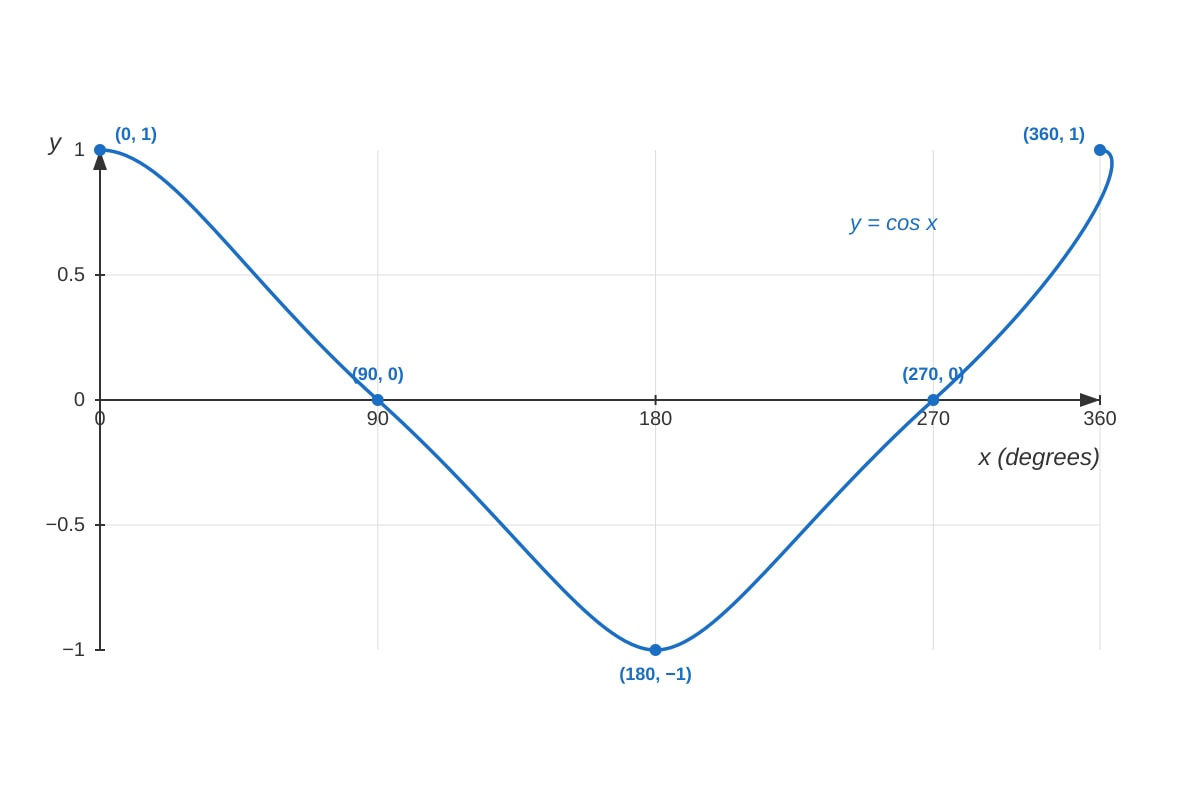
17. [3 marks] Answer: See sketch description.
Explanation: The graph of for has the following key features:
- Maximum at and .
- Minimum at .
- -intercepts at and .
- The curve starts at , decreases to , then increases back to .
Image pending generation: graph for Q17.
Marking Notes:
- 1 mark for correct shape (starting at maximum, decreasing to minimum, increasing to maximum).
- 1 mark for correct maximum and minimum points.
- 1 mark for correct x-intercepts.
Common Mistake: Drawing the graph of instead of . The cosine graph starts at its maximum value.
18. [3 marks] Answer:
Explanation: The reference angle is . Sine is positive in the first and second quadrants.
- In the first quadrant: .
- In the second quadrant: . Therefore, the solutions are and .
Marking Notes:
- 1 mark for rearranging to .
- 1 mark for finding the reference angle .
- 1 mark for both correct solutions.
Common Mistake: Only giving and forgetting the solution in the second quadrant.
19. [2 marks] Answer: Amplitude
Explanation: The amplitude of is . For , , so the amplitude is 3. This means the graph oscillates between and .
Marking Notes:
- 2 marks for the correct answer 3.
Common Mistake: Stating the amplitude as 1 (the amplitude of ).
20. [3 marks] Answer: Maximum height m
Explanation: The height is given by . The sine function oscillates between -1 and 1. The maximum value of is 1. Therefore, the maximum height is: m.
Marking Notes:
- 1 mark for recognising that the maximum of is 1.
- 1 mark for correct substitution.
- 1 mark for the final answer 18 m.
Common Mistake: Forgetting to add the constant term 10, or thinking the maximum of sine is 0.
End of Answer Key