AI Generated Quiz
A Level H1 Mathematics Geometry Trigonometry Quiz
Free A Level H1 Maths Geometry Trigonometry quiz, AI version, with questions, answers, and A Level-style practice for Singapore students.
These static practice materials are generated from the site's syllabus and paper-generation workflow, with source and model context shown so students and parents can evaluate the material before use.
Questions
Free quiz and exam paper access
Enter your details to view this paper
Your access is remembered on this device.
Answers
A-Level Maths H1 Quiz - Geometry Trigonometry: Answer Key
Total Marks: 50
Section A: Basic Trigonometric Ratios and Identities (Questions 1–5)
1. [2 marks]
Answer:
Explanation:
- In a right-angled triangle, the hypotenuse is the longest side. We are given the opposite side (5 cm) and the hypotenuse (13 cm).
- Using Pythagoras' theorem:
- Adjacent side = cm
Marking Notes:
- 1 mark for correctly finding the adjacent side
- 1 mark for correct final answer
2. [3 marks]
Answer:
Explanation:
- Start with
- Use the identity
- Factor the numerator:
- Cancel the common factor (valid since , so )
- Result:
Marking Notes:
- 1 mark for using
- 1 mark for factorising correctly
- 1 mark for correct final answer
3. [3 marks]
Answer:
Explanation:
- Consider a right-angled triangle with opposite = 3, adjacent = 4
- Hypotenuse =
- Since is acute, all ratios are positive
Marking Notes:
- 1 mark for finding the hypotenuse
- 1 mark for finding both and
- 1 mark for correct final answer
4. [4 marks]
Answer:
Explanation:
- Let . The equation becomes
- Factorise:
- So or
- : In ,
- : In , (cosine is negative in quadrants II and III)
- Therefore,
Marking Notes:
- 1 mark for substituting and factorising
- 1 mark for solving
- 1 mark for solving
- 1 mark for all four correct solutions
Common Mistake: Forgetting and as solutions to .
5. [3 marks]
Answer: Proof shown below.
Explanation:
- Start with the left-hand side:
- Recall , so
- LHS =
- Using , we have
- LHS = = RHS
Marking Notes:
- 1 mark for expressing in terms of and
- 1 mark for combining fractions correctly
- 1 mark for using the Pythagorean identity to simplify to 1
Section B: Trigonometric Graphs and Transformations (Questions 6–10)
6. [4 marks]
Answer: See description below.
Explanation: The graph of has:
- Amplitude: 2 (the coefficient of sine)
- Period: (the coefficient of is 1, so period = )
- Phase shift: units to the right (horizontal translation)
- Key points: The basic sine curve is shifted right by and stretched vertically by factor 2
- Intercepts: Solve , giving , so (but only and are in )
- Maximum points: , so , value = 2
- Minimum points: , so , value = -2
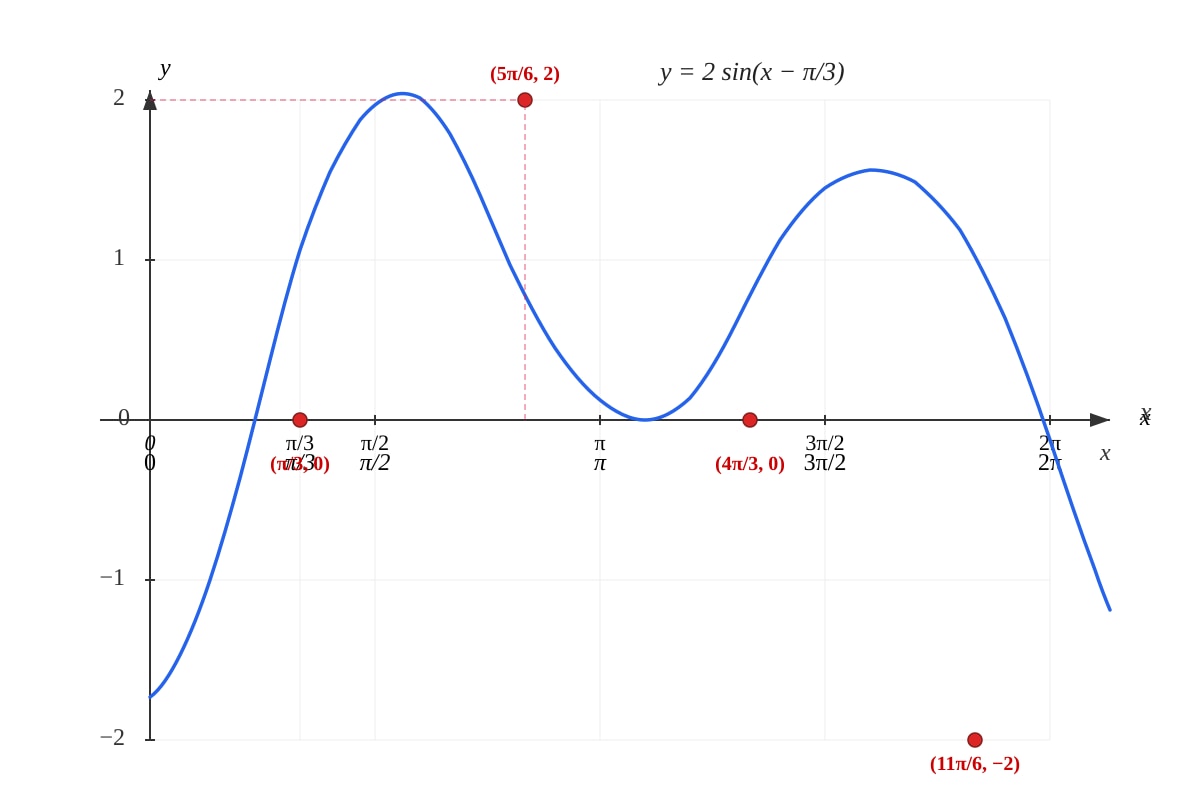
Generated graph for Q6.
Marking Notes:
- 1 mark for correct amplitude and period
- 1 mark for correct phase shift
- 1 mark for correct shape and key points
- 1 mark for labelled axes and intercepts
7. [3 marks]
Answer: , ,
Explanation:
- For , the maximum value is and the minimum value is
- Given: maximum = 5, minimum = -1
- and
- Adding the equations: , so
- Substituting: , so
- Period = , so
Marking Notes:
- 1 mark for setting up equations for max/min
- 1 mark for finding and
- 1 mark for finding
8. [2 marks]
Answer:
Explanation:
- Original:
- Translation units to the right: replace with , giving
- Vertical stretch by factor 3: multiply the function by 3, giving
Marking Notes:
- 1 mark for correct horizontal translation
- 1 mark for correct vertical stretch
9. [2 marks]
Answer: 4 solutions
Explanation:
- The equation has two solutions in each period of (one in and one in )
- The interval contains two full periods
- Therefore, number of solutions =
Marking Notes:
- 1 mark for recognising 2 solutions per period
- 1 mark for correct total
10. [2 marks]
Answer: and
Explanation:
- The asymptotes of occur at for integer
- For , the asymptotes occur when
- So
- For : gives , gives
Marking Notes:
- 1 mark for correct method
- 1 mark for both correct asymptotes in the given interval
Section C: Geometry of Triangles and Circles (Questions 11–15)
11. [3 marks]
Answer: cm
Explanation:
- Use the cosine rule:
- cm
Marking Notes:
- 1 mark for correctly applying the cosine rule
- 1 mark for correct substitution
- 1 mark for correct final answer
12. [3 marks]
Answer: Area = cm²
Explanation:
- Use Heron's formula:
- Area =
- Area =
- Area = cm²
Marking Notes:
- 1 mark for finding
- 1 mark for correct substitution into Heron's formula
- 1 mark for correct final answer
13. [3 marks]
Answer: cm
Explanation:
- Use the cosine rule:
- cm (1 d.p.)
Marking Notes:
- 1 mark for correct cosine rule setup
- 1 mark for correct substitution
- 1 mark for correct final answer to 1 d.p.
14. [2 marks]
Answer: cm
Explanation:
- The chord AB and the two radii OA and OB form an isosceles triangle with sides 10, 10, and chord AB
- The angle at the centre is 120°
- Using the cosine rule:
- cm
Marking Notes:
- 1 mark for correct method
- 1 mark for correct final answer
15. [3 marks]
Answer: Area cm²
Explanation:
- Use the formula: Area = , where and are two sides and is the included angle
- Area =
- Area =
- Area = cm²
- Correct to 1 d.p.: cm²
Marking Notes:
- 1 mark for correct formula
- 1 mark for correct substitution
- 1 mark for correct final answer to 1 d.p.
Section D: Applications and Problem Solving (Questions 16–20)
16. [2 marks]
Answer:
Explanation:
- The ladder, wall, and ground form a right-angled triangle
- The ladder is the hypotenuse (5 m), the distance from the wall is the adjacent side (1.5 m)
- Correct to nearest degree:
Marking Notes:
- 1 mark for correct trigonometric ratio
- 1 mark for correct final answer
17. [3 marks]
Answer: Distance m
Explanation:
- The angle of depression from the top of the building to the car equals the angle of elevation from the car to the top of the building (alternate angles)
- In the right-angled triangle: opposite = 30 m (height of building), adjacent = horizontal distance (let this be )
- m (1 d.p.)
Marking Notes:
- 1 mark for recognising angle of depression equals angle of elevation
- 1 mark for correct trigonometric setup
- 1 mark for correct final answer to 1 d.p.
18. [3 marks]
Answer: Perimeter cm
Explanation:
- A sector has two radii and an arc
- Arc length = cm
- Perimeter = cm
Marking Notes:
- 1 mark for correct arc length formula
- 1 mark for correct arc length
- 1 mark for correct perimeter
19. [4 marks]
Answer: km
Explanation:
- Bearing of 050° means the direction is 50° clockwise from north
- Bearing of 140° means the direction is 140° clockwise from north
- Draw triangle ABC. Angle at B: The bearing from A to B is 050°, and the bearing from B to C is 140°
- The angle between the north line at B and BC is 140°. The angle between the north line at B and BA (reverse direction of AB) is 050° + 180° = 230° (or equivalently, the interior angle at B is 140° - 50° = 90°)
- Actually, let's be more careful. The bearing of B from A is 050°. The bearing of C from B is 140°. The angle ABC is the angle between AB and BC measured inside the triangle. The direction of BA (from B to A) is 050° + 180° = 230°. The direction of BC is 140°. The angle between them is 230° - 140° = 90°.
- So triangle ABC has AB = 20 km, BC = 15 km, and angle ABC = 90°
- Using Pythagoras' theorem:
- km
Wait, let me re-check. The angle between the two bearings is 140° - 50° = 90°. So the angle at B is 90°.
- km
Marking Notes:
- 1 mark for drawing a correct diagram
- 1 mark for finding the angle at B
- 1 mark for correct application of Pythagoras/cosine rule
- 1 mark for correct final answer
20. [4 marks]
Answer: hours and hours (and also and hours for the full 24-hour period)
Explanation:
- Set :
- or (or )
- For :
- For :
- For the first 24 hours ():
- (from )
- (from )
- So the times are 2:00, 10:00, 14:00, and 22:00
Marking Notes:
- 1 mark for setting up the equation correctly
- 1 mark for solving
- 1 mark for finding the general solutions
- 1 mark for all correct times in the first 24 hours
Common Mistake: Forgetting the second set of solutions from the general solution of cosine.