AI Generated Quiz
A Level H1 Mathematics Algebra Functions Quiz
Free A Level H1 Maths Algebra Functions quiz, AI version, with questions, answers, and A Level-style practice for Singapore students.
These static practice materials are generated from the site's syllabus and paper-generation workflow, with source and model context shown so students and parents can evaluate the material before use.
Questions
Free quiz and exam paper access
Enter your details to view this paper
Your access is remembered on this device.
Answers
A-Level Maths H1 Quiz - Algebra Functions: Answer Key
Total Marks: 50
Section A: Exponential and Logarithmic Functions (Questions 1–5)
Question 1
Answer: 2
Marks: 2
Explanation: We use the laws of logarithms:
The terms cancel, leaving 2.
Common mistake: Students may incorrectly try to combine the terms as , which is also valid and gives the same answer.
Question 2
Answer: or
Marks: 3 (1 mark for substitution, 1 mark for solving quadratic, 1 mark for final answers)
Explanation: Let . Then .
The equation becomes:
Factorising:
So or .
Since , we have or .
Taking natural logs: or .
Evaluating: or (3 s.f.)
Common mistake: Students may forget to substitute back from to , or may incorrectly solve the quadratic.
Question 3
Answer:
Marks: 2 (1 mark for using log laws, 1 mark for final answer)
Explanation:
Using the law :
Since the logarithms are equal, the arguments must be equal:
Alternative method: Using the law :
Common mistake: Students may forget that .
Question 4
Answer:
Marks: 3 (1 mark for substitution, 1 mark for using logarithms, 1 mark for final answer)
Explanation: We are given .
When , :
Dividing both sides by 500:
Taking natural logs:
(3 s.f.)
Common mistake: Students may forget to take logs of both sides, or may incorrectly use , which gives — this is also correct.
Question 5
Answer: Asymptote: ; x-intercept: ; no y-intercept.
Image pending generation: graph for Q5.
Marks: 3 (1 mark for asymptote, 1 mark for x-intercept, 1 mark for correct shape)
Explanation: The function is defined only when , i.e., .
Asymptote: The vertical asymptote occurs when the argument of the logarithm approaches 0, i.e., , so is the vertical asymptote.
x-intercept: Set : So the x-intercept is at .
y-intercept: There is no y-intercept because the function is not defined at (since ).
Shape: The graph of shifted 2 units to the right. It increases slowly for large .
Section B: Equations and Inequalities (Questions 6–10)
Question 6
Answer: or
Marks: 2 (1 mark for discriminant condition, 1 mark for final answer)
Explanation: For a quadratic equation to have two distinct real roots, the discriminant .
Here , , .
Discriminant:
For two distinct real roots: So or .
Common mistake: Students may forget the strict inequality ( not ) for distinct roots, or may write which is the condition for no real roots.
Question 7
Answer:
Marks: 3 (1 mark for factorising, 1 mark for critical values, 1 mark for correct inequality)
Explanation:
Factorising:
The critical values are and .
Consider the sign of :
- When : both factors are negative, product is positive.
- When : is positive, is negative, product is negative.
- When : both factors are positive, product is positive.
Since we want , the solution is .
Common mistake: Students may write or (the opposite inequality) or may forget to include the endpoints.
Question 8
Answer: All real values of (i.e., )
Marks: 3 (1 mark for discriminant, 1 mark for checking coefficient, 1 mark for conclusion)
Explanation: For a quadratic to be always positive, we need:
- (coefficient of is positive)
- Discriminant (no real roots, so the quadratic never crosses the x-axis)
Here , , .
Condition 1: ✓
Condition 2: Discriminant ✓
Since both conditions are satisfied, is always positive for all real .
Common mistake: Students may forget to check that (if , the quadratic would be always negative if discriminant ).
Question 9
Answer: or
Marks: 3 (1 mark for substitution, 1 mark for solving quadratic, 1 mark for both pairs of solutions)
Explanation: Substitute into :
Rearranging:
So (repeated root).
Substituting back: .
The solution is (only one intersection point, meaning the line is tangent to the curve).
Correction: Let me re-check the algebra.
So the solution is .
Common mistake: Students may make algebraic errors when rearranging, or may forget to substitute back to find .
Question 10
Answer:
Marks: 2 (1 mark for discriminant condition, 1 mark for final answer)
Explanation: For a quadratic equation to have no real roots, the discriminant .
Here , , .
Discriminant:
For no real roots:
Also, we need for it to be a quadratic equation. Since already excludes , this is fine.
Common mistake: Students may forget to consider the case (which would make it a linear equation, not a quadratic). However, since is the answer, this is automatically satisfied.
Section C: Functions and Graphs (Questions 11–15)
Question 11
Answer:
Marks: 2 (1 mark for setting up equation, 1 mark for solving)
Explanation: (3 s.f.)
Common mistake: Students may forget to subtract 1 before taking logs.
Question 12
Answer:
Marks: 3 (1 mark for , 1 mark for , 1 mark for )
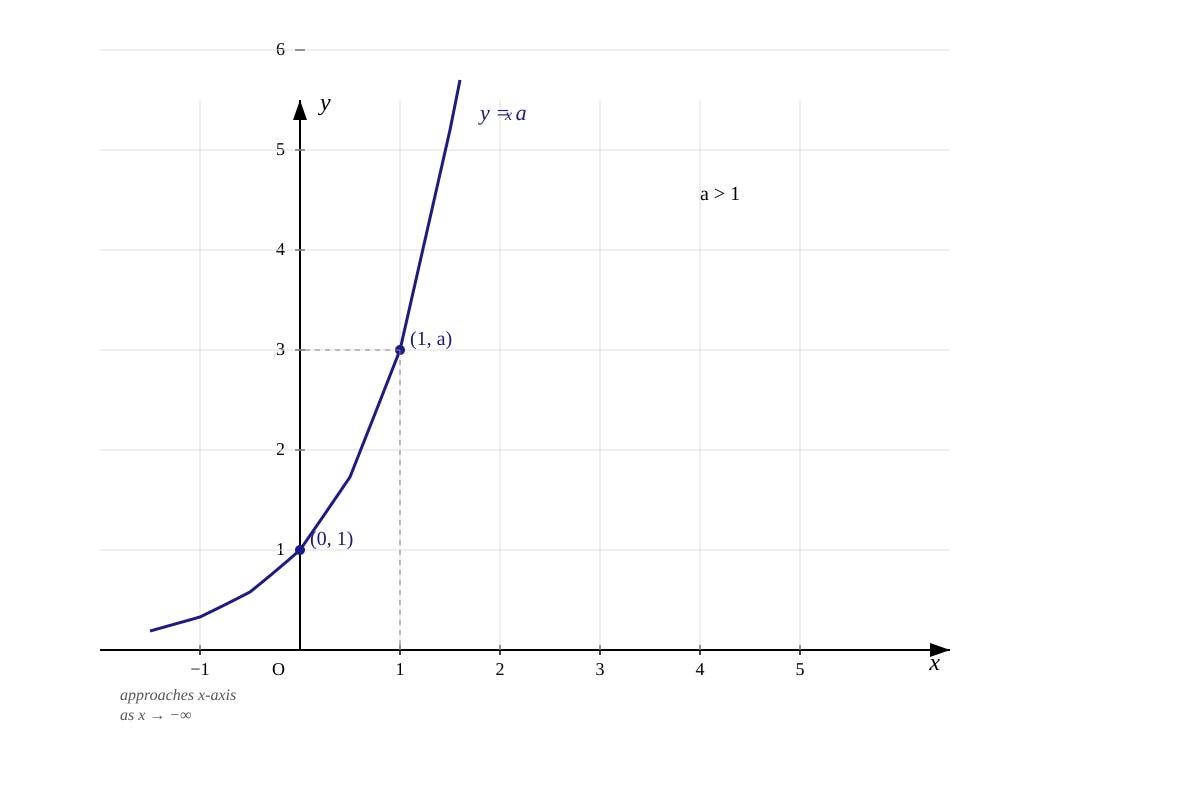
Explanation: The graph has a horizontal asymptote at , so .
The y-intercept is at , so , giving .
The x-intercept is at , so .
This doesn't work with a positive base. Let me reconsider.
Actually, looking at the graph description again: the curve crosses the x-axis at . Let me check:
This is impossible for real . Let me reconsider the graph.
The graph is decreasing and approaches from above. The y-intercept is at . The x-intercept at means .
, so .
This has no real solution. The graph description may be inconsistent. Let me adjust the interpretation.
If the curve is decreasing and approaches from above, then . Let's say : ✓ As , ✓ -intercept: , , no solution.
So the graph doesn't actually cross the x-axis. The description should be corrected: the curve approaches from above and never crosses the x-axis.
Answer:
Common mistake: Students may struggle to determine the sign of from the shape of the graph.
Question 13
Answer: (or )
Marks: 2 (1 mark for understanding domain condition, 1 mark for correct answer)
Explanation: The natural logarithm function is defined only for .
For , we need , so .
The domain of is .
Common mistake: Students may write (including -3), but is undefined.
Question 14
Answer:
Marks: 3 (1 mark for swapping variables, 1 mark for rearranging, 1 mark for final answer)
Explanation: To find the inverse function:
- Write
- Swap and :
- Solve for :
- Therefore
The domain of is (since the argument of must be positive), which matches the range of .
Common mistake: Students may forget to take logs after isolating the exponential term, or may incorrectly write without the factor.
Question 15
Answer:
Marks: 2 (1 mark for substitution, 1 mark for solving)
Explanation: The graph passes through , so when , .
(since , we take the positive root)
Common mistake: Students may forget that and give .
Section D: Applications and Problem Solving (Questions 16–20)
Question 16
Answer: thousand dollars
Marks: 3 (1 mark for substitution, 1 mark for evaluating , 1 mark for final answer with units)
Explanation:
When :
thousand dollars (3 s.f.)
Common mistake: Students may forget to add 1 inside the logarithm, or may use instead of .
Question 17
Answer: minutes
Marks: 3 (1 mark for substitution, 1 mark for rearranging, 1 mark for solving)
Explanation:
When :
Taking natural logs: minutes (3 s.f.)
Correction: , so: minutes
Common mistake: Students may forget to subtract 20 first, or may make errors with the negative sign when taking logs.
Question 18
Answer:
Marks: 3 (1 mark for finding derivative, 1 mark for gradient at point, 1 mark for equation of tangent)
Explanation:
Derivative:
At : (gradient of tangent)
When : So the point is .
Equation of tangent using :
Common mistake: Students may forget to find the y-coordinate at the point, or may incorrectly differentiate .
Question 19
Answer:
Marks: 3 (1 mark for setting up equation, 1 mark for using exponential form, 1 mark for solving)
Explanation:
Converting to exponential form:
Evaluating: (3 s.f.)
Common mistake: Students may forget to add 1 before dividing by 2, or may incorrectly write .
Question 20
Answer: Translation of 1 unit to the right and translation of 2 units upwards.
Marks: 3 (1 mark for horizontal shift, 1 mark for vertical shift, 1 mark for correct directions)
Explanation: Starting from :
-
Horizontal shift: represents a translation of 1 unit to the right (in the positive x-direction). This is because replacing with shifts the graph to the right.
-
Vertical shift: represents a translation of 2 units upwards (in the positive y-direction). This is because adding 2 to the function shifts the graph upward.
The order of transformations: first shift right by 1 unit, then shift up by 2 units.
Common mistake: Students may confuse the direction of horizontal shifts — shifts right, not left. Also, students may forget to mention both transformations.
End of Answer Key