From Real Exams Quiz

A Level H1 Mathematics Numbers Ratio Proportion Quiz

Free Exam-Derived Qwen3.7 Plus A Level H1 Mathematics Numbers Ratio Proportion quiz with questions and answers for Singapore students. This page is rendered as a direct URL so the questions and answers can be discovered without pressing in-page buttons.

These static practice materials are generated from the site's syllabus and paper-generation workflow, with source and model context shown so students and parents can evaluate the material before use.

A Level H1 Mathematics From Real Exams Generated by Qwen3.7 Plus Updated 2026-06-04

Questions

<!-- TuitionGoWhere generation metadata: stage=3-0; model=qwen/qwen3.7-plus; model_label=Qwen3.7 Plus; generated=2026-06-04; Sources: Stage 2-1 real exam-derived templates and Stage 2-2 exam-enriched syllabus. -->

A-Level Maths H1 Quiz - Numbers Ratio Proportion

Name: __________________________
Class: __________________________
Date: __________________________
Score: _________ / 60

Duration: 60 Minutes
Total Marks: 60

Instructions to Candidates:

  1. Answer all 20 questions.
  2. Write your answers in the spaces provided.
  3. All non-exact numerical answers must be correct to 3 significant figures, unless otherwise specified.
  4. Give non-exact answers in terms of π\pi or surds where appropriate.
  5. You are expected to use a graphing calculator.
  6. Unsupported answers from a graphing calculator are allowed unless the question specifically states otherwise.

Section A: Algebraic Manipulation and Indices (15 Marks)

1. Simplify the expression 2n+22n+12n\frac{2^{n+2} - 2^{n+1}}{2^n}, giving your answer as an integer. [2]

<br> <br> <br>

2. Given that x=32ax = 3^{2a} and y=3a+1y = 3^{a+1}, express x2y\frac{x^2}{y} in the form 3k3^k, where kk is an integer in terms of aa. [2]

<br> <br> <br>

3. Solve the equation 4x5(2x)+4=04^{x} - 5(2^{x}) + 4 = 0. [3]

<br> <br> <br> <br> <br>

4. Without using a calculator, simplify 75+1227\sqrt{75} + \sqrt{12} - \sqrt{27}, giving your answer in the form k3k\sqrt{3} where kk is an integer. [2]

<br> <br> <br>

5. Rationalize the denominator of 652\frac{6}{\sqrt{5} - \sqrt{2}} and simplify your answer. [3]

<br> <br> <br> <br> <br> <br>

6. Given that log2x+log2(x2)=3\log_2 x + \log_2 (x-2) = 3, find the value of xx. [3]

<br> <br> <br> <br> <br>

Section B: Ratio, Proportion and Variation (20 Marks)

7. The variable yy is inversely proportional to the square of xx. Given that y=12y=12 when x=2x=2, find the value of yy when x=4x=4. [3]

<br> <br> <br> <br> <br>

8. The resistance RR of a wire varies directly as its length LL and inversely as the square of its diameter dd. (a) Write down the formula connecting RR, LL, and dd, using kk as the constant of proportionality. [1] (b) If the length is doubled and the diameter is halved, find the factor by which the resistance changes. [3]

<br> <br> <br> <br> <br> <br> <br>

9. A sum of $5000 is divided among three people, A, B, and C, in the ratio 2:3:52:3:5. (a) Calculate the amount received by person B. [2] (b) Person C gives 20% of their share to person A. Calculate the new ratio of A's share to C's share, giving your answer in its simplest form. [3]

<br> <br> <br> <br> <br> <br> <br> <br>

10. The cost of running a factory consists of a fixed cost and a variable cost that is proportional to the number of units produced. When 100 units are produced, the total cost is $1200. When 250 units are produced, the total cost is $2100. (a) Find the fixed cost. [3] (b) Find the total cost when 400 units are produced. [2]

<br> <br> <br> <br> <br> <br> <br> <br>

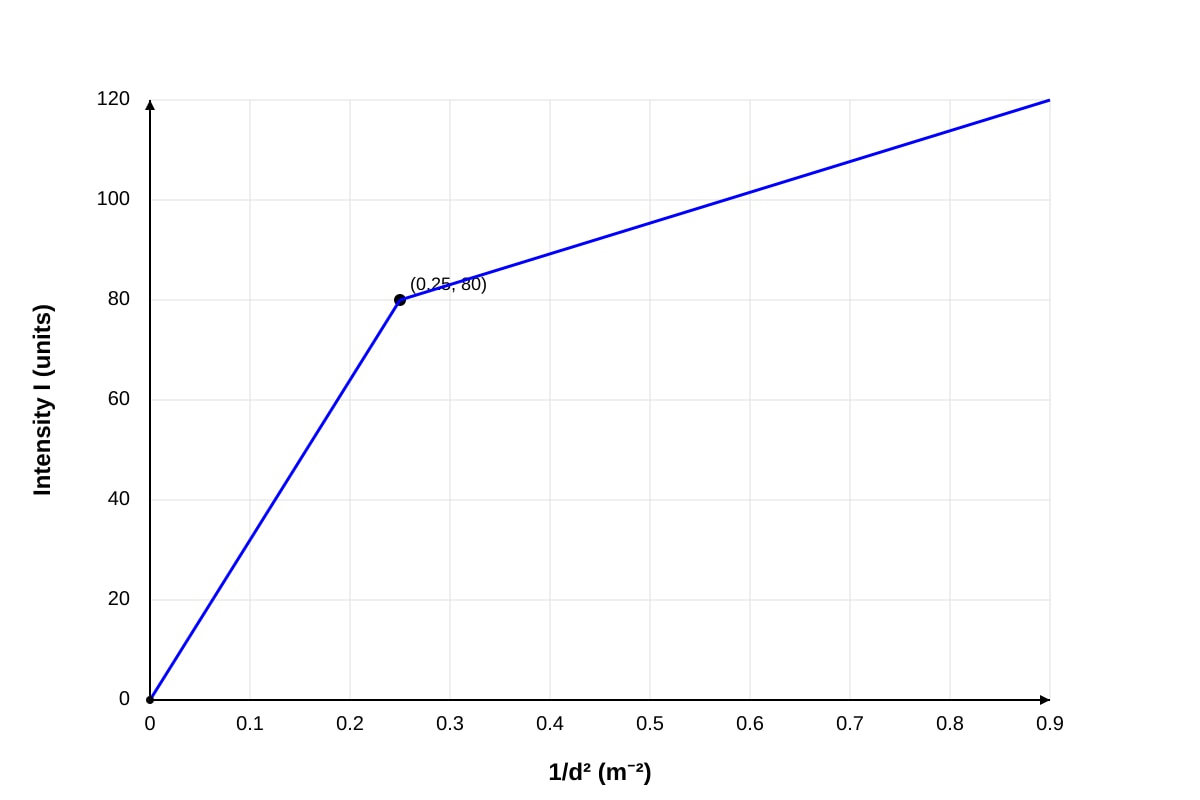
11. The intensity of light II from a source is inversely proportional to the square of the distance dd from the source. <image_placeholder> id: Q11-fig1 type: graph linked_question: Q11 description: A graph showing the relationship between Intensity I (y-axis) and 1/d^2 (x-axis). The line is straight and passes through the origin. labels: y-axis: Intensity I (units), x-axis: 1/d^2 (m^-2) values: The line passes through the point (0.25, 80). must_show: A straight line graph passing through (0,0) and (0.25, 80). </image_placeholder>

(a) Using the graph above, determine the constant of proportionality kk. [2] (b) Calculate the distance dd when the intensity is 20 units. [2]

<br> <br> <br> <br> <br> <br>

Section C: Applications in Business and Social Sciences (25 Marks)

12. A company's profit PP is modeled by the function P(x)=2x2+80x500P(x) = -2x^2 + 80x - 500, where xx is the number of items sold in hundreds. (a) Find the number of items (in hundreds) that must be sold to maximize profit. [2] (b) Calculate the maximum profit. [2]

<br> <br> <br> <br> <br> <br>

13. The population of a city is growing exponentially. In 2010, the population was 1.2 million. In 2020, the population was 1.5 million. (a) Find the annual growth rate rr, assuming the model P(t)=P0ertP(t) = P_0 e^{rt}, where tt is the number of years since 2010. [3] (b) Estimate the population in 2030. [2]

<br> <br> <br> <br> <br> <br> <br>

14. A bank offers an interest rate of 4% per annum, compounded monthly. (a) Calculate the effective annual interest rate. [3] (b) How many years will it take for an investment to double in value? Give your answer to the nearest year. [3]

<br> <br> <br> <br> <br> <br> <br> <br>

15. The demand DD for a product is related to its price pp by the equation D=1000p+10D = \frac{1000}{p+10}. (a) Find the price pp when the demand is 50 units. [2] (b) If the price increases by 10%, calculate the percentage change in demand. [3]

<br> <br> <br> <br> <br> <br> <br> <br>

16. A mixture of two chemicals, A and B, is prepared in the ratio 3:23:2 by volume. Chemical A costs $12 per liter and Chemical B costs $18 per liter. (a) Find the cost per liter of the mixture. [3] (b) If the cost of Chemical A increases by 20% and the cost of Chemical B decreases by 10%, find the new cost per liter of the mixture. [3]

<br> <br> <br> <br> <br> <br> <br> <br>

17. The index number for the price of a basket of goods in 2022, with 2020 as the base year, is 115. (a) If the cost of the basket in 2020 was $800, calculate the cost in 2022. [2] (b) If the inflation rate from 2022 to 2023 is 5%, calculate the index number for 2023 with 2020 as the base year. [3]

<br> <br> <br> <br> <br> <br> <br>

18. A car depreciates in value by 15% each year. (a) Write down an expression for the value of the car VV after nn years, if its initial value is $30,000. [2] (b) Find the number of years it takes for the car's value to drop below $10,000. [3]

<br> <br> <br> <br> <br> <br> <br> <br>

19. The ratio of men to women in a company is 3:53:5. The average salary of men is $45,000 and the average salary of women is $55,000. (a) Find the average salary of all employees in the company. [3] (b) If 10 men and 10 women are hired, does the average salary increase, decrease, or remain the same? Justify your answer. [2]

<br> <br> <br> <br> <br> <br> <br> <br>

20. A business project requires an initial investment of $10,000. The returns are expected to be $3,000 at the end of year 1, $4,000 at the end of year 2, and $5,000 at the end of year 3. Using a discount rate of 10% per annum, calculate the Net Present Value (NPV) of the project. Formula: NPV=Ct(1+r)tC0NPV = \sum \frac{C_t}{(1+r)^t} - C_0 [4]

<br> <br> <br> <br> <br> <br> <br> <br> <br> <br>

Answers

<!-- TuitionGoWhere generation metadata: stage=3-0; model=qwen/qwen3.7-plus; model_label=Qwen3.7 Plus; generated=2026-06-04; Sources: Stage 2-1 real exam-derived templates and Stage 2-2 exam-enriched syllabus. -->

A-Level Maths H1 Quiz - Numbers Ratio Proportion - Answer Key

1. Simplify 2n+22n+12n\frac{2^{n+2} - 2^{n+1}}{2^n}

  • Numerator: 2n+22n+1=2n222n21=2n(42)=2n(2)2^{n+2} - 2^{n+1} = 2^n \cdot 2^2 - 2^n \cdot 2^1 = 2^n(4 - 2) = 2^n(2)
  • Expression: 2n22n=2\frac{2^n \cdot 2}{2^n} = 2
  • Answer: 2 [2]

2. Express x2y\frac{x^2}{y} in the form 3k3^k

  • x=32a    x2=(32a)2=34ax = 3^{2a} \implies x^2 = (3^{2a})^2 = 3^{4a}
  • y=3a+1y = 3^{a+1}
  • x2y=34a3a+1=34a(a+1)=33a1\frac{x^2}{y} = \frac{3^{4a}}{3^{a+1}} = 3^{4a - (a+1)} = 3^{3a-1}
  • Answer: 33a13^{3a-1} so k=3a1k = 3a-1 [2]

3. Solve 4x5(2x)+4=04^{x} - 5(2^{x}) + 4 = 0

  • Let u=2xu = 2^x. Then 4x=(22)x=(2x)2=u24^x = (2^2)^x = (2^x)^2 = u^2.
  • Equation becomes u25u+4=0u^2 - 5u + 4 = 0.
  • Factorize: (u4)(u1)=0(u-4)(u-1) = 0.
  • u=4u = 4 or u=1u = 1.
  • Case 1: 2x=4    2x=22    x=22^x = 4 \implies 2^x = 2^2 \implies x = 2.
  • Case 2: 2x=1    2x=20    x=02^x = 1 \implies 2^x = 2^0 \implies x = 0.
  • Answer: x=0,2x = 0, 2 [3]

4. Simplify 75+1227\sqrt{75} + \sqrt{12} - \sqrt{27}

  • 75=25×3=53\sqrt{75} = \sqrt{25 \times 3} = 5\sqrt{3}
  • 12=4×3=23\sqrt{12} = \sqrt{4 \times 3} = 2\sqrt{3}
  • 27=9×3=33\sqrt{27} = \sqrt{9 \times 3} = 3\sqrt{3}
  • Sum: 53+2333=(5+23)3=435\sqrt{3} + 2\sqrt{3} - 3\sqrt{3} = (5+2-3)\sqrt{3} = 4\sqrt{3}
  • Answer: 434\sqrt{3} [2]

5. Rationalize 652\frac{6}{\sqrt{5} - \sqrt{2}}

  • Multiply numerator and denominator by conjugate 5+2\sqrt{5} + \sqrt{2}.
  • 6(5+2)(52)(5+2)=6(5+2)52=6(5+2)3\frac{6(\sqrt{5} + \sqrt{2})}{(\sqrt{5} - \sqrt{2})(\sqrt{5} + \sqrt{2})} = \frac{6(\sqrt{5} + \sqrt{2})}{5 - 2} = \frac{6(\sqrt{5} + \sqrt{2})}{3}
  • Simplify: 2(5+2)=25+222(\sqrt{5} + \sqrt{2}) = 2\sqrt{5} + 2\sqrt{2}
  • Answer: 25+222\sqrt{5} + 2\sqrt{2} [3]

6. Solve log2x+log2(x2)=3\log_2 x + \log_2 (x-2) = 3

  • Combine logs: log2(x(x2))=3\log_2 (x(x-2)) = 3
  • Convert to index form: x(x2)=23=8x(x-2) = 2^3 = 8
  • x22x8=0x^2 - 2x - 8 = 0
  • Factorize: (x4)(x+2)=0(x-4)(x+2) = 0
  • x=4x = 4 or x=2x = -2.
  • Check validity: For log2x\log_2 x, x>0x > 0. For log2(x2)\log_2 (x-2), x>2x > 2.
  • x=2x = -2 is rejected. x=4x = 4 is valid.
  • Answer: x=4x = 4 [3]

7. Inverse proportion y1x2y \propto \frac{1}{x^2}

  • Formula: y=kx2y = \frac{k}{x^2}
  • Find kk: 12=k22    12=k4    k=4812 = \frac{k}{2^2} \implies 12 = \frac{k}{4} \implies k = 48.
  • Equation: y=48x2y = \frac{48}{x^2}
  • Find yy when x=4x=4: y=4842=4816=3y = \frac{48}{4^2} = \frac{48}{16} = 3.
  • Answer: 3 [3]

8. Resistance variation (a) R=kLd2R = \frac{kL}{d^2} [1] (b) New L=2LL' = 2L, New d=12dd' = \frac{1}{2}d.

  • R=k(2L)(12d)2=2kL14d2=8kLd2=8RR' = \frac{k(2L)}{(\frac{1}{2}d)^2} = \frac{2kL}{\frac{1}{4}d^2} = 8 \frac{kL}{d^2} = 8R.
  • The resistance increases by a factor of 8.
  • Answer: 8 times [3]

9. Ratio division (a) Total parts = 2+3+5=102+3+5 = 10.

  • Value of one part = 500010=500\frac{5000}{10} = 500.
  • B's share = 3×500=15003 \times 500 = 1500.
  • Answer: $1500 [2] (b) C's initial share = 5×500=25005 \times 500 = 2500.
  • C gives 20% to A: 0.20×2500=5000.20 \times 2500 = 500.
  • New C = 2500500=20002500 - 500 = 2000.
  • A's initial share = 2×500=10002 \times 500 = 1000.
  • New A = 1000+500=15001000 + 500 = 1500.
  • New Ratio A:C = 1500:2000=15:20=3:41500 : 2000 = 15 : 20 = 3 : 4.
  • Answer: 3:43:4 [3]

10. Linear Cost Model C=a+bNC = a + bN

  • Eq 1: 1200=a+100b1200 = a + 100b
  • Eq 2: 2100=a+250b2100 = a + 250b
  • Subtract Eq 1 from Eq 2: 900=150b    b=6900 = 150b \implies b = 6.
  • Substitute b=6b=6 into Eq 1: 1200=a+600    a=6001200 = a + 600 \implies a = 600. (a) Fixed cost a=600a = 600. Answer: $600 [3] (b) Cost for 400 units: C=600+6(400)=600+2400=3000C = 600 + 6(400) = 600 + 2400 = 3000.
  • Answer: $3000 [2]

11. Light Intensity Graph (a) Graph is II vs 1d2\frac{1}{d^2}. Equation I=k(1d2)I = k(\frac{1}{d^2}).

  • Gradient k=ΔIΔ(1/d2)=8000.250=800.25=320k = \frac{\Delta I}{\Delta (1/d^2)} = \frac{80 - 0}{0.25 - 0} = \frac{80}{0.25} = 320.
  • Answer: k=320k = 320 [2] (b) I=20I = 20. 20=320d2    d2=32020=1620 = \frac{320}{d^2} \implies d^2 = \frac{320}{20} = 16.
  • d=16=4d = \sqrt{16} = 4 meters.
  • Answer: 4 m [2]

12. Profit Maximization (a) P(x)=2x2+80x500P(x) = -2x^2 + 80x - 500. This is a downward parabola.

  • Vertex at x=b2a=802(2)=804=20x = -\frac{b}{2a} = -\frac{80}{2(-2)} = \frac{80}{4} = 20.
  • Answer: 20 (hundred items) [2] (b) Max Profit P(20)=2(20)2+80(20)500P(20) = -2(20)^2 + 80(20) - 500.
  • P(20)=2(400)+1600500=800+1600500=300P(20) = -2(400) + 1600 - 500 = -800 + 1600 - 500 = 300.
  • Answer: $300 [2]

13. Exponential Growth (a) P(t)=1.2ertP(t) = 1.2 e^{rt}. At t=10t=10 (2020), P=1.5P=1.5.

  • 1.5=1.2e10r    e10r=1.51.2=1.251.5 = 1.2 e^{10r} \implies e^{10r} = \frac{1.5}{1.2} = 1.25.
  • 10r=ln(1.25)    r=ln(1.25)100.0223110r = \ln(1.25) \implies r = \frac{\ln(1.25)}{10} \approx 0.02231.
  • Answer: r0.0223r \approx 0.0223 [3] (b) 2030 is t=20t=20.
  • P(20)=1.2e20(0.02231)=1.2(e10r)2=1.2(1.25)2P(20) = 1.2 e^{20(0.02231)} = 1.2 (e^{10r})^2 = 1.2 (1.25)^2.
  • P(20)=1.2(1.5625)=1.875P(20) = 1.2 (1.5625) = 1.875.
  • Answer: 1.875 million [2]

14. Compound Interest (a) Effective Annual Rate (EAR) for 4% compounded monthly.

  • EAR=(1+0.0412)121EAR = (1 + \frac{0.04}{12})^{12} - 1.
  • EAR=(1.00333...)1211.040741=0.04074EAR = (1.00333...)^{12} - 1 \approx 1.04074 - 1 = 0.04074.
  • Answer: 4.07% [3] (b) Double value: 2=(1+0.0412)12t2 = (1 + \frac{0.04}{12})^{12t}.
  • ln2=12tln(1+0.0412)\ln 2 = 12t \ln(1 + \frac{0.04}{12}).
  • t=ln212ln(1.00333...)0.693112(0.003327)0.69310.039917.36t = \frac{\ln 2}{12 \ln(1.00333...)} \approx \frac{0.6931}{12(0.003327)} \approx \frac{0.6931}{0.0399} \approx 17.36.
  • Nearest year: 17 years.
  • Answer: 17 years [3]

15. Demand Function (a) D=50D = 50. 50=1000p+1050 = \frac{1000}{p+10}.

  • p+10=100050=20p+10 = \frac{1000}{50} = 20.
  • p=10p = 10.
  • Answer: $10 [2] (b) Price increases by 10%: New p=10(1.10)=11p = 10(1.10) = 11.
  • New Demand D=100011+10=10002147.619D' = \frac{1000}{11+10} = \frac{1000}{21} \approx 47.619.
  • % Change = 47.6195050×100%=2.38150×100%4.76%\frac{47.619 - 50}{50} \times 100\% = \frac{-2.381}{50} \times 100\% \approx -4.76\%.
  • Answer: Decrease of 4.76% [3]

16. Mixture Cost (a) Ratio 3:2. Total parts 5.

  • Cost = 3(12)+2(18)5=36+365=725=14.4\frac{3(12) + 2(18)}{5} = \frac{36 + 36}{5} = \frac{72}{5} = 14.4.
  • Answer: $14.40 per liter [3] (b) New Cost A = 12(1.20)=14.4012(1.20) = 14.40. New Cost B = 18(0.90)=16.2018(0.90) = 16.20.
  • New Mixture Cost = 3(14.40)+2(16.20)5=43.2+32.45=75.65=15.12\frac{3(14.40) + 2(16.20)}{5} = \frac{43.2 + 32.4}{5} = \frac{75.6}{5} = 15.12.
  • Answer: $15.12 per liter [3]

17. Index Numbers (a) Index 115 means 115% of base.

  • Cost 2022 = 800×115100=8×115=920800 \times \frac{115}{100} = 8 \times 115 = 920.
  • Answer: $920 [2] (b) Inflation 5% from 2022 to 2023.
  • Cost 2023 = 920×1.05=966920 \times 1.05 = 966.
  • Index 2023 (Base 2020) = 966800×100=1.2075×100=120.75\frac{966}{800} \times 100 = 1.2075 \times 100 = 120.75.
  • Answer: 120.75 [3]

18. Depreciation (a) V=30000(10.15)n=30000(0.85)nV = 30000(1 - 0.15)^n = 30000(0.85)^n.

  • Answer: V=30000(0.85)nV = 30000(0.85)^n [2] (b) 10000>30000(0.85)n10000 > 30000(0.85)^n.
  • 13>0.85n\frac{1}{3} > 0.85^n.
  • ln(1/3)>nln(0.85)\ln(1/3) > n \ln(0.85).
  • n>ln(1/3)ln(0.85)=1.09860.16256.76n > \frac{\ln(1/3)}{\ln(0.85)} = \frac{-1.0986}{-0.1625} \approx 6.76.
  • Since nn must be an integer year for "drop below", at n=6n=6, V11296V \approx 11296. At n=7n=7, V9601V \approx 9601.
  • It takes 7 years.
  • Answer: 7 years [3]

19. Weighted Average Salary (a) Let number of men = 3x3x, women = 5x5x.

  • Total Salary = 3x(45000)+5x(55000)=135000x+275000x=410000x3x(45000) + 5x(55000) = 135000x + 275000x = 410000x.
  • Total Employees = 8x8x.
  • Average = 410000x8x=51250\frac{410000x}{8x} = 51250.
  • Answer: $51,250 [3] (b) New hires: 10 men ($45k) and 10 women ($55k).
  • Average of new hires = 10(45000)+10(55000)20=50000\frac{10(45000)+10(55000)}{20} = 50000.
  • Since the average of the new group ($50,000) is less than the current average ($51,250), the overall average will decrease.
  • Answer: Decrease [2]

20. Net Present Value (NPV)

  • r=0.10r = 0.10.
  • PV1=30001.11=2727.27PV_1 = \frac{3000}{1.1^1} = 2727.27
  • PV2=40001.12=40001.21=3305.79PV_2 = \frac{4000}{1.1^2} = \frac{4000}{1.21} = 3305.79
  • PV3=50001.13=50001.331=3756.57PV_3 = \frac{5000}{1.1^3} = \frac{5000}{1.331} = 3756.57
  • Total PV Inflows = 2727.27+3305.79+3756.57=9789.632727.27 + 3305.79 + 3756.57 = 9789.63
  • NPV=9789.6310000=210.37NPV = 9789.63 - 10000 = -210.37
  • Answer: -$210.37 [4]