From Real Exams Quiz
A Level H1 Mathematics Graphs Coordinate Geometry Quiz
Free A Level H1 Maths Graphs Geometry quiz, Exam version, with questions, answers, and A Level-style practice for Singapore students.
These static practice materials are generated from the site's syllabus and paper-generation workflow, with source and model context shown so students and parents can evaluate the material before use.
Questions
Free quiz and exam paper access
Enter your details to view this paper
Your access is remembered on this device.
Answers
A-Level Maths H1 Quiz - Graphs Coordinate Geometry: Answer Key
Total Marks: 50
Section A: Short Questions (Questions 1–5, 10 marks)
Question 1
Answer: Marks: 2
Working: The curve crosses the -axis where . Substitute into : Therefore, the coordinates are .
Teaching Note: The -intercept is always found by setting . Recall that , which is a fundamental property of the exponential function.
Common Mistake: Students sometimes forget that and incorrectly compute .
Question 2
Answer: Marks: 1
Working: As , . Therefore, . The horizontal asymptote is .
Teaching Note: For curves of the form where , the horizontal asymptote is because the exponential term decays to zero as increases.
Question 3
Answer: Marks: 1
Working: The natural logarithm is defined only when , i.e., . As , , so . The vertical asymptote is .
Teaching Note: For , the vertical asymptote is always because the logarithm is undefined at and below zero.
Question 4
Answer: Marks: 2
Working: The curve crosses the -axis where . Substitute into : Therefore, the coordinates are .
Teaching Note: Again, . The coefficient 2 in the exponent does not affect the value at because .
Question 5
Answer: (or ) Marks: 2
Working: For all real , . Therefore, . The range is , i.e., .
Teaching Note: The exponential function is always positive for all real . Adding 5 shifts the entire range upward. Note that 5 itself is not included in the range because never equals 0.
Marking Note: Award 1 mark for recognising ; award 1 mark for the correct range.
Section B: Graph Sketching and Transformations (Questions 6–12, 18 marks)
Question 6
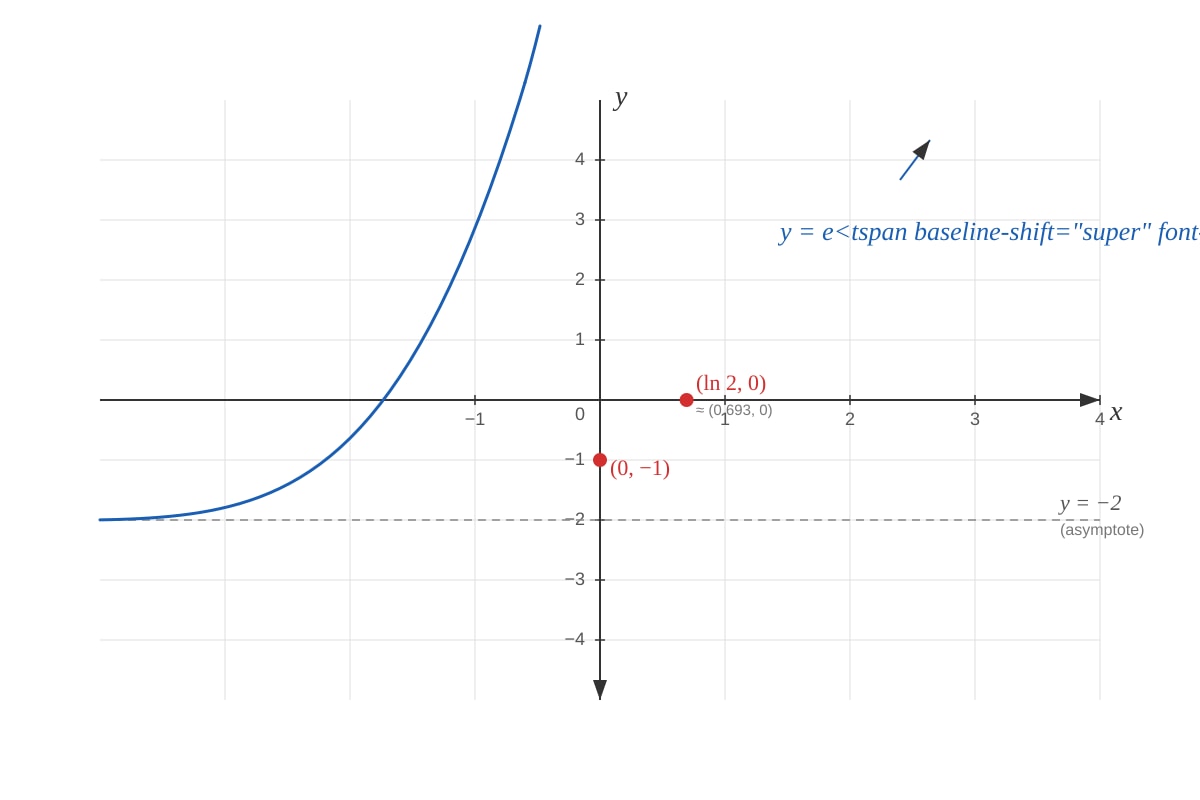
Answer: See sketch description below. Marks: 3
Expected Sketch Features:
- The curve approaches as (horizontal asymptote).
- The curve passes through (the -intercept).
- The curve crosses the -axis at .
- The curve increases without bound as .
Working:
- -intercept: Set : . So .
- -intercept: Set : . So .
- Asymptote: As , , so .
Marking Scheme:
- 1 mark: Correct shape of exponential curve (increasing, concave up).
- 1 mark: Correct -intercept and asymptote labelled.
- 1 mark: Correct -intercept labelled.
Common Mistake: Students often forget the -intercept or mislabel the asymptote as instead of .
Question 7
Answer: ; vertical asymptote Marks: 2
Working: A translation 3 units to the right replaces with : The vertical asymptote of is . Translating 3 units right shifts the asymptote to .
Teaching Note: For horizontal translations, remember: "right means subtract inside the function." The asymptote moves with the graph.
Marking Scheme:
- 1 mark: Correct equation .
- 1 mark: Correct asymptote .
Question 8
Answer: A horizontal stretch with scale factor (or a stretch parallel to the -axis with scale factor ). Marks: 2
Working: The transformation from to replaces with . Replacing with where represents a horizontal stretch with scale factor . Here, , so the scale factor is .
Teaching Note: This is a common point of confusion. Replacing with compresses the graph horizontally (makes it "steeper"), so the scale factor is , not 2.
Marking Scheme:
- 1 mark: Identifying it as a horizontal stretch.
- 1 mark: Correct scale factor .
Question 9
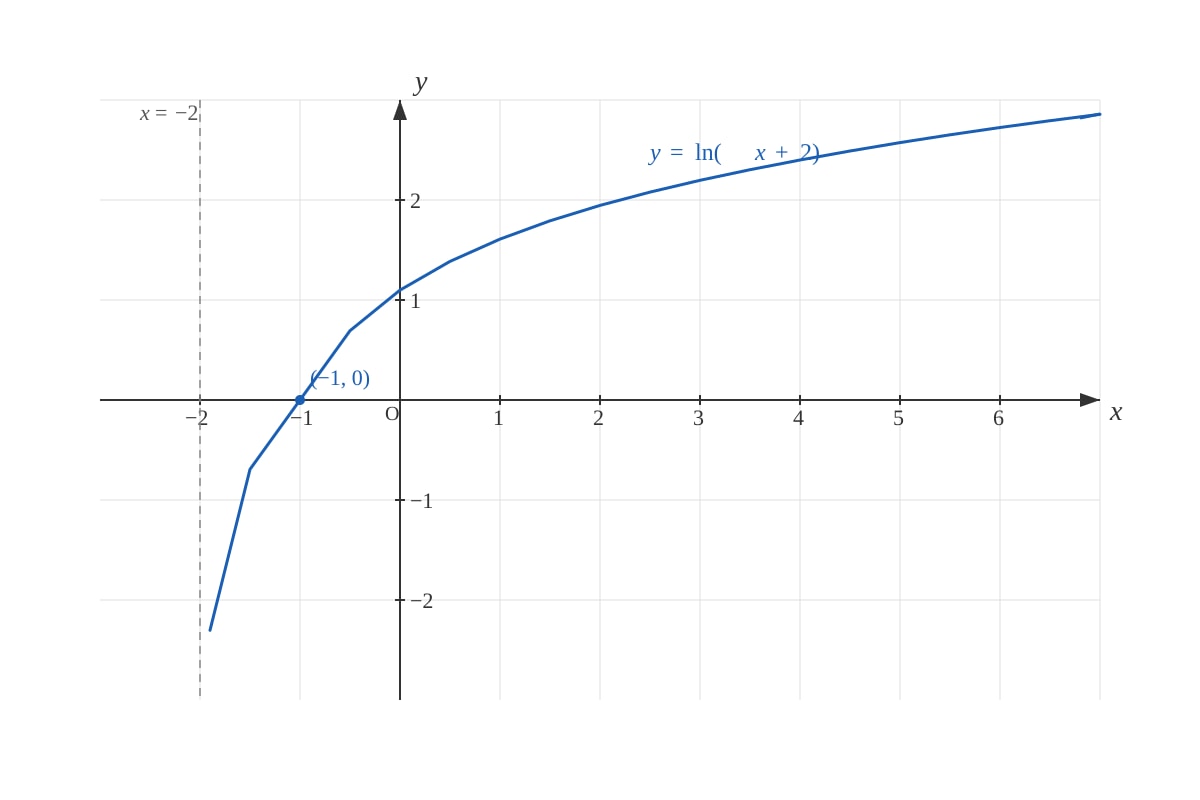
Answer: See sketch description below. Marks: 3
Expected Sketch Features:
- The curve approaches from the right (vertical asymptote).
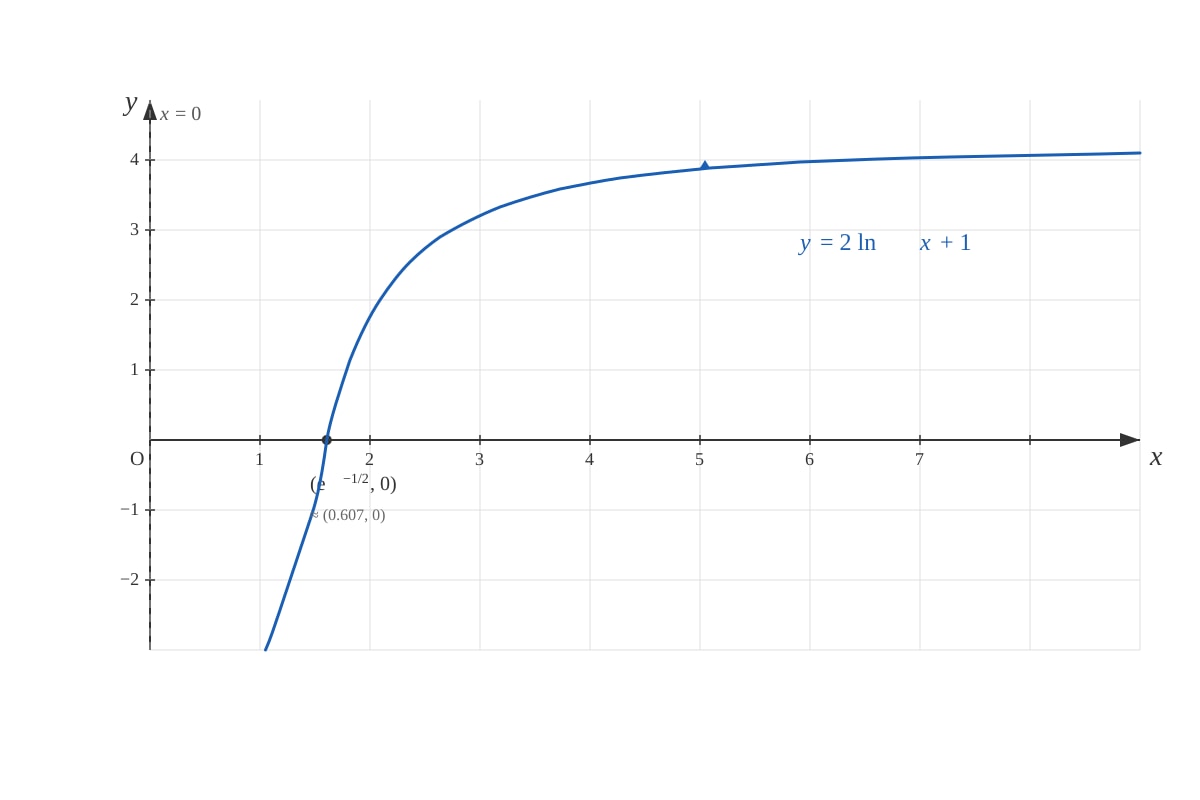
- The curve crosses the -axis at .
- The curve increases slowly without bound as .
Working:
- Vertical asymptote: .
- -intercept: Set : . So .
Marking Scheme:
- 1 mark: Correct shape of logarithmic curve.
- 1 mark: Correct vertical asymptote labelled.
- 1 mark: Correct -intercept labelled.
Common Mistake: Students sometimes place the asymptote at instead of . Remember: the asymptote is where the argument of the logarithm equals zero.
Question 10
Answer: Marks: 1
Working: Reflection in the -axis multiplies the entire function by :
Teaching Note: Reflection in the -axis changes the sign of the output (-values). Reflection in the -axis would replace with , giving .
Question 11
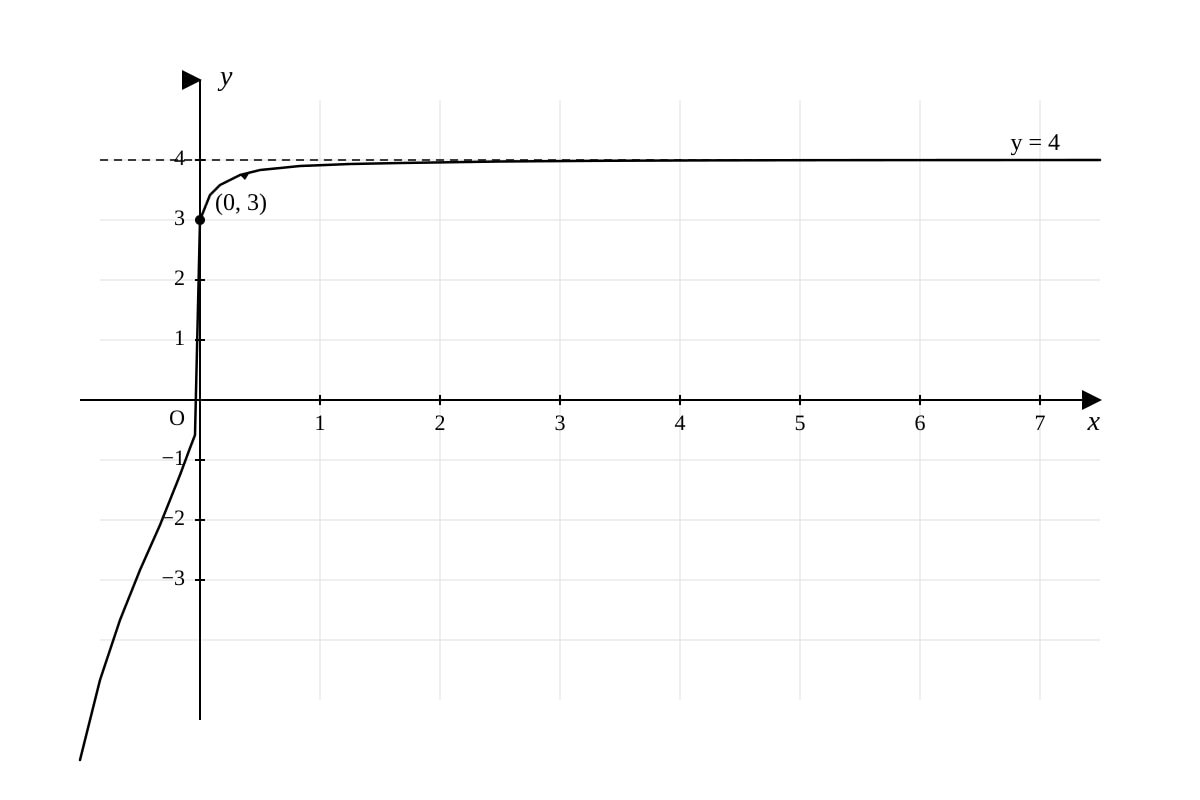
Answer: (a) (b) (c) See sketch description below. Marks: 4
Working: (a) As , , so . The horizontal asymptote is .
(b) Set : . The -intercept is .
(c) Expected Sketch Features:
- The curve approaches as (horizontal asymptote).
- The curve passes through .
- As , , so . The curve decreases steeply to the left.
Marking Scheme:
- 1 mark: Correct asymptote .
- 1 mark: Correct -intercept .
- 2 marks: Correct sketch with asymptote and intercept labelled.
Teaching Note: Note that grows without bound as (because ). This is why the curve goes down to negative infinity on the left.
Question 12
Answer: Marks: 1
Working: A stretch parallel to the -axis with scale factor 3 multiplies the entire function by 3:
Teaching Note: Vertical stretches multiply the output (the -value) by the scale factor. This is distinct from a horizontal stretch, which would modify the input.
Section C: Extended Response Questions (Questions 13–20, 22 marks)
Question 13
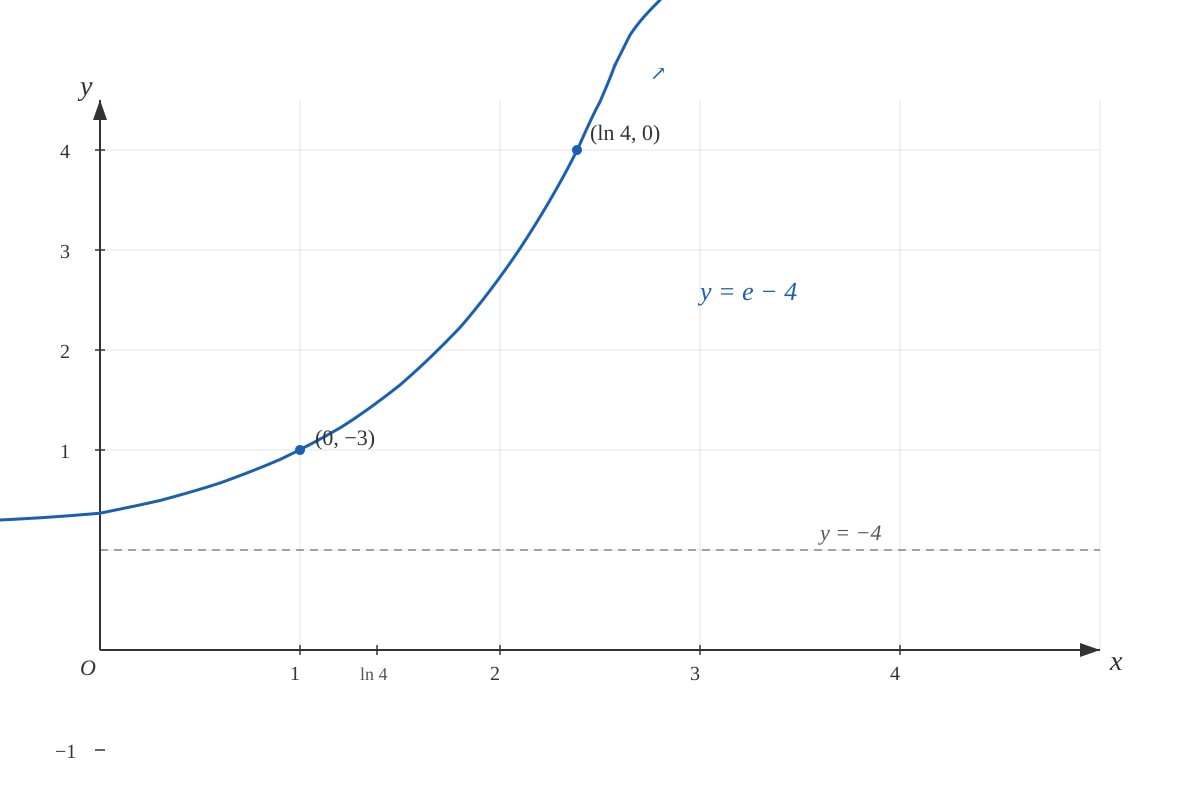
Answer: (a) (b) (c) See sketch description below. Marks: 4
Working: (a) Set : . The -intercept is .
(b) As , , so . The horizontal asymptote is .
(c) Expected Sketch Features:
- The curve approaches as .
- The curve passes through (the -intercept: ).
- The curve crosses the -axis at .
- The curve increases without bound as .
Marking Scheme:
- 1 mark: Correct -intercept .
- 1 mark: Correct asymptote .
- 2 marks: Correct sketch with intercepts and asymptote labelled.
Teaching Note: The exact form is required for full marks. A decimal approximation alone may lose a mark in an "exact" question.
Question 14
Answer: ; -intercept at Marks: 3
Working: A translation 2 units upwards adds 2 to the function:
To find the -intercept, set :
The -intercept is .
Teaching Note: To solve , exponentiate both sides: . Here, , so .
Marking Scheme:
- 1 mark: Correct equation .
- 2 marks: Correct -intercept with working.
Question 15
Answer: (a) (b) (c) Marks: 3
Working: (a) As , , so . The horizontal asymptote is .
(b) Set : . The -intercept is .
(c) Set : . The -intercept is .
Marking Scheme:
- 1 mark: Correct asymptote.
- 1 mark: Correct -intercept.
- 1 mark: Correct -intercept.
Common Mistake: For part (b), students sometimes write or forget the negative sign when rearranging. Remember: .
Question 16
Answer: Marks: 2
Working: Step 1: Translation 1 unit left: replace with .
Step 2: Reflection in the -axis: multiply by .
Teaching Note: Apply transformations in the order stated. A translation left by 1 unit means we add 1 inside the exponent (i.e., becomes ).
Marking Scheme:
- 1 mark: Correct translation .
- 1 mark: Correct reflection .
Question 17
Answer: (a) (b) (c) A horizontal stretch with scale factor (or stretch parallel to the -axis with scale factor ). Marks: 3
Working: (a) is defined only when , i.e., . The vertical asymptote is (the -axis).
(b) Set : . The -intercept is .
(c) Replacing with in gives . This is a horizontal stretch with scale factor .
Marking Scheme:
- 1 mark: Correct asymptote .
- 1 mark: Correct -intercept .
- 1 mark: Correct transformation description.
Teaching Note: The vertical asymptote of is still because the argument approaches 0 as approaches 0.
Question 18
Answer: Marks: 2
Working: Step 1: Stretch parallel to the -axis with scale factor : multiply the function by .
Step 2: Translate 3 units downwards: subtract 3.
Teaching Note: Vertical stretches multiply the output; vertical translations add/subtract a constant. Apply them in the order specified in the question.
Marking Scheme:
- 1 mark: Correct stretch .
- 1 mark: Correct translation .
Question 19
Answer: (a) (b) (c) See sketch description below. Marks: 3
Working: (a) is defined only when . The vertical asymptote is .
(b) Set : . The -intercept is .
(c) Expected Sketch Features:
- The curve approaches from the right (vertical asymptote).
- The curve crosses the -axis at .
- The curve increases slowly without bound as .
Marking Scheme:
- 1 mark: Correct asymptote .
- 1 mark: Correct -intercept .
- 1 mark: Correct sketch with asymptote and intercept labelled.
Teaching Note: The coefficient 2 in makes the curve steeper than , but does not change the asymptote or the general shape.
Question 20
Answer: ; domain: Marks: 2
Working: Reflection in the -axis replaces with :
For to be defined, we need , i.e., . The domain is , or in interval notation, .
Teaching Note: Reflecting in the -axis produces a curve that exists only for negative -values. The domain changes from to .
Marking Scheme:
- 1 mark: Correct equation .
- 1 mark: Correct domain .
END OF ANSWER KEY