From Real Exams Quiz
A Level H1 Mathematics Graphs Coordinate Geometry Quiz
Free A Level H1 Maths Graphs Geometry quiz, Exam version, with questions, answers, and A Level-style practice for Singapore students.
These static practice materials are generated from the site's syllabus and paper-generation workflow, with source and model context shown so students and parents can evaluate the material before use.
Questions
Free quiz and exam paper access
Enter your details to view this paper
Your access is remembered on this device.
Answers
A-Level Maths H1 Quiz - Graphs Coordinate Geometry: Answer Key
Total Marks: 50
Section A: Short Questions (Questions 1–5, 2 marks each)
Question 1
Answer:
Working/Marking Notes:
- The transformation shifts the graph vertically upward by 4 units.
- The horizontal asymptote also shifts up by 4 units: .
- [2 marks: 1 mark for identifying vertical shift, 1 mark for correct answer]
Teaching Note: A vertical translation moves every point on the graph, including asymptotes, up by units. Horizontal asymptotes shift vertically; vertical asymptotes remain unchanged.
Question 2
Answer:
Working/Marking Notes:
- The -axis is where .
- Substitute : .
- [2 marks: 1 mark for substituting , 1 mark for correct answer]
Teaching Note: The -intercept is always found by setting . Remember .
Question 3
Answer:
Working/Marking Notes:
- The natural logarithm is defined only when , i.e., .
- As , , so .
- Therefore, the vertical asymptote is .
- [2 marks: 1 mark for recognising the argument must be positive, 1 mark for correct answer]
Teaching Note: For , the vertical asymptote occurs where . The curve approaches this line but never touches it.
Question 4
Answer:
Working/Marking Notes:
- Complete the square: .
- The turning point of is at .
- Therefore, the turning point is .
- [2 marks: 1 mark for completing the square, 1 mark for correct coordinates]
Teaching Note: Completing the square is the standard method for finding the turning point of a quadratic. Since the coefficient of is positive, this is a minimum point.
Question 5
Answer:
Working/Marking Notes:
- Reflection in the -axis changes the sign of the -coordinate of every point.
- If is on , then is on the reflected graph.
- Therefore, the reflected graph has equation .
- [2 marks: 1 mark for understanding reflection in x-axis, 1 mark for correct equation]
Teaching Note: Reflection in the -axis: . Reflection in the -axis: .
Section B: Structured Questions (Questions 6–15)
Question 6
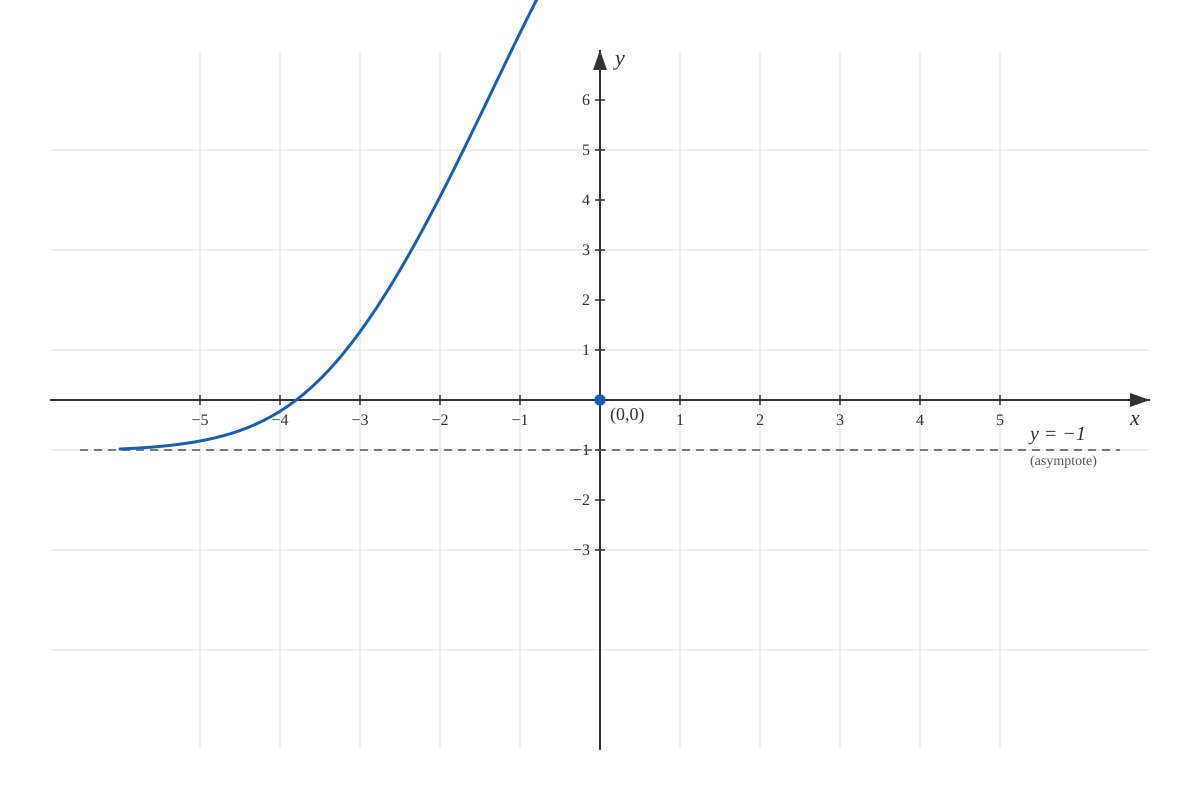
Answer: (a) See graph below. [2 marks]
Image pending generation: graph for Q6.
Marking Notes:
- [1 mark] Correct shape: exponential growth curve increasing from left to right
- [1 mark] Correct asymptote at and intercept at
Teaching Note: The graph of is shifted down by 1 unit. The horizontal asymptote of is , so after shifting down, it becomes . The -intercept: set . The -intercept: set . Both intercepts are at the origin.
Question 7
Answer:
Working/Marking Notes:
- The transformation shifts the graph horizontally to the right by 3 units.
- The maximum point shifts right by 3: .
- [2 marks: 1 mark for identifying horizontal shift, 1 mark for correct coordinates]
Teaching Note: For , the graph shifts right by units. The -coordinate of any point remains unchanged; only the -coordinate increases by .
Question 8
Answer: or
Working/Marking Notes:
- Factorise: .
- The quadratic is negative between its roots.
- Roots are and .
- Therefore, .
- [3 marks: 1 mark for factorisation, 1 mark for identifying roots, 1 mark for correct inequality]
Teaching Note: For a positive quadratic ( with ), the expression is negative between the two roots. A quick sketch of the parabola opening upward helps confirm this.
Question 9
Answer: ,
Working/Marking Notes:
- For two distinct real roots, the discriminant must be positive: .
- Here, , , .
- Discriminant: .
- .
- Since is the coefficient of , (otherwise the equation is linear, not quadratic).
- Therefore, , .
- [3 marks: 1 mark for discriminant condition, 1 mark for solving inequality, 1 mark for excluding ]
Teaching Note: The discriminant determines the nature of roots: positive for two distinct real roots, zero for equal roots, negative for no real roots. Always check whether the leading coefficient can be zero.
Question 10
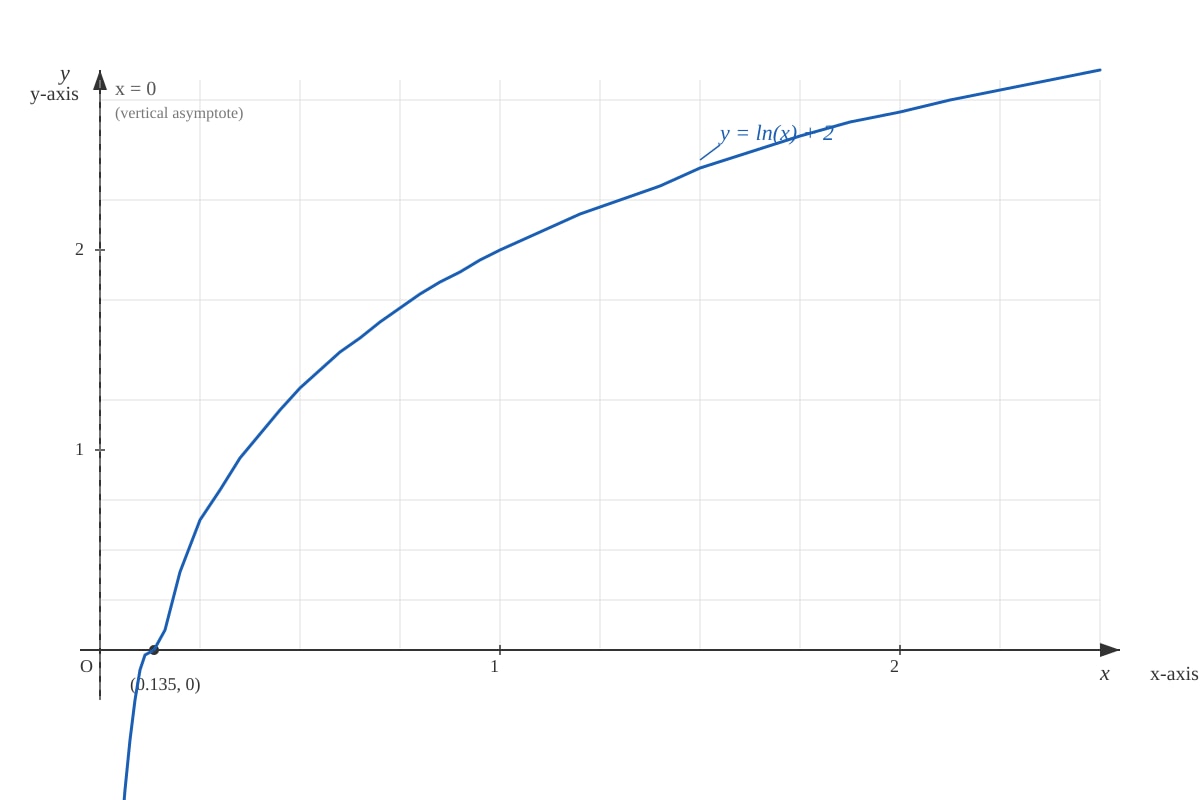
Answer: See graph below. [2 marks]
Image pending generation: graph for Q10.
Marking Notes:
- [1 mark] Correct logarithmic shape, increasing for
- [1 mark] Correct vertical asymptote at and x-intercept at approximately
Teaching Note: The graph of is shifted up by 2 units. The vertical asymptote remains at . The -intercept: set .
Question 11
Answer: and
Working/Marking Notes:
- Set the equations equal: .
- Rearrange: .
- Factorise: .
- So or .
- Substitute into :
- When : , giving .
- When : , giving .
- [3 marks: 1 mark for equating, 1 mark for solving quadratic, 1 mark for both coordinates]
Teaching Note: To find intersections, equate the two expressions for and solve. Always substitute back into the simpler equation (the line) to find the -coordinates.
Question 12
Answer:
Working/Marking Notes:
- The transformation shifts the graph vertically upward by 2 units.
- The minimum point shifts up by 2: .
- [2 marks: 1 mark for identifying vertical shift, 1 mark for correct coordinates]
Teaching Note: A vertical translation moves every point up by units. The -coordinate remains unchanged.
Question 13
Answer: or
Working/Marking Notes:
- The expression is positive when the numerator and denominator have the same sign.
- Critical values: ; .
- Test intervals:
- : numerator negative, denominator negative → positive ✓
- : numerator negative, denominator positive → negative ✗
- : numerator positive, denominator positive → positive ✓
- Therefore, or .
- [3 marks: 1 mark for critical values, 1 mark for sign analysis, 1 mark for correct intervals]
Teaching Note: For rational inequalities, find where the numerator and denominator are zero. These are the only points where the sign can change. Test one value in each interval. Remember is excluded (division by zero).
Question 14
Answer: Translation 1 unit to the right, followed by translation 3 units upward.
Working/Marking Notes:
- is shifted 1 unit to the right.
- is shifted 3 units upward.
- The transformations can be applied in either order.
- [2 marks: 1 mark for horizontal shift, 1 mark for vertical shift]
Teaching Note: For : the graph shifts units right (if ) and units up (if ). The order of translations does not matter.
Question 15
Answer: and
Working/Marking Notes:
- Set .
- Rearrange: .
- Factorise: .
- So or .
- Since for both, the points are and .
- [3 marks: 1 mark for setting up equation, 1 mark for solving, 1 mark for both coordinates]
Teaching Note: When finding intersections with a horizontal line , substitute into the curve equation and solve for . The -coordinate is always .
Section C: Extended Response Questions (Questions 16–20)
Question 16
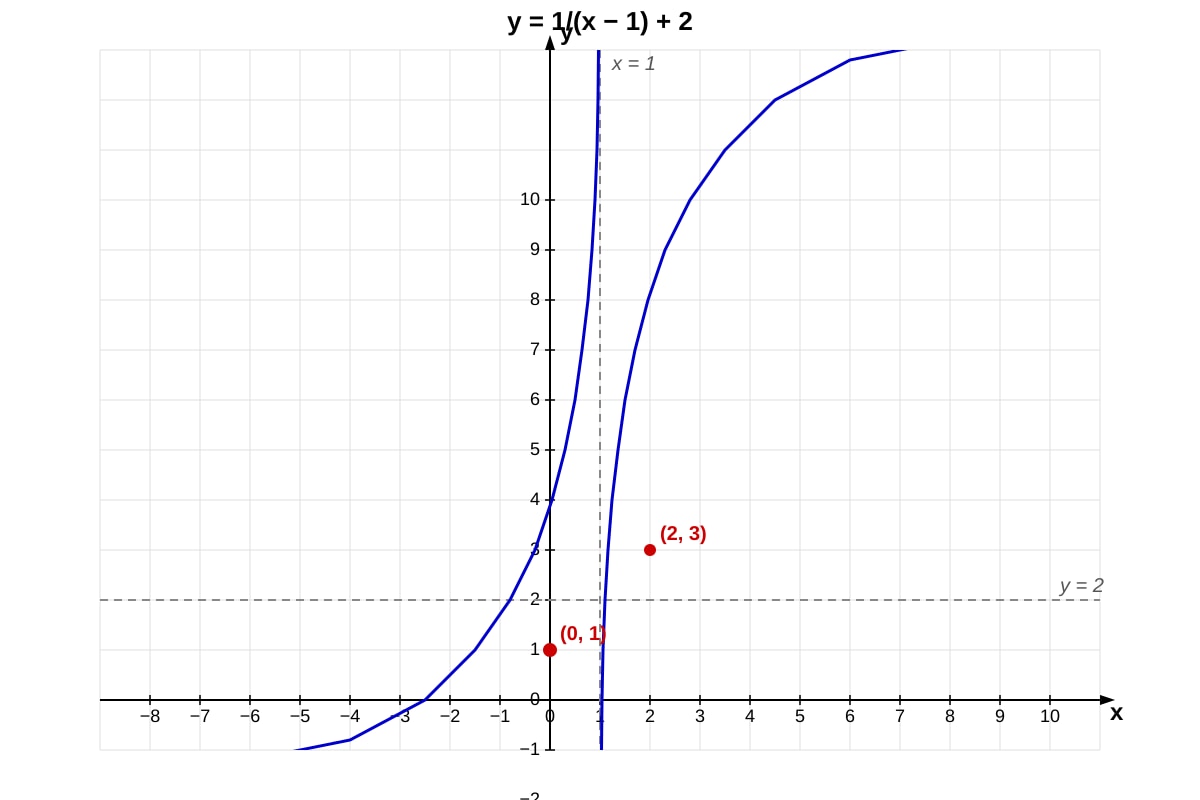
Answer: (a) Vertical asymptote: ; Horizontal asymptote: [2 marks]
(b) See graph below. [2 marks]
Image pending generation: graph for Q16.
Marking Notes: (a) [2 marks: 1 mark for each asymptote] (b) [2 marks: 1 mark for correct shape (two branches), 1 mark for correct asymptotes and intercept]
Teaching Note: For :
- Vertical asymptote: (where denominator is zero)
- Horizontal asymptote: (as , )
- -intercept: set , giving
Question 17
Answer: (a) [1 mark]
(b) , , [3 marks]
Working/Marking Notes: (a) The turning point is at since the maximum value is 8 at .
(b) Since the turning point is at , the quadratic can be written as:
Using :
Therefore, .
So , , .
Marking Notes:
- (a) [1 mark for correct coordinates]
- (b) [3 marks: 1 mark for vertex form, 1 mark for substituting , 1 mark for correct values of , , ]
Teaching Note: When given the turning point , use the vertex form . The sign of tells you whether it's a maximum () or minimum (). Here, since it's a maximum, must be negative.
Question 18
Answer: (a) and [3 marks]
(b) is a maximum; is a minimum. [1 mark]
Working/Marking Notes: (a) Find stationary points by setting :
Set : or .
Find -coordinates:
- When : , giving .
- When : , giving .
(b) Determine nature using the second derivative:
- At : , so is a maximum.
- At : , so is a minimum.
Marking Notes:
- (a) [3 marks: 1 mark for differentiating, 1 mark for solving , 1 mark for both coordinates]
- (b) [1 mark for both natures correct]
Teaching Note: Stationary points occur where . The second derivative test: if , it's a minimum; if , it's a maximum. This is a standard H1 technique.
Question 19
Answer: (a) , , [1 mark]
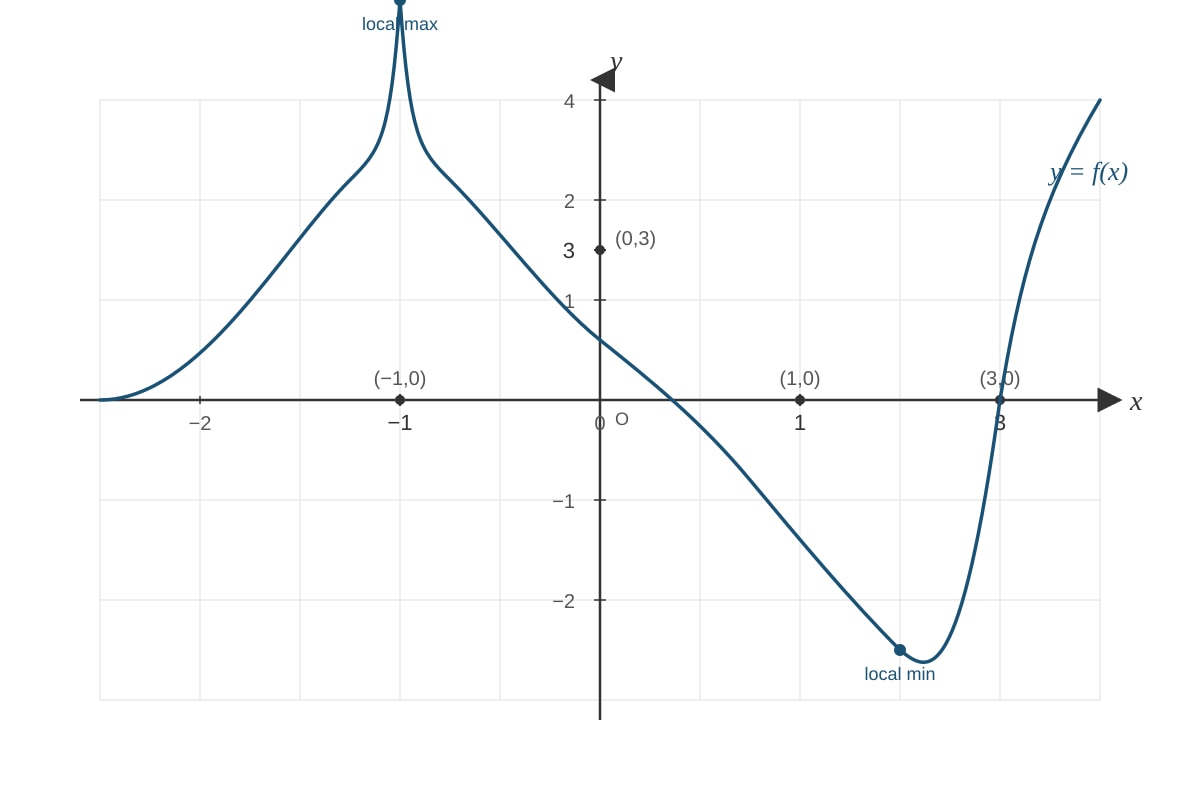
(b) See graph below. [3 marks]
Image pending generation: graph for Q19.
Marking Notes:
- (a) [1 mark for all three roots correct]
- (b) [3 marks: 1 mark for correct shape, 1 mark for correct vertical shift, 1 mark for correct new intercepts]
Teaching Note:
- (a) The roots of are where the curve crosses the -axis: , , .
- (b) shifts the entire graph up by 1 unit. The -intercept becomes . The -intercepts shift slightly: since the curve is raised, the crossings occur at slightly different -values. From the graph, these are approximately , , and .
Question 20
Answer: (a) and [3 marks]
(b) [1 mark]
Working/Marking Notes: (a) Set the equations equal: or
Substitute into :
- When : , giving .
- When : , giving .
(b) The inequality means the curve is below the line.
- The curve and line intersect at and .
- The curve opens upward (coefficient of is positive).
- Between the intersection points, the curve is below the line.
- Therefore, .
Marking Notes:
- (a) [3 marks: 1 mark for equating, 1 mark for solving quadratic, 1 mark for both coordinates]
- (b) [1 mark for correct inequality]
Teaching Note: For part (b), after finding intersections, determine which function is greater on each interval. Since the quadratic opens upward, it is below the line between the two intersection points. You can verify by testing : curve gives , line gives . Since , the inequality holds in this interval.
END OF ANSWER KEY