AI Generated Exam Paper
A Level H1 Mathematics Practice Paper 5
Free A Level H1 Maths Practice Paper 5, HY3 AI version, with questions, answers, and A Level-style practice for Singapore students.
These static practice materials are generated from the site's syllabus and paper-generation workflow, with source and model context shown so students and parents can evaluate the material before use.
Questions
TuitionGoWhere Practice Paper - Maths H1 A-Level
TuitionGoWhere Practice Paper (AI) — Version 5
Subject: Maths H1
Level: A-Level
Paper: Practice Paper (Statistics Probability Focus)
Duration: 1 hour 30 minutes
Total Marks: 60
Name: ___________________________
Class: ___________________________
Date: ___________________________
Instructions
- Answer all questions.
- Show your working clearly.
- Use an approved graphing calculator where appropriate.
- Write your answers in the spaces provided.
Section A: Probability and Counting (12 marks)
Questions 1–4
1. A club has 7 men and 5 women. In how many ways can a committee of 4 people be formed if it must contain exactly 2 women? [2]
2. Events A and B are such that P(A)=0.4, P(B)=0.5, and P(A∩B)=0.2. Find P(A∪B). [1]
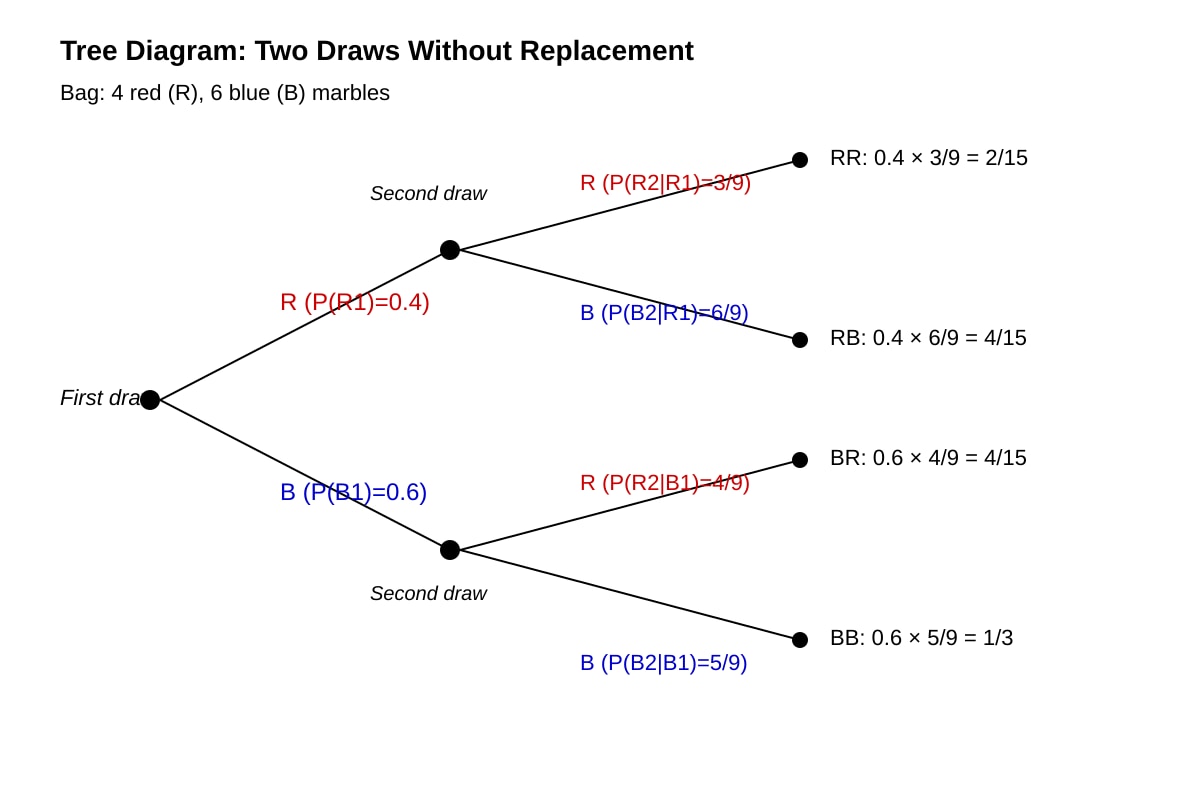
3. A bag contains 4 red and 6 blue marbles. Two marbles are drawn without replacement. Draw a tree diagram to represent the possible outcomes and their probabilities. [3]
Image pending generation: diagram for Q3.
4. Given that P(C)=0.3 and P(D∣C)=0.6, find P(C∩D). [1]
5. In a survey, 60% of students use public transport. Of those, 20% are late. Of those who do not use public transport, 10% are late. Find the probability a randomly chosen student is late. [2]
6. A password consists of 3 distinct letters from A, B, C, D, E. How many such passwords can be formed? [2]
Section B: Distributions (18 marks)
Questions 7–10
7. Let X∼B(20,0.3). Find P(X>8). [2]
8. The mass of a fruit follows N(150,202) grams. Find the probability that a randomly chosen fruit has mass between 140 g and 160 g. [3]
9. The number of daily customers at a shop is X∼B(50,0.4). Find the mean and variance of X. [2]
10. Given Y∼N(10,4), find P(Y<12) and the value of y such that P(Y<y)=0.9. [3]
11. A random variable W=3X−2 where X∼N(5,9). State the distribution of W and find P(W>10). [3]
12. Two independent variables U∼N(2,1) and V∼N(3,4). Find E(2U+V) and Var(2U+V). [3]
Section C: Sampling and Hypothesis Testing (18 marks)
Questions 13–16
13. A sample of 25 observations has ∑x=200, ∑x2=1700. Find the unbiased estimates of the population mean and variance. [3]
14. Explain what the Central Limit Theorem states about the sample mean when n≥30. [2]
15. A manufacturer claims the mean life of bulbs is 1000 hours. A sample of 40 bulbs has mean 980 h and sd 60 h. Test at 5% whether the mean life is less than claimed. [4]
16. A sample of 35 students has mean test score 62 and sd 8. Test at 1% if the mean score differs from 65. [4]
17. State the conditions under which a binomial distribution is a suitable model. [2]
Section D: Correlation and Regression (12 marks)
Questions 18–20
18. The product moment correlation coefficient for data on study hours and score is r=0.85. Comment on the relationship. [2]
19. Given summarised data: n=10, ∑x=50, ∑y=120, ∑xy=700, ∑x2=300. Find the regression line of y on x in the form y=a+bx. [4]
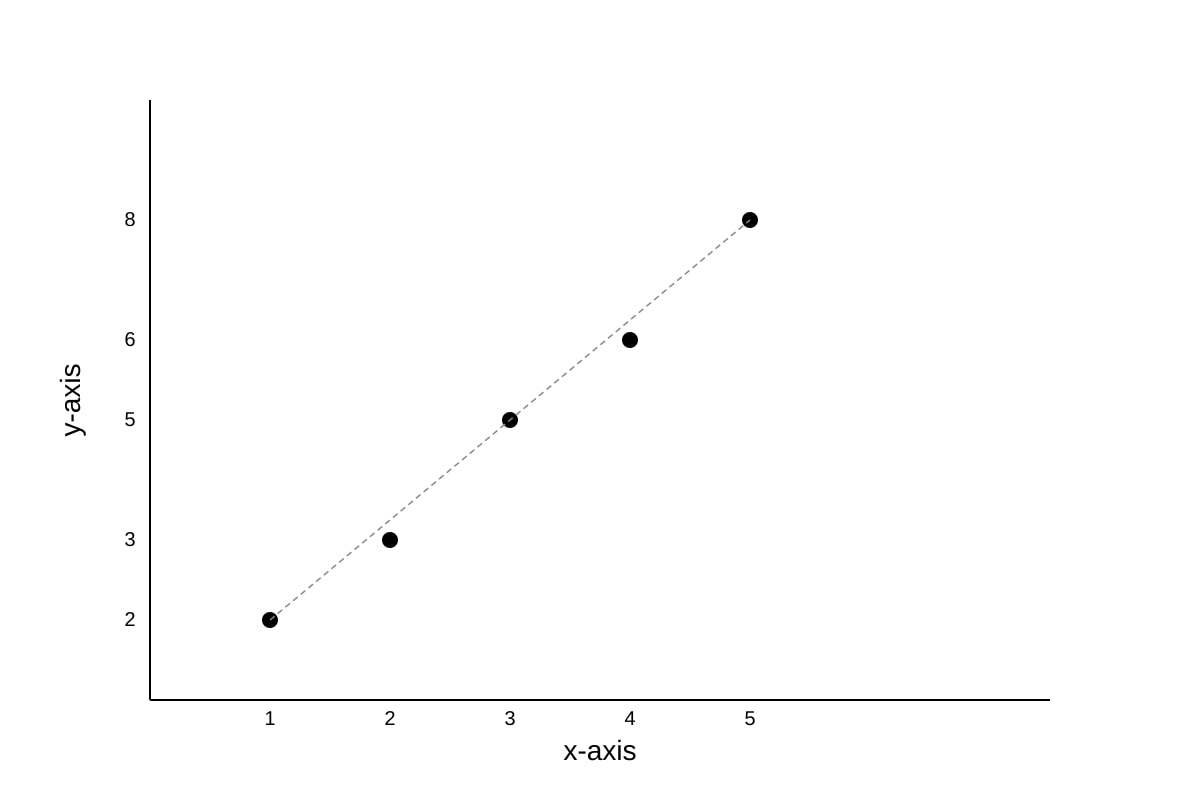
20. Sketch a scatter diagram for the following points: (1,2), (2,3), (3,5), (4,6), (5,8). Label axes. [2]
Image pending generation: graph for Q20.
End of Paper
Answers
TuitionGoWhere Practice Paper - Maths H1 A-Level (Version 5) Answer Key
Total Marks: 60
Section A: Probability and Counting
1. [2 marks]
Choose 2 women from 5: 5C2=10. Choose 2 men from 7: 7C2=21.
Total = 10×21=210.
Marking: 1 for each combination, 0 if multiplication error.
2. [1 mark]
P(A∪B)=P(A)+P(B)−P(A∩B)=0.4+0.5−0.2=0.7.
3. [3 marks]
Tree: First branch R (0.4), B (0.6). From R: R (3/9), B (6/9). From B: R (4/9), B (5/9).
Marking: 1 for structure, 1 for first probabilities, 1 for second-stage conditional probabilities.
4. [1 mark]
P(C∩D)=P(C)×P(D∣C)=0.3×0.6=0.18.
5. [2 marks]
P(L)=P(PT)×P(L∣PT)+P(notPT)×P(L∣notPT)=0.6×0.2+0.4×0.1=0.12+0.04=0.16.
6. [2 marks]
5P3=5×4×3=60.
Section B: Distributions
7. [2 marks]
P(X>8)=1−P(X≤8). Using GC, P(X≤8)≈0.8867, so answer ≈0.1133.
8. [3 marks]
Z1=(140−150)/20=−0.5, Z2=(160−150)/20=0.5.
P(−0.5<Z<0.5)=Φ(0.5)−Φ(−0.5)=0.6915−0.3085=0.3830.
9. [2 marks]
Mean = np=50×0.4=20. Variance = np(1−p)=50×0.4×0.6=12.
10. [3 marks]
P(Y<12): Z=(12−10)/2=1, Φ(1)=0.8413.
For P(Y<y)=0.9, z=1.282, y=10+1.282×2=12.564.
11. [3 marks]
W∼N(3×5−2,32×9)=N(13,81).
P(W>10): Z=(10−13)/9=−0.333, P(Z>−0.333)=0.6306.
12. [3 marks]
E(2U+V)=2E(U)+E(V)=4+3=7.
Var(2U+V)=4Var(U)+Var(V)=4×1+4=8 (independent).
Section C: Sampling and Hypothesis Testing
13. [3 marks]
xˉ=200/25=8.
s2=241700−25×82=241700−1600=100/24=4.17.
14. [2 marks]
CLT: For n≥30, sample mean Xˉ is approximately normally distributed with mean μ and variance σ2/n, regardless of population distribution.
15. [4 marks]
H0:μ=1000, H1:μ<1000.
Test stat: Z=(980−1000)/(60/40)=−2.108.
Critical at 5% 1-tail: -1.645. Reject H0. Evidence mean < 1000.
16. [4 marks]
H0:μ=65, H1:μ=65.
Z=(62−65)/(8/35)=−2.218. Critical 1% 2-tail: ±2.576. Not reject.
17. [2 marks]
Fixed n trials, independent, constant p, two outcomes (success/fail).
Section D: Correlation and Regression
18. [2 marks]
Strong positive linear relationship between study hours and score.
19. [4 marks]
b=300−502/10700−50×120/10=300−250700−600=100/50=2.
a=12−2×5=2. So y=2+2x.
20. [2 marks]
Scatter shows upward trend; axes labelled x and y, points plotted as specified.
Free quiz and exam paper access
Enter your details to view this paper
Your access is remembered on this device.