AI Generated Exam Paper
A Level H1 Mathematics Practice Paper 3
Free A Level H1 Maths Practice Paper 3, HY3 AI version, with questions, answers, and A Level-style practice for Singapore students.
These static practice materials are generated from the site's syllabus and paper-generation workflow, with source and model context shown so students and parents can evaluate the material before use.
Questions
Free quiz and exam paper access
Enter your details to view this paper
Your access is remembered on this device.
Answers
TuitionGoWhere Practice Paper - Maths H1 A-Level (Answers)
Version 3 of 5 — Answer Key
Section A: Probability and Counting
Q1 [2 marks]
Number of committees = ¹⁰C₃ = 10! / (3! 7!) = 120.
Teaching note: Order does not matter in a committee, so we use combinations not permutations.
Marking: 1 mark for correct formula, 1 mark for correct value.
Q2 [2 marks]
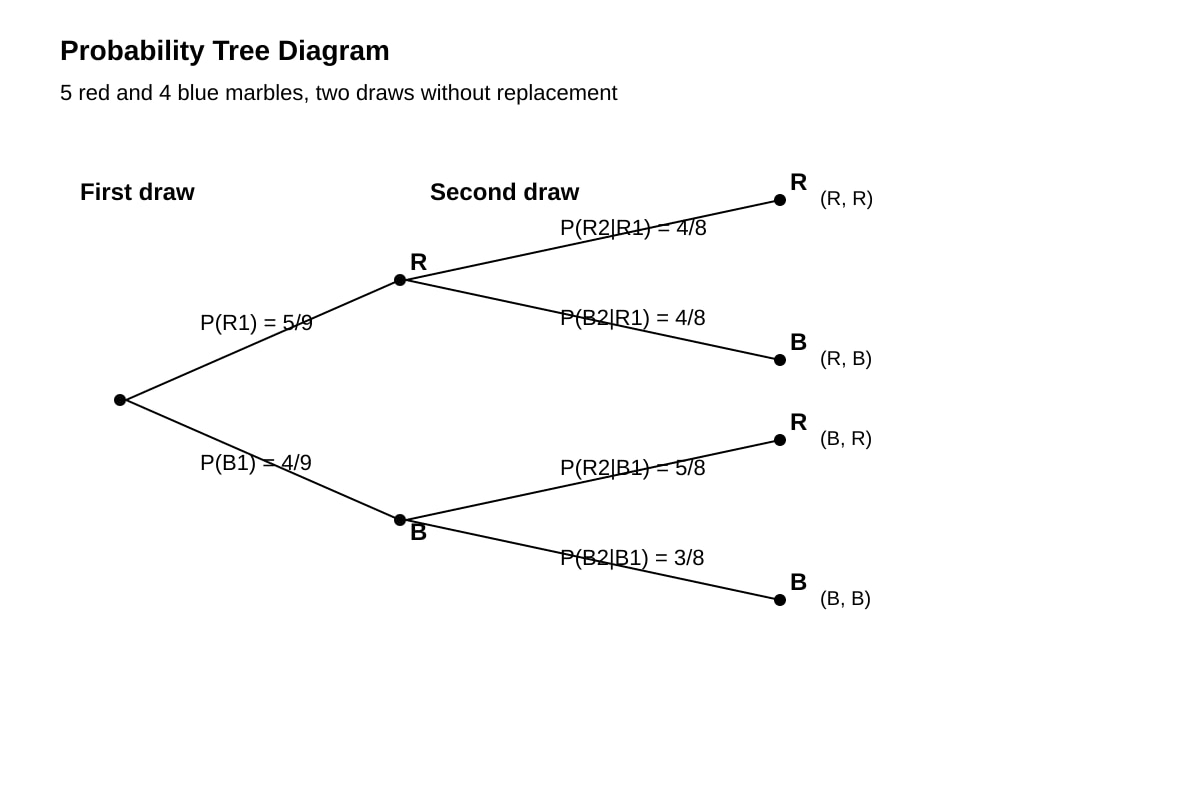
Tree diagram as per placeholder Q2-fig1. Probabilities:
P(RR) = (5/9)(4/8)=20/72, P(RB)=(5/9)(4/8)=20/72, P(BR)=(4/9)(5/8)=20/72, P(BB)=(4/9)(3/8)=12/72.
Teaching note: Without replacement reduces the denominator from 9 to 8 and changes colour counts.
Marking: 1 mark for correct tree structure, 1 mark for probabilities.
Q3 [3 marks]
P(A ∪ B) = P(A)+P(B)−P(A ∩ B) = 0.4+0.5−0.2 = 0.7.
P(A | B) = P(A ∩ B)/P(B) = 0.2/0.5 = 0.4.
Teaching note: Union uses inclusion-exclusion; conditional probability is intersection over given event.
Marking: 1 mark each for correct union, correct conditional, final values.
Q4 [3 marks]
X ~ B(15, 0.3). P(X = 5) = ¹⁵C₅ (0.3)⁵ (0.7)¹⁰ ≈ 0.206.
Teaching note: Use binomial probability formula for exact count.
Marking: 1 mark B(15,0.3), 1 mark formula, 1 mark value.
Q5 [4 marks]
P(at least 2 green) = P(2G1Y)+P(3G).
P(2G1Y) = (⁶C₂ ⁴C₁)/¹⁰C₃ = (15×4)/120 = 60/120.
P(3G) = ⁶C₃/¹⁰C₃ = 20/120.
Total = 80/120 = 2/3 ≈ 0.667.
Teaching note: Without replacement → hypergeometric style using combinations.
Marking: 1 mark setup, 2 marks computations, 1 mark final.
Q6 [4 marks]
P(C ∪ D) = P(C)+P(D)−P(C)P(D) = 0.6+0.3−0.18 = 0.72.
P(C′ ∩ D) = P(C′)P(D) = 0.4×0.3 = 0.12.
Teaching note: Independence lets multiplication of marginals.
Marking: 2 marks union, 2 marks intersection.
Section B: Distributions
Q7 [3 marks]
Mean = np = 20×0.35 = 7. Variance = np(1−p) = 20×0.35×0.65 = 4.55.
Teaching note: Binomial mean and variance formulae (no proof needed).
Marking: 1 mark mean, 1 mark variance, 1 mark values.
Q8 [3 marks]
X ~ N(400, 50²). Z₁ = (380−400)/50 = −0.4, Z₂ = (450−400)/50 = 1.0.
P(−0.4 < Z < 1.0) = Φ(1.0)−Φ(−0.4) = 0.8413−0.3446 = 0.4967.
Teaching note: Standardise both bounds then use tables.
Marking: 1 mark z-scores, 1 mark table use, 1 mark answer.
Q9 [4 marks]
X ~ N(30, 8²). For 90th percentile, z = 1.282. x = 30 + 1.282×8 = 40.256 min.
Teaching note: Inverse normal using z-table.
Marking: 1 mark identify z, 2 marks substitution, 1 mark answer.
Q10 [3 marks]
Z = (12−10)/2 = 1.0. P(Z < 1.0) = Φ(1.0) = 0.8413.
Teaching note: Direct standardising.
Marking: 1 mark z, 1 mark table, 1 mark answer.
Q11 [4 marks]
(60−μ)/σ = z₀.₁ = −1.282; (80−μ)/σ = z₀.₉ = 1.282.
Subtract: 20/σ = 2.564 → σ ≈ 7.80. Then μ = 60 + 1.282×7.80 ≈ 70.0.
Teaching note: Solve simultaneous z-equations.
Marking: 2 marks equations, 2 marks solve.
Q12 [3 marks]
Conditions: (i) fixed number of trials n; (ii) each trial independent with constant success probability p; (iii) two outcomes per trial.
Teaching note: Core binomial assumptions.
Marking: 1 mark each, any two of three = 2 marks, all three = 3.
Q13 [4 marks]
E(2U−V) = 2E(U)−E(V) = 2×5−3 = 7.
Var(3U+2V) = 9Var(U)+4Var(V) = 9×4+4×1 = 40.
Teaching note: Independence removes covariance term.
Marking: 2 marks expectation, 2 marks variance.
Section C: Sampling, Correlation, Hypothesis
Q14 [2 marks]
x̄ = 500/25 = 20. s² = (11000 − 500²/25)/24 = (11000−10000)/24 = 1000/24 ≈ 41.67.
Teaching note: Unbiased variance uses n−1 denominator.
Marking: 1 mark mean, 1 mark variance.
Q15 [2 marks]
CLT: For sufficiently large n (≥30), the sample mean X̄ is approximately normally distributed with mean μ and variance σ²/n, regardless of population distribution.
Teaching note: Key theorem for inference.
Marking: 1 mark approximation, 1 mark parameters.
Q16 [3 marks]
μ̂ = 4.2 hrs. SE = s/√n = 1.1/√40 ≈ 0.174 hrs.
Teaching note: Standard error of mean from sample sd.
Marking: 1 mark mean, 2 marks SE.
Q17 [2 marks]
r = 0.81 indicates strong positive linear relationship: more study hours associated with higher scores.
Teaching note: Closer to 1 = stronger positive.
Marking: 1 mark strength, 1 mark direction.
Q18 [2 marks]
Correlation ≠ causation; possible confounding variables (e.g., motivation, prior ability) or reverse causality.
Teaching note: Observational link only.
Marking: 1 mark distinction, 1 mark example.
Q19 [3 marks]
H₀: μ = 500, H₁: μ < 500.
Test stat: z = (495−500)/(12/√35) = −5/(2.028) ≈ −2.47.
Teaching note: One-sample z-test for mean (CLT n=35).
Marking: 1 mark H₀/H₁, 2 marks statistic.
Q20 [2 marks]
Since −2.47 < −1.645, reject H₀. There is evidence at 5% that mean weight is less than 500 g.
Teaching note: Test statistic beyond critical value → reject.
Marking: 1 mark decision, 1 mark context.