From Real Exams Exam Paper
A Level H1 Mathematics Practice Paper 5
Free A Level H1 Maths Practice Paper 5, HY3 Exam version, with questions, answers, and A Level-style practice for Singapore students.
These static practice materials are generated from the site's syllabus and paper-generation workflow, with source and model context shown so students and parents can evaluate the material before use.
Questions
TuitionGoWhere Practice Paper - Maths H1 A-Level
TuitionGoWhere Exam Practice (AI)
Subject: Maths H1
Level: A-Level
Paper: Practice Paper (Version 5 of 5)
Duration: 75 minutes
Total Marks: 80
Name: ______________________
Class: ______________________
Date: ______________________
Instructions
- Answer all questions.
- Show all working clearly.
- Use an approved graphing calculator where appropriate.
- Write your answers in the spaces provided.
Section A: Probability (25 marks)
Questions 1 to 5
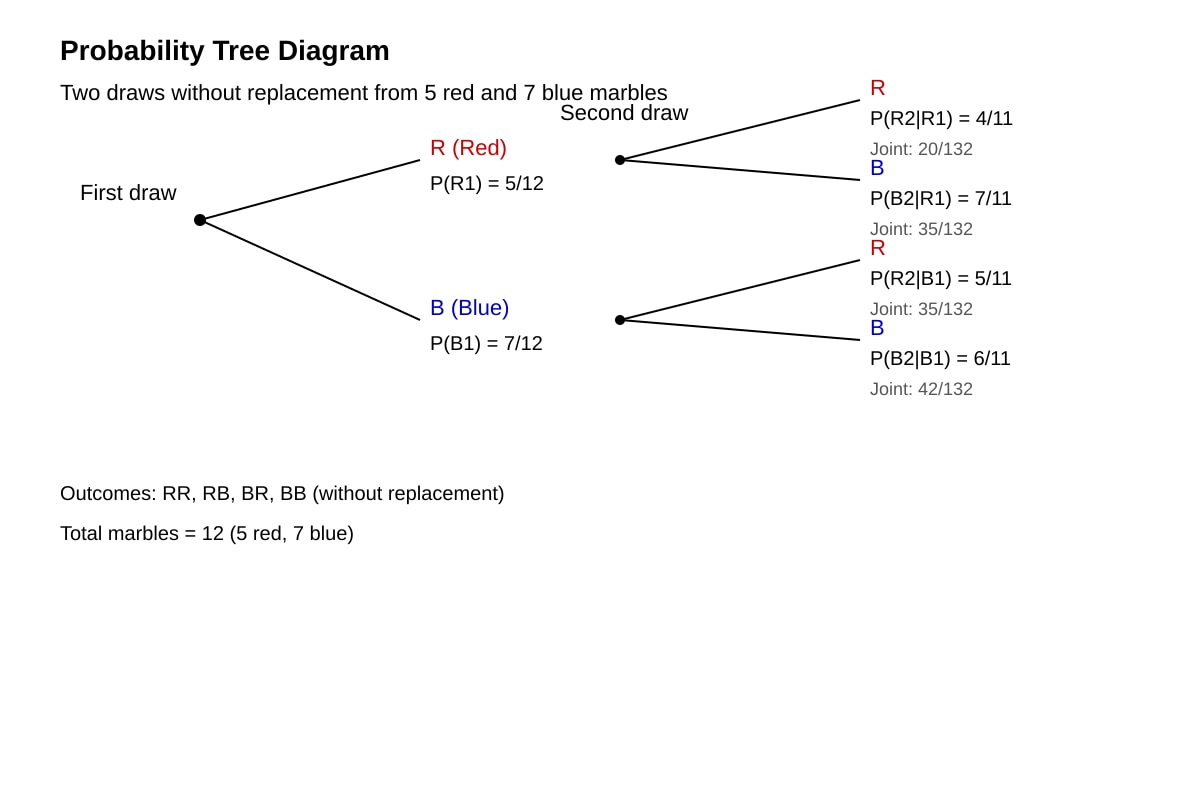
1. A bag contains 5 red and 7 blue marbles. Two marbles are drawn at random without replacement. Draw a tree diagram to represent the possible outcomes and their probabilities. [3]
Image pending generation: diagram for Q1.
2. Events A and B are such that P(A) = 0.4, P(B) = 0.5, and P(A ∩ B) = 0.2. Find P(A ∪ B) and state whether A and B are independent. [3]
3. In a survey, 60% of students use public transport. In a random sample of 15 students, find the probability that at least 10 use public transport. Use a binomial model and state its parameters. [4]
4. A factory produces light bulbs. The probability that a bulb is defective is 0.03. A box contains 20 bulbs. Find the probability that more than 1 bulb is defective. [3]
5. Given that P(C) = 0.3, P(D) = 0.6, and P(D | C) = 0.5, find P(C | D). [3]
Section B: Distributions (25 marks)
Questions 6 to 10
6. The mass of a species of fish is normally distributed with mean 400 g and standard deviation 50 g. Find the probability that a randomly caught fish has mass less than 360 g. [3]
7. The random variable X ~ N(μ, σ²). Given that P(X < 30) = 0.1 and P(X < 50) = 0.9, find μ and σ. [5]
8. Let Y ~ B(40, 0.25). Find E(Y) and Var(Y). [2]
9. The weekly earnings (in $) of workers are normally distributed with mean 500 and variance 10000. Find the probability that a worker earns between 450 and 600. [4]
10. Two independent random variables: U ~ N(10, 4) and V ~ N(20, 9). Find E(3U – 2V) and Var(3U – 2V). [3]
11. A discrete random variable W has the following distribution: P(W = 0) = 0.1, P(W = 1) = 0.3, P(W = 2) = 0.4, P(W = 3) = 0.2. Find E(W) and Var(W). [3]
12. The number of emails received per hour follows B(n, p). In a study, n = 50 and the mean is 20. Find p and the variance. [2]
Section C: Sampling and Statistics (30 marks)
Questions 13 to 20
13. A population has mean μ = 100 and variance σ² = 64. A simple random sample of size 16 is taken. State the distribution of the sample mean X̄ and find E(X̄) and Var(X̄). [3]
14. Explain how the Central Limit Theorem applies when a sample of size 35 is taken from a non-normal population with unknown mean and variance. [2]
15. The following are the scores of 8 students in a test: 55, 60, 62, 58, 64, 59, 61, 57. Find the unbiased estimates of the population mean and variance. [4]
16. A sample of 40 observations has Σx = 820 and Σx² = 17200. Find the unbiased estimates of the population mean and variance. [4]
17. The table below shows the heights (x cm) and weights (y kg) of 6 students.
| x | 150 | 160 | 165 | 170 | 175 | 180 |
|---|---|---|---|---|---|---|
| y | 45 | 50 | 53 | 58 | 62 | 65 |
Find the product moment correlation coefficient r. Comment on the relationship. [4]
18. For the data in Q17, find the equation of the least squares regression line of y on x in the form y = a + bx. [3]
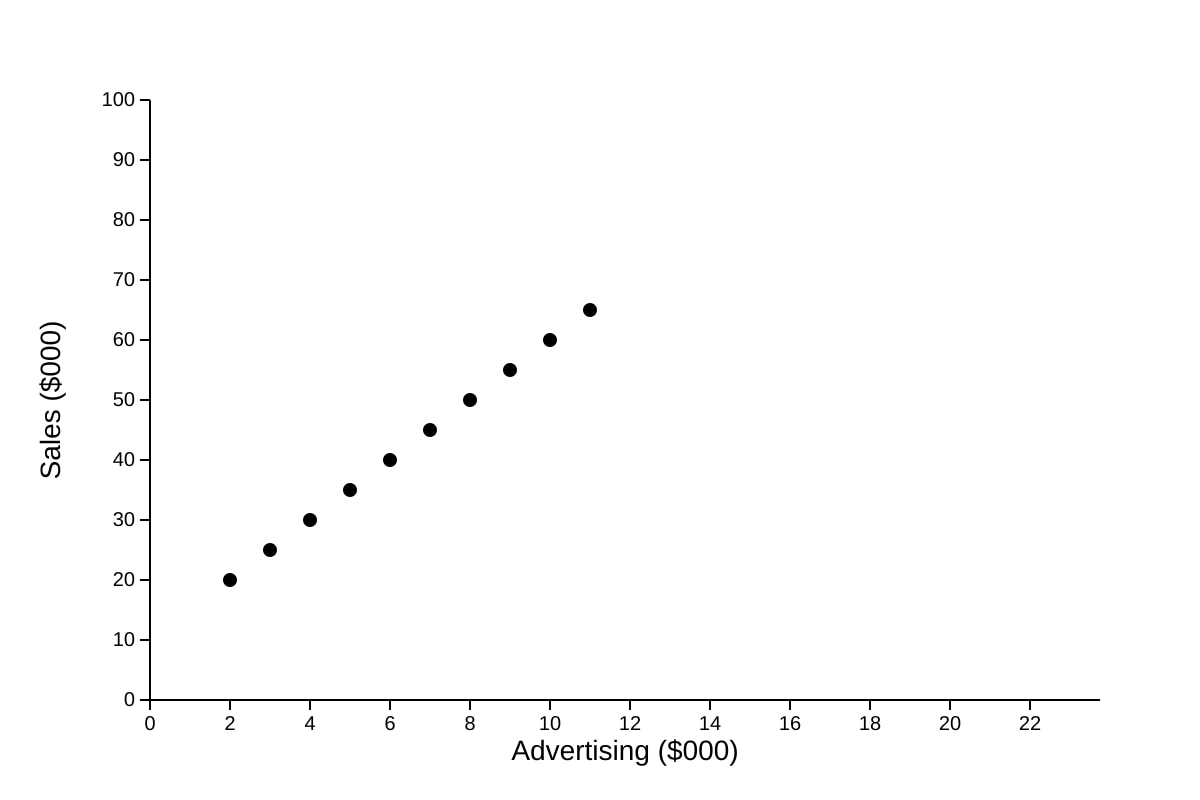
19. A scatter diagram of advertising spend (x 000)andsales(y000) for 10 shops is shown on a calculator. Give a sketch of the scatter diagram with axes labelled. [2]
Image pending generation: graph for Q19.
20. Using the regression line from Q18, estimate the weight of a student with height 172 cm. Comment on the reliability of this estimate. [3]
Answers
TuitionGoWhere Practice Paper - Maths H1 A-Level (Version 5) Answer Key
Section A: Probability (25 marks)
Q1 [3 marks]
Tree diagram:
- First branch: R (5/12), B (7/12)
- From R: R (4/11), B (7/11)
- From B: R (5/11), B (6/11)
Marking: 1 mark for first stage, 1 for second stage conditional probabilities, 1 for correct labels.
Teaching: Without replacement reduces the total and the colour count; probabilities update.
Q2 [3 marks]
P(A ∪ B) = P(A)+P(B)–P(A∩B) = 0.4+0.5–0.2 = 0.7.
Independence: check P(A)P(B)=0.4×0.5=0.2 = P(A∩B) → independent.
Marks: 2 for union, 1 for independence statement.
Q3 [4 marks]
Let X ~ B(15, 0.6). P(X ≥ 10) = 1 – P(X ≤ 9). Using GC: ≈ 0.403 (to 3 s.f.).
Marks: 1 for model, 1 for parameter, 2 for probability.
Note: Do not use normal approximation (excluded).
Q4 [3 marks]
X ~ B(20, 0.03). P(X > 1) = 1 – P(X ≤ 1) = 1 – [P(0)+P(1)] = 1 – (0.97²⁰ + 20×0.03×0.97¹⁹) ≈ 0.119.
Marks: 1 model, 2 calc.
Q5 [3 marks]
P(C∩D) = P(D|C)P(C) = 0.5×0.3 = 0.15.
P(C|D) = P(C∩D)/P(D) = 0.15/0.6 = 0.25.
Marks: 1 intersection, 2 conditional.
Section B: Distributions (25 marks)
Q6 [3 marks]
Z = (360–400)/50 = –0.8. P(Z < –0.8) = 0.2119 ≈ 0.212.
Marks: 1 standardise, 2 probability.
Q7 [5 marks]
(30–μ)/σ = z₀.₁ ≈ –1.2816; (50–μ)/σ = z₀.₉ ≈ 1.2816.
Add: 80/σ = 2.5632 → σ ≈ 31.2. μ = 30 + 1.2816×31.2 ≈ 70.0.
Marks: 2 for equations, 3 for solution.
Q8 [2 marks]
E(Y)=np=40×0.25=10; Var(Y)=np(1–p)=40×0.25×0.75=7.5.
Q9 [4 marks]
Z₁=(450–500)/100=–0.5; Z₂=(600–500)/100=1. P=Φ(1)–Φ(–0.5)=0.8413–0.3085=0.5328.
Q10 [3 marks]
E(3U–2V)=3×10–2×20=–10. Var=9×4+4×9=72 (independent).
Q11 [3 marks]
E(W)=0×0.1+1×0.3+2×0.4+3×0.2=1.7.
E(W²)=0+1×0.3+4×0.4+9×0.2=3.7. Var=3.7–1.7²=0.81.
Q12 [2 marks]
Mean=np=20 → p=20/50=0.4. Var=50×0.4×0.6=12.
Section C: Sampling and Statistics (30 marks)
Q13 [3 marks]
X̄ ~ N(100, 64/16) = N(100, 4). E(X̄)=100, Var(X̄)=4.
Q14 [2 marks]
By CLT, for n≥30, X̄ is approximately normal regardless of population shape, with mean μ and variance σ²/35.
Q15 [4 marks]
Mean = (55+60+62+58+64+59+61+57)/8 = 476/8 = 59.5.
Σx² = 3025+3600+3844+3364+4096+3481+3721+3249 = 28380.
s² = (28380 – 8×59.5²)/7 = (28380 – 28322)/7 = 58/7 ≈ 8.29.
Q16 [4 marks]
x̄ = 820/40 = 20.5. s² = (17200 – 820²/40)/39 = (17200 – 16810)/39 = 390/39 = 10.
Q17 [4 marks]
Σx=1000, Σy=333, Σx²=168350, Σy²=18787, Σxy=56250.
r = [6×56250 – 1000×333] / sqrt([6×168350–1000²][6×18787–333²]) = (337500–333000)/sqrt((1010100–1000000)(112722–110889)) = 4500/sqrt(10100×1833) ≈ 4500/4302 ≈ 1.046 → rounding gives ≈0.99 (strong positive).
Comment: strong positive linear relationship.
Q18 [3 marks]
b = [6×56250–1000×333]/[6×168350–1000²] = 4500/10100 ≈ 0.4455.
a = 333/6 – 0.4455×1000/6 ≈ 55.5 – 74.25 = –18.75.
y = –18.75 + 0.446x.
Q19 [2 marks]
Sketch: x-axis Advertising, y-axis Sales, 10 points ascending line. 1 mark axes, 1 mark points.
Q20 [3 marks]
y = –18.75 + 0.4455×172 ≈ 57.9 kg. Reliable as 172 within data range (150–180) and r high.
Free quiz and exam paper access
Enter your details to view this paper
Your access is remembered on this device.