From Real Exams Exam Paper
A Level H1 Mathematics Practice Paper 4
Free A Level H1 Maths Practice Paper 4, HY3 Exam version, with questions, answers, and A Level-style practice for Singapore students.
These static practice materials are generated from the site's syllabus and paper-generation workflow, with source and model context shown so students and parents can evaluate the material before use.
Questions
Free quiz and exam paper access
Enter your details to view this paper
Your access is remembered on this device.
Answers
TuitionGoWhere Practice Paper - Maths H1 A-Level (Version 4) Answer Key
Subject: Maths H1
Level: A-Level
Paper: Practice Paper (Statistics & Probability Topic Quiz)
Version: 4 of 5
Total Marks: 60
Section A: Probability and Counting
Q1 [2 marks]
Number of ways = ⁹C₂ × ⁶C₂ = 36 × 15 = 540.
Teaching note: Choose 2 boys from 9 (⁹C₂ = 9!/(2!7!) = 36) and 2 girls from 6 (⁶C₂ = 15). Multiply for independent choices.
Marking: 1 mark for correct combination setup, 1 mark for final answer.
Q2 [2 marks]
P(A ∪ B) = P(A) + P(B) − P(A ∩ B) = 0.4 + 0.5 − 0.2 = 0.7.
Teaching note: Addition rule avoids double-counting intersection.
Marking: 1 mark formula, 1 mark answer.
Q3 [3 marks]
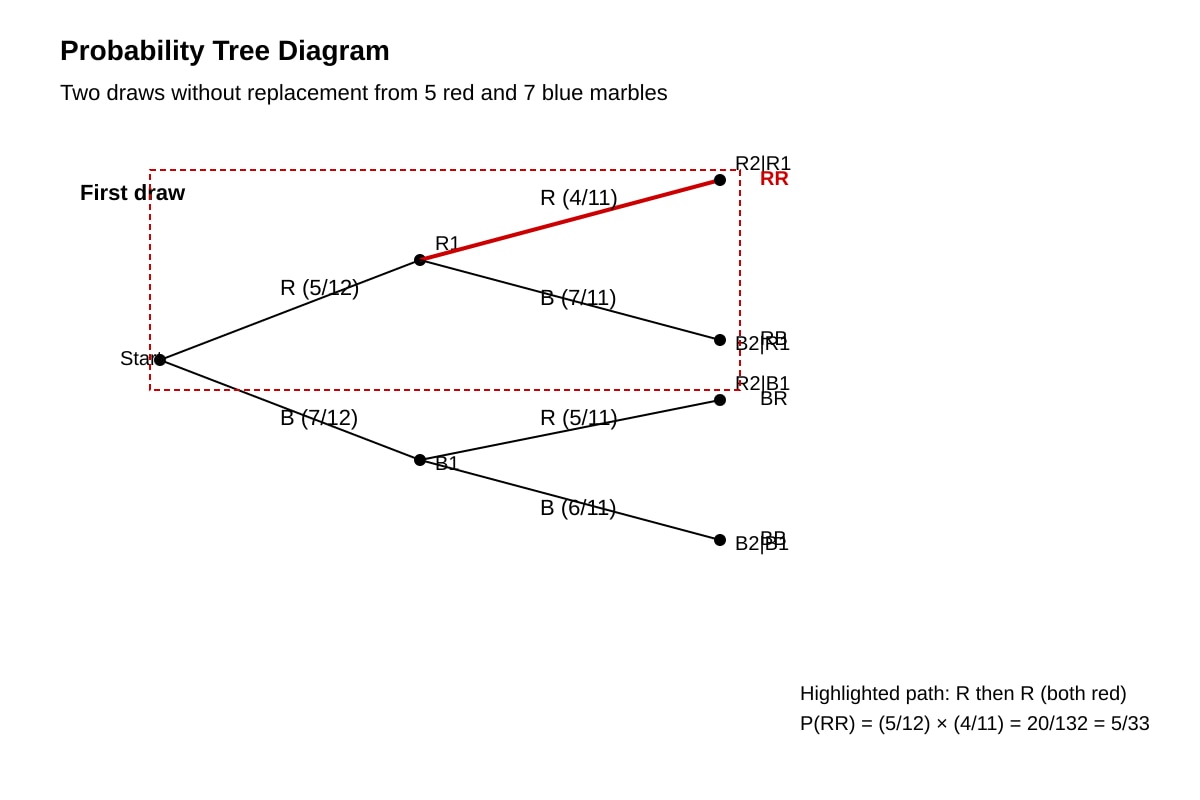
Tree: P(RR) = (5/12)×(4/11) = 20/132 = 5/33 ≈ 0.1515.
Teaching note: Without replacement, second draw has 4 red of 11 total. Multiply along branch.
Marking: 1 mark tree (see placeholder), 1 mark probability product, 1 mark answer.
Q4 [2 marks]
P(C ∩ D) = P(C) × P(D|C) = 0.3 × 0.6 = 0.18.
Teaching note: Conditional probability definition.
Marking: 1 mark method, 1 mark answer.
Q5 [3 marks]
Let M = uses MRT, L = late. P(L) = P(L|M)P(M) + P(L|M')P(M') = 0.15×0.6 + 0.08×0.4 = 0.09 + 0.032 = 0.122.
Teaching note: Law of total probability.
Marking: 1 mark setup, 1 mark substitution, 1 mark answer.
Section B: Distributions
Q6 [2 marks]
Conditions: fixed number n of independent trials; each trial has 2 outcomes (success/failure); constant probability p of success.
Marking: 1 mark for independence & fixed n, 1 mark for constant p & 2 outcomes.
Q7 [3 marks]
P(X > 2) = 1 − P(X ≤ 2) = 1 − [P(0)+P(1)+P(2)] using B(20,0.05).
P(0)=0.95²⁰≈0.3585, P(1)=20×0.05×0.95¹⁹≈0.3774, P(2)=190×0.05²×0.95¹⁸≈0.1887. Sum≈0.9246, so ans ≈ 0.0754.
Marking: 1 mark identify CDF, 1 mark computation, 1 mark final.
Q8 [3 marks]
Z = (45−50)/8 = −0.625. P(Z < −0.625) ≈ 0.266.
Teaching note: Standardise using Z=(X−μ)/σ.
Marking: 1 mark Z, 1 mark prob, 1 mark answer.
Q9 [4 marks]
Top 10% ⇒ P(X > x) = 0.10 ⇒ P(Z > z)=0.10 ⇒ z≈1.2816. x = 120 + 1.2816×15 ≈ 139.2 g.
Marking: 1 mark identify z, 1 mark z-value, 1 mark formula, 1 mark answer.
Q10 [4 marks]
E(2X−3Y+5)=2E(X)−3E(Y)+5 = 2(20)−3(30)+5 = 40−90+5 = −45.
Var = 2²Var(X)+3²Var(Y) = 4×16 + 9×25 = 64+225 = 289.
Teaching note: Independence ⇒ no covariance term.
Marking: 2 marks E, 2 marks Var.
Section C: Sampling and Estimation
Q11 [1 mark]
Every sample of size n has equal chance of being selected.
Marking: 1 mark definition.
Q12 [3 marks]
x̄ = 820/40 = 20.5. s² = [17800 − (820²/40)]/(39) = [17800−16810]/39 = 990/39 ≈ 25.38.
Marking: 1 mark mean, 2 marks variance.
Q13 [3 marks]
X̄ ~ N(100, 64/36) = N(100, 1.777...). Mean=100, Var=64/36=16/9.
Marking: 1 mark distribution, 1 mark mean, 1 mark variance.
Q14 [3 marks]
For large n (≥30), sample mean approx normal regardless of population distribution, with mean μ and variance σ²/n.
Marking: 1 mark n large, 1 mark mean, 1 mark variance.
Q15 [4 marks]
s² = [132500 − (2550²/50)]/49 = [132500 − 130050]/49 = 2450/49 = 50. X̄ approx N(51, 50/50=1) by CLT.
Marking: 2 marks variance, 2 marks distribution.
Section D: Correlation and Regression
Q16 [2 marks]
r=0.82 indicates strong positive linear correlation between study hours and test scores.
Marking: 1 mark strength, 1 mark context.
Q17 [3 marks]
b = [10×2600 − 120×200]/[10×1800 − 120²] = [26000−24000]/[18000−14400] = 2000/3600 = 5/9 ≈ 0.556.
a = (200−b×120)/10 = (200−66.67)/10 ≈ 13.33. Line: y = 13.33 + 0.556x.
Marking: 1 mark b, 1 mark a, 1 mark form.
Q18 [4 marks]
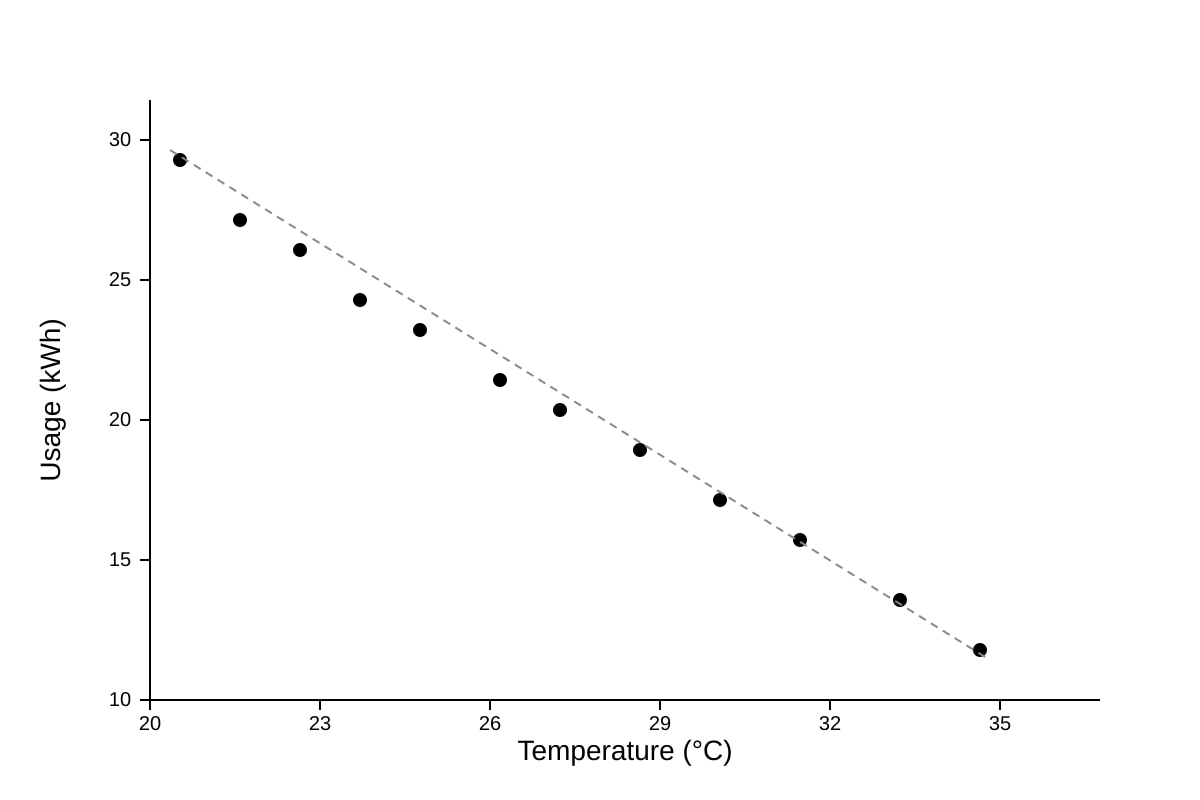
Sketch: negative slope, labelled axes, 12 points close to line.
Marking: 1 mark axes, 1 mark points, 1 mark trend, 1 mark label.
Q19 [4 marks]
At x=15, y ≈ 13.33+0.556×15 ≈ 21.67. Since 15 outside data range (8–14), extrapolation ⇒ unreliable.
Marking: 2 marks estimate, 2 marks comment.
Q20 [5 marks]
Σx=35, Σy=272, Σx²=173, Σxy=1330, n=8.
r = [8×1330−35×272]/√([8×173−35²][8×?−272²]); Σy²=20²+25²+...+38²=9622.
Denom = [1384−1225][76976−73984] = 159×2992 = 475728; √=689.7. Num=10640−9520=1120. r≈0.997.
b = 1120/159 ≈ 7.044; a=(272−7.044×35)/8 ≈ 2.06. Line: y=2.06+7.04x. Strong positive linear.
Marking: 2 marks r, 2 marks line, 1 mark comment.