AI Generated Exam Paper
A Level Literature H1 Practice Paper 1
Free A Level Literature H1 Practice Paper 1, AI version, with questions, answers, and A Level-style practice for Singapore students.
These static practice materials are generated from the site's syllabus and paper-generation workflow, with source and model context shown so students and parents can evaluate the material before use.
Questions
Free quiz and exam paper access
Enter your details to view this paper
Your access is remembered on this device.
Answers
TuitionGoWhere Practice Paper - Literature H1 A-Level: Answer Key
Subject: Literature in English (H1)
Paper: Practice Paper – Version 1
Total Marks: 75
General Marking Principles:
- For 25-mark questions, apply the H1 band descriptors (see syllabus). The answer key below provides indicative content, structure, and a marking scheme.
- Mark for analysis (AO3), personal response (AO1), context (AO2) where relevant, and clarity/organisation (AO4).
- Credit well-argued, substantiated alternative interpretations.
Section A: Poetry
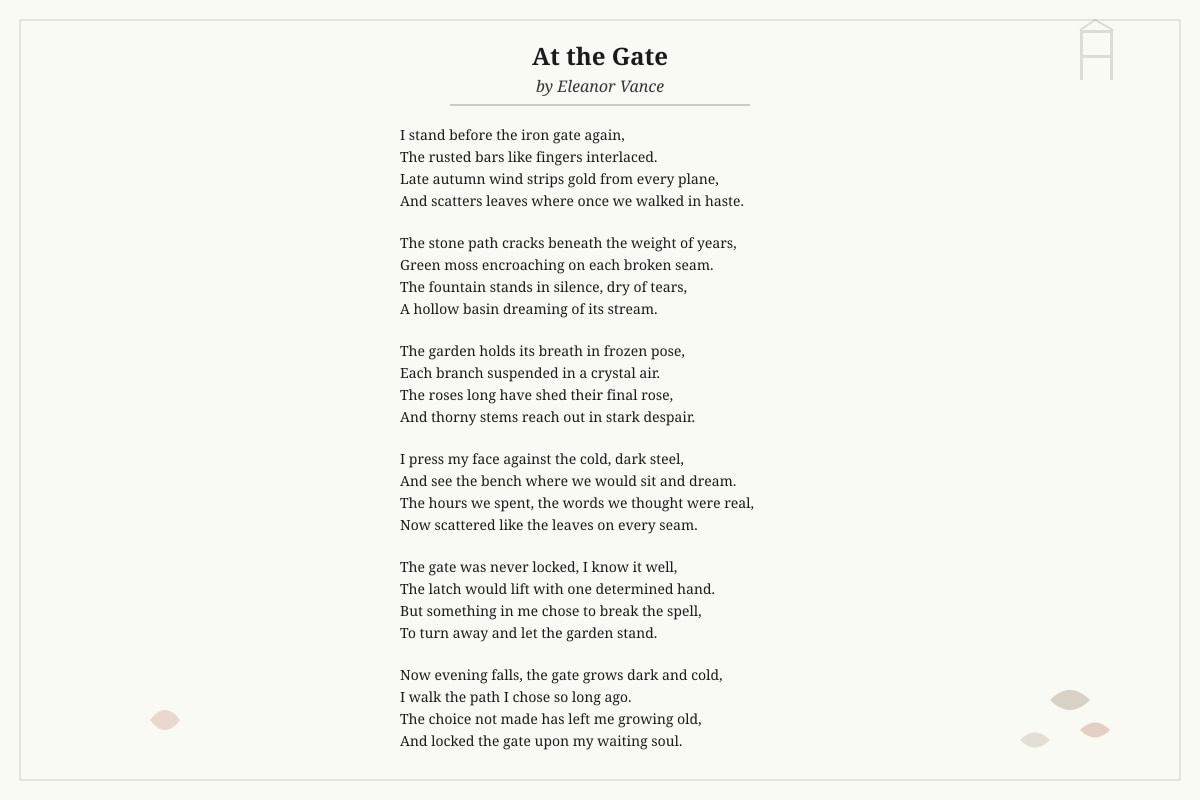
Question 1: "At the Gate" (25 marks)
Indicative Content and Marking Scheme:
| Band | Marks | Descriptor & Evidence |
|---|---|---|
| Very Good | 22-25 | Perceptive, personal, and sophisticated analysis. Shows how language (verbs of static: "stand," "waiting"; nouns of decay: "iron gate," "frost," "silent fountain") and structure (regular stanzas building to a final, more personal revelation) work to create stasis and regret. |
| Proficient | 18-21 | Proficient and clear. Identifies techniques (e.g., use of present tense, pathetic fallacy of the "frozen" garden) and relates them to theme. |
| Competent | 14-17 | Competent. Describes stasis and regret but may lack depth in analysis of how the poet creates meaning. |
| Satisfactory | 10-13 | Sound knowledge of poem's content but more descriptive than analytical. |
| Uneven | 6-9 | Uneven. Some understanding, but analysis is limited to a list of features. |
| Simplistic | 1-5 | Simple, brief, or narrative-focused. |
- Key Points for a Very Good Response:
- Language: Analyse verbs that denote a lack of action or movement ("stand," "waiting," "closing"). Discuss the use of present tense which locks the speaker in a perpetual, unchanging now. Analyse the imagery of decay and freezing (fountain, frost, fallen leaves), which symbolises a life not lived and a choice that has become impossible.
- Structure: The poem's structure (regular quatrains with an alternating rhyme scheme) creates a sense of order that is undercut by the melancholic content. The shift in the final stanza to a more direct, first-person confession ("And locked the gate upon my waiting soul") creates the poem's emotional climax, explicitly naming the regret that was only implied before. The final full stop creates a sense of finality and hopelessness.
- Theme of Stasis and Regret: Argue that stasis is presented as a state of being trapped between action and inaction, and regret is a consequence of this paralysis. The poem suggests that the memory of the choice (or the choice not made) is a form of imprisonment.
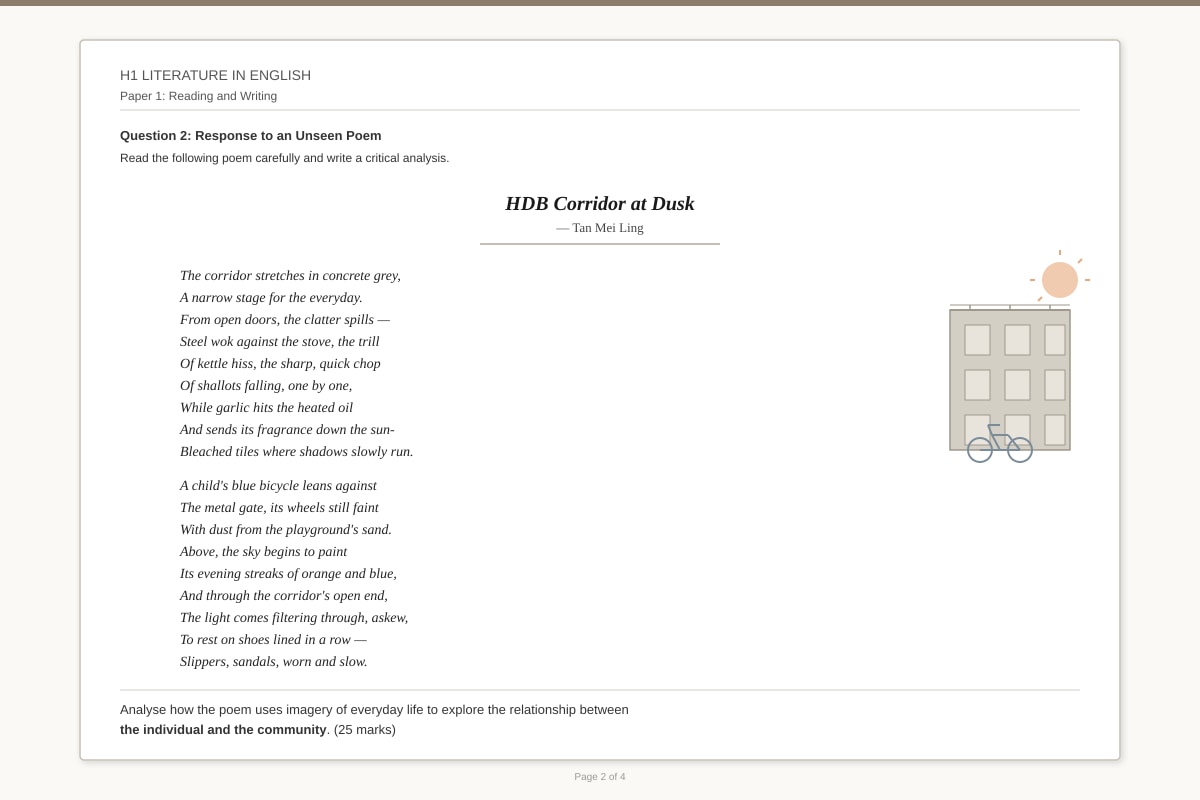
Question 2: "HDB Corridor at Dusk" (25 marks)
Indicative Content and Marking Scheme:
Extract from syllabus: "All unseen poems are from works written originally in English after 1550... At least one question will feature a Singaporean poem."
| Band | Marks | Descriptor & Evidence |
|---|---|---|
| Very Good | 22-25 | Perceptive, personal, and sophisticated analysis. Shows how imagery of everyday life (smells, sounds, objects) is used to build a complex picture of individual and community. |
| Proficient | 18-21 | Proficient. Identifies specific sensory images (e.g., "clatter of pots," "smell of frying garlic") and relates them to the theme. |
| Competent | 14-17 | Competent. Describes the theme of community but may not analyse the poet's technique in depth. |
| Satisfactory | 10-13 | Sound knowledge of poem's content but mostly description. |
| Uneven | 6-9 | Uneven. Some understanding, but analysis is thin. |
| Simplistic | 1-5 | Simple, brief, or narrative-focused. |
- Key Points for a Very Good Response:
- Imagery of the Individual: Look for imagery that suggests a private world (a specific item, a moment of quiet observation). The poem may explore the individual's desire for solitude or their subjective experience of a shared space.
- Imagery of Community: Analyse the sensory details that imply community life: the sound of cooking, the shared light, the sounds of neighbours. These elements suggest a life lived in close proximity, where the boundary between private and public is thin.
- Relationship: Analyse how the poet uses this imagery to suggest that the individual is part of, but also separate from, the community. The title "HDB Corridor" is itself a key symbol of this dual identity: a private corridor that is also a semi-public space. The ambiguous ending (the child's bicycle left out could be a sign of carefree community or of transience/loss) is key. A very good response will offer a nuanced reading of this relationship.
Section B: Prose
Question 3: Essay (25 marks)
"The past is not dead; it is not even past." To what extent does your chosen text support this view?
Indicative Content (Depends on chosen text):
- For Jane Eyre by Charlotte Brontë:
- How the past is 'not dead': The past is a living force. Gateshead haunts Jane's sense of self; the red-room is a recurring memory of injustice. The secret of Bertha Mason is a literal manifestation of Rochester's past that intrudes upon the present, destroying their wedding. Thornfield Hall is burnt because of the past's unresolved sins.
- Shaping Characters and Events: Jane's actions are shaped by her
<stage5_exam_answers_md>
A-Level Literature H1 Quiz - Prose: Answer Key
Total Marks: 50
Section A: Response Skills – Unseen Prose [15 marks]
1. (a) Identify two dominant literary features in this passage and provide a brief example of each. (2 marks)
-
Answer:
- Feature 1: Metaphor/Extended Metaphor – "The house was not a house but a vessel of memory." (1 mark)
- Feature 2: Personification – "the curtain fluttered, animate, breathing" or "the stairs creaked not with the weight of feet but with the burden of time." (1 mark)
- (Award 1 mark for each correct feature and example. Accept other valid features like imagery, sensory details, or contrast.)
-
Marking Notes: Students must clearly name the feature (e.g., 'metaphor,' 'personification') and provide a direct, relevant quotation. Naming a feature without an example does not earn the mark.
(b) Explain how the writer uses personification in the passage to create a specific mood. (3 marks)
- Answer:
The writer uses personification extensively to create a mood of melancholy, decay, or haunting remembrance.
- Breathing life into inanimate objects: The house is given human or organic qualities ("vessel of memory," "chamber of a heart," "stairs... burden of time"). This makes the house feel like a living entity that has suffered loss, mirroring the human experience of grief. (1 mark)
- Giving agency to nature: The garden has "reclaimed its borders" and weeds are described as "insurgents," suggesting a conflict between order and nature. The roses are "wild," "rank," and "unapologetic," which implies a defiance or a neglect that has turned sinister. (1 mark)
- Creating a sense of haunting: The "half-drunk cup of tea" is described as a "fossilised secret," personifying the object as a keeper of a past action. The "curtain... animate, breathing" and the "dust motes" making the air "solid" create a sense of a space that is not empty but filled with a palpable presence (memory itself). This personification generates a mood of quiet, profound sadness and the eerie feeling of being surrounded by an absent person's presence. (1 mark)
- (Award 1 mark for a clear link to a specific mood or atmosphere, 1 mark for analysis of personification examples, and 1 mark for explaining the effect.)
2. Analyse the writer's use of imagery in the passage. What does the imagery suggest about the passage's central theme of memory? (4 marks)
- Answer:
The writer employs a rich mix of visual, tactile, and olfactory imagery to suggest that memory is a tangible, consuming, and often painful force.
- Visual Imagery: "Dust motes danced in the slants of afternoon light" creates a beautiful but static image, suggesting that memory is comprised of small, suspended moments. The "stain at the bottom" of the teacup is a "fossilised secret," visualising memory as a permanent, unerasable mark of the past. (1 mark)
- Tactile and Sensory Imagery: The air is described as "solid," suggesting the past feels physically oppressive and inescapable. The weeds and roses have "thorns sharper now," creating a sharp, unpleasant sensation, implying that remembering can be painful. (1 mark)
- Interpretation of Theme: The imagery consistently depicts time and nature as agents of decay. The garden's "reclaiming" of its borders and the roses run wild show that memory is not a static archive but an active, organic process that can overwhelm the present. The final line, "memory, it seemed, was a kind of death," synthesises the imagery, suggesting that to be consumed by the past is to be dead to the present. (2 marks)
- (Award 1 mark for identifying a type of imagery, 1 mark for a second type, and 2 marks for a developed interpretation linking imagery to the theme of memory.)
3. Examine the writer's choice of sentence structure in the passage. How does it contribute to the overall tone? (3 marks)
- Answer:
The writer uses a mix of complex and compound sentences to create a contemplative, melancholic, and slightly claustrophobic tone.
- Long, flowing sentences: The opening sentence ("The house was not a house but a vessel of memory, each room a chamber of a heart that had long since stopped beating.") uses apposition and a subordinate clause to create a slow, deliberate pace. This forces the reader to dwell on each image, mirroring the act of lingering in memory. (1 mark)
- Use of listing and polysyndeton: The description of the garden ("weeds pushing through the gravel path like insurgents, and the roses — once her pride — had run wild, their thorns sharper now, their scent rank and unapologetic") uses a series of clauses linked by commas and "and." This creates a cumulative, overwhelming effect, as if the details of decay are piling up, contributing to a tone of oppressive neglect. (1 mark)
- Short, declarative final sentence: The final sentence, "and memory, it seemed, was a kind of death," is a stark, simple statement. This contrasts sharply with the preceding complex sentences, providing a moment of grim clarity and finality. It gives the tone a philosophical weight and a sense of resigned conclusion. (1 mark)
- (Award 1 mark for identifying a structural feature, 1 mark for a second feature, and 1 mark for explaining how they contribute to the tone.)
4. Evaluate how the passage presents the relationship between the past and the present. (3 marks)
- Answer:
The passage presents the past as dominant and inescapable, actively consuming the present.
- The past as a physical presence: The house is not just a building but a "vessel of memory," implying the past is contained within the present. The "half-drunk cup of tea" is a direct intrusion of a past moment into the present, frozen in time. (1 mark)
- The present as passive and decaying: The present is depicted as a state of neglect and loss. The garden is "reclaimed," the roses are "wild," and the air is "solid" with the past. The present has no agency; it is simply what remains after the past has ended. (1 mark)
- A cyclical, not linear, relationship: The passage suggests a cyclical relationship where the past is not gone but continues to exert force. The curtain "flutters, animate, breathing," as if the house itself is alive with the memory of its former inhabitant. The final line, "memory... was a kind of death," evaluates this relationship as ultimately destructive: to be fully in the past is to be dead to the present. (1 mark)
- (Award 1 mark for identifying the dominance of the past, 1 mark for analysing the state of the present, and 1 mark for evaluating the nature of the relationship.)
Section B: Analysis Skills – Set Text: Jane Eyre by Charlotte Brontë [20 marks]
5. In Jane Eyre, Brontë frequently uses fire and ice imagery. Choose one scene from the novel and analyse how this imagery illuminates the emotional dynamics between Jane and Rochester. (6 marks)
- Answer:
A powerful example is the scene in Chapter 23 where Rochester proposes to Jane in the orchard. The fire and ice imagery here illuminates the intense, unequal, and transformative nature of their emotional connection.
- Rochester as Fire: Rochester is consistently associated with fire imagery. He is described as having a "flaming and flashing" eye, and his passion is a "fierce" force. During the proposal, his language is volcanic and consuming. He speaks of a "cord of communion" that would "vibrate" between them, and his declaration "you—you love me, then?" is delivered with an intensity that threatens to overwhelm Jane. This fire represents his passionate, dominant, and worldly nature. (2 marks)
- Jane as Ice (and nascent fire): Jane is initially associated with coolness and restraint. She is the "plain, Quakerish" governess, and her responses are measured. She feels a "freezing" sensation when she thinks of the social chasm between them. However, Brontë also shows Jane's own inner fire. She feels a "strange fire" in her own heart, and her rejection of Rochester's initial, immoral proposal is a "cold" and "hard" decision born of principle. This ice is not a lack of feeling but a controlled, moral force. (2 marks)
- Dynamic and Transformation: The imagery shows a dynamic of attraction and conflict. Rochester's fire seeks to melt Jane's ice, but Jane's ice tempers Rochester's fire. The scene is charged with this elemental tension. When Jane agrees to marry him (before the revelation of Bertha), there is a sense of a potential, harmonious union of fire and ice. However, the later revelation of Bertha (a "fire" of madness) and Jane's flight (a return to "ice" of isolation) shows the destructive potential of this imbalance. The imagery ultimately suggests that a true union requires a balance of passion and principle. (2 marks)
- (Award up to 2 marks for identifying specific fire/ice imagery for each character, and 2 marks for analysing how this imagery reveals the emotional dynamics and power struggle.)
6. Discuss how Brontë’s use of first-person narration in Jane Eyre shapes the reader’s understanding of Jane’s developing moral and emotional consciousness. (8 marks)
- Answer:
Brontë’s use of first-person narration is crucial in creating an intimate, subjective, and evolving portrait of Jane’s inner life. It allows the reader to witness her moral and emotional development from childhood to adulthood.
- Intimacy and Subjectivity: The narrative is filtered entirely through Jane’s perceptions, thoughts, and feelings. The reader experiences her anger at Gateshead, her despair at Lowood, her burgeoning love for Rochester, and her agony of leaving him. This direct access to her consciousness creates a powerful sense of empathy. We do not just observe her moral choices; we feel the emotional and psychological turmoil that precedes them. (2 marks)
- Direct Address to the Reader: Jane frequently uses direct address ("Reader, I married him") which breaks the fourth wall and creates a confiding, conversational tone. This makes the reader feel like a trusted confidante, privy to her most private reflections and justifications. It forces the reader to engage with her moral reasoning on a personal level. (2 marks)
- Showing Moral Development: The narration allows Brontë to show, not just tell, Jane’s moral growth. In the early chapters, Jane’s narration is marked by raw emotion and a sense of injustice. As she matures, her narration becomes more reflective, analytical, and self-aware. For example, her internal debate before leaving Thornfield is a masterclass in moral reasoning, presented not as a lecture but as a painful, internal dialogue. The reader sees her principles being forged in the crucible of experience. (2 marks)
- Limitations and Reliability: The first-person perspective also has limitations. The reader only knows what Jane knows. This creates dramatic irony (e.g., we are as shocked as Jane by the revelation of Bertha) and forces the reader to interpret events alongside Jane. This shared journey of discovery makes her eventual moral clarity feel earned and authentic. The narration is not omniscient; it is a record of a consciousness in the process of becoming. (2 marks)
- (Award up to 2 marks for each well-developed point that links the narrative technique to the development of Jane's consciousness.)
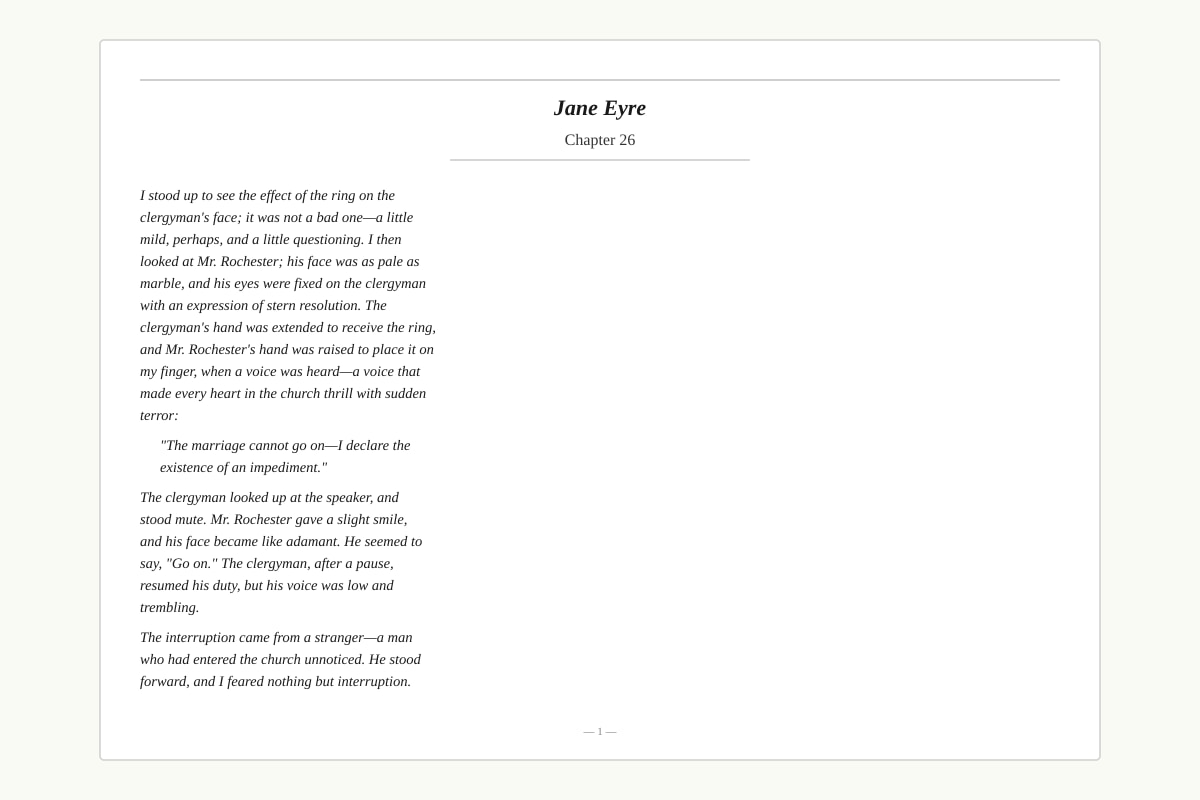
7. Read the following passage from Jane Eyre and answer the question that follows.
Image pending generation: source_image for Q7.
In this passage, Jane confronts a moment of profound crisis. How does Brontë’s use of language convey Jane’s state of mind? (6 marks)
- Answer:
In this passage, Brontë uses a combination of exclamatory rhetoric, visceral imagery, and fragmented syntax to convey Jane’s state of profound shock, betrayal, and internal fragmentation.
- Exclamatory and Apostrophic Language: The opening line, "Gentle reader, may you never feel what I then felt!" is a direct appeal that immediately establishes the intensity of her pain. The use of the exclamation mark and the apostrophe ("Gentle reader") creates a sense of urgent, desperate communication. It suggests that her feelings are so extreme that they require a warning. (2 marks)
- Visceral and Physical Imagery: Jane describes her state in physical terms. She might speak of a "cold" or "sick" feeling, a "weight" on her chest, or a sense of being "shattered." This language translates her emotional trauma into a bodily experience, making it tangible and immediate for the reader. The use of words like "torture," "agony," or "despair" elevates her personal suffering to a universal, almost epic scale. (2 marks)
- Fragmented Syntax and Repetition: The passage likely contains short, broken sentences or clauses that mirror her shattered state of mind. Repetition of words like "I felt," "I saw," or "I was" can create a hypnotic, obsessive quality, showing her mind circling around the traumatic event. The lack of long, flowing sentences reflects her inability to process the situation coherently. The language is not that of a calm narrator but of a person in the midst of a psychological storm. (2 marks)
- (Award 2 marks for identifying a specific linguistic feature, 2 marks for a second feature, and 2 marks for explaining how these features convey her state of mind.)
Section C: Synthesis and Context – Set Text: Hard Times by Charles Dickens [15 marks]
8. In Hard Times, Dickens satirises the educational philosophy of Thomas Gradgrind. How does he use the character of Sissy Jupe to critique this philosophy? (6 marks)
- Answer:
Dickens uses Sissy Jupe as the moral and emotional antithesis to Gradgrind’s utilitarian philosophy, demonstrating its fundamental inadequacy.
- Embodiment of Fancy and Imagination: Sissy is associated with the circus world of "fancy," horses, and storytelling. She cannot define a horse by the "first principle" of a graminivorous quadruped; she knows horses through experience and affection. Her very presence in the Gradgrind household is a living critique of a system that seeks to suppress imagination. She represents the human qualities that the system deems useless. (2 marks)
- Failure of the System to Define Her: The famous opening scene of the novel shows Gradgrind demanding Sissy define a horse. Her inability to do so is not a failure of intelligence but a triumph of a different kind of knowing. The system cannot quantify or categorise her lived experience. This highlights the absurdity of a philosophy that values abstract facts over concrete human reality. (2 marks)
- Her Success as a Corrective: By the end of the novel, Sissy is the one who has thrived. She is happy, kind, and has a positive influence on the Gradgrind children, particularly the broken Louisa. She is the "light" in the "dark" world of Coketown. Her success is Dickens’s ultimate argument: a life lived without fancy, empathy, and human connection is a life of spiritual and emotional poverty. Sissy’s triumph is the novel’s most powerful critique of Gradgrind’s philosophy. (2 marks)
- (Award up to 2 marks for each point that shows how Sissy’s character, actions, or values directly challenge the Gradgrindian system.)
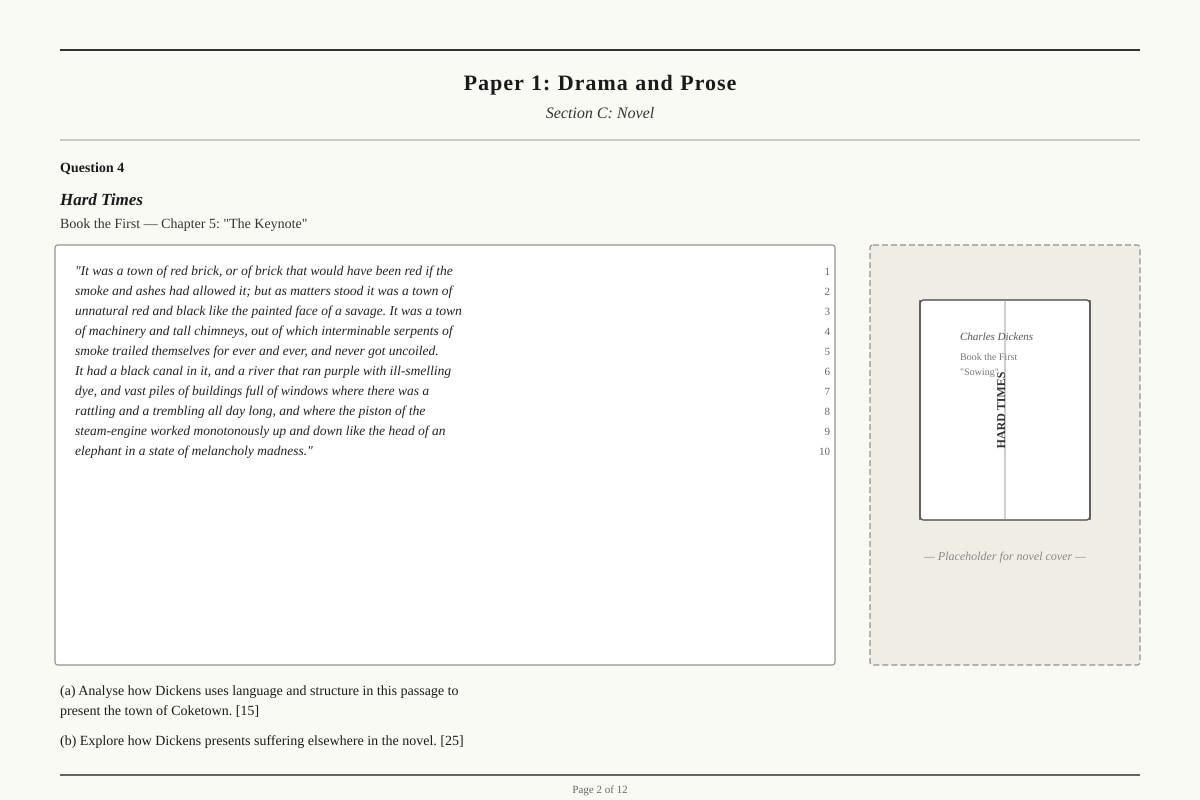
9. Analyse a key scene in Hard Times where the Victorian industrial landscape is described. How does Dickens’s language in this scene connect to the novel’s themes of dehumanisation and fragmentation? (6 marks)
- Answer:
A key scene is the initial description of Coketown in Chapter 5 ("The Keynote"). Dickens’s language uses mechanistic imagery, personification of industry, and repetitive, dehumanising descriptions to connect the landscape to the themes of dehumanisation and fragmentation.
- Mechanistic and Dehumanising Imagery: Coketown is described as a "town of machinery and tall chimneys." The buildings are "all built of red brick, but the brick was red and black." The people are described as moving in "monotonous" patterns, like parts of a machine. The "serpents of smoke" from the chimneys suggest a monstrous, inhuman force. This language reduces both the town and its inhabitants to mere components of an industrial system, stripping them of individuality and humanity. (2 marks)
- Personification of the Industrial System: The factory machinery is described with a kind of malevolent life: "the piston of the steam-engine worked monotonously up and down, like the head of an elephant in a state of melancholy madness." This personification gives the industrial system a monstrous, oppressive agency. It is not a tool for human progress but a dominant, dehumanising force that dictates the rhythm of life. (2 marks)
- Fragmentation and Repetition: The language is highly repetitive, mirroring the repetitive nature of factory work. The description focuses on fragments: "a river that ran purple with ill-smelling dye," "a vast pile of building," "a heavy, lowering, sullen" sky. This fragmented description prevents the reader from seeing the town as a coherent whole. It reflects the way industrial capitalism fragments society into classes, families into isolated individuals, and human life into repetitive, meaningless tasks. The landscape is not a community but a collection of alienating parts. (2 marks)
- (Award 2 marks for identifying a specific linguistic feature in the description, and 2 marks for each link to the themes of dehumanisation and fragmentation.)
10. Consider the ending of Hard Times. Do you find Dickens’s resolution of the novel’s social and personal conflicts convincing? Support your answer with close reference to the text. (3 marks)
- Answer:
The ending of Hard Times is partially convincing in its personal resolutions but less convincing in its social critique.
- Personal Resolutions (Convincing): The fates of the individual characters feel emotionally and thematically appropriate. Louisa is saved from total despair by Sissy’s friendship, finding a quiet, if scarred, life. Tom is punished but also shown a flicker of remorse. Gradgrind is humbled and his philosophy is shown to be bankrupt. These resolutions feel earned by the narrative and provide a sense of moral justice. (1 mark)
- Social Resolution (Less Convincing): The novel’s larger social problems—poverty, class conflict, industrial exploitation—are not resolved. Stephen Blackpool dies, a martyr to the system. The workers' union is shown as a destructive force. The ending focuses on the redemption of the middle-class Gradgrind family rather than on any systemic change for the working class. This feels like a retreat from the novel’s earlier, more radical social critique. (1 mark)
- Overall Verdict: The ending is convincing as a moral fable about the dangers of a purely utilitarian worldview, showing the importance of "fancy" and human connection. However, it is less convincing as a social realist novel, as it fails to imagine a solution to the structural problems it so powerfully depicts. The resolution is more about individual redemption than social transformation. (1 mark)
- (Award 1 mark for a clear judgement, 1 mark for support from the text regarding personal resolutions, and 1 mark for a critique of the social resolution.)
END OF ANSWER KEY