AI Generated Quiz
A Level H2 History Source Based Skills Quiz
Free A Level H2 History Source Based Skills quiz, HY3 AI version, with questions, answers, and A Level-style practice for Singapore students.
These static practice materials are generated from the site's syllabus and paper-generation workflow, with source and model context shown so students and parents can evaluate the material before use.
Questions
Free quiz and exam paper access
Enter your details to view this paper
Your access is remembered on this device.
Answers
A-Level History H2 Quiz - Source Based Skills (Answer Key)
Total Marks: 50
Level: A-Level H2 (9174) — Source Based Skills
Note: Content generated from LLM-inferred templates (Stage 4/5). Not derived from national exam papers; syllabus-aligned practice.
Section A Answers (1–10)
Q1 [2 marks]
Answer: Provenance refers to the origin of a source — who created it, when, and for what purpose.
Teaching note: In source analysis, provenance helps assess bias. Marks: 1 for "origin/creator", 1 for "date/purpose".
Q2 [2 marks]
Answer: A primary source was produced during the period studied (e.g., a 1945 speech); a secondary source is produced later by someone analysing the past (e.g., a 2020 textbook).
Teaching note: One clear difference = 2 marks. Common mistake: saying secondary is "less true" — not required.
Q3 [3 marks]
Answer: As a government official speech, it may be propaganda to justify policy; limited by political bias and lack of independent verification.
Marking: 1 = identifies bias/propaganda, 1 = explains policy justification, 1 = notes limited objectivity.
Q4 [3 marks]
Answer: Tone is positive/laudatory; purpose is to promote US policy and shape public opinion favourably.
Marking: 1 tone, 1 purpose, 1 links to US Info Service.
Q5 [2 marks]
Answer: Corroboration is comparing multiple sources to see if they agree, strengthening evidence reliability.
Teaching: 1 def, 1 mention of cross-checking.
Q6 [3 marks]
Answer: Useful for showing Soviet perspective/criticism of US; not sufficient alone as cartoons are satire, not factual record.
Marking: 1 useful (perspective), 1 not sufficient (satire), 1 needs other sources.
Q7 [2 marks]
Answer: Contextualisation is placing a source in its historical, social, and political setting to understand its meaning.
(1 sentence = 2 marks if complete.)
Q8 [3 marks]
Answer: Warsaw Pact defence spending rose from 5.8% to 6.2% of GDP (1970–1980), showing increased militarisation relative to NATO decline.
Marking: 1 trend identified, 1 data used, 1 contrast with NATO.
Q9 [3 marks]
Answer: 2015 article has hindsight, access to archives, and scholarly review; 1990 editorial was immediate and possibly speculative.
Marking: 1 hindsight, 1 archives, 1 scholarly.
Q10 [2 marks]
Answer: Sources may contain bias, propaganda, or incomplete info; critical analysis is needed.
(2 marks for two reasons or one well-explained.)
Section B Answers (11–15)
Q11 [5 marks]
Answer: Source E criticises ASEAN as weak/institutional failure; Source F praises solidarity/coordination. They disagree on effectiveness. Both address 1997 crisis response.
Marking descriptors: 2 for identifying contrasting views, 2 for using evidence from both, 1 for concluding on nature of difference.
Q12 [4 marks]
Answer: Useful: insider view of policy, candid if private. Limited: personal opinion, may not reflect official line; declassified may be redacted.
Marking: 2 useful (insider, candid), 2 limits (personal, redaction).
Q13 [4 marks]
Answer: Agree: both acknowledge crisis was resolved without nuclear war. Disagree: H says US won; I says compromise.
Marking: 2 for agreement, 2 for disagreement.
Q14 [5 marks]
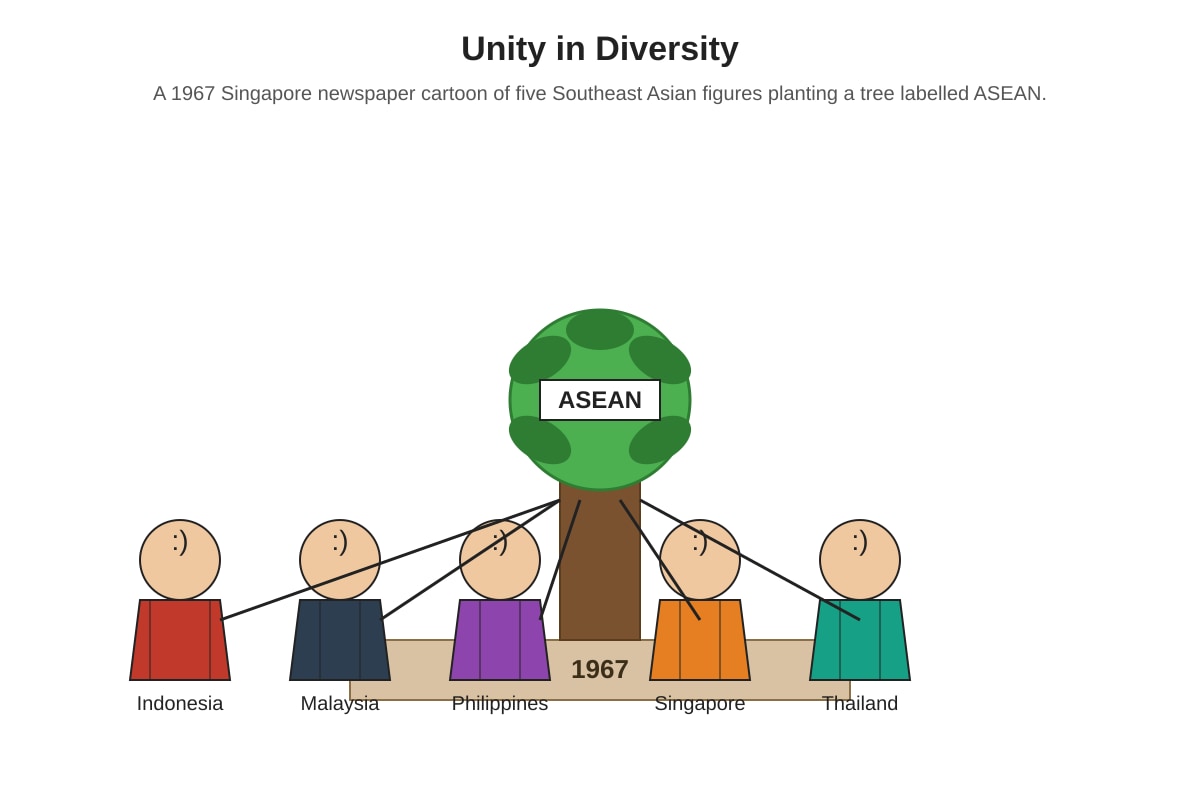
Answer: Cartoon shows optimistic founding unity ("Unity in Diversity"), useful for attitudes of 1967 elites; not factual on mechanisms.
Marking: 2 usefulness (attitudes), 2 limitation (symbolic), 1 links to label/caption.
Q15 [4 marks]
Answer: 1979 communiqué may conceal true motives / Soviet justification; 2000 synthesis uses multiple sources and hindsight.
Marking: 2 for gov limits, 2 for historian strength.
Section C Answers (16–20)
Q16 [6 marks]
Answer: J shows stated humanitarian/resistance support; K reveals hidden containment aim. Claim "purely humanitarian" not supported — mixed motive.
Marking: 2 J evidence, 2 K evidence, 2 conclusion on claim.
Q17 [6 marks]
Answer: L and N support popular movements; M supports top-down. Sources partially support view but show multiple causes.
Marking: 2 L/N, 2 M counter, 2 synthesis of "how far".
Q18 [5 marks]
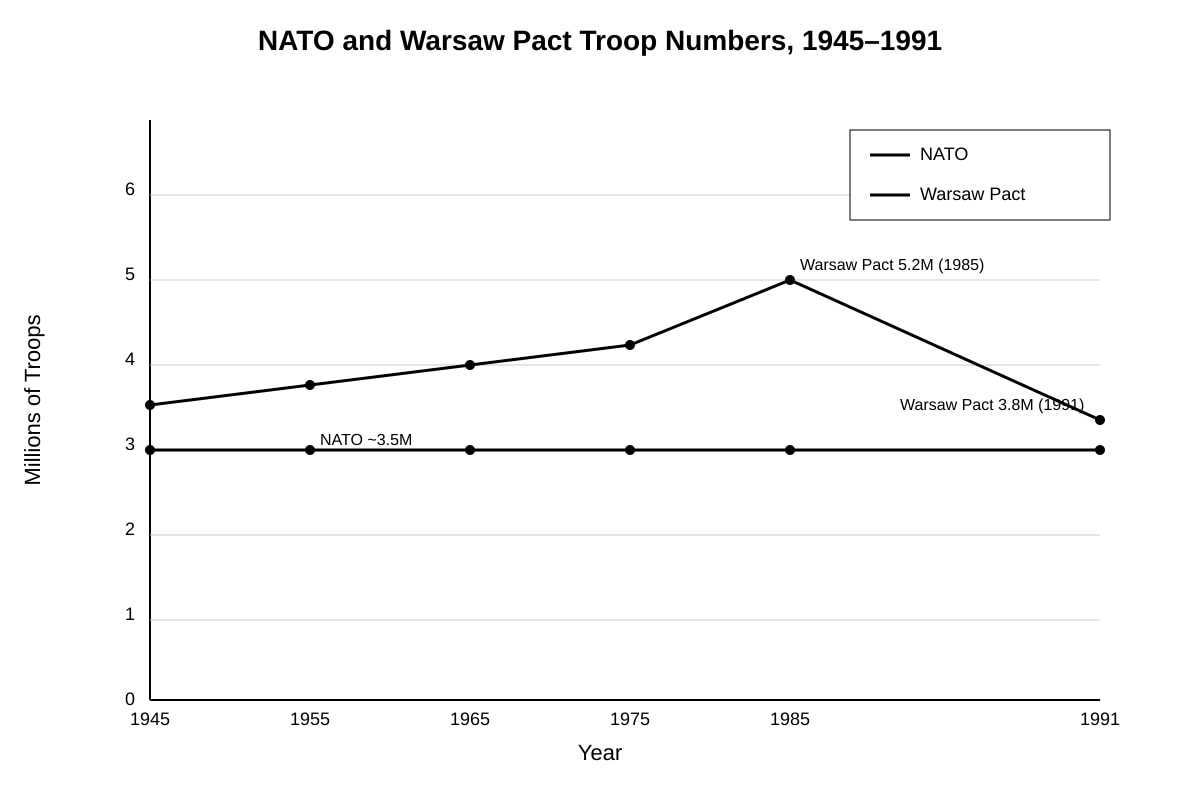
Answer: Graph shows Warsaw Pact had more troops yet collapsed; military size alone insufficient — political factors key.
Marking: 2 reads graph, 2 limitation argued, 1 links to Cold War end.
Q19 [5 marks]
Answer: O (Geneva) likely sees colonial conflict/partition; P (1975 textbook) may frame as heroic resistance. Differ by perspective.
Marking: 2 O, 2 P, 1 comparison.
Q20 [5 marks]
Answer: Agree partly: source reveals creator bias; disagree: skilled analysis extracts past facts. Balanced judgment needed.
Marking: 2 for, 2 against, 1 conclusion.