A-Level History H2 Quiz - Ancient Civilisations
Name: ___________________________
Class: ___________________________
Date: ___________________________
Score: _______ / 40
Duration: 50 minutes
Total Marks: 40
Instructions:
- This quiz contains 20 questions across three sections. Answer all questions.
- Section A: Short factual and conceptual questions (1–8). Section B: Source-based analysis (9–14). Section C: Extended responses (15–20).
- Use the provided sources and extracts where indicated. Write clearly and concisely.
- This is syllabus-first practice content generated from LLM-inferred templates. It is NOT derived from official A-Level past-year papers. The topic "Ancient Civilisations" is outside the official H2 History (9174) syllabus and is provided as enrichment practice.
Section A: Foundations of Ancient Civilisations (Questions 1–8)
1. [2 marks] Identify one defining feature of a "civilisation" as opposed to a nomadic or tribal society, with reference to scholarly criteria.
2. [1 mark] Name the river system on which Mesopotamian civilisation first developed.
3. [2 marks] Explain one function of cuneiform writing in ancient Sumerian society.
4. [2 marks] State two architectural features of the Egyptian Old Kingdom pyramids that reflected state centralisation.
5. [1 mark] Which ancient civilisation is associated with the Indus Valley cities of Mohenjo-daro and Harappa?
6. [3 marks] Compare the political organisation of ancient Athens and Sparta in one paragraph (about 60–80 words), highlighting one key difference.
7. [2 marks] What was the polis in ancient Greek civilisation, and why was it significant?
8. [2 marks] Identify one major technological contribution of the Roman civilisation that aided administrative control across its empire.
Section B: Source-Based Analysis (Questions 9–14)
Source A: Extract from a modern historian's introduction to Mesopotamian society (2021):
"The temple economy of Uruk depended on a vast scribal class. Tablets reveal that priests allocated barley rations to workers, suggesting a redistributive economy directed by religious authority rather than market exchange."
Source B: Translation of a Sumerian temple tablet (c. 2500 BCE):
"Received by the temple of Inanna: 1200 litres of barley from the estate of Ur-Nanshe. Distributed to 40 temple workers as monthly ration. Recorded by scribe Lugal-e."
9. [4 marks] Compare the evidence provided by Source A and Source B on the role of temples in Mesopotamian economic life.
10. [2 marks] How useful is Source B for understanding labour organisation in ancient Sumer? Give one reason.
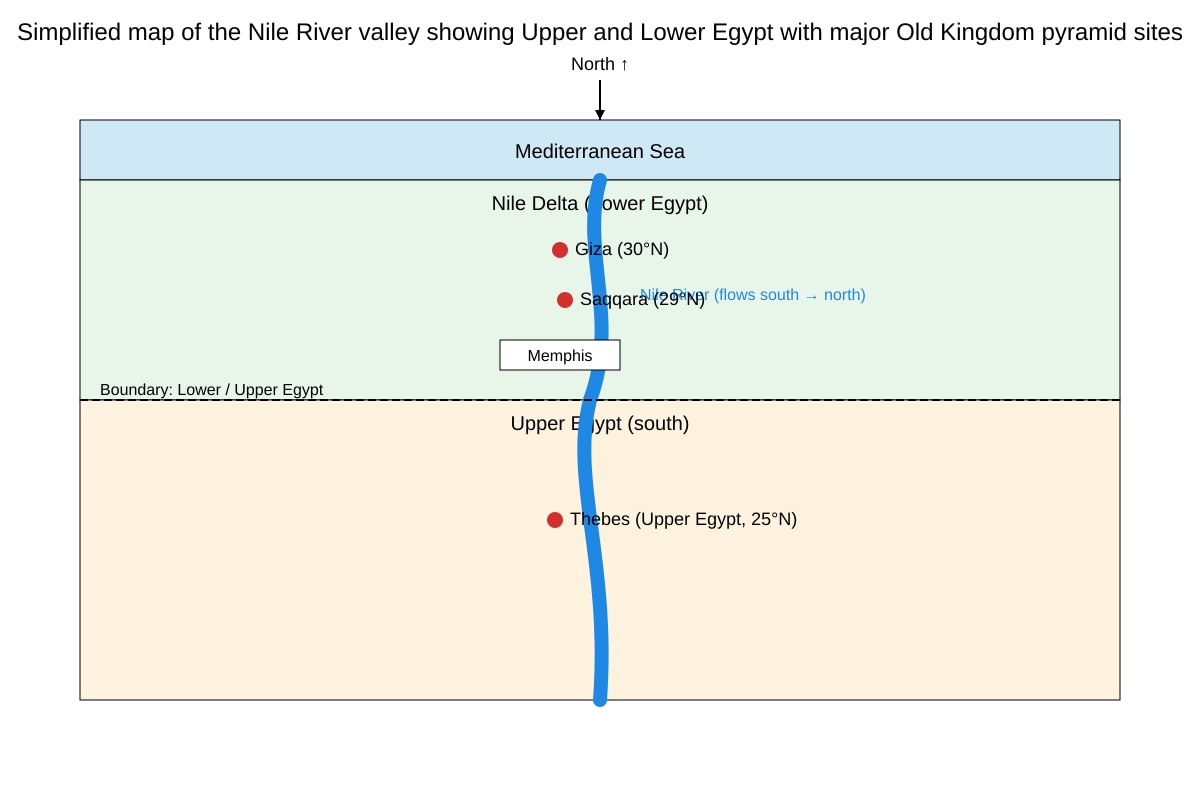
Generated map for 11.
11. [3 marks] Using the map above, explain how the geography of the Nile contributed to the political unification of Upper and Lower Egypt by c. 3100 BCE.
Source C: Excerpt from Herodotus, Histories Book II (5th century BCE):
"The Egyptians are religious to a surpassing degree… they preserve every custom from antiquity. The king is also a priest of Ptah, and none may touch the sacred crocodiles."
Source D: Inscription from the temple of Karnak (c. 1200 BCE):
"Pharaoh Merneptah, beloved of Amun, smote the Libyans and the Sea Peoples. The land rejoices; the gods are pleased."
12. [4 marks] Assess the reliability of Source C and Source D for understanding the relationship between Egyptian kingship and religion.
13. [3 marks] Using Sources C and D, explain one way in which pharaohs legitimised their rule through religion.
14. [2 marks] What limitation does Source C have as evidence for daily life of non-elite Egyptians? State one point.
Section C: Extended Responses (Questions 15–20)
15. [3 marks] To what extent did geography determine the economic structure of the Indus Valley civilisation? Provide two supporting points.
16. [3 marks] Explain how the Code of Hammurabi reflected the social hierarchy of Babylon. Give one example of a law showing class difference.
17. [4 marks] "The Persian Empire succeeded because of tolerance, not force." Using your knowledge, evaluate this view with reference to two policies of Cyrus or Darius.
18. [3 marks] Outline two reasons for the decline of the Roman Republic by the 1st century BCE.
19. [3 marks] How did the invention of democracy in Athens differ from modern representative democracy? State one structural difference.
20. [4 marks] Using sources and your knowledge, assess the view that writing was the single most important factor in the rise of ancient civilisations. Give reasoned judgement.
</stage5_quiz_answers_md>
A-Level History H2 Quiz - Ancient Civilisations: Answer Key
Total Marks: 40
Topic: Ancient Civilisations (enrichment; not in official 9174 syllabus)
Note: Answers are teaching notes for students new to the topic.
Section A (Q1–8)
Q1 [2 marks]
Answer: A civilisation typically shows urban centres, surplus food, social stratification, centralised authority, and written records. One defining feature: presence of writing (or urban settlement with surplus economy).
Teaching: Scholars (e.g., Childe's criteria) list 10 traits; writing lets states keep tax and law records. Award 1 mark for naming a valid feature, 1 mark for brief explanation (e.g., "writing enabled administration beyond kinship memory").
Q2 [1 mark]
Answer: Tigris and Euphrates rivers (Mesopotamia = "between rivers").
Teaching: Mesopotamia in modern Iraq; both rivers needed for irrigation. Common mistake: naming only one river → still award if context clear, but expect both.
Q3 [2 marks]
Answer: Cuneiform was used to record transactions, laws, and temple rations (e.g., barley distribution).
Teaching: Scribes impressed wedge signs on clay. One function: administrative record-keeping (1m) + explanation (1m) such as "enabled temple economy to track worker rations."
Q4 [2 marks]
Answer: (i) Massive stone blocks requiring state-organised labour; (ii) precise alignment to cardinal points showing surveyor class.
Teaching: Centralisation = pharaoh could mobilise thousands. Award 1m each feature.
Q5 [1 mark]
Answer: Indus Valley civilisation (or Harappan civilisation).
Teaching: Flourished 2600–1900 BCE in modern Pakistan/India.
Q6 [3 marks]
Answer: Athens was a democracy with citizen assembly; Sparta was an oligarchic military state ruled by two kings and ephors. Key difference: political participation open in Athens, restricted in Sparta.
Marking: 1m Athens trait, 1m Sparta trait, 1m clear difference. Expected ~60–80 words.
Q7 [2 marks]
Answer: Polis = city-state (e.g., Athens). Significant as the centre of political, religious, and social identity for Greeks.
Teaching: 1m definition, 1m significance (loyalty beyond kinship).
Q8 [2 marks]
Answer: Roman roads (or aqueducts, or Latin administrative script). Example: road network enabled troop movement and tax collection.
Teaching: 1m tech, 1m link to control.
Section B (Q9–14)
Q9 [4 marks]
Answer: Both sources show temples as economic redistributors. Source A (modern hist.) argues temple economy was non-market, run by scribes. Source B (tablet) confirms: 1200L barley received and rationed to 40 workers by scribe. Agreement: temple directed rationing. Difference: A gives interpretation ("redistributive, religious authority"), B is raw record.
Marking: 1m both show temple role, 1m A interpretation, 1m B corroborates, 1m comparison of type (secondary vs primary).
Q10 [2 marks]
Answer: Useful because it is a near-contemporary record of actual ration amounts and scribal role (1m). Reason: direct evidence from c.2500 BCE (1m).
Teaching: Primary source close in time = high usefulness for labour org.
Q11 [3 marks]
Answer: The Nile's predictable floods (map shows uniform valley) allowed surplus agriculture; the river's north flow linked Upper (south) and Lower (north) Egypt, making transport and unification by one ruler feasible.
Marking: 1m geography (flood/surplus), 1m connectivity via river, 1m link to unification c.3100 BCE. Image must show orientation & sites.
Q12 [4 marks]
Answer: Source C (Herodotus, Greek, 5th c.) is secondary, outsider view → moderate reliability, may romanticise ("religious to surpassing degree"). Source D (contemporary inscription) is official propaganda → low reliability for objective fact but high for self-presentation. Both show king-priest link.
Marking: 1m C eval, 1m D eval, 1m compare, 1m conclusion on religion-kingship.
Q13 [3 marks]
Answer: Pharaohs claimed divine favour (D: "beloved of Amun"; C: king as priest). Legitimisation via god approval of military success.
Marking: 1m point, 2m use of sources.
Q14 [2 marks]
Answer: Herodotus focuses on elites/priests; silent on peasants' lives (1m) + possible Greek bias (1m).
Section C (Q15–20)
Q15 [3 marks]
Answer: Geography (Indus/Ravi rivers) enabled irrigation and trade. Points: (1) fertile plains → surplus; (2) uniform weights suggest long-distance trade. Extent: strong but not sole (also admin).
Marking: 2 points (2m) + judgement (1m).
Q16 [3 marks]
Answer: Code shows three classes: free men, commoners, slaves. Example: "If a man puts out eye of equal, his eye put out" vs lesser penalty for slave (class diff).
Marking: 1m hierarchy, 2m example.
Q17 [4 marks]
Answer: Evaluate: Cyrus allowed exiled Jews return (tolerance, 1m) + Darius built satrapies with local customs (1m). But force used (conquests, 1m). Judgement: tolerance aided stability but empire rested on military (1m).
Teaching: Use two policies, weigh.
Q18 [3 marks]
Answer: (1) Generals (Marius/Sulla) used armies for power; (2) economic inequality undermined civic balance. 1m each + 1m clarity.
Q19 [3 marks]
Answer: Athens: direct democracy (citizens voted in assembly). Modern: representatives elected. Difference: scale/representation (1m) + explanation (2m).
Q20 [4 marks]
Answer: Writing enabled law, tax, memory (Sources A/B show scribes). But agriculture, cities also vital. Judgement: important but not single factor.
Marking: 2m sources/knowledge, 2m reasoned judgement.
</stage5_quiz_answers_md>
<stage5_quiz_md>
A-Level History H2 Quiz - Ancient Civilisations
Name: ___________________________
Class: ___________________________
Date: ___________________________
Score: _______ / 40
Duration: 50 minutes
Total Marks: 40
Instructions:
- This quiz contains 20 questions across three sections. Answer all questions.
- Section A: Short factual and conceptual questions (1–8). Section B: Source-based analysis (9–14). Section C: Extended responses (15–20).
- Use the provided sources and extracts where indicated. Write clearly and concisely.
- This is syllabus-first practice content generated from LLM-inferred templates. It is NOT derived from official A-Level past-year papers. The topic "Ancient Civilisations" is outside the official H2 History (9174) syllabus and is provided as enrichment practice.
Section A: Foundations of Ancient Civilisations (Questions 1–8)
1. [2 marks] Identify one defining feature of a "civilisation" as opposed to a nomadic or tribal society, with reference to scholarly criteria.
2. [1 mark] Name the river system on which Mesopotamian civilisation first developed.
3. [2 marks] Explain one function of cuneiform writing in ancient Sumerian society.
4. [2 marks] State two architectural features of the Egyptian Old Kingdom pyramids that reflected state centralisation.
5. [1 mark] Which ancient civilisation is associated with the Indus Valley cities of Mohenjo-daro and Harappa?
6. [3 marks] Compare the political organisation of ancient Athens and Sparta in one paragraph (about 60–80 words), highlighting one key difference.
7. [2 marks] What was the polis in ancient Greek civilisation, and why was it significant?
8. [2 marks] Identify one major technological contribution of the Roman civilisation that aided administrative control across its empire.
Section B: Source-Based Analysis (Questions 9–14)
Source A: Extract from a modern historian's introduction to Mesopotamian society (2021):
"The temple economy of Uruk depended on a vast scribal class. Tablets reveal that priests allocated barley rations to workers, suggesting a redistributive economy directed by religious authority rather than market exchange."
Source B: Translation of a Sumerian temple tablet (c. 2500 BCE):
"Received by the temple of Inanna: 1200 litres of barley from the estate of Ur-Nanshe. Distributed to 40 temple workers as monthly ration. Recorded by scribe Lugal-e."
9. [4 marks] Compare the evidence provided by Source A and Source B on the role of temples in Mesopotamian economic life.
10. [2 marks] How useful is Source B for understanding labour organisation in ancient Sumer? Give one reason.
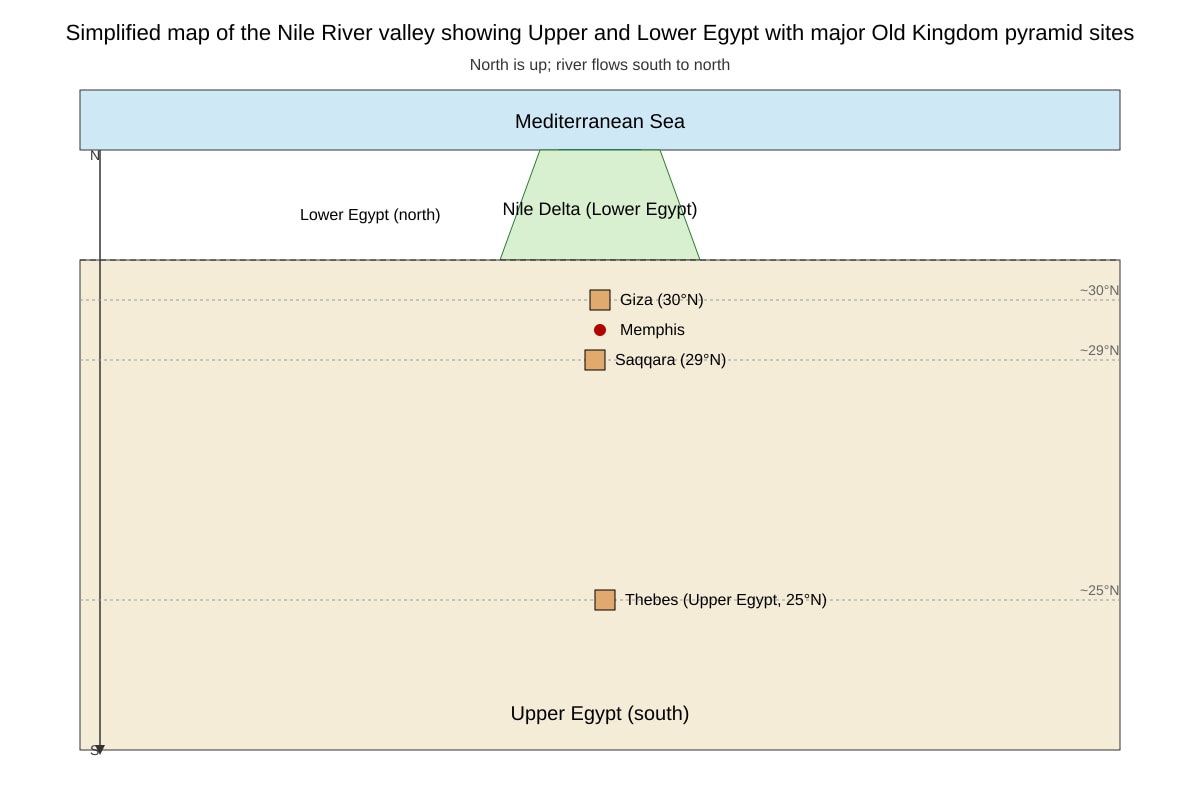
Generated map for 11.
11. [3 marks] Using the map above, explain how the geography of the Nile contributed to the political unification of Upper and Lower Egypt by c. 3100 BCE.
Source C: Excerpt from Herodotus, Histories Book II (5th century BCE):
"The Egyptians are religious to a surpassing degree… they preserve every custom from antiquity. The king is also a priest of Ptah, and none may touch the sacred crocodiles."
Source D: Inscription from the temple of Karnak (c. 1200 BCE):
"Pharaoh Merneptah, beloved of Amun, smote the Libyans and the Sea Peoples. The land rejoices; the gods are pleased."
12. [4 marks] Assess the reliability of Source C and Source D for understanding the relationship between Egyptian kingship and religion.
13. [3 marks] Using Sources C and D, explain one way in which pharaohs legitimised their rule through religion.
14. [2 marks] What limitation does Source C have as evidence for daily life of non-elite Egyptians? State one point.
Section C: Extended Responses (Questions 15–20)
15. [3 marks] To what extent did geography determine the economic structure of the Indus Valley civilisation? Provide two supporting points.
16. [3 marks] Explain how the Code of Hammurabi reflected the social hierarchy of Babylon. Give one example of a law showing class difference.
17. [4 marks] "The Persian Empire succeeded because of tolerance, not force." Using your knowledge, evaluate this view with reference to two policies of Cyrus or Darius.
18. [3 marks] Outline two reasons for the decline of the Roman Republic by the 1st century BCE.
19. [3 marks] How did the invention of democracy in Athens differ from modern representative democracy? State one structural difference.
20. [4 marks] Using sources and your knowledge, assess the view that writing was the single most important factor in the rise of ancient civilisations. Give reasoned judgement.