From Real Exams Quiz
A Level H2 History Singapore Southeast Asia Quiz
Free A Level H2 History Singapore SEA quiz, HY3 Exam version, with questions, answers, and A Level-style practice for Singapore students.
These static practice materials are generated from the site's syllabus and paper-generation workflow, with source and model context shown so students and parents can evaluate the material before use.
Questions
Free quiz and exam paper access
Enter your details to view this paper
Your access is remembered on this device.
Answers
A-Level History H2 Quiz - Singapore Southeast Asia (Answer Key)
Total Marks: 40
Topic: Singapore & Southeast Asia
Section A: Source-Based Questions
Q1. [1 mark]
Answer: 1967.
Teaching note: Source A states it is a "1967 founding declaration" of the regional organisation (ASEAN). Direct recall from source.
Q2. [2 marks]
Answer: Poorer members (e.g., Indonesia, Philippines) suspected that Singapore and Malaysia benefited disproportionately from trade; they feared uneven gains from cooperation.
Marking: 1 mark for identifying suspicion of unequal benefit; 1 mark for naming example or elaboration from Source B.
Q3. [4 marks]
Answer: Both sources acknowledge ASEAN's formation for cooperation (Source A idealistic, Source B critical). Source A presents ASEAN as a framework for mutual respect and growth; Source B argues it remained a "talk-shop" with no concrete integration and persistent suspicion.
Marking descriptors:
- 1 mark: Both agree on purpose of cooperation.
- 1 mark: Source A shows optimism/official stance.
- 1 mark: Source B shows scepticism/practical failure.
- 1 mark: Clear comparison of tones (ideal vs critical).
Q4. [3 marks]
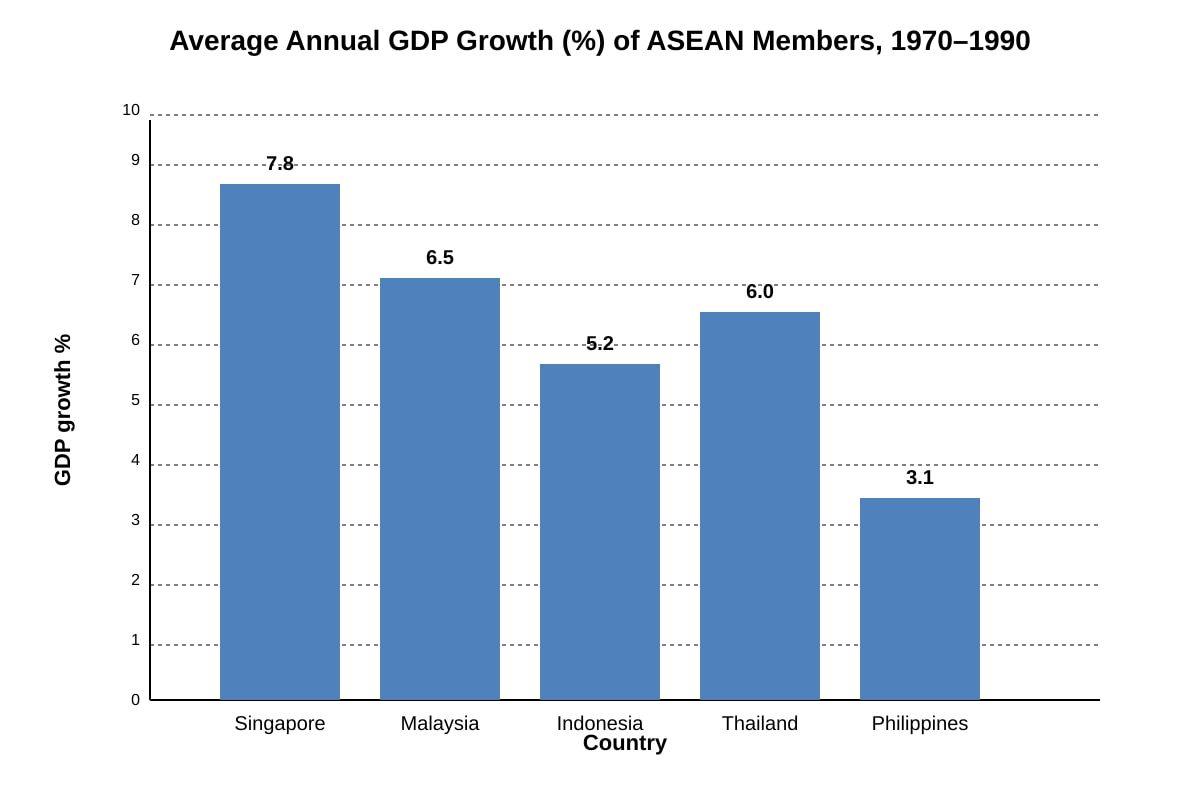
Answer: Philippines had lowest growth (3.1%). Suggests regional imbalance where poorer/less industrialised members lagged behind Singapore/Malaysia.
Marking: 1 mark correct country; 1 mark references chart/Source D; 1 mark inference on imbalance.
Q5. [5 marks]
Answer: Sources A and C support: A shows intent to shield from external interference; C states Cold War divisions healed with Vietnam's entry. Source B (1971) shows early distrust but predates 1995. Overall, sources provide moderate-strong support by 1995 as C confirms dialogue replacing force.
Marking:
- 1 mark: Use of Source A (founding aim).
- 1 mark: Use of Source B (early limitation noted).
- 1 mark: Use of Source C (1995 healing).
- 1 mark: Comparison across time.
- 1 mark: Judgement on "how far" (e.g., partially, as economic gaps remained).
Section B: Short Structured Questions
Q6. [2 marks]
Answer: Any two of: Indonesia, Malaysia, Philippines, Singapore, Thailand.
Note: From Source A.
Q7. [1 mark]
Answer: Non-interference / mutual respect.
Q8. [2 marks]
Answer: E.g., lack of natural resources; need to create jobs; racial tensions with Malay majority previously.
Marking: 1 mark for valid challenge; 1 mark for brief explanation.
Q9. [2 marks]
Answer: Indonesia feared Malaysia was a British neo-colonial construct; opposed expansion of influence.
Marking: 1 mark fear of neo-colonialism; 1 mark specific to Konfrontasi.
Q10. [1 mark]
Answer: E.g., export-oriented industrialisation, HDB housing, foreign investment incentives.
Q11. [2 marks]
Answer: E.g., Ethnic Malays in Singapore; Ethnic Chinese in Indonesia; Moros in Philippines.
Marking: 1 mark group, 1 mark state.
Q12. [2 marks]
Answer: Term for rapidly industrialising economies (Singapore, Hong Kong, Taiwan, South Korea) with high growth; in SEA context often Singapore referenced.
Marking: 1 mark definition; 1 mark SEA link.
Q13. [3 marks]
Answer: Singapore: state-led capitalism, EDB attracted MNCs, high growth (see Source D 7.8%). Indonesia: import substitution then liberalisation.
Marking: 1 mark policy; 1 mark effect; 1 mark example/country.
Q14. [2 marks]
Answer: Cold War superpower support for anti-communist regimes led to military coups (e.g., Indonesia 1965 Suharto).
Marking: 1 mark link to Cold War; 1 mark example.
Q15. [1 mark]
Answer: Ended isolation of Vietnam; symbolised post-Cold War regional inclusion.
Section C: Essay-Style Questions
Q16. [5 marks - plan]
Answer plan:
- Intro: Thesis – fear of external domination (colonialism, superpowers) key, identity secondary.
- Point 1: ASEAN 1967 (5 founders) formed amid Cold War/Communist fear (Indonesia, SG, MY).
- Point 2: Thailand aligned US to avoid communist takeover.
- Point 3: Vietnam war impacted neutral states (e.g., Cambodia).
- Counter: Shared anti-colonial identity existed but weaker.
- Conclusion.
Marking: Up to 5 points for coherent plan with 3 countries.
Q17. [3 marks]
Answer: Industrial policy (Jurong), education, stable governance, housing.
Marking: 1 mark each up to 3.
Q18. [4 marks]
Answer: Partial achievement – economic growth (Source D), political dialogue (C), but gaps (B, Philippines low).
Marking: 1 mark source use; 1 mark own knowledge; 1 mark balance; 1 mark judgement.
Q19. [3 marks]
Answer: E.g., Malays in SG, Chinese in Indo; policies (affirmative action) caused rift. Assess: not main but contributed.
Marking: 1 mark example 1; 1 mark example 2; 1 mark assessment.
Q20. [3 marks]
Answer: Cold War shaped alignments: SG (non-aligned but capitalist), Vietnam (communist), Indonesia (anti-communist purge).
Marking: 1 mark per country up to 3.