From Real Exams Quiz
A Level H2 History Conflict International Relations Quiz
Free A Level H2 History Conflict IR quiz, Exam version, with questions, answers, and A Level-style practice for Singapore students.
These static practice materials are generated from the site's syllabus and paper-generation workflow, with source and model context shown so students and parents can evaluate the material before use.
Questions
Free quiz and exam paper access
Enter your details to view this paper
Your access is remembered on this device.
Answers
A-Level History H2 Quiz - Conflict International Relations — ANSWER KEY
Total Marks: 50
Section A: Short-Answer Questions (10 marks)
Question 1 (2 marks)
Answer: Collective security is a principle of the United Nations Charter (Article 1) whereby member states agree to collectively respond to acts of aggression against any member state, treating an attack on one as an attack on all. It is based on the idea that peace is indivisible and that collective action by the international community is more effective than individual state action in deterring and responding to aggression.
Marking notes:
- 1 mark for defining the principle (collective response to aggression)
- 1 mark for linking it to the UN Charter or the idea of "an attack on one is an attack on all"
Common mistake: Students often confuse collective security with collective defence (e.g., NATO). Collective security is universal (all UN members); collective defence is regional/alliance-based.
Question 2 (2 marks)
Answer: Two specific operational constraints include:
- The superpower veto in the Security Council – The USA and USSR could veto any proposed enforcement action, paralysing the Council in conflicts where their interests were engaged.
- The requirement for host state consent – Peacekeeping missions could only be deployed with the consent of the host state, which limited the UN's ability to intervene in internal conflicts or where the government opposed intervention.
Marking notes:
- 1 mark for each correctly identified constraint (2 marks total)
- Accept other valid constraints such as: limited mandate (observe/report only), insufficient funding, lack of standing army, non-interference principle
Question 3 (2 marks)
Answer: In the Korean War (1950–1953), the UN authorised a combat force (UN Command) led by the USA to repel North Korean aggression, acting under a Security Council resolution passed while the USSR was boycotting the Council. In the Suez Crisis (1956), the UN established the first peacekeeping force (UNEF I) to supervise the ceasefire and withdrawal of foreign troops, operating with the consent of the parties involved and not engaging in combat.
Key difference: The Korean War involved UN-authorised enforcement action (combat), while the Suez Crisis involved UN peacekeeping (non-combat interposition).
Marking notes:
- 1 mark for identifying the Korean War as enforcement/combat action
- 1 mark for identifying the Suez Crisis as peacekeeping/non-combat
Question 4 (2 marks)
Answer: The "Uniting for Peace" resolution (1950) allowed the UN General Assembly to take action to maintain international peace and security when the Security Council was unable to act due to a veto by a permanent member. It enabled the General Assembly to recommend collective measures, including the use of armed force, in situations where the Security Council was paralysed.
Significance: It was an attempt to circumvent the Cold War paralysis of the Security Council by shifting responsibility to the General Assembly, where no veto existed.
Marking notes:
- 1 mark for explaining the mechanism (General Assembly acts when Security Council is blocked)
- 1 mark for explaining its significance (circumventing the veto/Cold War paralysis)
Question 5 (2 marks)
Answer: The principle of non-interference in the internal affairs of member states (Article 2(7) of the UN Charter) was a challenge to UN peacekeeping because many conflicts during the Cold War were internal (civil wars, decolonisation struggles). The UN could not intervene in these conflicts without the consent of the host government, which often opposed external involvement. This principle was used by states to resist UN scrutiny of their domestic affairs, limiting the UN's ability to address the root causes of conflict.
Marking notes:
- 1 mark for explaining the principle (non-interference in internal affairs)
- 1 mark for explaining how it constrained peacekeeping (limited intervention in internal conflicts)
Section B: Source-Based Questions (20 marks)
Question 6 (6 marks)
Answer:
Comparison (points of agreement):
- Both sources agree that the UN's effectiveness was dependent on the will/agreement of member states, particularly the great powers.
- Both sources acknowledge that the UN was not a supranational authority capable of imposing peace; it could only act when conditions (i.e., great power agreement) allowed.
- Both sources imply that the Cold War context limited the UN's capacity to act.
Contrast (points of difference):
- Source A (Hammarskjöld, 1958) presents the limitation as a structural feature of the UN itself: "We are not a world government." The tone is pragmatic and accepts the limitation as inherent to the organisation's design.
- Source B (US Senate report, 1967) presents the limitation as a consequence of the Cold War specifically: "the Cold War has paralysed the Council." The tone is more critical, suggesting the limitation is a failure of the system rather than an inherent feature.
- Source A focuses on the Secretariat's limited role ("observe and report"), while Source B focuses on the Security Council's paralysis.
Marking scheme:
- 2 marks for identifying clear points of agreement (must be explicit, not vague)
- 2 marks for identifying clear points of contrast (must be specific)
- 2 marks for well-structured answer that compares directly (not describing sources separately)
Common mistake: Students often summarise each source separately rather than directly comparing them. The command words "compare and contrast" require explicit identification of similarities and differences.
Question 7 (4 marks)
Answer:
Source C partially supports the view in Source B that the UN was ineffective due to superpower politics, but from a different perspective.
Support:
- Source C confirms that the Soviet Union used its veto to block operations it opposed, which aligns with Source B's claim that the Cold War paralysed the Security Council.
- Source C explicitly states that the USSR "cannot and will not accept operations that bypass the Security Council," demonstrating the superpower obstruction that Source B describes.
Limitations of support:
- Source C does not support Source B's implication that both superpowers were equally responsible for the paralysis. Instead, Source C blames the West ("imperialist ambitions") and presents the Soviet position as a defence of the Charter.
- Source C's perspective is that of a Soviet diplomat defending his country's actions, so it is a partisan account rather than an objective assessment.
- Source C focuses on the legitimacy of UN operations, while Source B focuses on the operational consequences of superpower disagreement.
Overall: Source C provides partial support for Source B's general claim about superpower obstruction, but it offers a different interpretation of who was responsible and why.
Marking scheme:
- 2 marks for identifying points of support
- 2 marks for identifying limitations/qualifications
Question 8 (4 marks)
Answer:
Reliability factors supporting Source A:
- Provenance: Dag Hammarskjöld was UN Secretary-General (1953–1961), so he had direct, first-hand knowledge of the UN's operational constraints.
- Date: 1958 places the source in the midst of the Cold War, making it contemporary to the events it describes.
- Purpose: The speech appears to be a frank assessment of the UN's limitations, not a propaganda piece. Hammarskjöld was known for his independent and principled stance.
Reliability factors limiting Source A:
- Position bias: As Secretary-General, Hammarskjöld had an interest in defending the UN's record and managing expectations. He may have downplayed the UN's failures to maintain confidence in the organisation.
- Audience: The speech was likely directed at member states, so Hammarskjöld may have been diplomatic in his criticism, avoiding direct blame of specific powers.
- Limited perspective: The source reflects only the Secretary-General's view, not the perspectives of member states or those affected by UN operations.
Overall assessment: Source A is a moderately reliable source for understanding the UN's operational constraints. It provides an insider's perspective but must be read critically, considering Hammarskjöld's position and the diplomatic context.
Marking scheme:
- 2 marks for identifying factors that support reliability
- 2 marks for identifying factors that limit reliability
Common mistake: Students often state that a source is "reliable because it is a primary source" without further analysis. Primary sources can be biased; reliability must be assessed based on provenance, purpose, and content.
Question 9 (2 marks)
Answer:
- Observer missions: UN missions where unarmed military observers monitor ceasefires, truces, or peace agreements. They do not engage in combat and operate with the consent of the parties. Example: UNTSO (Middle East, 1948).
- Interposition forces: UN peacekeeping forces that are deployed between conflicting parties to create a buffer zone, supervise disengagement, and prevent renewed hostilities. They are lightly armed and use force only in self-defence. Example: UNEF I (Egypt/Israel, 1956).
Marking notes:
- 1 mark for defining observer missions
- 1 mark for defining interposition forces
Question 10 (4 marks)
Answer:
Sources that support the view:
- Source A (Hammarskjöld): States that the UN can do "little more than observe and report" without great power agreement, directly supporting the view that the UN was unable to fulfil its primary purpose.
- Source B (US Senate report): Explicitly states that the Cold War "paralysed" the Security Council, creating a "severe limitation" on the UN's capacity to fulfil its primary purpose.
- Source D (Thakur): States that the Cold War "constrained the UN in two fundamental ways" and that the UN could only "manage conflicts at the margins," supporting the view of limited effectiveness.
Sources that qualify or contradict the view:
- Source C (Malik): Does not directly contradict the view that the UN was constrained, but presents the constraint as a legitimate defence of the Charter rather than a failure. This qualifies the view by suggesting that the constraint was not necessarily a failure but a reflection of the UN's design.
Overall assessment: Sources A, B, and D strongly support the view that the UN was unable to fulfil its primary purpose during the Cold War. Source C provides a different interpretation of why this was the case but does not fundamentally challenge the factual claim of limited effectiveness. The sources collectively support the view, though they offer different explanations for the limitation.
Marking scheme:
- 2 marks for identifying sources that support the view with evidence
- 1 mark for identifying sources that qualify/contradict the view
- 1 mark for an overall synthesis/judgement
Section C: Essay Questions (20 marks)
Question 11 (20 marks)
Marking scheme (Levels-based):
| Level | Marks | Descriptor |
|---|---|---|
| L5 | 17–20 | Sustained, well-substantiated argument with nuanced evaluation; considers multiple factors; clear judgement |
| L4 | 13–16 | Good argument with relevant evidence; some evaluation of factors; clear conclusion |
| L3 | 9–12 | Competent argument with some evidence; may be descriptive rather than analytical |
| L2 | 5–8 | Limited argument with some relevant points; may lack structure or evidence |
| L1 | 1–4 | Weak or irrelevant response; minimal historical knowledge |
Answer framework:
Introduction:
- Acknowledge the statement's validity: Cold War rivalry was undoubtedly a major factor in UN failure.
- However, argue that other factors were also significant, including structural weaknesses in the UN Charter, financial constraints, and the nature of post-colonial conflicts.
- Thesis: Cold War rivalry was the most significant factor, but it was not the only one.
Paragraph 1: Cold War rivalry as the primary factor
- Security Council paralysis: The superpower veto prevented authorisation of enforcement action in most major crises (e.g., Hungary 1956, Czechoslovakia 1968, Vietnam War).
- Proxy wars: The superpowers often supported opposing sides in regional conflicts, making UN mediation difficult (e.g., Angola, Afghanistan, Cambodia).
- Example: The USSR vetoed resolutions on the Soviet invasion of Hungary (1956) and Afghanistan (1979); the USA vetoed resolutions on its intervention in Vietnam and Grenada.
- Impact: The UN could only act in conflicts where superpower interests were not directly engaged (e.g., Suez 1956, where both superpowers opposed the British-French-Israeli action).
Paragraph 2: Structural weaknesses of the UN Charter
- Article 2(7) – Non-interference: Prevented UN action in internal conflicts, which were the majority of post-1945 conflicts.
- No standing army: The UN relied on member states to contribute troops, which was slow and unreliable.
- Limited mandate: Peacekeeping missions could only observe and report, not enforce peace.
- Example: ONUC in Congo (1960–1964) struggled because its mandate was unclear and it lacked the authority to impose order.
Paragraph 3: Financial and logistical constraints
- Funding dependence: The UN relied on member state contributions, which were often withheld or delayed.
- Example: The Soviet Union and France refused to pay for UNEF I and ONUC, creating a financial crisis in the 1960s.
- Logistical limitations: The UN had no permanent military infrastructure, making rapid deployment difficult.
Paragraph 4: Nature of post-colonial conflicts
- Internal conflicts: Many post-1945 conflicts were civil wars or decolonisation struggles where the UN's consent-based model was ineffective.
- Example: The UN could not intervene in the Nigerian Civil War (1967–1970) or the Bangladesh Liberation War (1971) without the consent of the host government.
- Non-state actors: The UN was designed to deal with interstate conflicts, not insurgencies or guerrilla warfare.
Conclusion:
- Cold War rivalry was the most significant factor because it directly paralysed the Security Council, which was the primary mechanism for collective security.
- However, structural weaknesses, financial constraints, and the changing nature of conflict also contributed to UN failure.
- Overall, the statement is largely valid but requires qualification: the Cold War was the most important factor, but not the only one.
Question 12 (20 marks)
Answer framework:
Introduction:
- The end of the Cold War (1991) brought new challenges: ethnic conflicts, failed states, humanitarian crises, and civil wars.
- The UN was designed for a world of interstate conflict and great power consensus, not the complex internal conflicts of the 1990s.
- Thesis: The UN was partially prepared (it had some mechanisms) but was largely unprepared for the scale and nature of post-Cold War challenges.
Paragraph 1: Evidence that the UN was unprepared
- Rwanda (1994): UNAMIR was underfunded, undermanned, and had a weak mandate. The UN failed to prevent the genocide despite warnings.
- Srebrenica (1995): UNPROFOR was unable to protect civilians in the safe area, leading to the massacre of 8,000 Bosniak men and boys.
- Somalia (1993): UNOSOM II attempted enforcement action but suffered heavy casualties, leading to US withdrawal and a crisis of confidence.
- Structural issues: The UN lacked rapid deployment capability, intelligence capacity, and clear rules of engagement for complex emergencies.
Paragraph 2: Evidence that the UN was partially prepared
- Expansion of peacekeeping: The number of peacekeeping missions increased dramatically after 1991 (e.g., Cambodia, Mozambique, El Salvador, Eastern Slavonia).
- Success stories: UNTAC in Cambodia (1992–1993) successfully supervised elections and facilitated a transition to peace. UNTAES in Eastern Slavonia (1996–1998) successfully demilitarised the region.
- New mechanisms: The UN developed new approaches, including multidimensional peacekeeping (civilian police, human rights monitoring, electoral assistance).
Paragraph 3: The nature of post-Cold War challenges
- Ethnic conflicts: The breakup of Yugoslavia and the Rwandan genocide were fundamentally different from Cold War proxy wars.
- Failed states: Somalia and Haiti lacked functioning governments, making the consent-based model of peacekeeping impossible.
- Humanitarian intervention: The UN struggled with the tension between sovereignty and the responsibility to protect.
Paragraph 4: Reforms and adaptations
- An Agenda for Peace (1992): Boutros-Ghali's report proposed new mechanisms, including peace enforcement units and preventive diplomacy.
- Brahimi Report (2000): Recommended clearer mandates, more robust rules of engagement, and better resources.
- Mixed record: Reforms were slow and often inadequate.
Conclusion:
- The UN was not adequately prepared for the post-Cold War world, as demonstrated by the failures in Rwanda, Srebrenica, and Somalia.
- However, the UN showed some capacity to adapt and had some successes (Cambodia, Eastern Slavonia).
- Overall, the statement is largely valid: the UN's Cold War-era structures and assumptions were poorly suited to the challenges of the 1990s.
Question 13 (20 marks)
Answer framework:
Introduction:
- Define collective security: the principle that an attack on one member state is an attack on all, and the international community will respond collectively.
- The UN Charter's collective security system (Chapter VII) was designed to deter aggression, but it was rarely implemented as intended.
- Thesis: The principle of collective security was a significant obstacle, but other factors (Cold War rivalry, structural weaknesses, financial constraints) were equally or more important.
Paragraph 1: Collective security as an obstacle
- Unrealistic assumptions: Collective security assumed that all member states would agree on who was the aggressor and would be willing to act. This was rarely the case.
- Veto power: The permanent members could veto enforcement action, making collective security impossible when a great power was involved.
- Example: The USSR vetoed action on Hungary (1956); the USA vetoed action on Nicaragua (1980s).
- Selective application: Collective security was applied inconsistently (e.g., Korea 1950, but not Vietnam or Afghanistan).
Paragraph 2: Cold War rivalry as a greater obstacle
- Superpower competition: The USA and USSR were more interested in expanding their influence than in maintaining collective security.
- Proxy wars: The superpowers supported opposing sides in regional conflicts, undermining UN efforts.
- Example: In Angola, the UN could not mediate because the USA and USSR were arming opposing factions.
Paragraph 3: Structural weaknesses of the UN
- No standing army: The UN had no military force of its own and relied on voluntary contributions from member states.
- Military staff committee: Article 47 of the Charter provided for a Military Staff Committee to command UN forces, but it was never operational due to superpower disagreement.
- Financial constraints: Member states often withheld contributions, limiting the UN's capacity to act.
Paragraph 4: Post-Cold War challenges
- Internal conflicts: Collective security was designed for interstate aggression, not civil wars or humanitarian crises.
- Example: In Rwanda (1994), the UN could not invoke collective security because the conflict was internal, not interstate.
- New threats: Terrorism, failed states, and ethnic cleansing required different responses.
Conclusion:
- The principle of collective security was an obstacle because it was based on unrealistic assumptions about great power consensus.
- However, Cold War rivalry was a more significant obstacle because it directly paralysed the Security Council.
- The statement is partially valid but overstates the role of collective security as an obstacle.
Question 14 (20 marks)
Answer framework:
Introduction:
- Great power politics refers to the actions and interactions of the major powers (USA, USSR/Russia, China, UK, France) in pursuit of their national interests.
- The UN was designed to manage great power relations, but the Cold War turned the Security Council into an arena of superpower competition.
- Thesis: Great power politics was the most significant challenge, but not the only one.
Paragraph 1: Great power politics as the primary challenge
- Security Council paralysis: The veto was used extensively by both superpowers to block action on conflicts involving their interests.
- Example: USSR vetoed resolutions on Hungary (1956), Czechoslovakia (1968), Afghanistan (1979); USA vetoed resolutions on Israel, Nicaragua, Grenada.
- Selective engagement: Great powers supported UN action only when it aligned with their interests (e.g., Korea 1950, Gulf War 1991).
Paragraph 2: Other challenges to UN effectiveness
- Financial constraints: The UN was chronically underfunded, with the USA often withholding contributions to pressure the organisation.
- Bureaucratic inefficiency: The UN Secretariat was slow, uncoordinated, and often ineffective.
- Lack of political will: Even when the Security Council agreed, member states were often unwilling to contribute troops or resources.
Paragraph 3: Post-Cold War period
- New consensus: The end of the Cold War created a brief period of great power cooperation (e.g., Gulf War 1991, Cambodia 1992).
- Renewed tensions: By the late 1990s, great power disagreements re-emerged (e.g., Kosovo 1999, where Russia opposed NATO action).
- Unipolar moment: US dominance after the Cold War created new tensions, with the US often bypassing the UN (e.g., Iraq 2003).
Paragraph 4: Case studies
- Korea (1950): UN action was possible only because the USSR was boycotting the Security Council.
- Suez (1956): Both superpowers opposed the British-French-Israeli action, allowing UN action.
- Rwanda (1994): No great power interests were engaged, so the UN failed to act despite warnings.
- Kosovo (1999): NATO acted without UN authorisation due to Russian opposition in the Security Council.
Conclusion:
- Great power politics was the most significant challenge because it directly determined whether the UN could act in any given crisis.
- However, other factors (financial, bureaucratic, political will) also contributed to UN failures.
- The statement is largely valid but requires qualification: great power politics was the most significant challenge, but it was not the only one.
Question 15 (20 marks)
Answer framework:
Introduction:
- The Cold War period (1945–1991) was characterised by Security Council paralysis and limited peacekeeping.
- The post-Cold War period (1991–2000) saw an expansion of UN peacekeeping but also major failures.
- Thesis: The UN was more active in the post-Cold War period, but its success was mixed and arguably not greater than during the Cold War.
Paragraph 1: Evidence of greater success in the post-Cold War period
- Expansion of peacekeeping: The number of peacekeepers increased from 10,000 in 1988 to 70,000 in 1994.
- Successful missions: UNTAC (Cambodia), UNTAES (Eastern Slavonia), UNMIK (Kosovo) were relatively successful.
- New approaches: Multidimensional peacekeeping addressed root causes of conflict (elections, human rights, police reform).
- Great power cooperation: The Gulf War (1991) demonstrated what the UN could achieve with superpower consensus.
Paragraph 2: Evidence of continued or greater failure
- Rwanda (1994): The UN failed to prevent genocide despite clear warnings.
- Srebrenica (1995): UNPROFOR failed to protect civilians in the safe area.
- Somalia (1993): UNOSOM II failed after the "Black Hawk Down" incident.
- Angola (1993): UNAVEM II failed to prevent the resumption of civil war.
Paragraph 3: Comparison with Cold War period
- Cold War successes: UNEF I (1956), UNFICYP (1964), UNTSO (1948) were relatively successful in maintaining ceasefires.
- Cold War failures: ONUC (Congo) was controversial; the UN failed to act in Hungary (1956), Czechoslovakia (1968), and Vietnam.
- Key difference: Cold War peacekeeping was limited in scope but often achieved its limited objectives. Post-Cold War peacekeeping was more ambitious but often failed to achieve its broader goals.
Paragraph 4: Factors explaining the mixed record
- Nature of conflicts: Post-Cold War conflicts were more complex (ethnic, internal, humanitarian).
- Expectations: The UN was expected to do more with limited resources.
- Political will: The initial post-Cold War consensus faded by the mid-1990s.
Conclusion:
- The UN was more active in the post-Cold War period, but its success was not clearly greater than during the Cold War.
- Cold War peacekeeping was limited but often effective within its narrow mandate. Post-Cold War peacekeeping was more ambitious but suffered from major failures.
- Overall, the statement is not fully valid: the UN's record in the post-Cold War period was mixed, and it is difficult to argue that it was a "greater success" overall.
Section D: Data-Response Questions (Extension)
Question 16 (2 marks)
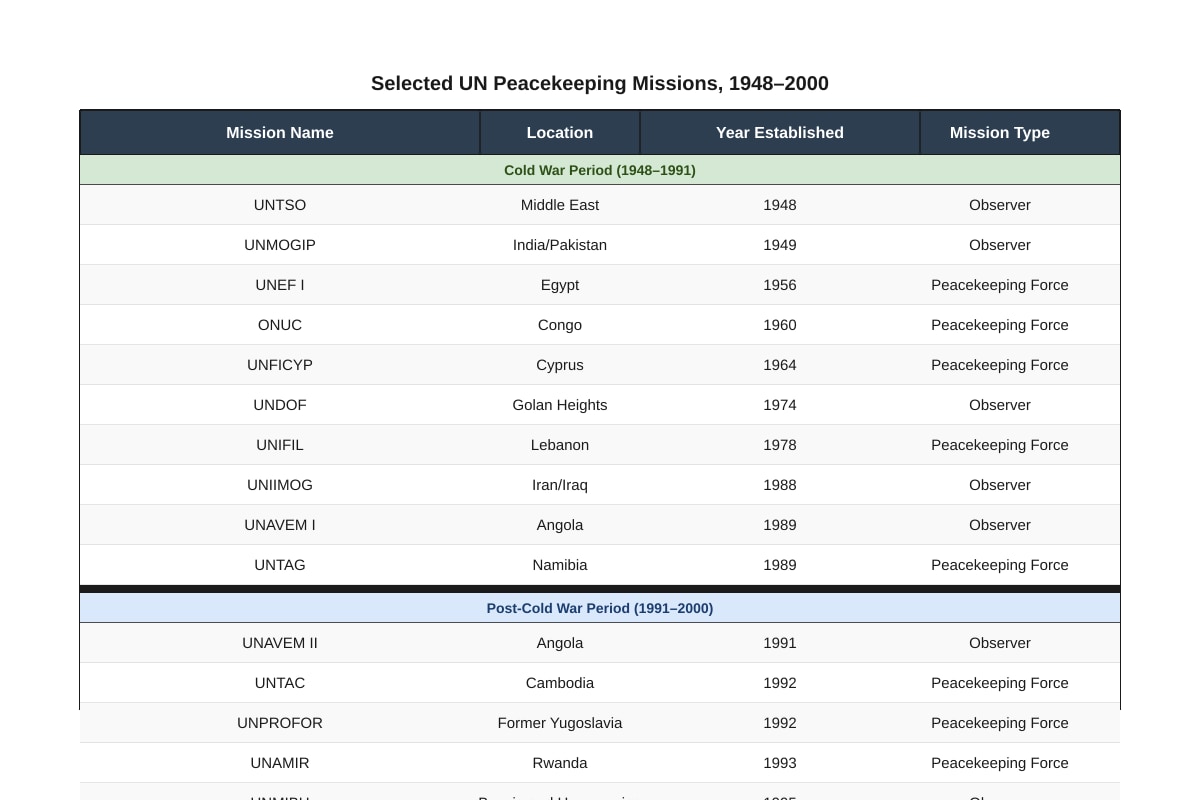
Answer: One pattern visible is that most Cold War peacekeeping missions were established in the Middle East (UNTSO, UNEF I, UNEF II, UNIFIL) or in Europe (UNFICYP in Cyprus). Another pattern is that missions were primarily observer missions or interposition forces designed to monitor ceasefires rather than enforce peace.
Marking notes:
- 1 mark for identifying a clear pattern
- 1 mark for providing evidence from the table
Question 17 (3 marks)
Answer: The data shows that after 1991, the number of peacekeeping missions established increased significantly. During the Cold War (1948–1991), the table shows 6 missions established over 43 years. After the Cold War (1991–2000), the table shows 5 missions established in just 9 years. This supports the view that the end of the Cold War led to an expansion of UN peacekeeping activities, as the Security Council was no longer paralysed by superpower rivalry and could authorise more missions.
Marking notes:
- 1 mark for identifying the increase in number of missions
- 1 mark for comparing the rate of establishment (Cold War vs. post-Cold War)
- 1 mark for explaining the link to the end of superpower rivalry
Question 18 (3 marks)
Answer: One reason is that UN peacekeeping missions were established in conflicts where the superpowers had a shared interest in stability or where neither superpower had a direct stake. For example, UNEF I (1956) was established because both the USA and USSR opposed the British-French-Israeli invasion of Egypt. UNFICYP (1964) was established because Cyprus was not a direct superpower proxy conflict. In contrast, conflicts where superpower interests were directly engaged (e.g., Vietnam, Afghanistan) saw no UN peacekeeping missions because the superpowers would veto any such proposal.
Marking notes:
- 1 mark for identifying the role of superpower interests
- 1 mark for providing an example from the table
- 1 mark for explaining the contrast with conflicts where no mission was established
Question 19 (4 marks)
Answer:
Usefulness:
- The table provides clear, comparative data on the number, location, and type of peacekeeping missions before and after the Cold War.
- It allows for quantitative analysis of the expansion of peacekeeping after 1991.
- It shows the shift from observer missions to more complex peacekeeping forces.
Limitations:
- The table only includes selected missions; it may not be comprehensive.
- It does not provide data on mission size, budget, or effectiveness.
- It does not explain why missions were established or why they succeeded or failed.
- The table does not include missions that were proposed but not established, which would provide a fuller picture.
Overall: The table is useful as a starting point for understanding the changing nature of UN peacekeeping, but it must be supplemented with qualitative evidence and case studies.
Marking notes:
- 2 marks for identifying useful aspects
- 2 marks for identifying limitations
Question 20 (8 marks)
Marking scheme (Levels-based):
| Level | Marks | Descriptor |
|---|---|---|
| L4 | 7–8 | Sustained analysis using both data and own knowledge; clear judgement on transformation |
| L3 | 5–6 | Good analysis with relevant evidence; some evaluation |
| L2 | 3–4 | Limited analysis; may describe rather than evaluate |
| L1 | 1–2 | Weak or irrelevant response |
Answer framework:
Introduction:
- The end of the Cold War transformed UN peacekeeping in terms of scale, scope, and ambition.
- However, the transformation did not necessarily lead to greater effectiveness.
Using the data:
- The table shows an increase in the number of missions after 1991.
- The types of missions also changed: post-Cold War missions (UNAVEM II, UNPROFOR, UNAMIR, UNTAES, UNMIK) were more complex and often involved internal conflicts.
Using own knowledge:
- Expansion: The UN peacekeeping budget increased from 3.6 billion in 1994.
- New mandates: Post-Cold War missions included civilian protection
<stage3_quiz_answers_md>
A-Level History H2 Quiz - Conflict International Relations - ANSWERS
Total Marks: 50
Section A: Short-Answer Questions (10 marks)
1. Define the term "collective security" as it applies to the United Nations Charter. [2]
Model Answer: Collective security is the principle that an attack on one member state is considered an attack on all, and the international community (through the UN) will respond collectively to maintain peace. Under the Charter, the Security Council can authorise collective action, including military force, to restore international peace and security.
Mark Scheme:
- 1 mark for a clear definition of the principle (e.g., "an attack on one is an attack on all").
- 1 mark for linking it to the UN Charter/Security Council's role in authorising collective action.
2. State two specific operational constraints faced by UN peacekeeping missions during the Cold War period (1945–1991). [2]
Model Answer:
- Lack of superpower consensus: The Cold War rivalry meant the Security Council was often paralysed by the veto, preventing authorisation of enforcement action in major crises.
- Consent-based operations: Peacekeeping missions required the consent of the host state(s), limiting their ability to intervene in internal conflicts or against the will of a sovereign government.
Mark Scheme:
- 1 mark for each valid constraint (max 2). Accept other valid constraints such as: limited mandate (e.g., only observation/interposition), lack of permanent standing forces, funding disputes, non-interference in internal affairs.
3. Identify one key difference between the UN's role in the Korean War (1950–1953) and its role in the Suez Crisis (1956). [2]
Model Answer: In the Korean War, the UN authorised a military enforcement action (a "police action") led by the US to repel North Korea's invasion, using a resolution passed while the Soviet Union was boycotting the Security Council. In the Suez Crisis, the UN established the first large-scale peacekeeping force (UNEF I) to supervise the ceasefire and withdrawal of foreign troops, operating with the consent of the parties involved.
Mark Scheme:
- 1 mark for identifying a clear difference (e.g., enforcement vs. peacekeeping; superpower-led vs. neutral force).
- 1 mark for providing specific detail (e.g., naming UNEF, mentioning the Soviet boycott).
4. What was the significance of the "Uniting for Peace" resolution (1950) for the United Nations? [2]
Model Answer: The "Uniting for Peace" resolution allowed the General Assembly to recommend collective action, including the use of force, when the Security Council was unable to act due to a veto by a permanent member. This shifted some responsibility from the Security Council to the General Assembly, enabling the UN to bypass Cold War paralysis in certain situations.
Mark Scheme:
- 1 mark for explaining the mechanism (General Assembly can act when Security Council is deadlocked).
- 1 mark for explaining its significance (bypassing the veto, enabling UN action in some crises).
5. Explain briefly why the principle of non-interference in the internal affairs of member states was a challenge to UN peacekeeping during the Cold War. [2]
Model Answer: The UN Charter (Article 2(7)) prohibits the UN from intervening in matters that are essentially within the domestic jurisdiction of any state. During the Cold War, many conflicts were internal (civil wars, decolonisation struggles), and the principle of non-interference was used by states to resist UN involvement, limiting peacekeeping to situations where the host state consented.
Mark Scheme:
- 1 mark for explaining the principle (non-interference in domestic affairs).
- 1 mark for linking it to the challenge (prevented UN action in internal conflicts without consent).
Section B: Source-Based Questions (20 marks)
6. (a) Compare and contrast the evidence provided by Sources A and B on the limitations of the United Nations during the Cold War. [6]
Model Answer:
Comparison (similarities): Both sources agree that the UN's effectiveness was fundamentally limited by the Cold War. Source A states that the UN's effectiveness "depends entirely on the will of its member states" and that without agreement among the great powers, the Secretariat can "do little more than observe and report." Source B similarly argues that the Cold War "paralysed the Council whenever the interests of the superpowers are engaged," limiting the UN to acting only in conflicts where superpowers had no direct stake.
Contrast (differences):
- Perspective: Source A is from a UN Secretary-General (internal perspective), focusing on the institutional limitations of the Secretariat. Source B is from a US Senate committee (external/national perspective), focusing on the structural contradiction in the Charter.
- Emphasis: Source A emphasises the UN as a "dynamic instrument" that is constrained by member states' will, suggesting potential if conditions allow. Source B is more critical, describing a "fundamental contradiction" and a "severe limitation" on the UN's capacity to fulfil its primary purpose.
- Blame: Source A does not explicitly blame any power bloc, while Source B implies that superpower rivalry (both US and USSR) is the cause of paralysis.
Mark Scheme:
- Level 4 (5-6 marks): Detailed comparison and contrast with specific evidence from both sources.
- Level 3 (3-4 marks): Good comparison or contrast, with some evidence.
- Level 2 (1-2 marks): Limited comparison or contrast, or only describes one source.
- Level 1 (0 marks): No valid comparison or contrast.
7. (b) How far does Source C support the view expressed in Source B about the reasons for UN ineffectiveness? [4]
Model Answer:
Source C partially supports Source B's view. Both sources agree that the Security Council was paralysed and that the UN was ineffective in maintaining peace. Source B argues that the Cold War paralysed the Council "whenever the interests of the superpowers are engaged." Source C, from the Soviet perspective, confirms this by stating that the USSR "cannot and will not accept operations that bypass the Security Council" and insists on its veto right.
However, Source C challenges Source B's implied neutrality. Source B presents the paralysis as a structural problem, while Source C explicitly blames the "imperialist ambitions of the Western powers" and accuses peacekeeping of being a "cover" for Western interests. Source C does not see the UN's ineffectiveness as a shared failure but as a result of Western attempts to circumvent the Charter.
Therefore, Source C supports the factual claim of ineffectiveness but offers a different, more partisan explanation for the reasons behind it.
Mark Scheme:
- Level 4 (4 marks): Detailed evaluation, showing both support and challenge with specific evidence.
- Level 3 (3 marks): Good evaluation, showing support or challenge with evidence.
- Level 2 (1-2 marks): Limited evaluation, or only describes one source.
- Level 1 (0 marks): No valid evaluation.
8. (c) Assess the reliability of Source A as evidence for understanding the operational constraints of the UN during the Cold War. [4]
Model Answer:
Source A is partially reliable but has significant limitations.
Reliable aspects:
- Authorship: Dag Hammarskjöld was UN Secretary-General (1953-1961), giving him direct, insider knowledge of the UN's operational constraints.
- Content: His description of the UN as dependent on member states' will and limited to observation when great powers disagree is accurate and consistent with historical evidence (e.g., UN in Hungary 1956, Congo 1960-64).
- Purpose: The speech was a public address, likely intended to be candid about the UN's limitations while still defending its role.
Unreliable aspects:
- Perspective: As Secretary-General, Hammarskjöld had a vested interest in portraying the UN positively and defending its role. He may have downplayed the UN's failures or the extent of superpower obstruction.
- Context: The speech was in 1958, during a period of Cold War tension. He may have been trying to manage expectations and maintain support for the UN without alienating member states.
- Omission: The source does not mention specific failures (e.g., the UN's inability to act in Hungary in 1956) or the role of the veto in preventing action.
Conclusion: Source A is a useful primary source for understanding the official UN perspective on its constraints, but it must be cross-referenced with other sources (like B and D) for a more complete and critical picture.
Mark Scheme:
- Level 4 (4 marks): Detailed assessment of reliability, considering authorship, purpose, context, and content, with a balanced conclusion.
- Level 3 (3 marks): Good assessment with some consideration of reliability factors.
- Level 2 (1-2 marks): Limited assessment, or only states whether it is reliable or not.
- Level 1 (0 marks): No valid assessment.
9. (d) With reference to Source D, explain what is meant by "observer missions and interposition forces". [2]
Model Answer:
- Observer missions: Small, unarmed or lightly armed teams deployed to monitor ceasefires, report on violations, and provide information to the UN. They do not enforce peace but observe and report (e.g., UNTSO in Palestine).
- Interposition forces: Larger, lightly armed peacekeeping forces deployed between opposing sides after a ceasefire to separate them, maintain a buffer zone, and supervise the disengagement (e.g., UNEF I in Sinai after the Suez Crisis).
Mark Scheme:
- 1 mark for a clear explanation of "observer missions."
- 1 mark for a clear explanation of "interposition forces."
10. (e) How far do Sources A–D support the view that the United Nations was unable to fulfil its primary purpose of maintaining international peace and security during the Cold War period? [4]
Model Answer:
The sources largely support the view that the UN was unable to fulfil its primary purpose, but with some nuance.
Supporting evidence:
- Source A states the UN can "do little more than observe and report" without great power agreement.
- Source B argues the UN was "hampered by a fundamental contradiction" and could only act "in conflicts where the superpowers have had no direct stake."
- Source C confirms the Soviet Union would block any action it opposed, preventing enforcement.
- Source D concludes the UN could "manage conflicts at the margins" but could not "address the root causes of the major confrontations."
Limitations to the view:
- Source A also describes the UN as a "dynamic instrument for peace," suggesting it was not entirely unable to act, but constrained.
- The sources focus on major crises (Korea, Suez, Hungary) but do not mention the UN's successes in managing smaller conflicts (e.g., peacekeeping in Cyprus, Kashmir, the Middle East).
- The UN did authorise enforcement action in Korea (1950) and established successful peacekeeping missions (UNEF I), showing it could fulfil its purpose in specific circumstances.
Conclusion: The sources strongly support the view that the UN was unable to maintain peace in the major Cold War confrontations, but they also show it had some success in managing peripheral conflicts. The view is therefore largely valid but requires qualification.
Mark Scheme:
- Level 4 (4 marks): Detailed evaluation, using evidence from multiple sources to support and challenge the view, with a balanced conclusion.
- Level 3 (3 marks): Good evaluation, using evidence from sources to support or challenge the view.
- Level 2 (1-2 marks): Limited evaluation, or only describes sources.
- Level 1 (0 marks): No valid evaluation.
Section C: Essay Questions (20 marks)
11. "The failure of the United Nations in maintaining international peace and security between 1945 and 1991 was due to the Cold War rivalry between the superpowers." To what extent do you agree with this statement? [20]
Model Answer:
Introduction: The statement argues that the UN's failure to maintain peace during the Cold War was primarily caused by superpower rivalry. While this was a major factor, other structural, financial, and operational limitations also contributed. This essay will argue that superpower rivalry was the most significant cause of UN ineffectiveness, but not the only one.
Paragraph 1: The Security Council Veto (Agree)
- The Charter gave the five permanent members (P5) the veto, which was intended to ensure great power consensus.
- During the Cold War, the US and USSR used the veto to block action against themselves or their allies.
- Examples: USSR vetoed action on Hungary (1956), Czechoslovakia (1968); US vetoed action on Israel, Vietnam.
- This paralysed the Security Council in most major crises, preventing enforcement action.
Paragraph 2: Limited Peacekeeping (Agree)
- Peacekeeping was developed as a Cold War compromise, but it was limited to consent-based, non-enforcement missions.
- The UN could only act where superpowers agreed or had no direct stake (e.g., Suez 1956, Congo 1960-64, Cyprus 1964).
- In major confrontations (e.g., Vietnam War, Soviet invasion of Afghanistan), the UN was powerless.
Paragraph 3: Other Structural Limitations (Disagree - Partially)
- The UN lacked a permanent standing army and depended on member states for troops and funding.
- The principle of non-interference in internal affairs (Article 2(7)) prevented action in many conflicts.
- These limitations existed independently of the Cold War, though the Cold War exacerbated them.
Paragraph 4: Financial and Political Constraints (Disagree - Partially)
- The UN faced chronic financial crises, with major powers (especially the US and USSR) withholding funds for political reasons.
- The General Assembly was dominated by blocs (e.g., Non-Aligned Movement), leading to political gridlock.
- These issues were linked to the Cold War but also reflected broader North-South tensions.
Paragraph 5: Successes (Counter-Argument)
- The UN did have some successes: authorising the Korean War (1950), establishing UNEF I (1956), peacekeeping in Cyprus (1964), and mediating the end of the Iran-Iraq War (1988).
- These show the UN could act when superpowers agreed or when the conflict was peripheral.
Conclusion: The Cold War rivalry was the most important cause of UN failure, as it paralysed the Security Council and limited peacekeeping to marginal conflicts. However, other structural, financial, and political limitations also played a role. The UN was not a complete failure, but its ability to maintain peace was severely constrained by the bipolar world order. Therefore, I largely agree with the statement, but with the qualification that other factors also contributed.
Mark Scheme:
- Level 5 (17-20 marks): Excellent essay with clear argument, detailed evidence, balanced evaluation, and sophisticated analysis.
- Level 4 (13-16 marks): Good essay with clear argument, good evidence, and some evaluation.
- Level 3 (9-12 marks): Competent essay with some argument and evidence, but limited evaluation.
- Level 2 (5-8 marks): Limited essay with some relevant points but weak argument.
- Level 1 (1-4 marks): Poor essay with little relevant content.
- Level 0 (0 marks): No relevant content.
12. Evaluate the effectiveness of United Nations peacekeeping operations in the period 1945–1991. [20]
Model Answer:
Introduction: UN peacekeeping was a Cold War innovation designed to manage conflicts where superpowers agreed to allow UN involvement. Its effectiveness was mixed: it succeeded in some contexts but failed in others. This essay will argue that peacekeeping was effective in managing peripheral conflicts but ineffective in addressing major crises or internal conflicts.
Paragraph 1: Definition and Origins
- Peacekeeping was not in the Charter; it evolved as a response to Cold War paralysis.
- First mission: UNTSO (1948) in Palestine; first large-scale force: UNEF I (1956) in Suez.
- Principles: consent of parties, impartiality, non-use of force except in self-defence.
Paragraph 2: Successes (Effective)
- Suez Crisis (1956): UNEF I successfully supervised the withdrawal of British, French, and Israeli forces and maintained a buffer zone for a decade.
- Cyprus (1964): UNFICYP helped maintain peace between Greek and Turkish Cypriots, preventing full-scale war.
- Kashmir (1949): UNMOGIP monitored the ceasefire line, reducing direct conflict between India and Pakistan.
- These missions succeeded because they had clear mandates, consent of parties, and limited objectives.
Paragraph 3: Failures (Ineffective)
- Congo (1960-64): ONUC was drawn into a civil war, exceeded its mandate, and faced significant casualties. It stabilised the country but at great cost and with questionable legitimacy.
- Middle East (1967): UNEF I was withdrawn at Egypt's request, leading to the Six-Day War. This showed the weakness of consent-based peacekeeping.
- Lebanon (1978): UNIFIL was unable to prevent Israeli invasions or Hezbollah's activities, showing the limits of peacekeeping in complex conflicts.
Paragraph 4: Limitations (Reasons for Ineffectiveness)
- Consent-based: Missions could be withdrawn at any time by the host state (e.g., Egypt 1967).
- Limited mandate: Peacekeepers could only observe, report, and interpose; they could not enforce peace.
- Lack of resources: Missions were underfunded, understaffed, and lacked modern equipment.
- Superpower rivalry: The UN could not act in conflicts where superpowers had direct interests (e.g., Vietnam, Afghanistan).
Paragraph 5: Overall Assessment
- Peacekeeping was effective in managing small, inter-state conflicts where both sides wanted peace (e.g., Suez, Cyprus).
- It was ineffective in internal conflicts (e.g., Congo) and in major Cold War confrontations.
- Its effectiveness was limited by the Cold War context, but it provided a valuable tool for conflict management.
Conclusion: UN peacekeeping was partially effective during the Cold War. It succeeded in managing peripheral conflicts and preventing escalation, but it failed in more complex internal conflicts and major crises. The Cold War context was the primary limitation, but the inherent weaknesses of consent-based peacekeeping also contributed. Therefore, its effectiveness was limited but not non-existent.
Mark Scheme:
- Level 5 (17-20 marks): Excellent essay with clear argument, detailed evidence, balanced evaluation, and sophisticated analysis.
- Level 4 (13-16 marks): Good essay with clear argument, good evidence, and some evaluation.
- Level 3 (9-12 marks): Competent essay with some argument and evidence, but limited evaluation.
- Level 2 (5-8 marks): Limited essay with some relevant points but weak argument.
- Level 1 (1-4 marks): Poor essay with little relevant content.
- Level 0 (0 marks): No relevant content.
13. To what extent did the end of the Cold War transform the role and effectiveness of the United Nations in maintaining international peace and security? [20]
Model Answer:
Introduction: The end of the Cold War (1989-1991) removed the superpower veto paralysis that had constrained the UN for decades. This led to a period of optimism and expanded UN activism in the 1990s. However, the new challenges of intra-state conflicts, humanitarian crises, and the limits of UN capacity meant that the transformation was only partial. This essay will argue that the end of the Cold War significantly transformed the UN's role but did not guarantee its effectiveness.
Paragraph 1: The New World Order (Transformation)
- The Security Council was no longer paralysed by the veto, allowing for consensus on action (e.g., Gulf War 1990-91, Somalia 1992, Bosnia 1992-95).
- The UN authorised more peacekeeping missions in the 1990s than in the entire Cold War period.
- The concept of peacekeeping expanded to include peace enforcement, humanitarian intervention, and nation-building.
Paragraph 2: Successes (Effective)
- Gulf War (1990-91): The UN authorised a US-led coalition to expel Iraq from Kuwait, showing the potential for collective security after the Cold War.
- Namibia (1989-90): UNTAG successfully supervised elections and transition to independence.
- Cambodia (1992-93): UNTAC organised elections and helped rebuild the state.
- Mozambique (1992-94): ONUMOZ successfully implemented a peace agreement.
Paragraph 3: Failures (Ineffective)
- Somalia (1992-93): UNOSOM II attempted peace enforcement but ended in the "Black Hawk Down" incident and withdrawal.
- Rwanda (1994): The UN failed to prevent the genocide despite having a peacekeeping force (UNAMIR) on the ground.
- Bosnia (1992-95): The UN was unable to prevent ethnic cleansing and the Srebrenica massacre (1995), despite having peacekeepers present.
- These failures showed that the UN lacked the political will, resources, and mandate to handle complex intra-state conflicts.
Paragraph 4: Limitations (Reasons for Limited Transformation)
- The UN still depended on member states for troops and funding, leading to delays and inadequate resources.
- The Security Council remained dominated by the P5, with the US often acting unilaterally (e.g., Kosovo 1999, Iraq 2003).
- The principle of sovereignty and non-interference remained a barrier to intervention in internal conflicts.
- The UN's institutional capacity was not designed for complex nation-building and peace enforcement.
Paragraph 5: Overall Assessment
- The end of the Cold War transformed the UN's role by removing the veto paralysis and expanding the scope of peacekeeping.
- However, the UN's effectiveness was limited by the new challenges of intra-state conflicts, lack of political will, and inadequate resources.
- The UN had some successes (Namibia, Cambodia, Mozambique) but also major failures (Rwanda, Bosnia, Somalia).
Conclusion: The end of the Cold War significantly transformed the UN's role, allowing it to become more active and expand its mandate. However, this did not automatically make it more effective. The UN faced new challenges in the 1990s that it was not equipped to handle, leading to both successes and failures. Therefore, the transformation was significant but incomplete, and the UN's effectiveness remained limited by political and structural constraints.
Mark Scheme:
- Level 5 (17-20 marks): Excellent essay with clear argument, detailed evidence, balanced evaluation, and sophisticated analysis.
- Level 4 (13-16 marks): Good essay with clear argument, good evidence, and some evaluation.
- Level 3 (9-12 marks): Competent essay with some argument and evidence, but limited evaluation.
- Level 2 (5-8 marks): Limited essay with some relevant points but weak argument.
- Level 1 (1-4 marks): Poor essay with little relevant content.
- Level 0 (0 marks): No relevant content.
End of Answers