AI Generated Exam Paper
A Level H2 History Practice Paper 4
Free A Level H2 History Practice Paper 4, HY3 AI version, with questions, answers, and A Level-style practice for Singapore students.
These static practice materials are generated from the site's syllabus and paper-generation workflow, with source and model context shown so students and parents can evaluate the material before use.
Questions
TuitionGoWhere Practice Paper - History H2 A-Level
TuitionGoWhere Practice Paper (AI) — Version 4 of 5
Subject: History H2
Level: A-Level (Pre-University)
Paper: Source Based Skills Practice Paper
Duration: 1 hour 30 minutes
Total Marks: 60
Name: ________________________
Class: ________________________
Date: ________________________
Instructions:
- This practice paper tests source-based skills aligned to the H2 History (9174) syllabus Theme I (Cold War) and Paper 2 regional conflict source methods.
- Answer all questions.
- Read each source carefully before answering.
- Marks for each question are shown in brackets.
- This is a syllabus-first AI-generated practice paper (Version 4). It is not derived from official national A-Level papers.
Section A: Source Comprehension and Comparison (Questions 1–8) [20 marks]
1. Source A is a 1962 speech by a US State Department official. What is the explicit main concern expressed about Soviet actions in Cuba? [2]
2. Source B is a Soviet newspaper editorial from October 1962. Identify one tone feature that suggests state-controlled messaging. [1]
3. Compare the evidence in Sources A and B on the question of who threatened peace in the Caribbean in 1962. [4]
4. Source C is a telegram from the US embassy in Moscow, 22 Oct 1962. What type of source is it, and what is one limitation of using it alone? [2]
5. How does Source D (a Cuban citizen's letter, 1963) differ from Source B in terms of perspective? [2]
6. Using Sources A and C, what shared factual claim can be corroborated? [2]
7. Source E is a 1992 memoir by a Soviet officer. Why might its reliability differ from Source B? [2]
8. "Sources A and B are equally useful for understanding the Cuban Missile Crisis." Assess this claim with one reason. [3]
Section B: Source Reliability and Utility (Questions 9–14) [18 marks]
9. Define "provenance" in source analysis. [1]
10. Source F is a declassified CIA report (1961) on Laos. Give one reason it may be reliable. [2]
11. Source G is a Hollywood film (1974) dramatising the Vietnam War. Explain why it has limited utility as factual evidence. [2]
12. Assess the usefulness of Source H (UN General Assembly voting record, 1979) for studying Cold War bloc alignment. [3]
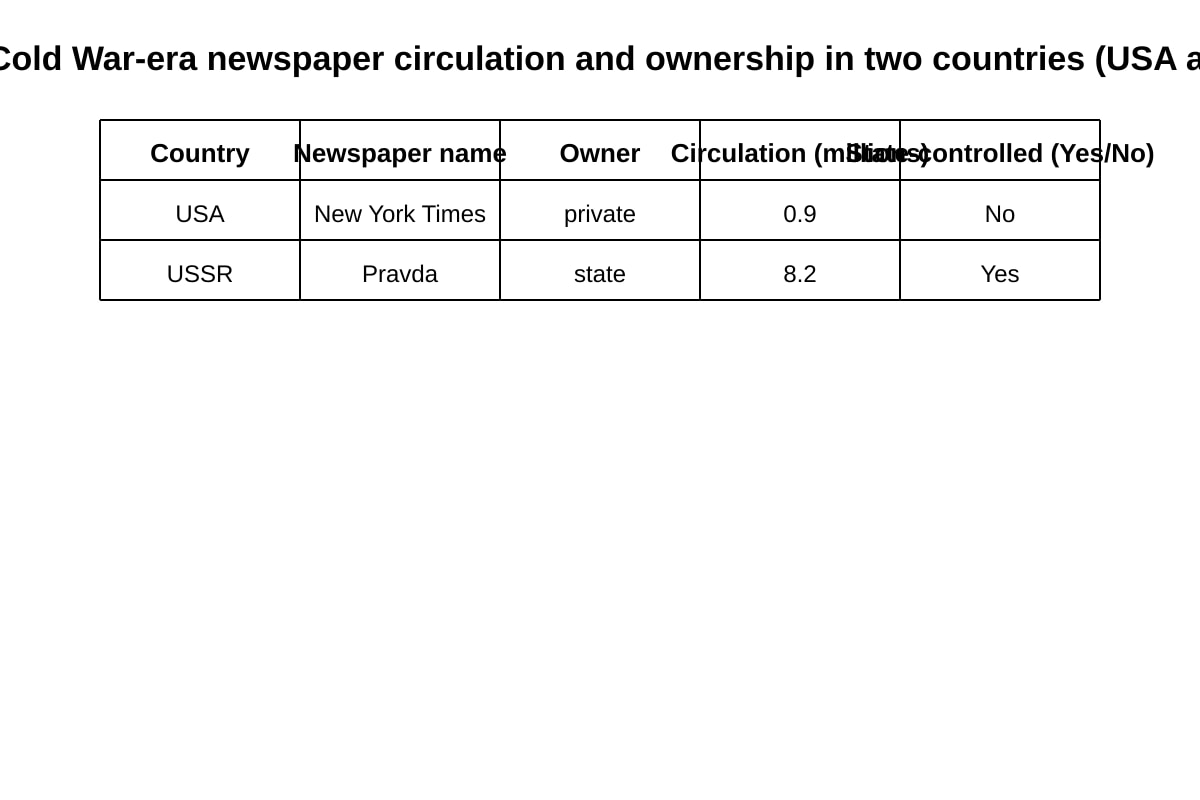
13.
Image pending generation: table for Q13.
Using the table in Q13-fig1, explain one way ownership affects source reliability. [3]
14. Why is date of production important when evaluating Source I (a 1989 East German protest leaflet)? [2]
Section C: Multi-Source Evaluation (Questions 15–20) [22 marks]
Read Sources J–O below (summary extracts):
- Source J (1965): Malaysian PM states confrontation with Indonesia is purely defensive.
- Source K (1965): Indonesian newspaper claims Malaysia is a neocolonial puppet of Britain.
- Source L (1966): UK Foreign Office memo notes economic strain from confrontation.
- Source M (1990): Historian argues confrontation was driven by Sukarno's domestic legitimacy needs.
- Source N (1965): Australian diplomat report warns of communist expansion via Indonesia.
- Source O (2001): Scholar critiques traditional Cold War framing of confrontation as oversimplified.
15. Which two sources agree that external powers were involved in the Konfrontasi? [2]
16. How far do Sources J and K support the view that the conflict was based on mutual misunderstanding? [4]
17. Assess the reliability of Source M for understanding Sukarno's motives. [3]
18. Using Sources L and N, what economic and security concerns are revealed? [3]
19. How does Source O challenge the interpretation in Source N? [3]
20. How far do Sources J–O support the assertion that "The Konfrontasi was fundamentally a Cold War proxy conflict rather than a genuine regional dispute"? [7]
Answers
TuitionGoWhere Practice Paper — Answer Key (Version 4)
Subject: History H2
Level: A-Level
Total Marks: 60
Section A: Answers (20 marks)
1. [2 marks]
Answer: The explicit main concern is Soviet deployment of offensive missiles in Cuba threatening US security.
Teaching: Source A (speech) explicitly states missile bases; students should identify explicit not inferred worry.
Mark: 2 for clear identification.
2. [1 mark]
Answer: Uniform, pro-government language / no dissenting view.
Teaching: State media shows controlled tone.
Mark: 1 for one feature.
3. [4 marks]
Answer: Both identify Caribbean tension; A blames USSR, B blames US imperialism.
Structure: Both agree peace threatened (1). A holds Soviet actions responsible (1); B holds US blockade responsible (1); different attribution of blame (1).
Teaching: Compare not summarise separately.
4. [2 marks]
Answer: Diplomatic communication (primary). Limitation: single-embassy view, may lack local nuance.
Mark: 1 type + 1 limitation.
5. [2 marks]
Answer: B is official state view; D is personal civilian experience, showing daily impact not ideology.
Mark: 1 each.
6. [2 marks]
Answer: Both state Soviet missiles present in Cuba Oct 1962.
Mark: 2 for corroborated fact.
7. [2 marks]
Answer: Memoir has hindsight, possibly reflective; B was contemporary propaganda with censorship.
Mark: 1 each.
8. [3 marks]
Answer: Not equal: A is official US with policy bias; B is Soviet state media with censorship. Usefulness differs by perspective.
Mark: 1 claim + 2 reasons.
Section B: Answers (18 marks)
9. [1 mark]
Answer: Provenance = origin of source (author, date, context).
10. [2 marks]
Answer: Declassified, based on intelligence gathering; likely informed.
Mark: 2 for reason.
11. [2 marks]
Answer: Dramatised, artistic licence, not documentary.
Mark: 2.
12. [3 marks]
Answer: Useful: shows voting blocs objectively. Limitation: no debate detail.
Mark: 2 useful + 1 limit.
13. [3 marks]
Answer: State-owned Pravda had huge circulation and control; private NYT smaller, freer. Ownership shapes bias.
Mark: 1 link + 2 explain.
14. [2 marks]
Answer: 1989 pre-collapse context shows rising dissent; date signals timing of opposition.
Mark: 2.
Section C: Answers (22 marks)
15. [2 marks]
Answer: K and N (Britain puppet, communist expansion).
16. [4 marks]
Answer: Partial: J says defensive, K says puppet — shows mismatch not just misunderstanding.
Mark: 2 each source.
17. [3 marks]
Answer: Moderate: retrospective, analytical, but single historian view.
Mark: 1 reliable + 2 qualify.
18. [3 marks]
Answer: L: economic strain; N: communist expansion fear.
Mark: 1.5 each.
19. [3 marks]
Answer: O says oversimplified; N treats as communist threat — challenges frame.
Mark: 3.
20. [7 marks]
Answer: Moderate support: J–N show Cold War links; O critiques proxy claim.
Mark: 2 intro + 4 sources + 1 conclusion.
Free quiz and exam paper access
Enter your details to view this paper
Your access is remembered on this device.