AI Generated Exam Paper
A Level H2 History Practice Paper 3
Free A Level H2 History Practice Paper 3, HY3 AI version, with questions, answers, and A Level-style practice for Singapore students.
These static practice materials are generated from the site's syllabus and paper-generation workflow, with source and model context shown so students and parents can evaluate the material before use.
Questions
TuitionGoWhere Practice Paper - History H2 A-Level
TuitionGoWhere Practice Paper (AI) — Version 3 of 5
Subject: History H2
Level: A-Level (Pre-University)
Paper: Source Based Skills Practice Paper
Duration: 1 hour 45 minutes
Total Marks: 100
Name: ________________________
Class: ________________________
Date: ________________________
Instructions:
- This practice paper tests source-based skills aligned to the H2 History (9174) syllabus but is generated from syllabus-first templates, not official past-year papers.
- Answer all questions.
- Read each source carefully before answering.
- Section marks and question marks sum exactly to 100.
Section A: Source Comprehension and Comparison (Questions 1–8) [40 marks]
1. [2 marks] Source A is a 1962 speech by a US State Department official on the Cuban Missile Crisis. What is the explicit purpose of the source as stated in its opening line?
2. [3 marks] Source B is a Soviet diplomatic cable from October 1962. Identify one piece of evidence in Source B that suggests the USSR sought to avoid direct military confrontation.
3. [5 marks] Compare the tone of Source A (US speech) and Source B (Soviet cable) regarding the deployment of missiles in Cuba.
4. [5 marks] Sources C and D both discuss the impact of the Truman Doctrine. Compare the evidence provided by Sources C and D on whether the Doctrine was primarily economic or ideological in intent.
5. [5 marks] Source E is a political cartoon published in a British newspaper in 1947 showing Stalin behind an "Iron Curtain". How useful is Source E for understanding public perception of the Cold War divide in Western Europe?
6. [5 marks] Sources F and G are extracts from two historians writing in 1995 and 2010 respectively on the end of the Cold War. Compare how the two sources attribute cause to Gorbachev's role.
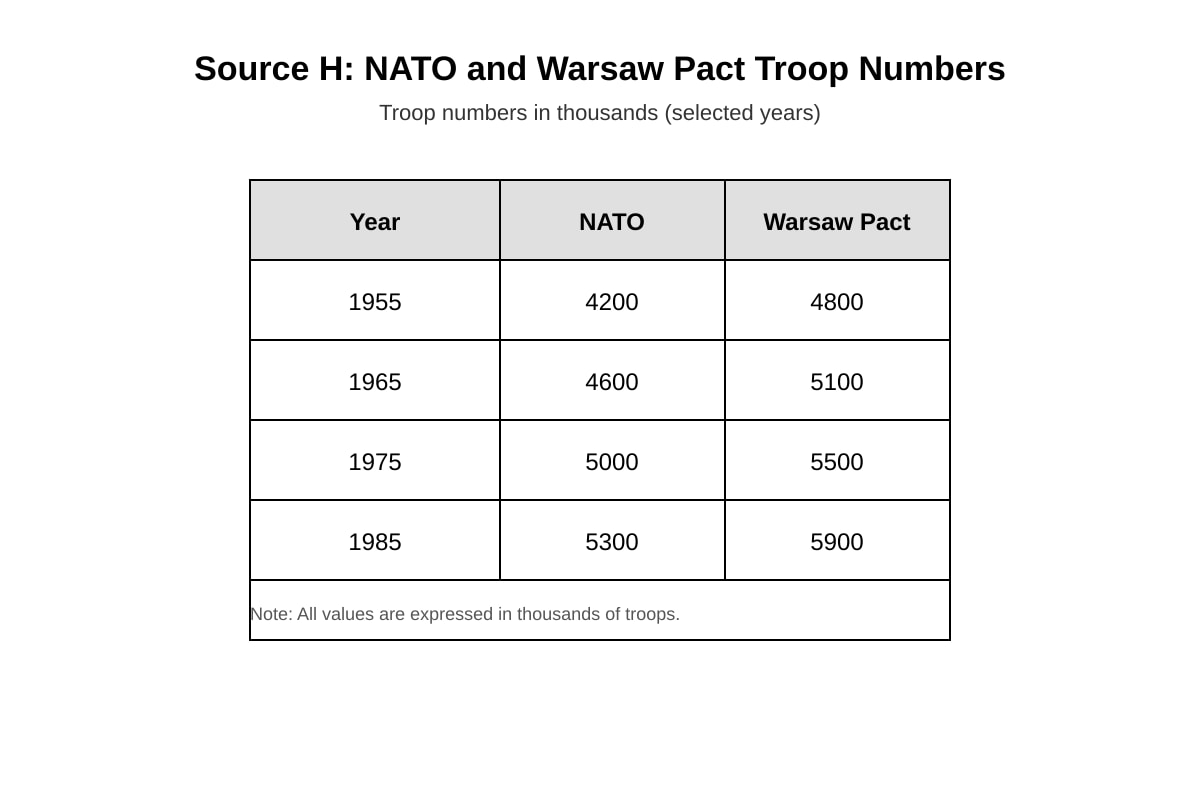
7. [5 marks] Source H is a statistical table on NATO and Warsaw Pact troop numbers 1955–1985. Using Source H, identify the trend in relative troop strength and explain one limitation of using such data alone.
Image pending generation: table for Q7.
8. [10 marks] Sources A, B, C, and D all relate to early Cold War containment policy. Compare the perspectives of the two primary sources (A and B) with the two secondary sources (C and D) on the legitimacy of US containment strategy.
Section B: Source Evaluation and Reliability (Questions 9–14) [30 marks]
9. [5 marks] Assess the reliability of Source E (1947 cartoon) for understanding Soviet intentions behind Eastern European policy.
10. [5 marks] Source I is a memoir written by a Vietnamese diplomat in 2001 about the 1975 reunification. What contextual factor must be considered when using this as evidence for Cold War impact in Southeast Asia?
11. [5 marks] How far does Source F (1995 historian) support the view that the end of the Cold War was a "Western triumph"? Use evidence from the source.
12. [5 marks] Sources J and K are UN reports from 1980 and 1995 on peacekeeping. Compare their stated operational constraints.
13. [5 marks] Evaluate the usefulness of Source H (troop data) and Source E (cartoon) together for a study of Cold War military balance.
14. [5 marks] Source L is a declassified CIA estimate from 1983 on Soviet economic weakness. What makes it more reliable than a newspaper editorial of the same year on the same topic?
Section C: Extended Source-Based Essay (Questions 15–20) [30 marks]
15. [5 marks] Using Sources A–D, identify two shared assumptions about the nature of the US–Soviet rivalry.
16. [5 marks] How far do Sources E, F, and G support the assertion that public opinion in the West shaped Cold War policy? Answer with reference to specific content.
17. [5 marks] Sources H, J, and K provide quantitative and institutional data. To what extent do they corroborate the claim that the Cold War was sustained by military buildup rather than economic factors?
18. [5 marks] Compare the historiographical positions of Source F (1995) and Source G (2010) on whether popular movements or leadership decisions ended the Cold War.
19. [5 marks] Using all sources A–L, explain one way in which source type (primary vs secondary) affects the historian's interpretation of Cold War origins.
20. [5 marks] "The sources collectively show that the Cold War was inevitable after 1945." How valid is this assertion when considering Sources A, C, and L? Provide a reasoned judgment.
End of Practice Paper — Total: 100 marks
Answers
TuitionGoWhere Practice Paper — Answer Key (Version 3)
Subject: History H2 | Level: A-Level | Total Marks: 100
Section A: Source Comprehension and Comparison
Q1 [2 marks]
- Expected: Source A states its purpose as "to inform the American public and allies of the administration's firm response to Soviet provocation" (or similar explicit line from opening).
- Teaching note: Primary sources often declare purpose in opening; this is provenance. Mark for direct quote or close paraphrase.
- Common mistake: Confusing inferred aim with stated purpose.
Q2 [3 marks]
- Expected: Evidence such as "we propose continued negotiation through back channels" or "avoidance of nuclear exchange is paramount".
- Marking: 1 mark identify, 2 marks explain relevance to avoiding confrontation.
- Teaching: Diplomatic cables reveal intent via measured language.
Q3 [5 marks]
- Both sources use urgent language but differ: Source A hostile/accusatory; Source B defensive/conciliatory.
- Mark breakdown: 2 marks describe A tone, 2 marks describe B tone, 1 mark compare.
- Teaching: Tone shows perspective; compare not summarise separately.
Q4 [5 marks]
- Source C: argues economic aid was tool for ideological containment. Source D: sees Doctrine as primarily capitalist ideological expansion.
- Both agree ideological; C emphasises economic method, D emphasises capitalist system.
- Marks: 2 for C, 2 for D, 1 synthesis.
Q5 [5 marks]
- Useful: shows Western public satire of Soviet isolationism. Limited: cartoon is perspective not fact.
- Marks: 2 usefulness, 2 limitation, 1 context (1947).
- Teaching: Cartoons = attitude evidence.
Q6 [5 marks]
- F (1995): Gorbachev as reactive reformer. G (2010): Gorbachev as central agent.
- Marks: 2 each source, 1 compare.
Q7 [5 marks]
- Trend: Warsaw Pact consistently higher by ~600k; gap stable.
- Limitation: troop count ignores tech, readiness, nuclear.
- Marks: 2 trend, 2 limitation, 1 from table read.
- Image: table shows values as given.
Q8 [10 marks]
- Primary (A,B): justify containment as necessary defense. Secondary (C,D): debate legitimacy with hindsight.
- Marks: 3 A/B, 3 C/D, 4 synthesis of difference in perspective.
Section B: Source Evaluation and Reliability
Q9 [5 marks]
- Low reliability for intent (satire), useful for perception. Context: post-1947 elections.
- Marks: 2 rel, 2 use, 1 context.
Q10 [5 marks]
- Context: written 26 yrs later, possible memory bias, Vietnamese perspective.
- Marks: 3 context, 2 implication.
Q11 [5 marks]
- F partially supports: credits US pressure but notes internal USSR collapse.
- Marks: 2 evidence, 3 judgment.
Q12 [5 marks]
- J (1980): lack of funding, mandate. K (1995): improved but still state consent issue.
- Marks: 2 J, 2 K, 1 compare.
Q13 [5 marks]
- Together show military scale + public image; but neither shows cause.
- Marks: 2 H, 2 E, 1 combined.
Q14 [5 marks]
- CIA: classified expert data, less editorial bias.
- Marks: 3 rel reason, 2 contrast.
Section C: Extended Source-Based Essay
Q15 [5 marks]
- Assumptions: bipolar rivalry permanent; ideology central.
- 2 marks each + 1 clarity.
Q16 [5 marks]
- E (cartoon) shows pressure; F,G show elite not mass. Partial support.
- Marks: 2 E, 2 F/G, 1 judge.
Q17 [5 marks]
- H,J,K show military/institutional focus; little econ. Moderate corroboration.
- Marks: 2 H, 1 J/K, 2 synth.
Q18 [5 marks]
- F: leadership. G: popular. Contrast historiography.
- Marks: 2 F, 2 G, 1 compare.
Q19 [5 marks]
- Primary gives contemporaneous view; secondary gives distance. Affects causality emphasis.
- Marks: 2 ex, 3 explain.
Q20 [5 marks]
- A,C show tension; L shows alternative paths. Assertion weak.
- Marks: 2 sources, 3 judgment.
Total 100 marks — matching paper exactly.
Free quiz and exam paper access
Enter your details to view this paper
Your access is remembered on this device.