AI Generated Exam Paper
A Level H2 History Practice Paper 1
Free A Level H2 History Practice Paper 1, HY3 AI version, with questions, answers, and A Level-style practice for Singapore students.
These static practice materials are generated from the site's syllabus and paper-generation workflow, with source and model context shown so students and parents can evaluate the material before use.
Questions
Free quiz and exam paper access
Enter your details to view this paper
Your access is remembered on this device.
Answers
TuitionGoWhere Practice Paper — History H2 A-Level (Answers)
Subject: History H2
Level: A-Level
Paper: Source Based Skills Practice Paper (Version 1 of 5)
Total Marks: 40
Section A: Source Comparison and Reliability (10 marks)
Question 1 (10 marks)
(a) Compare and contrast the evidence provided by Sources A and B on the motives of the United States in post-war Europe. [5]
Teaching note: A good answer identifies both similarity (both see US as expansionist in some framing) and difference (A = defensive/economic; B = aggressive/capitalist exploitation).
Mark breakdown:
- Identification of Source A view: US sees USSR as expansionist; US policy = support free peoples; economic recovery = stability. [1]
- Identification of Source B view: US = aggressive imperialist; Truman Doctrine = capitalist domination. [1]
- Comparison point 1: Both depict US as seeking influence over Europe. [1]
- Contrast point 1: A presents US as protective/liberating; B presents US as exploitative/aggressive. [1]
- Contrast point 2: A emphasises economic recovery; B emphasises capitalist exploitation. [1]
Model answer:
Both sources present the US as seeking influence in Europe, but from opposite standpoints. Source A (Byrnes, 1946) portrays US motives as defensive and benevolent: the USSR is expanding, so the US must support free peoples and rebuild Europe economically to ensure stability. Source B (Soviet textbook, 1950) portrays US motives as aggressive and self-serving: American "imperialists" use the Truman Doctrine to dominate Europe and exploit its weakened economies. Thus A frames US action as necessary containment; B frames it as capitalist exploitation. The contrast reflects the different political contexts—A is an official US statement, B is Soviet propaganda.
(b) Assess the usefulness of Source B for understanding Soviet perceptions of US policy in 1946–1950. [5]
Teaching note: Usefulness ≠ reliability. Source B is useful because it shows official Soviet indoctrination, but limited because it is one-sided.
Mark breakdown:
- Identifies source type and origin (Soviet textbook, 1950). [1]
- Explains usefulness: reveals how Soviet citizens were taught to view US policy. [1]
- Notes limitation: propaganda, no alternative view, anti-US bias. [1]
- Concludes on balance: useful for perception, not for factual accuracy. [1]
- Uses term "usefulness vs reliability" correctly. [1]
Model answer:
Source B is useful as evidence of official Soviet perceptions because as a textbook it reflects state-approved views taught to youth (1). It shows that by 1950 the USSR portrayed the Truman Doctrine as capitalist domination, revealing how the Soviet public was conditioned to see US policy as exploitative (1). However, its usefulness is limited: it is propaganda with no mention of Western perspectives, so it cannot confirm actual US motives (1). As a textbook it tells us about intended perception, not objective fact (1). Thus it is highly useful for understanding Soviet self-representation, but must be cross-checked with other sources for accuracy (1).
Section B: Source-Based Case Study (30 marks)
Question 2 (30 marks)
(a) Compare and contrast the evidence provided by Sources C and D on the nature of the Soviet threat as perceived in the West. [10]
Teaching note: Source C = Kennan (official, analytical, internal). Source D = Churchill (public speech, dramatic). Both see threat but differ in tone and detail.
Mark breakdown (10):
- Both see Soviet expansionism as a threat. [2]
- C: threat is ideological, long-term, based on insecurity; D: threat is immediate, physical, "iron curtain". [2]
- C is private/advisory; D is public/rhetorical. [2]
- C emphasises internal Soviet psychology; D emphasises concrete geopolitical division. [2]
- Conclusion weighing similarity and difference. [2]
Model answer:
Both Sources C and D perceive the Soviet Union as a threat to Western Europe after 1945 (2). Kennan (C, 1946) describes the threat as rooted in Russian insecurity and an inability to coexist with the US; he sees Soviet pressure as "superficial" in Germany/Austria, implying a long-term ideological struggle (2). Churchill (D, 1946) depicts the threat as immediate and physical—an "iron curtain" dividing the continent, with Communist parties imposed by Moscow (2). The sources differ in form: C is a confidential telegram advising policy; D is a public speech aimed at rallying US opinion (2). Thus C offers a calculated strategic view; D offers a moral call to action. Together they show the West perceived both a deep ideological threat and a concrete geopolitical divide (2).
(b) How far do Sources C to G support the view that the Cold War was caused primarily by ideological differences rather than security concerns? [20]
Teaching note: Student must use all sources, weigh support/contradiction, consider source nature, and conclude with a judged extent.
Mark breakdown (20):
- Explicit judgment of "how far" with clear line. [3]
- Use of C: ideological (communist belief) vs security (insecurity). [3]
- Use of D: iron curtain = ideological division, but also security fear. [3]
- Use of E: Stalin rejects threat, says pretext = security concern from US troops. [3]
- Use of F: Truman links ideology (free peoples) to security (resisting subjugation). [3]
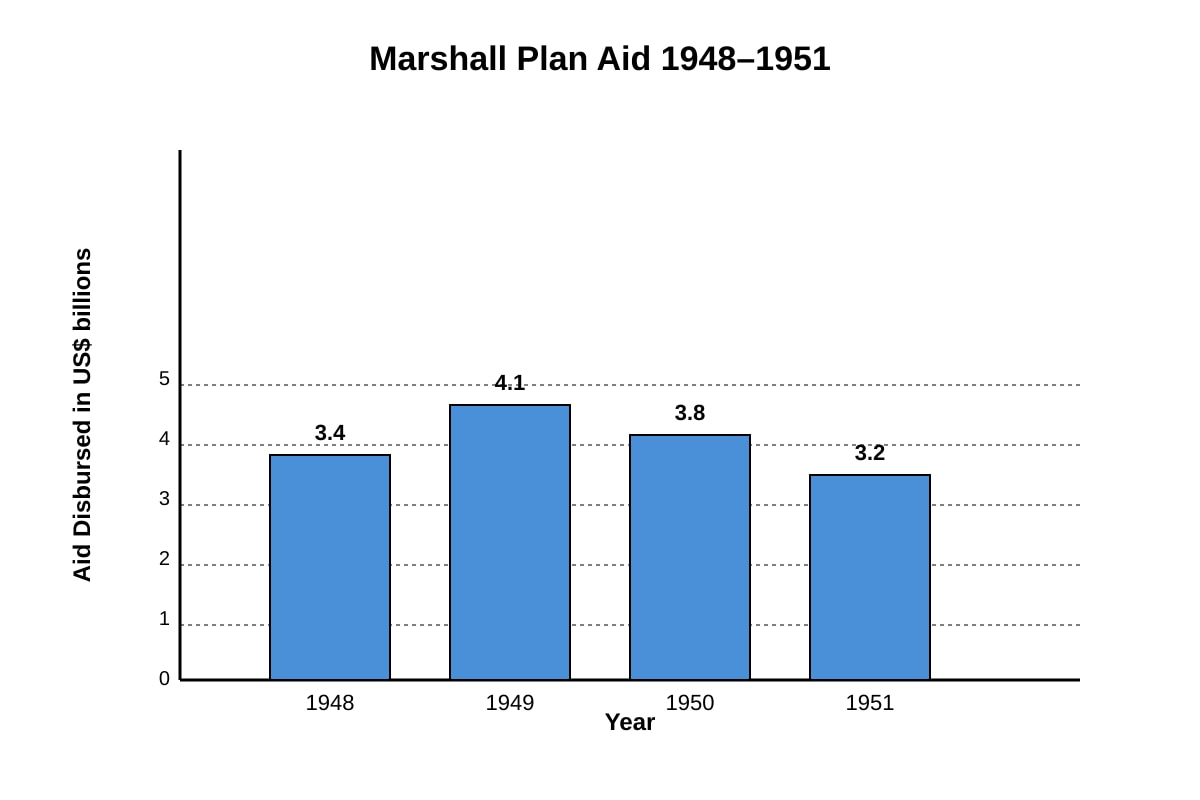
- Use of G: economic aid = security (containment) not purely ideological. [3]
- Conclusion synthesising weight of evidence. [3]
Model answer:
The sources provide moderate support for the view that ideology caused the Cold War more than security, but several sources show security concerns were equally important (3).
Source C (Kennan) supports the ideological view: he claims Soviet ideology is inherently expansionist and cannot coexist with the US, a classic ideological reading (3). Source D (Churchill) also stresses ideology—"Communist parties" and "iron curtain"—yet his fear of armed minorities shows a security anxiety about Soviet control (3). Source E (Stalin) contradicts the pure-ideology view: he argues Churchill invents a threat to keep US troops in Europe, implying the real issue was security/spheres of influence, not ideology (3). Source F (Truman) blends both: he frames the struggle as ideological (free vs subjugated) but his policy is a security response to "outside pressures" (3). Source G (Marshall aid data) shows material/economic aid—a security strategy to contain communism, not merely ideological (3).
Overall, C and D emphasise ideology; E and G emphasise security. F combines both. Therefore the sources do not fully support the claim: they show ideology and security were intertwined, with neither solely primary (3).
End of Answer Key </stage5_exam_md>
<stage5_exam_answers_md>
TuitionGoWhere Practice Paper — History H2 A-Level (Answers)
Subject: History H2
Level: A-Level
Paper: Source Based Skills Practice Paper (Version 1 of 5)
Total Marks: 40
Section A: Source Comparison and Reliability (10 marks)
Question 1 (10 marks)
(a) Compare and contrast the evidence provided by Sources A and B on the motives of the United States in post-war Europe. [5]
Teaching note: A good answer identifies both similarity (both see US as expansionist in some framing) and difference (A = defensive/economic; B = aggressive/capitalist exploitation).
Mark breakdown:
- Identification of Source A view: US sees USSR as expansionist; US policy = support free peoples; economic recovery = stability. [1]
- Identification of Source B view: US = aggressive imperialist; Truman Doctrine = capitalist domination. [1]
- Comparison point 1: Both depict US as seeking influence over Europe. [1]
- Contrast point 1: A presents US as protective/liberating; B presents US as exploitative/aggressive. [1]
- Contrast point 2: A emphasises economic recovery; B emphasises capitalist exploitation. [1]
Model answer:
Both sources present the US as seeking influence in Europe, but from opposite standpoints. Source A (Byrnes, 1946) portrays US motives as defensive and benevolent: the USSR is expanding, so the US must support free peoples and rebuild Europe economically to ensure stability. Source B (Soviet textbook, 1950) portrays US motives as aggressive and self-serving: American "imperialists" use the Truman Doctrine to dominate Europe and exploit its weakened economies. Thus A frames US action as necessary containment; B frames it as capitalist exploitation. The contrast reflects the different political contexts—A is an official US statement, B is Soviet propaganda.
(b) Assess the usefulness of Source B for understanding Soviet perceptions of US policy in 1946–1950. [5]
Teaching note: Usefulness ≠ reliability. Source B is useful because it shows official Soviet indoctrination, but limited because it is one-sided.
Mark breakdown:
- Identifies source type and origin (Soviet textbook, 1950). [1]
- Explains usefulness: reveals how Soviet citizens were taught to view US policy. [1]
- Notes limitation: propaganda, no alternative view, anti-US bias. [1]
- Concludes on balance: useful for perception, not for factual accuracy. [1]
- Uses term "usefulness vs reliability" correctly. [1]
Model answer:
Source B is useful as evidence of official Soviet perceptions because as a textbook it reflects state-approved views taught to youth (1). It shows that by 1950 the USSR portrayed the Truman Doctrine as capitalist domination, revealing how the Soviet public was conditioned to see US policy as exploitative (1). However, its usefulness is limited: it is propaganda with no mention of Western perspectives, so it cannot confirm actual US motives (1). As a textbook it tells us about intended perception, not objective fact (1). Thus it is highly useful for understanding Soviet self-representation, but must be cross-checked with other sources for accuracy (1).
Section B: Source-Based Case Study (30 marks)
Question 2 (30 marks)
(a) Compare and contrast the evidence provided by Sources C and D on the nature of the Soviet threat as perceived in the West. [10]
Teaching note: Source C = Kennan (official, analytical, internal). Source D = Churchill (public speech, dramatic). Both see threat but differ in tone and detail.
Mark breakdown (10):
- Both see Soviet expansionism as a threat. [2]
- C: threat is ideological, long-term, based on insecurity; D: threat is immediate, physical, "iron curtain". [2]
- C is private/advisory; D is public/rhetorical. [2]
- C emphasises internal Soviet psychology; D emphasises concrete geopolitical division. [2]
- Conclusion weighing similarity and difference. [2]
Model answer:
Both Sources C and D perceive the Soviet Union as a threat to Western Europe after 1945 (2). Kennan (C, 1946) describes the threat as rooted in Russian insecurity and an inability to coexist with the US; he sees Soviet pressure as "superficial" in Germany/Austria, implying a long-term ideological struggle (2). Churchill (D, 1946) depicts the threat as immediate and physical—an "iron curtain" dividing the continent, with Communist parties imposed by Moscow (2). The sources differ in form: C is a confidential telegram advising policy; D is a public speech aimed at rallying US opinion (2). Thus C offers a calculated strategic view; D offers a moral call to action. Together they show the West perceived both a deep ideological threat and a concrete geopolitical divide (2).
(b) How far do Sources C to G support the view that the Cold War was caused primarily by ideological differences rather than security concerns? [20]
Teaching note: Student must use all sources, weigh support/contradiction, consider source nature, and conclude with a judged extent.
Mark breakdown (20):
- Explicit judgment of "how far" with clear line. [3]
- Use of C: ideological (communist belief) vs security (insecurity). [3]
- Use of D: iron curtain = ideological division, but also security fear. [3]
- Use of E: Stalin rejects threat, says pretext = security concern from US troops. [3]
- Use of F: Truman links ideology (free peoples) to security (resisting subjugation). [3]
- Use of G: economic aid = security (containment) not purely ideological. [3]
- Conclusion synthesising weight of evidence. [3]
Model answer:
The sources provide moderate support for the view that ideology caused the Cold War more than security, but several sources show security concerns were equally important (3).
Source C (Kennan) supports the ideological view: he claims Soviet ideology is inherently expansionist and cannot coexist with the US, a classic ideological reading (3). Source D (Churchill) also stresses ideology—"Communist parties" and "iron curtain"—yet his fear of armed minorities shows a security anxiety about Soviet control (3). Source E (Stalin) contradicts the pure-ideology view: he argues Churchill invents a threat to keep US troops in Europe, implying the real issue was security/spheres of influence, not ideology (3). Source F (Truman) blends both: he frames the struggle as ideological (free vs subjugated) but his policy is a security response to "outside pressures" (3). Source G (Marshall aid data) shows material/economic aid—a security strategy to contain communism, not merely ideological (3).
Overall, C and D emphasise ideology; E and G emphasise security. F combines both. Therefore the sources do not fully support the claim: they show ideology and security were intertwined, with neither solely primary (3).
End of Answer Key