From Real Exams Exam Paper
A Level H2 History Practice Paper 4
Free A Level H2 History Practice Paper 4, HY3 Exam version, with questions, answers, and A Level-style practice for Singapore students.
These static practice materials are generated from the site's syllabus and paper-generation workflow, with source and model context shown so students and parents can evaluate the material before use.
Questions
TuitionGoWhere Exam Practice (AI) — History H2 A-Level
Practice Paper: Source Based Skills (Version 4 of 5)
School: TuitionGoWhere Exam Practice (AI)
Subject: History H2
Level: A-Level
Paper: Practice Paper — Source Based Skills (Version 4)
Duration: 1 hour 30 minutes
Total Marks: 80
Name: ________________________
Class: ________________________
Date: ________________________
Instructions:
- This paper contains 20 questions across three sections testing source-based skills drawn from the H2 History (9174) syllabus.
- Read all sources carefully before answering.
- Write your answers in the spaces provided.
- Marks for each question are shown in brackets.
- Section marks and total marks are shown at the end of each section.
Section A: Source Comprehension and Comparison (Questions 1–7)
Total Marks: 28
Read the following sources on Cold War developments, then answer Questions 1–7.
Source A
Extract from a 1946 newspaper editorial in the London Times discussing postwar Europe:
"The Soviet Union's refusal to permit free elections in Poland confirms the deepest fears of the West. A curtain of iron has descended across the continent, dividing liberated Europe into spheres of influence. Britain and America must hold the line."
Source B
From a 1947 Soviet broadcast transcript by Moscow Radio:
"The Marshall Plan is a wolf in sheep's clothing. It is not aid but a chain to bind the economies of Europe to Wall Street. The USSR proposes a separate programme of mutual assistance among socialist states."
Source C
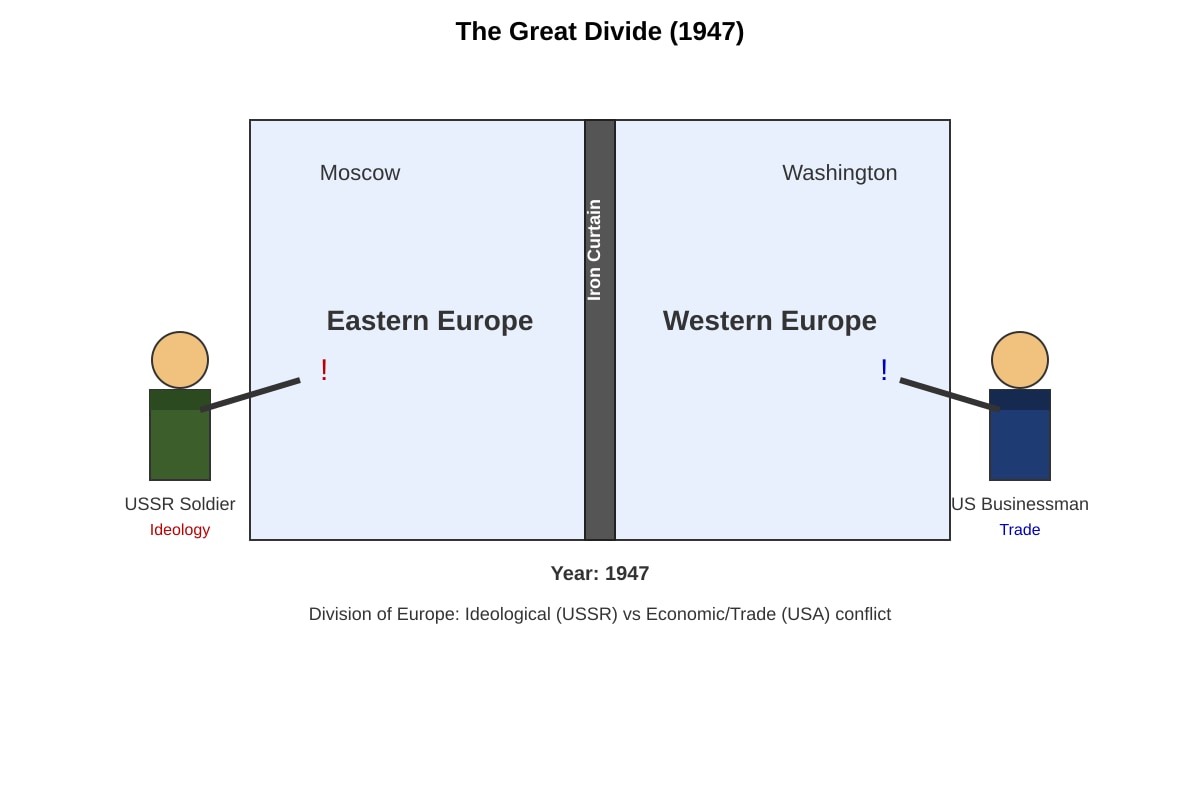
Cartoon titled "The Great Divide" published in a US magazine, 1947.
Image pending generation: cartoon for Q4.
Q1. What does Source A mean by the phrase "curtain of iron"? [2]
Q2. According to Source B, what was the Soviet perception of the Marshall Plan? [2]
Q3. Identify one explicit point of agreement between Source A and Source B. [2]
Q4. Using Source C and your own knowledge, explain how the cartoon illustrates the concept of bipolar division in postwar Europe. [4]
Q5. Compare the tone used in Source A and Source B. [4]
Q6. How useful is Source A as evidence of British public opinion in 1946? [6]
Q7. "Both sources confirm that economic aid was a tool of superpower rivalry." How far do Sources A and B support this statement? [8]
Section A Total: 28 marks
Section B: Multi-Source Evaluation (Questions 8–14)
Total Marks: 28
Read Sources D–H on the end of the Cold War, then answer Questions 8–14.
Source D
Memoir excerpt by a former USSR foreign ministry official, 1992:
"Gorbachev's 'New Thinking' dismantled the confrontational stance. Without his reforms, the wall would still stand. The initiative was ours."
Source E
Speech by US President Reagan, 1987:
"General Secretary Gorbachev, if you seek peace, tear down this wall! Our resolve forced the Soviets to the table. Strength, not concession, ended the standoff."
Source F
Data table: Defence spending as % of GNP, 1980–1989.
| Year | USA | USSR |
|---|---|---|
| 1980 | 5.2 | 15.0 |
| 1985 | 6.1 | 17.0 |
| 1989 | 5.5 | 11.0 |
Source G
Polish trade union leaflet, Solidarity, 1988:
"Workers of Gdansk will not wait for Moscow. Our strikes are the true voice of liberation. The people, not politicians, break chains."
Source H
Historian's essay, 2015:
"Post-revisionist scholarship shows the end was a confluence: Gorbachev's retreat, US pressure, and grassroots movements each played a role impossible to isolate."
Q8. What does Source F show about the trend in USSR defence spending by 1989? [2]
Q9. According to Source E, what ended the Cold War? [2]
Q10. Compare the views of Sources D and E on who ended the Cold War. [4]
Q11. How reliable is Source G as evidence of popular dissent in Poland? [6]
Q12. To what extent do Sources D, E, and H agree on the causes of the end of the Cold War? [6]
Q13. Using Sources F and H, assess the value of statistical data versus historiography for understanding the Cold War's end. [4]
Q14. How far do Sources D–H support the view that the end of the Cold War was primarily due to Gorbachev's initiatives? [4]
Section B Total: 28 marks
Section C: Applied Source Skills (Questions 15–20)
Total Marks: 24
Q15. Define the term "provenance" in source analysis. [2]
Q16. A student claims: "A primary source is always more reliable than a secondary source." Explain why this is not necessarily true. [4]
Q17. Given a speech by a Cold War leader and a later historian's account, state two questions you would ask to evaluate corroboration. [4]
Q18.
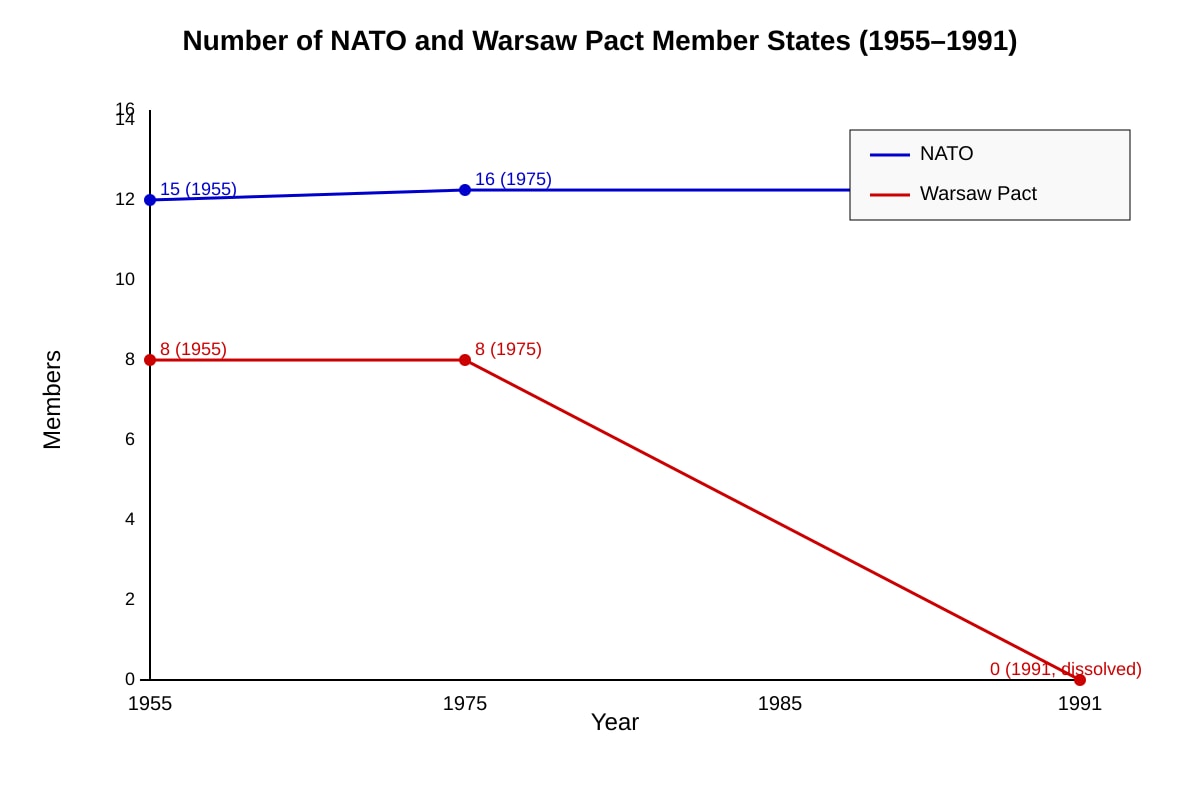
Image pending generation: graph for Q18.
Using the graph, what does the dissolution of the Warsaw Pact in 1991 indicate about the Cold War order? [4]
Q19. Identify two features of a source-based case study question in H2 History Paper 1. [4]
Q20. "Contextualisation requires placing a source in its historical setting." Describe two elements you would include when contextualising a 1962 Cuban Missile Crisis document. [6]
Section C Total: 24 marks
Paper Total: 80 marks
Answers
TuitionGoWhere Exam Practice (AI) — History H2 A-Level
Practice Paper: Source Based Skills (Version 4) — Answer Key
Total Marks: 80
Teaching notes included for each question.
Section A Answers (28 marks)
Q1. [2 marks]
Answer: Source A uses "curtain of iron" (later popularised as "Iron Curtain") to mean a rigid political and ideological barrier separating Soviet-controlled Eastern Europe from the West.
Teaching note: Define metaphor: physical barrier = division. 1 mark for identifying division, 1 mark for linking to Soviet/West spheres.
Q2. [2 marks]
Answer: The Soviet Union viewed the Marshall Plan as a deceptive tool ("wolf in sheep's clothing") to bind European economies to US capitalist control.
Teaching note: 1 mark for "not genuine aid", 1 mark for "US economic domination".
Q3. [2 marks]
Answer: Both sources agree that the superpowers were creating separate blocs/dividing Europe (A: spheres of influence; B: separate socialist programme).
Teaching note: Must show explicit point from both. 1 mark each source.
Q4. [4 marks]
Answer: The cartoon shows a wall splitting Europe; USSR soldier = Eastern bloc ideology, US businessman = Western capitalism; labels show trade and ideology as divide. This illustrates bipolarity: two rival centres of power.
Marking: 2 marks for describing visual, 2 marks for linking to bipolar concept.
Teaching note: Image must show wall, two figures, labels. Bipolar = two dominant powers post-1945.
Q5. [4 marks]
Answer: Source A tone = alarmed/warning (British perspective); Source B tone = accusatory/defensive (Soviet). Both hostile but from opposing sides.
Marking: 2 marks per source tone analysis.
Q6. [6 marks]
Answer: Useful as it reflects elite/media British view; but limited as editorial not broad public survey, possible bias against USSR.
Marking: 3 marks reliability (author, date, bias), 3 marks usefulness (addresses question, limitations).
Teaching note: Reliability ≠ usefulness. Editorial = one viewpoint.
Q7. [8 marks]
Answer: Sources A and B show rivalry but A focuses on elections (political), B on economy (Marshall). Both imply aid/influence used as tools. Partial support.
Marking: 4 marks comparison, 4 marks evaluation of "how far".
Teaching note: Do not overstate; sources imply not explicitly state "tool".
Section A Total: 28
Section B Answers (28 marks)
Q8. [2 marks]
Answer: USSR defence spending rose 1980–85 then fell sharply by 1989 (17% to 11% GNP).
Teaching note: 1 mark trend up, 1 mark down.
Q9. [2 marks]
Answer: US strength and resolve forced Soviets to negotiate (Reagan's view).
Teaching note: Attribute to Source E.
Q10. [4 marks]
Answer: D credits Gorbachev/USSR; E credits US pressure. Directly contradictory on agency.
Marking: 2 marks each source view.
Q11. [6 marks]
Answer: Reliable as contemporary worker voice; but leaflet is advocacy, may exaggerate. Useful for grassroots perspective missing in elite sources.
Marking: 3 reliability, 3 usefulness.
Q12. [6 marks]
Answer: D and E conflict (USSR vs USA); H synthesises all. Moderate agreement only on multi-causality.
Marking: 2 D, 2 E, 2 H.
Q13. [4 marks]
Answer: F shows quantitative strain; H gives interpretation. Stats show burden, historiography explains meaning.
Marking: 2 each.
Q14. [4 marks]
Answer: D strongly supports; E contradicts; G/H qualify. Limited to moderate support for "primarily".
Marking: 1 per source group, 1 synthesis.
Section B Total: 28
Section C Answers (24 marks)
Q15. [2 marks]
Answer: Provenance = source origin (author, date, purpose).
Teaching note: 1 mark definition, 1 mark elements.
Q16. [4 marks]
Answer: Primary may be biased/partial; secondary can synthesise evidence. Reliability depends on context not type.
Marking: 2 each point.
Q17. [4 marks]
Answer: (1) Do they describe same event similarly? (2) Are there conflicting interests?
Marking: 2 per question.
Q18. [4 marks]
Answer: Warsaw Pact line hits 0 in 1991 = bloc dissolved, bipolar order ended. NATO stable.
Teaching note: Use graph values: WP 1991=0.
Q19. [4 marks]
Answer: (1) Compulsory source case study on Cold War; (2) Sub-questions compare and test assertion.
Marking: 2 each.
Q20. [6 marks]
Answer: (1) Date/context of 1962 superpower tension; (2) Author (JFK/Khrushchev) position.
Marking: 3 each.
Section C Total: 24
Paper Total: 80
Free quiz and exam paper access
Enter your details to view this paper
Your access is remembered on this device.