From Real Exams Exam Paper
A Level H2 History Practice Paper 3
Free A Level H2 History Practice Paper 3, HY3 Exam version, with questions, answers, and A Level-style practice for Singapore students.
These static practice materials are generated from the site's syllabus and paper-generation workflow, with source and model context shown so students and parents can evaluate the material before use.
Questions
Free quiz and exam paper access
Enter your details to view this paper
Your access is remembered on this device.
Answers
TuitionGoWhere Exam Practice (AI) — History H2 A-Level Practice Paper Answer Key (Version 3)
Paper: Source Based Skills Practice Paper
Total Marks: 80
Level: A-Level H2
Section A: Source Comprehension (20 marks)
1. [2 marks]
Source A reveals the US was opposed to any single power dominating Europe and would resist Soviet unilateral action. It shows a defensive but firm stance seeking stability in Germany.
Teaching note: A primary speech shows policy intent. Student should identify "oppose domination" and "stable Germany" as key points.
Marking: 1 mark for opposition to Soviet dominance; 1 mark for building stable Germany / closing window for unilateral action.
2. [2 marks]
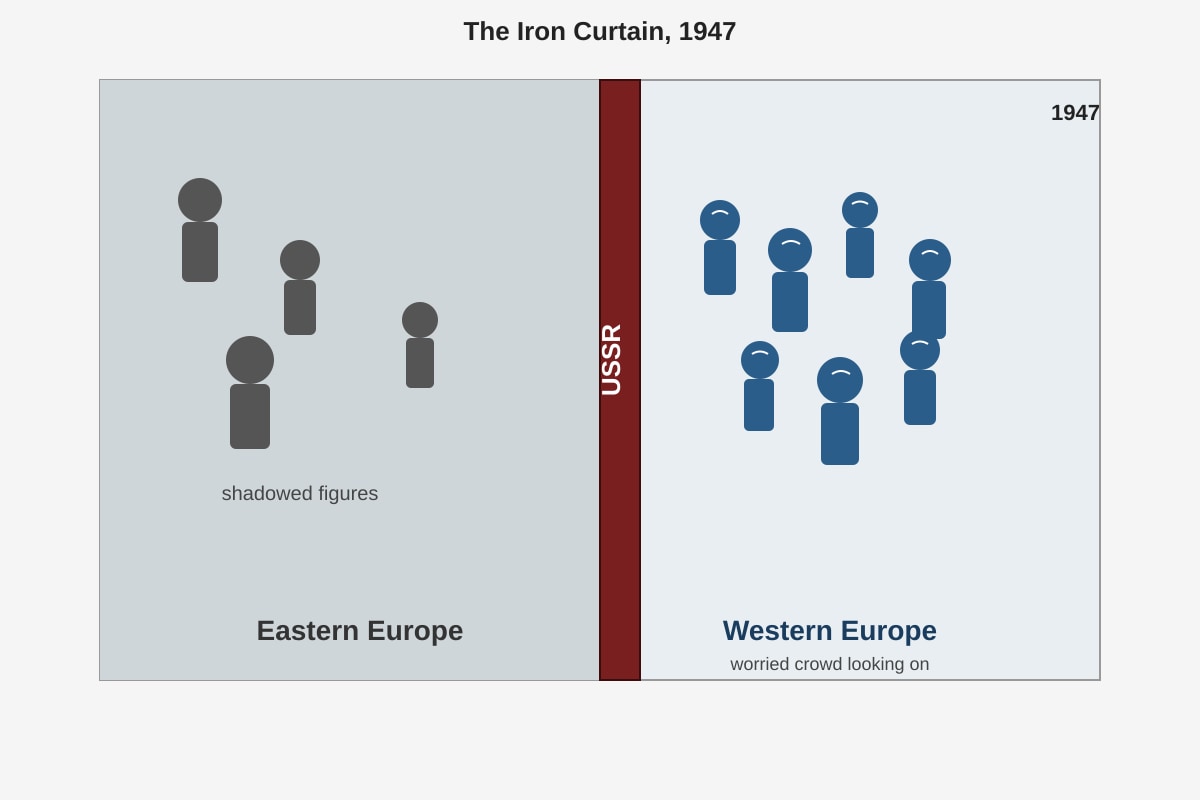
The cartoon conveys that the USSR was isolating Eastern Europe behind an "Iron Curtain", causing anxiety in the West.
Marking: 1 mark for Iron Curtain / division; 1 mark for Western worry or Soviet shadowing.
3. [2 marks]
Britain could no longer afford military presence; without US aid Greece and Turkey would fall to Soviet influence.
Marking: 1 mark for financial burden; 1 mark for risk of Soviet influence.
4. [2 marks]
Kennan proposes "containment" — strong resistance at every point, as Soviets are cautious and avoid direct war.
Marking: 1 mark for containment; 1 mark for cautious / no direct war reasoning.
5. [3 marks]
Working: France = 1.1+1.0+0.7+0.5 = 3.3; UK = 1.3+0.9+0.6+0.4 = 3.2; West Germany = 0.5+0.8+0.9+0.7 = 2.9; Italy = 0.6+0.5+0.4+0.3 = 1.8. Highest = France (3.3).
Marking: 1 mark for correct sums; 1 mark identification France; 1 mark correct total.
6. [3 marks]
Source B uses fearful imagery (curtain, shadows) suggesting threat; Source A is formal/direct but not visually alarmist, stating policy. Difference: B is emotional/public, A is official/measured.
Marking: 1 mark B emotional; 1 mark A measured; 1 mark comparison of tone.
7. [2 marks]
Metaphor suggests Soviets saw Marshall Plan as deceptive — seemingly helpful but actually exploitative/imperialist.
Marking: 1 mark deceptive; 1 mark exploitative intent.
8. [1 mark]
Source F (Pravda).
Marking: 1 mark correct.
9. [1 mark]
Soviets are cautious and will not risk direct war.
Marking: 1 mark.
10. [2 marks]
UK 1948 = 1.3, 1951 = 0.4. Decrease = (1.3–0.4)/1.3 × 100 = 69.2%.
Marking: 1 mark for values; 1 mark for correct %.
Section B: Source Comparison (30 marks)
11. [10 marks]
Both sources show Europe divided after 1945. Source A (speech) states US will oppose Soviet domination and notes closing window for unilateral action — implies division. Source B (cartoon) visualises division via Iron Curtain.
Agreement: both reflect East–West split.
Difference: A is policy-oriented, names Germany; B is public anxiety, generic.
Reliability: A official US, B media perception.
Marking descriptors: 2 marks identify agreement; 4 marks contrast content/type; 2 marks source nature; 2 marks synthesis.
12. [10 marks]
Source C sees Soviet threat as financial/strategic loss of Greece/Turkey. Source D sees ideological threat, Soviet committed to destroy rival power but cautious.
Both: threat real. Diff: C practical, D doctrinal.
Marking: 3 + 3 + 2 + 2 as above.
13. [10 marks]
E shows aid flows (positive US support). F calls it imperialist trap. Contrast: factual vs hostile interpretation.
Marking: 3 agreement on topic; 4 difference; 3 evaluation.
Section C: Assertion Evaluation (30 marks)
14. [30 marks]
Claim: Cold War caused primarily by mutual misunderstanding not deliberate policy.
Sources A, C, D show deliberate policy (containment, aid, opposition). B shows perception gap. F shows propaganda misunderstanding.
Support limited: only B/F suggest perception issues; rest show policy.
Overall: moderate/limited support.
Marking: Unpack claim (4); source-by-source (16); synthesis (10).