From Real Exams Exam Paper
A Level H2 History Practice Paper 2
Free A Level H2 History Practice Paper 2, HY3 Exam version, with questions, answers, and A Level-style practice for Singapore students.
These static practice materials are generated from the site's syllabus and paper-generation workflow, with source and model context shown so students and parents can evaluate the material before use.
Questions
TuitionGoWhere Exam Practice (AI) — History H2 A-Level Practice Paper
School: TuitionGoWhere Exam Practice (AI)
Subject: History H2
Level: A-Level
Paper: Practice Paper (Source-Based Skills) — Version 2 of 5
Duration: 1 hour 30 minutes
Total Marks: 80
Name: ________________________
Class: ________________________
Date: ________________________
Instructions
- This paper contains 20 questions across three sections testing source-based skills drawn from A-Level H2 History prelim patterns.
- Read all sources carefully before answering.
- Write your answers in the spaces provided.
- Section A: 5 short structured questions (2–4 marks each). Section B: 10 comparison and reliability questions (4–6 marks each). Section C: 5 extended source-evaluation questions (8–10 marks each).
- Total marks: 80.
Section A: Source Identification and Basic Skills (Questions 1–5)
[Total: 14 marks]
1. [2 marks] What is meant by the term "provenance" when analysing a historical source?
2. [3 marks] Identify two differences between a primary source and a secondary source. Give one example of each.
3. [3 marks] A cartoon published in a US newspaper in 1962 shows Khrushchev and Kennedy in a tug-of-war over a missile. State what type of source this is and explain one limitation of using it as evidence for the Cuban Missile Crisis.
4. [3 marks] Explain the historical skill of "corroboration" in source analysis.
5. [3 marks] Why is the date of a source important when evaluating its usefulness for a historical inquiry?
Section B: Comparison and Reliability (Questions 6–15)
[Total: 46 marks]
Source A (Extract from a 1989 speech by a Polish trade union leader):
"Workers in Gdansk have organised peacefully for free representation. The state's refusal to recognise our rights shows the fragility of the communist system. Change will come from the people."
Source B (Extract from a 1990 Soviet government bulletin):
"Recent labour disturbances in Poland were resolved through proper legal channels. The government remains stable and continues to guide socialist development in consultation with the workers."
6. [5 marks] Compare the evidence provided by Sources A and B on the situation of workers in Poland in 1989–1990.
Source C (1991 memoir of a US diplomat):
"Gorbachev's reforms opened the door, but it was the people in the streets of Leipzig and Warsaw who ended the Cold War."
Source D (1988 editorial in a Soviet party newspaper):
"Under the wise leadership of the Communist Party, the USSR is strengthening international socialism and detente. External pressures are manageable."
7. [5 marks] Compare the views in Sources C and D on the role of leadership in ending the Cold War.
8. [4 marks] How useful is Source D as evidence for understanding Soviet official attitudes before 1989?
Source E (Statistical table — NATO and Warsaw Pact troop numbers 1985):
| Year | NATO troops (000s) | Warsaw Pact troops (000s) |
|---|---|---|
| 1985 | 4,200 | 3,900 |
Source F (1986 news report): "Both alliances maintain roughly equal military forces in Europe."
9. [4 marks] How far do Sources E and F agree on military balance in Europe?
10. [5 marks] Assess the reliability of Source A as evidence for popular opposition to communism in Poland.
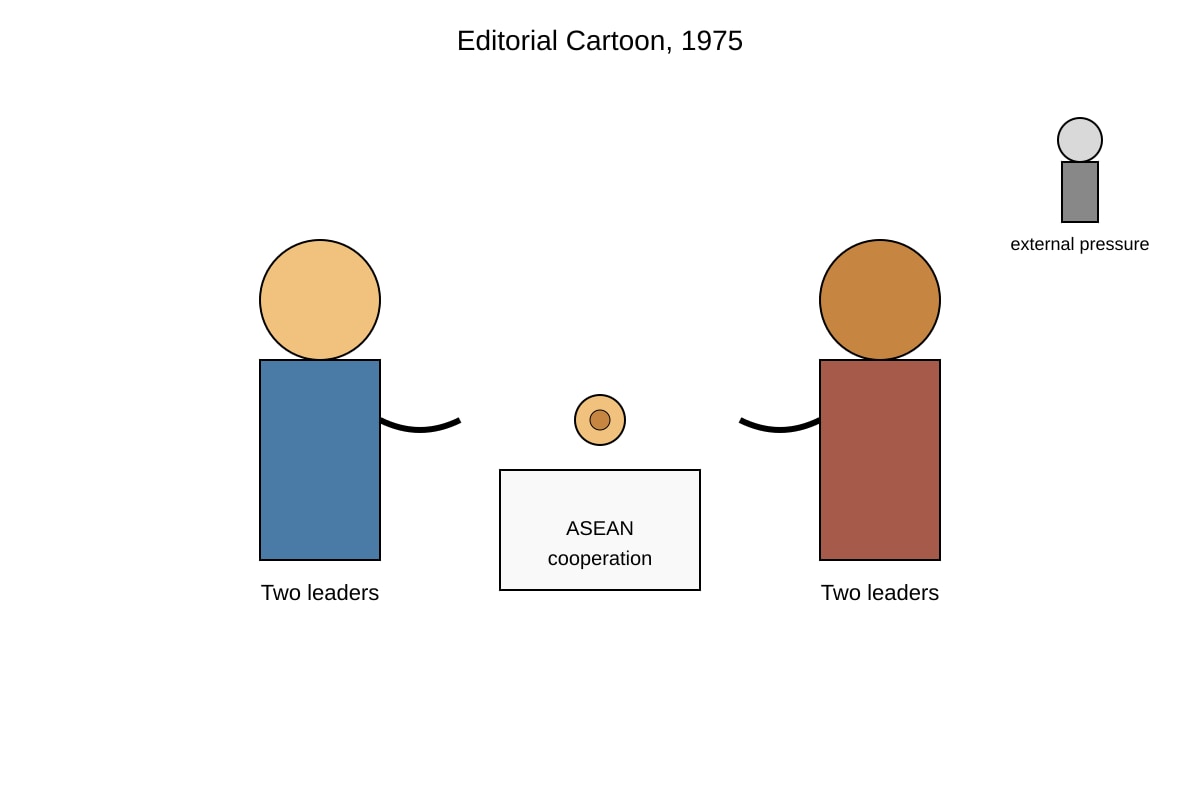
Source G (Cartoon, 1975): Two Southeast Asian leaders shaking hands over a document labelled "ASEAN cooperation", with a small figure labelled "external pressure" in the corner.
Image pending generation: cartoon for 11.
11. [4 marks] What does Source G suggest about ASEAN's approach to regional cooperation? Use the cartoon's features.
Source H (1963 Malaysian government statement): "The formation of Malaysia is a peaceful step towards stability welcomed by all communities."
Source I (1964 report by a foreign journalist): "In Borneo, armed opposition to the Malaysia plan reveals deep division among local populations."
12. [5 marks] Compare Sources H and I on the acceptance of the Malaysia plan.
13. [5 marks] How reliable is Source I for understanding local responses to Malaysia's formation?
Source J (1980 World Bank data): "GDP growth in ASEAN averaged 6% annually 1970–1980."
Source K (1979 speech by an ASEAN finance minister): "Our open economic policies have driven rapid regional growth."
14. [4 marks] Compare Sources J and K on the cause of ASEAN economic growth.
15. [5 marks] Assess the usefulness of Source J for a study of Southeast Asian economies in the 1970s.
Section C: Extended Evaluation (Questions 16–20)
[Total: 20 marks]
16. [4 marks] "Sources A, B and C show that the end of communist rule in Poland was caused mainly by foreign pressure." How far do the sources support this assertion?
17. [4 marks] Using Sources D and F, how far do they support the view that the Cold War was stable until the late 1980s?
18. [4 marks] How far do Sources G, H and I support the claim that regional cooperation in Southeast Asia faced external and internal challenges?
19. [4 marks] Sources J and K support the assertion that government policy was the key to ASEAN growth. How far is this valid?
20. [4 marks] Using all sources A–K, how far do they support the view that popular movements were more important than leaders in Cold War ending?
End of Paper
Answers
TuitionGoWhere Exam Practice (AI) — History H2 A-Level Practice Paper (Version 2) Answer Key
Total Marks: 80
Section A: 14 | Section B: 46 | Section C: 20
Section A Answers (14 marks)
Q1 [2 marks]
Provenance = the origin of a source: author, date, place, and purpose of creation.
Teaching note: Students must show they know it is not just "who wrote it" but the full background that affects bias.
Mark: 1 for author/date, 1 for purpose/context.
Q2 [3 marks]
Primary: produced during the event (e.g., 1945 Yalta conference minutes). Secondary: produced later analysing events (e.g., a 2000 history book). Differences: time of creation, distance from event, intent.
Mark: 1 diff + example, 1 diff + example, 1 clarity.
Q3 [3 marks]
Type: visual/cartoon source. Limitation: reflects cartoonist's bias, not factual troop movements; useful for attitude not data.
Mark: 1 type, 2 for limitation explained.
Q4 [3 marks]
Corroboration = comparing sources to see where they agree, strengthening evidence.
Mark: 1 definition, 2 application.
Q5 [3 marks]
Date shows proximity to event, possible censorship, or hindsight. A 1962 source lacks knowledge of 1991 outcome.
Mark: 1 per valid point.
Section B Answers (46 marks)
Q6 [5 marks]
Both mention Polish workers (agree on subject). Source A says state refuses rights, system fragile, change from people. Source B says resolved legally, stable, guided by party. They disagree on stability and who drives change.
Mark: 1 compare subject, 2 A view, 2 B view + contrast.
Q7 [5 marks]
Source C: people + Gorbachev opened door, people ended CW. Source D: party leadership wise, stable socialism. Contrast: C gives people role, D credits leadership.
Mark: 2 each source, 1 synthesis.
Q8 [4 marks]
Useful: shows official Soviet line pre-1989. Limited: propaganda, no alternative view.
Mark: 2 useful, 2 limit.
Q9 [4 marks]
E: NATO 4200 vs WP 3900 (close). F: roughly equal. They agree on approximate parity.
Mark: 2 E, 2 F/agreement.
Q10 [5 marks]
Reliable: author involved, contemporary. Unreliable: biased as union leader. Useful for popular view.
Mark: 2 rel, 3 usefulness/bias.
Q11 [4 marks]
Cartoon shows leaders cooperating via document, external pressure minor. Suggests ASEAN saw cooperation as internal, external as background.
Mark: 2 features, 2 interpretation.
Q12 [5 marks]
H: peaceful, welcomed. I: armed opposition, division. Clear disagreement on acceptance.
Mark: 2 H, 2 I, 1 contrast.
Q13 [5 marks]
Reliable: observer, immediate. Limited: one region, foreign view. Useful for local dissent.
Mark: 2 rel, 3 limit/use.
Q14 [4 marks]
J: data shows growth. K: attributes to policy. J silent on cause, K asserts cause.
Mark: 2 J, 2 K.
Q15 [5 marks]
Useful: quantifies growth. Limited: aggregate, hides inequality.
Mark: 2 use, 3 limit.
Section C Answers (20 marks)
Q16 [4 marks]
A and C mention people; B says stable; no foreign pressure claim. Sources weakly support.
Mark: 1 per source eval, 1 conclusion.
Q17 [4 marks]
D: stable socialism. F: equal forces. Support stability view moderately; no late-80s change shown.
Mark: 2 D, 2 F.
Q18 [4 marks]
G: external pressure small. H: internal welcome. I: internal opposition. Supports mixed challenges.
Mark: 1 each source, 1 synth.
Q19 [4 marks]
K credits policy; J neutral. Partly valid.
Mark: 2 K, 2 J/caveat.
Q20 [4 marks]
A,C pro-people; B,D pro-leader. Mixed; not fully supported.
Mark: 1 each group, 1 conclusion.
Free quiz and exam paper access
Enter your details to view this paper
Your access is remembered on this device.