AI Generated Quiz
A Level History H1 Source Based Skills Quiz
Free A Level History H1 Source Based Skills quiz, HY3 AI version, with questions, answers, and A Level-style practice for Singapore students.
These static practice materials are generated from the site's syllabus and paper-generation workflow, with source and model context shown so students and parents can evaluate the material before use.
Questions
Free quiz and exam paper access
Enter your details to view this paper
Your access is remembered on this device.
Answers
A-Level History H1 Quiz - Source Based Skills (Answer Key)
Topic: Source Based Skills (Theme I)
Total Marks: 40
Section A: Source Comprehension
Q1. [2 marks]
Answer: 1947.
Teaching note: Source A states "By 1947, the Soviet Union had installed communist-led governments across Poland, Hungary, and Romania." Direct retrieval from text. Common mistake: writing 1950 (date of memorandum, not installation).
Q2. [2 marks]
Answer: Through Soviet pressure ensuring one-party control / not freely chosen.
Teaching note: The source says "Soviet pressure ensured one-party control" and "had not freely chosen such rule." Mark for identifying pressure and lack of free choice.
Q3. [3 marks]
Answer: Expansionist. Phrase: "not merely defensive but a deliberate expansion of Soviet power."
Marking: 1 mark for expansionist, 2 marks for quoting/explaining phrase. Teaching note: Shows author's interpretation; key for AO3 evaluation.
Q4. [2 marks]
Answer: Provenance = origin of a source (author, date, purpose, context).
Teaching note: Define clearly; in H1, provenance helps judge reliability. Concise but must include origin elements.
Q5. [3 marks]
Answer: Date situates source in chronology; later sources may reflect hindsight; contemporary sources show immediate perception.
Marking: 1 mark date/chronicology, 2 marks explanation of impact on evidence. Teaching note: Cold War sources from 1946 vs 1990 differ in perspective.
Section B: Provenance and Reliability
Q6. [2 marks]
Answer: Winston Churchill, 5 March 1946.
Teaching note: From Source B header. Easy recall; do not confuse with 1947 Truman Doctrine.
Q7. [3 marks]
Answer: Churchill was opposition leader/anti-Soviet; speech in USA; may exaggerate Soviet threat to rally West.
Marking: 1 mark identity/biases, 2 marks reasoning. Teaching note: Provenance shows potential Western bias.
Q8. [2 marks]
Answer: Corroboration = comparing sources to see if they agree, strengthening evidence.
Teaching note: Key concept in evidence evaluation.
Q9. [3 marks]
Answer: Soviet textbook from 1988 likely defensive narrative; state-authored so may omit blame on USSR; limits reliability for independent cause.
Marking: 1 mark provenance (Soviet/state), 2 marks impact on reliability. Teaching note: Post-Cold War sources still shaped by official view.
Q10. [3 marks]
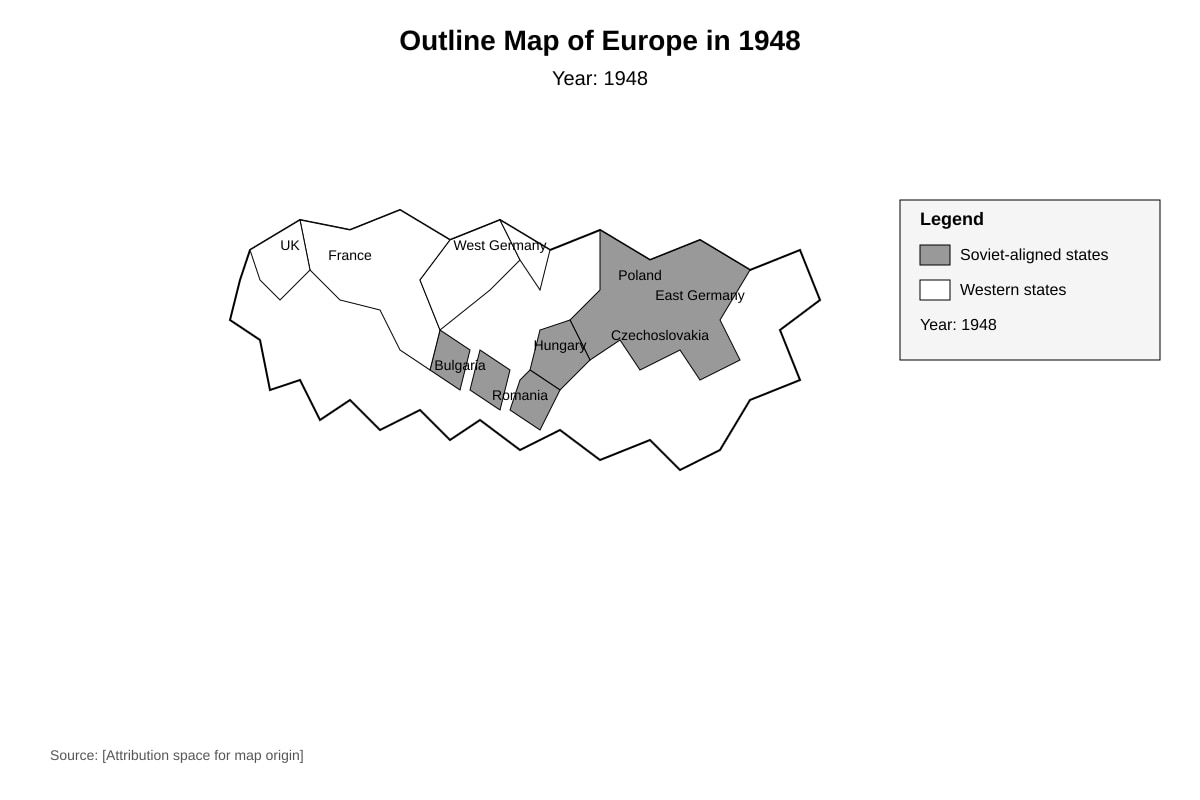
Answer: Check creator, date, purpose, accuracy of shading, legend, and whether it reflects opinion or fact.
Marking: 2 marks for listing checks, 1 mark link to map placeholder (Q10-fig1 must show attribution space). Teaching note: Image placeholder requires source label; student must not assume map is neutral.
Section C: Comparison of Sources
Q11. [3 marks]
Answer: Both see USSR as threatening to free West (C: "pressure on free institutions"; D: "resisting subjugation by outside pressures").
Marking: 1 mark similarity, 2 marks use of both sources. Teaching note: Comparison needs both texts.
Q12. [3 marks]
Answer: C suggests containment (flexible pressure); D proposes active support to free peoples (policy of support).
Marking: 1 mark difference, 2 marks evidence from each. Teaching note: C is diplomatic cable, D is public policy.
Q13. [2 marks]
Answer: Understanding perspectives of people in past without imposing present values.
Teaching note: From syllabus concepts.
Q14. [3 marks]
Answer: Both critical of Soviet influence; A formal/official, B rhetorical/public.
Marking: 1 mark compare tone, 2 marks reference both. Teaching note: Tone aids source nature judgment.
Q15. [3 marks]
Answer: Comparison shows convergence/divergence, reduces single-source bias, builds stronger argument.
Marking: 3 marks for reasoned explanation. Teaching note: AO3 requires cross-referencing.
Section D: Testing an Assertion
Q16. [2 marks]
Answer: Source A says Soviet installed governments by pressure, "deliberate expansion."
Teaching note: Direct support from A.
Q17. [3 marks]
Answer: Churchill describes "iron curtain" descent by USSR, implying Soviet action dividing Europe. Supports expansionism.
Marking: 1 mark reference, 2 marks explanation. Teaching note: B is early claim of Soviet bloc formation.
Q18. [3 marks]
Answer: Kennan says USSR "does not take unnecessary risks" and is flexible; suggests not outright expansionist but reactive; challenges assertion.
Marking: 1 mark quote, 2 marks challenge logic. Teaching note: Post-revisionist view.
Q19. [3 marks]
Answer: Truman's support to "free peoples" against "outside pressures" can be seen as US intervention provoking USSR; revisionists blame US.
Marking: 1 mark policy, 2 marks revisionist use. Teaching note: Shows other side of cause.
Q20. [5 marks]
Answer: Balanced judgement:
- For expansionism: A (1950 Brit memo, official) and B (1946 Churchill, political) show Soviet imposition.
- For US provocation: C (1946 Kennan, diplomat) shows USSR cautious; D (1947 Truman, policy) shows US active role.
- Provenance: Western sources bias to Soviet blame; US source shows own initiative. Conclusion: both contributed; assertion oversimplifies.
Marking: 2 marks two sources per side, 2 marks provenance note, 1 mark conclusion. Teaching note: Holistic L3–L4 standard; must use all sources.