AI Generated Quiz
A Level History H1 Issue Analysis Quiz
Free A Level History H1 Issue Analysis quiz, HY3 AI version, with questions, answers, and A Level-style practice for Singapore students.
These static practice materials are generated from the site's syllabus and paper-generation workflow, with source and model context shown so students and parents can evaluate the material before use.
Questions
Free quiz and exam paper access
Enter your details to view this paper
Your access is remembered on this device.
Answers
A-Level History H1 Quiz - Issue Analysis: Answer Key
Total Marks: 40
Topic: Issue Analysis (syllabus-first; no past-paper evidence used)
Section A Answers (Q1–8)
Q1 [2 marks]
Answer: Cause and effect is the recognition of multiple short- and long-term causes and consequences of an event, and establishing a hierarchy among them.
Teaching note: In issue analysis, students must not just list causes but rank them (e.g. ideological difference as long-term, Berlin Blockade as short-term trigger).
Q2 [2 marks]
Answer: Because no single account of the past is complete; different authors reflect their focus and viewpoint.
Teaching note: "Accounts" concept means we cross-check Churchill's speech vs Soviet records to avoid bias.
Q3 [2 marks]
Answer: Understanding the perspectives of people in the past without imposing present-day values.
Teaching note: E.g. Soviets saw Eastern Europe as security buffer, not just domination.
Q4 [2 marks]
Answer: Any one: Yalta/Potsdam disagreements, Iron Curtain speech, Long Telegram, Truman Doctrine, Marshall Plan, Berlin Blockade, NATO.
Teaching note: Mark any specific manifestation 1945–49.
Q5 [2 marks]
Answer: It was a response to perceived Soviet expansion (cause of tension) and also a public US policy that intensified rivalry (manifestation).
Teaching note: Shows dual nature in issue analysis.
Q6 [2 marks]
Answer: Second and Third Indochina Wars must not be compared.
Teaching note: Also Korea/Cuba and China/Japan bans exist, but Q asks Theme III.
Q7 [2 marks]
Answer: A framework to situate events (e.g. Reagan's SDI before Gorbachev's changes) in proper order.
Teaching note: Prevents confusion of timing in multi-cause issues.
Q8 [2 marks]
Answer: Security interests, ideology, Sino-American relations, or border conflict 1969.
Teaching note: Any one factor from syllabus.
Section B Answers (Q9–14)
Q9 [2 marks]
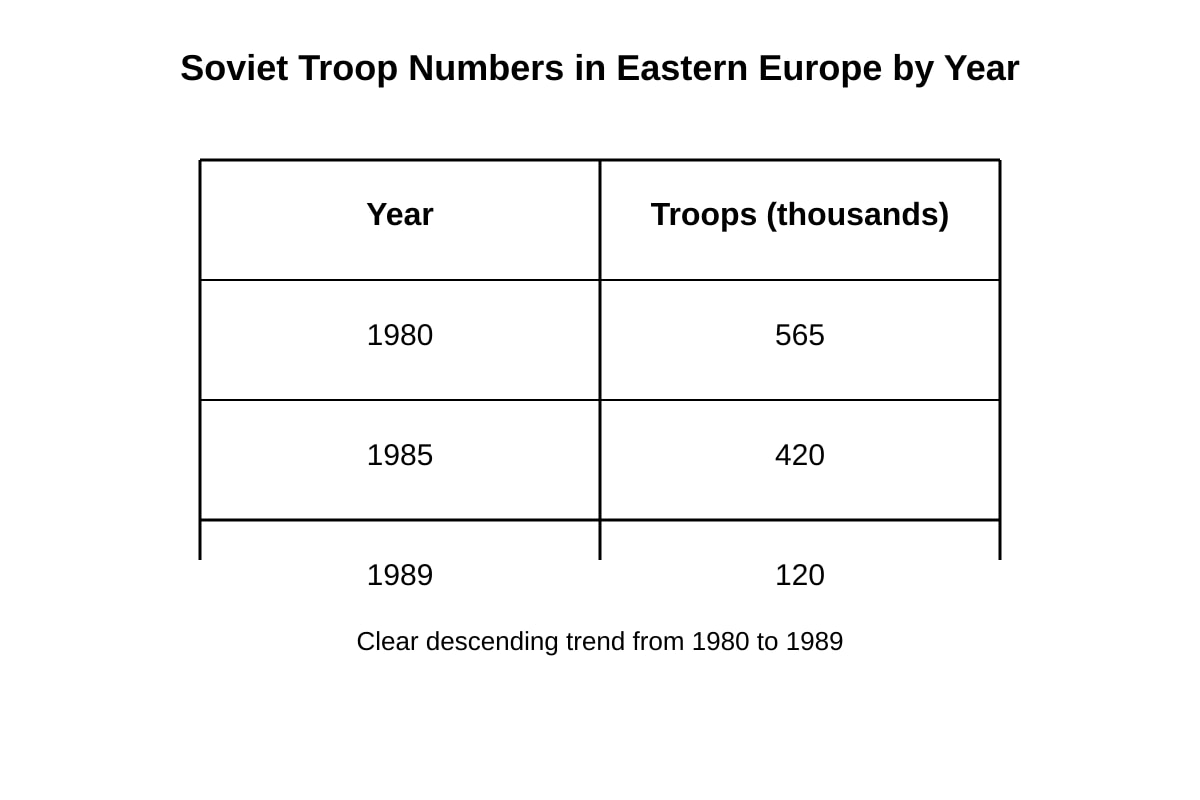
Answer: (565,000 – 120,000) / 565,000 × 100 = 78.76% decrease ≈ 79%.
Working: 445k drop / 565k = 0.7876.
Teaching note: Use Source C table values.
Q10 [3 marks]
Answer: Source A sees control as abandoned peacefully via Sinatra Doctrine; Source B insists on maintaining control for security. Difference: A = relaxation, B = rigidity. Both discuss ally control.
Marking: 1 for A view, 1 for B view, 1 for contrast.
Q11 [3 marks]
Answer: Source C shows troops fell from 565k (1980) to 120k (1989), proving reduced Soviet presence matching A's claim of reversed control.
Marking: 1 stat + 1 link to A + 1 explanation.
Q12 [2 marks]
Answer: Speech, 1985. Limitation: pre-dates Gorbachev's later shift; may not reflect end-stage policy.
Teaching note: Provenance = type+date; limitation = outdated perspective.
Q13 [3 marks]
Answer: Change: troop numbers dropped (Source C). Continuity: earlier stance (Source B) shows long-term aim of control.
Marking: 1 change, 1 continuity, 1 use of sources.
Q14 [3 marks]
Answer: Value: contemporary post-1991 view giving insider rationale (New Thinking). Limit: hindsight, possibly Western-friendly.
Marking: 1 provenance, 1 content, 1 critical note.
Section C Answers (Q15–20)
Q15 [1 mark] Traditional, revisionist, post-revisionist, or post-Cold War.
Q16 [1 mark] "People Power" debate.
Q17 [2 marks] Traditional = USSR blame; Revisionist = USA blame.
Q18 [1 mark] AO3.
Q19 [2 marks] Syllabus forbids Korea/Cuba comparison in Theme I; essays only on Themes II/III; source study only for Theme I.
Q20 [1 mark] Opened US-China rapprochement, shifting bipolar balance.