AI Generated Quiz
A Level History H1 Issue Analysis Quiz
Free A Level History H1 Issue Analysis quiz, AI version, with questions, answers, and A Level-style practice for Singapore students.
These static practice materials are generated from the site's syllabus and paper-generation workflow, with source and model context shown so students and parents can evaluate the material before use.
Questions
Free quiz and exam paper access
Enter your details to view this paper
Your access is remembered on this device.
Answers
A-Level History H1 Quiz - Issue Analysis: Answer Key
Section A: Identifying and Explaining Historical Issues
1. Define what is meant by a "historical issue" in the context of A-Level History. Explain how the study of historical issues differs from simply recounting a sequence of events. (4 marks)
Answer: A "historical issue" is a question, problem, or point of disagreement about the past that is debated by historians. It is not simply a fact (e.g., "the Berlin Blockade began in 1948") but a point of contention (e.g., "who was primarily responsible for the Berlin Blockade?"). Studying historical issues differs from recounting a sequence of events because it requires analysis, evaluation of evidence, and engagement with different interpretations. While narration describes what happened, issue analysis explores why it happened, how it is understood, and why historians disagree.
Marking Scheme:
- 1 mark for a clear definition of "historical issue" (a debated question/problem).
- 1 mark for stating it is not a simple fact but a point of contention.
- 1 mark for explaining that issue analysis requires evaluation/interpretation.
- 1 mark for comparing it to simple narration (e.g., narration tells, analysis debates).
2. The origins of the Cold War are a major historical issue. Briefly explain the core disagreement between two of the following schools of historical interpretation on this issue: (6 marks)
- (a) Traditionalist
- (b) Revisionist
- (c) Post-Revisionist
Answer:
- (a) Traditionalist view: The Traditionalist (or Orthodox) interpretation, popular in the 1950s and 1960s, places primary responsibility for the Cold War on the Soviet Union. It argues that Soviet expansionism, ideological aggression, and Stalin's violation of wartime agreements forced the USA into a necessary defensive posture of containment. Key evidence cited includes the Sovietisation of Eastern Europe, the Berlin Blockade, and the rejection of the Marshall Plan.
- (b) Revisionist view: The Revisionist interpretation, which gained prominence during the Vietnam War era, shifts responsibility toward the United States. It argues that American economic expansionism (the "open door" policy) and a desire to secure global markets for capitalism, combined with Truman's aggressive anti-Soviet stance, provoked the USSR. Revisionists, such as William Appleman Williams, argue that the Soviet actions were largely defensive.
- (c) Post-Revisionist view: The Post-Revisionist interpretation, emerging in the 1970s and 1980s, attempts a more balanced approach. Historians like John Lewis Gaddis argue that neither superpower was solely to blame. Instead, they focus on structural factors in the international system, mutual misperceptions, and the breakdown of communication. The Cold War is seen as an inevitable clash of superpowers arising from a power vacuum after WWII, rather than a deliberate act of aggression by one side.
Marking Scheme (choose two):
- 1 mark for naming and positioning the school in time.
- 1 mark for correctly stating its core argument on responsibility (who is blamed).
- 1 mark for a specific piece of evidence or key historian that supports the interpretation.
- Repeat for the second school.
3. Identify and explain one specific historical issue related to the end of the Cold War. Your answer should clearly state the issue and outline why it is considered a matter of historical debate. (4 marks)
Answer: Issue: "Who was primarily responsible for ending the Cold War?"
Explanation: This is a matter of debate because different historians emphasise different factors and actors. The Western Triumphalist view argues that the USA's renewed confrontation (Reagan's military build-up, the Strategic Defense Initiative) forced the USSR to its knees, effectively "winning" the Cold War. The Soviet Initiative view argues that Gorbachev's "New Thinking" and internal reforms (glasnost, perestroika) were the primary drivers, with Gorbachev choosing to end confrontation, not being forced into it. The "People Power" debate argues that social movements and revolutions in Eastern Europe (e.g., Poland's Solidarity, the fall of the Berlin Wall) were the main catalyst, putting pressure on both superpowers. Because the evidence supports multiple, often conflicting, narratives, the issue remains a key area of historical inquiry.
Marking Scheme:
- 1 mark for stating a clear historical issue (e.g., "causes of the fall of the USSR").
- 1 mark for explaining why it is debated (multiple interpretations).
- 1-2 marks for outlining at least one specific interpretation with a reason for debate.
4. The relationship between China and the USA during the Cold War is often described in terms of "confrontation and rapprochement." State the core historical issue that this description raises for historians studying Sino-American relations. (3 marks)
Answer: The core historical issue is: Why did Sino-American relations change from intense hostility (1949-1970s) to rapprochement (1970s onwards)? The issue is explaining the reversal. The simple description of the pattern does not explain the cause of the change. Historians debate the relative importance of factors such as the Sino-Soviet split, the US desire to find an ally against the USSR (Nixon's strategy), the end of the Vietnam War, and ideological moderation on both sides. The "confrontation and rapprochement" frame leaves open the central historical question: what caused the shift?
Marking Scheme:
- 1 mark for identifying the issue (the cause of the shift).
- 1 mark for explaining why it is a problem (it is not a simple description).
- 1 mark for hinting at the key factors in the debate (e.g., Sino-Soviet split).
5. In studying the Vietnam War (1955-1975), historians debate whether it was primarily a Cold War conflict, a nationalist war, or a civil war. Explain why this is considered a significant historical issue. (3 marks)
Answer: This is significant because the framing of the conflict determines the historical analysis. If it was a Cold War conflict, the focus is on the superpowers (USA containment vs. USSR and China backing Ho Chi Minh). If it was a nationalist war, the focus is on Vietnam's struggle for independence from foreign intervention (France, then USA). If it was a civil war, the focus is on internal divisions between North and South Vietnam. The historical issue is not just about labels; it is about what caused the war, who the primary agents were, and what the war's ultimate meaning was. The debate shapes how we assign responsibility for the destruction and legacy of the war.
Marking Scheme:
- 1 mark for stating the significance (different labels lead to different histories).
- 1 mark for explaining at least one consequence of the label.
- 1 mark for connecting it to a deeper historical analysis (e.g., causes, agents, meaning).
Section B: Analysing Source-Based Issues
6. Compare the perspectives of Source A and Source B on the issue of the Truman Doctrine. Identify one similarity and two differences in their views of the policy. (10 marks)
Answer: Similarity (2 marks): Both sources recognise that the Truman Doctrine is a significant and powerful policy that will have a major international impact. Source A argues for its necessity, while Source B criticises its imposition, but neither downplays its importance.
Differences (4 marks each):
- Nature of the Policy: Source A (Truman) frames the Doctrine as a selfless, defensive policy aimed at "support[ing] free peoples" and providing "economic and financial aid" for stability. Source B (Vyshinsky) frames it as an aggressive, expansionist policy of "blatant interference" designed to "impose its will" and create "military bases."
- Motivation: Source A implies the motivation is principled and humanitarian (helping free peoples). Source B states the motivation is strategic and imperialistic (splitting the world into hostile camps for US power).
- Consequence: Source A predicts a consequence of orderly political processes. Source B predicts a consequence of global division and conflict.
Marking Scheme (Level-based for 10 marks):
- L3 (8-10 marks): Identifies one clear similarity and two clear differences. Uses specific quotes/references from both sources to support each point. Explains the reasons behind each perspective.
- L2 (4-7 marks): Identifies similarities/differences but may not use both sources equally. Some reference to content but may be paraphrasing rather than explaining.
- L1 (1-3 marks): Describes each source separately without comparison. Simple statements of difference with no reference to context.
7. Assess the value of Source A as evidence for a historian studying the issue of American motivations in the early Cold War. In your answer, consider the content, authorship, and context of the source. (8 marks)
Answer: Value:
- Content: The source provides a direct, first-hand articulation of the stated US policy. It explicitly frames the US as a defender of "free peoples" against "subjugation." This is valuable as evidence of the public rhetoric and official justification for the policy.
- Authorship: As a primary source from President Truman, it is valuable as the voice of the highest US authority. It shows what the US executive wanted the world (and the US Congress) to believe.
- Context: The source was delivered in a specific context (March 1947) when the US was seeking Congressional funding to aid Greece and Turkey against Soviet pressure. This context makes the speech a strategic act as well as a statement of policy.
Limitations:
- The source is propaganda. It presents a one-sided, self-justifying view. It does not reveal underlying American economic or geopolitical motives (e.g., securing oil routes, expanding US influence).
- The source is a public statement. Private documents (e.g., Kennan's Long Telegram, NSC-68) may offer a different, more strategic rationale.
- As a single source, it cannot be corroborated without other evidence.
Marking Scheme (8 marks):
- 8 marks: Full, balanced assessment. Identifies value (content, authorship, context) AND limitations. Uses specific terms (e.g., provenance, purpose).
- 4-7 marks: Good analysis of value but weaker on limitations. Or identifies limitations without contextualising why the source is still valuable.
- 1-3 marks: Simple description of the source. No evaluation of its usefulness as evidence.
8. Using Source C, explain a key historical issue faced by newly independent nations in Asia and Africa during the Cold War. How does Zhou Enlai’s speech frame this issue? (5 marks)
Answer: Key Historical Issue: The issue of neutrality vs. alignment. Newly independent nations wanted to maintain their hard-won sovereignty and avoid being drawn into a new form of subordination as pawns of the superpowers ("to become instruments of either the United States or the Soviet Union").
How Zhou frames the issue (in Source C):
- He presents the issue as a choice between becoming a "pawn" or remaining "independent."
- He connects it to the previous history of colonialism ("suffered from colonialism for centuries").
- He offers a solution: "Peaceful coexistence" and refusing "the temptation to become instruments."
- He elevates the struggle for "national independence" as the primary goal, suggesting that Cold War loyalties should be secondary.
Marking Scheme:
- 1-2 marks for identifying the issue (e.g., non-alignment, neutrality vs. alignment).
- 2-3 marks for sourcing the answer directly from Zhou's speech, using quotes or explicit references.
9. Explain how a historian could use Source B to challenge the interpretation of the Truman Doctrine presented in Source A. (4 marks)
Answer: A historian could use Source B as a contradictory account to challenge the benevolent image presented in Source A.
- Challenge to Motivation: Source A claims the US was acting to "support free peoples." Source B directly challenges this by claiming the US was acting for its own power ("impose its will").
- Challenge to Means: Source A claims the aid is "economic and financial." Source B claims it is a cover for "military bases."
- Providing an Alternative Frame: The historian could use Source B not just as evidence of Soviet propaganda, but to argue that the US policy was genuinely perceived by others as aggressive, and that this perception itself was a key factor in escalating the Cold War. The historian does not have to agree with Vyshinsky, but can use his speech as evidence of how the policy was received in the international arena.
Marking Scheme:
- 1-2 marks for identifying a point of contradiction.
- 1-2 marks for explaining how the source is used (e.g., as evidence of perception).
10. Identify a potential limitation of using all three sources together to understand the global impact of the Cold War. What perspective is missing from this set of sources? (3 marks)
Answer: Limitation: All three sources are from the perspective of elite political leaders (US President, Soviet Foreign Minister, Chinese Premier). They represent the views of the powerful, not the people who experienced the Cold War.
Missing Perspective: The human/social perspective is missing. There are no sources from ordinary citizens, soldiers, refugees, or civilians caught in the superpower struggle. For example, the perspective of a Vietnamese farmer, a Korean family, or a German living in Berlin is not represented. This set of sources cannot tell us about the human cost, social disruption, or grassroots reactions to the Cold War.
Marking Scheme:
- 1 mark for identifying the "elite" bias.
- 1 mark for naming a missing perspective (e.g., local/grassroots).
- 1 mark for giving a specific example of that missing perspective.
Section C: Evaluating and Arguing on Historical Issues
11. "The issue of who was responsible for the emergence of the Cold War is the central historical debate for Theme I." To what extent do you agree with this statement? Support your answer with reference to specific historical interpretations. (5 marks)
Answer: Agree (to some extent): The responsibility debate is arguably the foundational issue. It organises how historians approach the entire Cold War narrative. The Traditionalist (blames USSR), Revisionist (blames USA), and Post-Revisionist (blames mutual actions) schools all start with this question. If a historian believes the USSR caused it, they will interpret later events (e.g., Vietnam) through a containment lens.
Disagree: Even if one agrees it is central, it is not the only central issue. Other issues are equally significant:
- The issue of ideology vs. security: Was the Cold War a clash of ideas or a security dilemma? Post-Revisionists argue this is more complex than simple blame.
- The issue of inevitability: Was the Cold War inevitable given the post-WWII power vacuum, or could it have been avoided? This is a different question from "who was to blame."
Conclusion: The statement is largely true for the early period, but the issue of "responsibility" is connected to other, deeper questions. A good historian would examine responsibility as part of a wider analysis of ideology, security, and structures.
Marking Scheme:
- 1-2 marks for agreeing with reasons.
- 1-2 marks for challenging with alternative issues.
- 1 mark for a balanced conclusion.
12. Discuss the key factors that make the Cuban Missile Crisis a significant issue for historical analysis. Why does it continue to generate debate among historians? (5 marks)
Answer: Significance Factors:
- Existential Threat: It was the closest the world came to a direct nuclear war. It dramatically highlights the dangers of the superpower confrontation.
- Decision-Making: It provides a rich case study for analysing high-stakes decision-making (Kennedy's EXCOMM, Khrushchev's gamble). Historians debate whether leaders were "stepping back from the brink" or were close to losing control.
- Multiple Actors: It involved more than just USA-USSR. It included Cuba, the UN, and the Organisation of American States.
Reason for Continued Debate:
- The full extent of secret negotiations, back-channel communications (e.g., the "back channel" to Khrushchev), and the role of non-crisis factors (e.g., Jupiter missiles in Turkey) continues to be uncovered.
- Historians debate the causes of the resolution. Was it Kennedy's "quarantine" strategy, Khrushchev's desire for a deal, or simple luck? Different interpretations continue to emerge.
- It raises counterfactual questions ("What if Kennedy had bombed the missile sites?") that are inherently debatable.
Marking Scheme:
- 1-2 marks for identifying significance factors (nuclear danger, decision-making).
- 1-2 marks for reasons for ongoing debate (new evidence, conflicting interpretations).
- 1 mark for a specific example (e.g., back-channel, Jupiter missiles).
13. Evaluate the historical issue of whether the Sino-Soviet split was caused more by ideological differences or by conflicting national interests. Provide evidence for your reasoning. (5 marks)
Answer: Argument for Ideological Causes:
- The split began with Khrushchev's de-Stalinisation speech and criticism of Stalin. China, under Mao, saw this as a betrayal of Marxist-Leninist orthodoxy.
- Ideological disputes over "peaceful coexistence" (USSR) vs. "world revolution" (China) were key.
- The Chinese accused the USSR of being "revisionist" and abandoning the class struggle.
Argument for National Interest Causes:
- The USSR's desire for détente with the USA (e.g., the Partial Test Ban Treaty 1963) clashed with China's strategic need for a strong Soviet ally against the USA.
- Territorial disputes, including the 1969 border conflict, point to a classic national security clash.
- The USSR under Brezhnev sought to maintain its sphere of influence, while China sought greater independence and leadership of the communist world. This is a power struggle, not just an ideological one.
Marking Scheme:
- 1-2 marks for a clear argument for ideological causes.
- 1-2 marks for a clear argument for national interest causes.
- 1 mark for an evaluative conclusion (e.g., "they were intertwined").
14. The Vietnam War is an issue that connects all three themes of the H1 syllabus. Explain how studying this single conflict allows a historian to analyse the interconnected nature of the Cold War. (5 marks)
Answer:
- Theme I (The Development of the Cold War): Vietnam was a direct expression of the containment policy. The USA escalated to prevent a "domino effect." The USSR and China supported North Vietnam, making it a theatre of superpower rivalry.
- Theme II (The Cold War and East Asia): Vietnam affected Sino-Soviet relations (they competed over influence in Hanoi) and Sino-American relations (the war delayed rapprochement for years).
- Theme III (The Cold War and Southeast Asia): The war shaped the region. It led to the ASEAN response (seeking regional stability), the decolonisation of Indochina, and the subsequent conflicts in Cambodia and Laos.
Conclusion: By studying Vietnam, a historian can trace how a local nationalist struggle became a global ideological war, which in turn transformed local and regional dynamics. It is a case study of interconnection: local actions had global effects, and global powers shaped local destinies.
Marking Scheme:
- 1 mark for connecting to Theme I.
- 1 mark for connecting to Theme II.
- 1 mark for connecting to Theme III.
- 1-2 marks for explaining the interconnection (e.g., "local events had global causes," "superpower rivalry shaped regional outcomes").
15. "The end of the Cold War was primarily the result of internal economic failures within the USSR, not the policies of the United States." Identify and explain one historical argument that supports this view, and one argument that challenges it. (5 marks)
Answer: Argument Supporting (Internal Economic Failures): The USSR's centrally planned economy had been stagnating since the 1970s. The cost of the arms race and the war in Afghanistan drained resources. By the 1980s, the system was failing to produce goods, innovate, or provide for its citizens. Gorbachev's perestroika (restructuring) was an attempt to fix this. The collapse was inevitable because the economic model was unsustainable.
Argument Challenging (US Policy): The USA's Reagan Doctrine explicitly aimed to put economic and military pressure on the USSR. The Strategic Defense Initiative (SDI) forced the USSR into a new, expensive arms race they could not afford. By supporting anti-communist movements (Afghanistan mujahideen, Polish Solidarity), the USA drained Soviet resources. From this view, US policy was the decisive trigger that accelerated the inevitable economic collapse and pushed the USSR into crisis.
Marking Scheme:
- 1-2 marks for a clear argument supporting the view (economic failures).
- 1-2 marks for a clear argument challenging the view (US policy).
- 1 mark for a good example or historian reference.
Section D: Application and Synthesis of Issue Analysis
16. A student argues that the key historical issue regarding Japan's role in the Cold War is simply how it balanced its relationship with the USA. Explain why this framing is an oversimplification of the issue. (5 marks)
Answer: This is an oversimplification because it ignores other key aspects of Japan's role:
- Japan's Economic Responses: The student’s framing ignores Japan's own independent economic strategy. Japan used the Cold War to rebuild its economy, focused on export-led growth, and engaged economically with China (a communist state) and Southeast Asia despite the USA's preferences.
- Japan's Political Agency: Japan was not a passive follower. It used the security alliance to stay firmly in the US camp while pursuing its own interests. The "balancing" was a complex political strategy, not a simple binary choice.
- Domestic Politics: Japanese domestic politics (e.g., the influence of the Socialist Party, pacifist public opinion) shaped its foreign policy. The issue is not just about the USA, but about Japan's internal debate over rearmament, pacifism, and national identity.
- Multiple Relationships: Japan had a complex relationship with China (both confrontation and engagement) which was not simply driven by the USA.
Marking Scheme:
- 1-2 marks for identifying the limitation (it ignores Japan's own agency).
- 2-3 marks for explaining alternative perspectives (economic, domestic, multi-lateral).
17. Analyse the historical issue of "dependency versus agency" in the context of the Cold War in Southeast Asia. Use one specific example from Theme III to support your analysis. (5 marks)
Answer: Issue: The core question is whether Southeast Asian states were primarily dependent pawns of superpower conflict, or whether they exercised agency to shape their own destinies.
Example - Indonesia under Sukarno and Suharto:
- Dependency: Under Sukarno (Guided Democracy), Indonesia was heavily influenced by the USA and USSR. The West was concerned about the PKI (Communist Party of Indonesia). The USA covertly supported regional rebellions. Indonesia appeared to be a dependent player in the Cold War.
- Agency: After Suharto's New Order (post-1965), Indonesia actively chose to align with the West, but on its own terms. It used the Cold War context to secure massive Western economic aid and development. It also took a leading role in forming ASEAN (1967), a manifestation of regional agency and non-alignment, designed to manage the Cold War rather than be consumed by it.
Conclusion: The Cold War in Southeast Asia was a dialectical process. External pressures enforced dependency, but local actors could leverage that pressure to pursue their own goals, demonstrating agency within constraints.
Marking Scheme:
- 1 mark for clearly defining "dependency" and "agency."
- 2-3 marks for a specific, accurate example (e.g., Indonesia, Vietnam, Philippines, ASEAN).
- 1-2 marks for concluding the interaction between both forces.
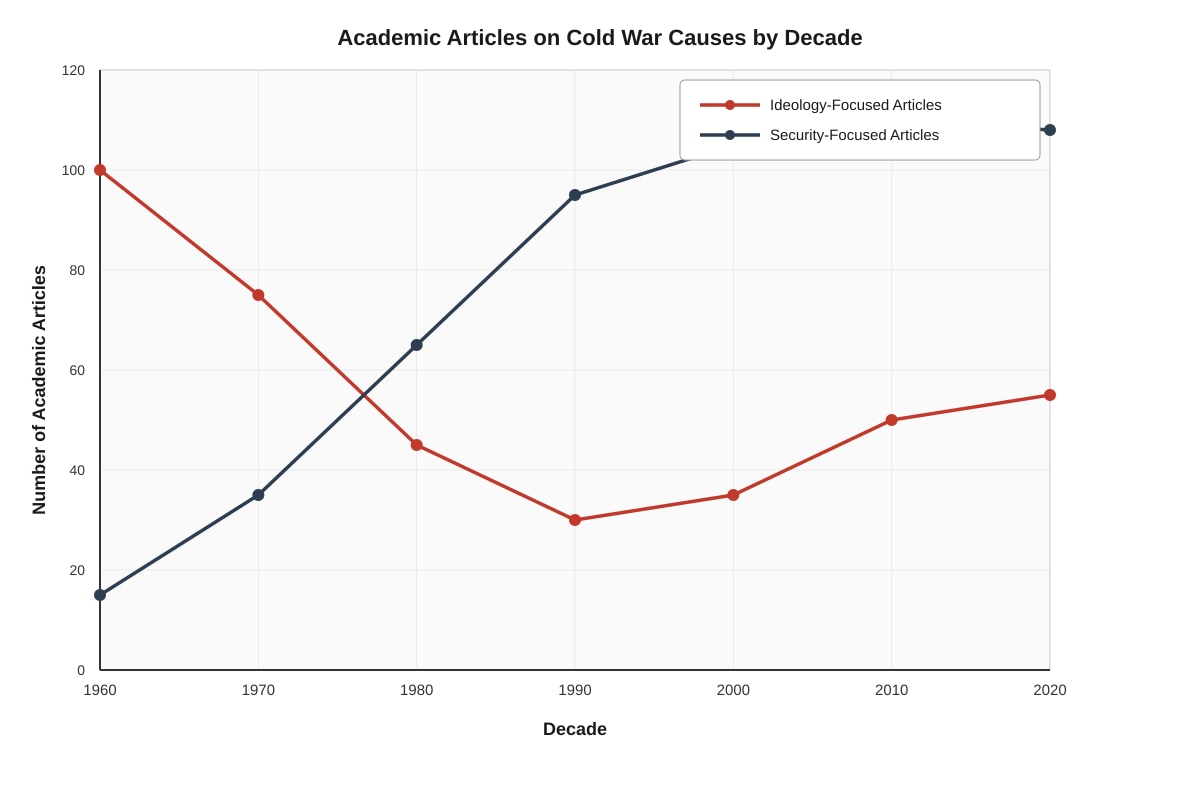
18. Based on the graph, explain how the focus of historical debate on the issue of the Cold War's origins has shifted over time. What does this suggest about how historical issues evolve? (5 marks)
Answer: Shift Over Time (from graph):
- 1960s-1970s: The graph shows "Ideology-Focused Articles" were high. This suggests that early historians (Traditionalists) and scholars focused on the clash of communism vs. capitalism.
- 1980s-1990s: "Security-Focused Articles" rose steeply, while "Ideology-Focused" declined. This reflects the influence of the Post-Revisionist school and realist IR theory, which emphasise security dilemmas, state power, and strategic calculations, rather than ideology.
- 2000s-2020s: The two lines are closer together, suggesting a synthesis. Historians may be moving toward a more complex view that combines ideology and security.
What this suggests about historical issues:
- Historical issues are dynamic. They change in response to new evidence, new methodologies, and the present-day concerns of historians.
- The dominant paradigm shifts over time. What was considered the most important factor in the 1960s (ideology) is not necessarily the same in the 2000s (security).
- The evolution shows that historical knowledge is not static. It is an ongoing dialogue between different schools of thought.
Marking Scheme:
- 2-3 marks for accurately interpreting the trend from the graph.
- 2 marks for explaining what it suggests about the evolution of historical issues (dynamic, dialogue, paradigm shifts).
19. A historian studying the Cold War states: "The greatest challenge in writing history is not finding evidence, but deciding what is an issue worth examining." With reference to the H1 History syllabus, evaluate this statement. (5 marks)
Answer: Agree: The statement is highly valid because history is not just a collection of facts. The H1 syllabus shows that historians choose to focus on certain issues (origins, end, superpower relations) over others (e.g., the environmental impact of the Cold War, women's roles in the conflict). The "importance" of an issue is a human decision, shaped by what we consider relevant today. The syllabus itself is a product of this decision-making.
Challenge: It could be argued that finding enough reliable evidence is the primary challenge. Even if you identify a good issue, if evidence is scarce, you cannot study it. For example, studying the secret decision-making in the Kremlin requires evidence that is still being declassified. Without the evidence, the issue remains speculative.
Conclusion: Both are challenging, but the historian's quote points to a deeper, philosophical challenge. The syllabus's structure—with its explicit focus on "historical issues" and "interpretations"—suggests that how we frame the history is just as important as the facts we use.
Marking Scheme:
- 1-2 marks for agreeing with clear reasoning.
- 1-2 marks for challenging with a valid counter-argument.
- 1 mark for a concluding judgement that refers to syllabus context.
20. Imagine you are an historian tasked with writing a new book on one historical issue from the A-Level History H1 syllabus. Identify the issue you would choose, explain why you think it is the most important one to re-examine, and outline one piece of evidence (beyond what is in the standard textbooks) you would use to make your case. (5 marks)
Sample Answer: Issue: The role of non-state actors in ending the Cold War (the "People Power" perspective).
Why it's important to re-examine: Most textbooks focus on Gorbachev and Reagan. This is an elite-driven narrative. A new book could argue that the ordinary people of Eastern Europe (e.g., the sailors in Gdansk, the protesters in Leipzig, the citizens of East Berlin tearing down the Wall) were the primary agents of change. They created the crisis that forced both superpowers to react. They provided the "People Power" that the Gorbachev/Reagan narratives often discount. This shifts the historical focus from "great men" to "ordinary people."
Evidence: I would use personal testimonies and oral histories from individuals who participated in the Monday demonstrations in Leipzig (1989). A standard textbook might mention the demonstrations, but an oral history collection would capture the fear, courage, and spontaneous organisation of the crowd. For example, a diary entry from a Leipzig protester saying, "We were not afraid because there were so many of us," would be used to argue that the collective action of the people, not just Gorbachev's decision, made change happen.
Marking Scheme:
- 1 mark for identifying a clear issue from the H1 syllabus.
- 1-2 marks for explaining why it is important to re-examine (argument for significance).
- 1-2 marks for a specific, original piece of evidence (not a standard textbook source).