AI Generated Quiz
A Level History H1 Issue Analysis Quiz
Free A Level History H1 Issue Analysis quiz, AI version, with questions, answers, and A Level-style practice for Singapore students.
These static practice materials are generated from the site's syllabus and paper-generation workflow, with source and model context shown so students and parents can evaluate the material before use.
Questions
Free quiz and exam paper access
Enter your details to view this paper
Your access is remembered on this device.
Answers
A-Level History H1 Quiz - Issue Analysis: Answer Key
Total Marks: 50
Section A: Short-Answer and Source-Based Questions (25 marks)
1. Define the term "historical empathy" as it applies to the study of the Cold War. Explain why it is important for historians to avoid imposing present-day values when analysing the actions of leaders like Stalin or Truman. [3 marks]
Answer:
- Definition (1 mark): Historical empathy is the ability to understand the perspectives, motivations, and constraints of people in the past, based on the context of their own time, rather than judging them by modern standards.
- Explanation (2 marks): It is important because imposing present-day values (presentism) can lead to anachronistic judgments. For example, judging Stalin's paranoia or Truman's anti-communism as irrational ignores the genuine security fears and ideological frameworks of the post-1945 world. Without empathy, historians risk oversimplifying complex decisions and failing to understand why leaders acted as they did.
Marking Notes:
- Award 1 mark for a clear definition of historical empathy.
- Award up to 2 marks for a well-explained reason, with a specific example (e.g., Stalin, Truman, or another leader).
2. Study Source A below.
Source A: An excerpt from a speech by President Harry S. Truman to the US Congress, 12 March 1947 (the Truman Doctrine speech).
"I believe that it must be the policy of the United States to support free peoples who are resisting attempted subjugation by armed minorities or by outside pressures. I believe that we must assist free peoples to work out their own destinies in their own way. I believe that our help should be primarily through economic and financial aid which is essential to economic stability and orderly political processes."
(a) Identify the main issue Truman is addressing in this speech. [1 mark]
Answer: The main issue is the threat of communist expansion/subjugation (or "containing communism").
Marking Notes:
- Accept "communist expansion", "Soviet expansion", or "containment".
(b) Explain how this speech reflects the Cold War issue of ideological conflict between the USA and the USSR. [2 marks]
Answer:
- Point 1 (1 mark): Truman frames the conflict as one between "free peoples" and "armed minorities" or "outside pressures", which is a direct reference to the ideological struggle between capitalist democracy and communist totalitarianism.
- Point 2 (1 mark): The speech presents the USA as the defender of freedom and democracy, implicitly positioning the USSR as the aggressor. This reflects the core ideological divide of the Cold War, where each side saw itself as the champion of a universal model of society.
Marking Notes:
- Award 1 mark for identifying the ideological framing (freedom vs. subjugation).
- Award 1 mark for explaining how this reflects the USA-USSR ideological conflict.
3. Explain how the issue of "security" shaped the Soviet Union's decision to establish satellite states in Eastern Europe after 1945. [3 marks]
Answer:
- Point 1 (1 mark): The USSR had been invaded twice via Eastern Europe (WWI and WWII) and sought a buffer zone to prevent future attacks.
- Point 2 (1 mark): Establishing pro-Soviet governments in Poland, Czechoslovakia, Hungary, etc., ensured that these states would not be hostile or aligned with the West.
- Point 3 (1 mark): This was a direct response to the Soviet perception of insecurity, which was rooted in historical experience and the lack of natural geographical barriers.
Marking Notes:
- Award 1 mark for each well-explained point linking security to the establishment of satellite states.
- Accept references to the "buffer zone" or "sphere of influence" as evidence of security concerns.
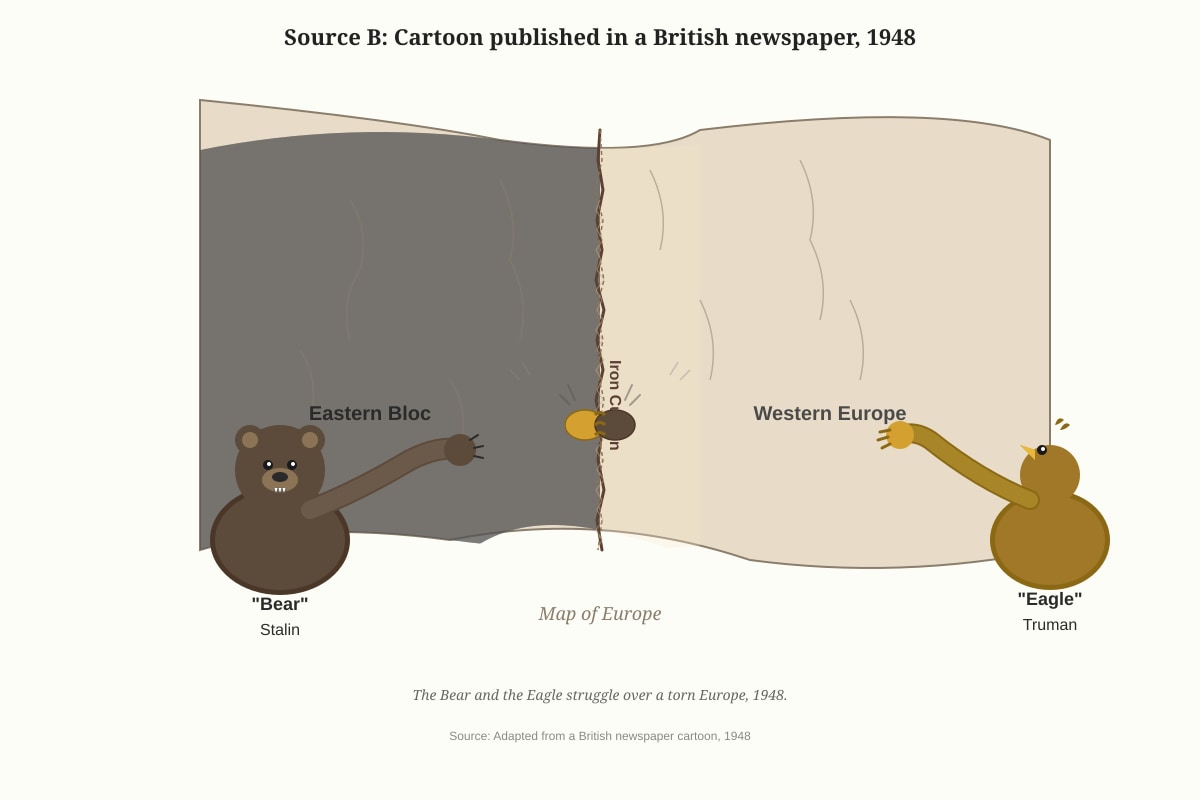
4. Study Source B below.
Source B: A cartoon published in a British newspaper in 1948, showing Stalin and Truman arm-wrestling over a map of Europe. Stalin is labelled "Bear" and Truman is labelled "Eagle". The map is torn along the line of the Iron Curtain.
(a) What issue is the cartoonist highlighting about the state of Europe in 1948? [1 mark]
Answer: The issue is the division of Europe into two opposing blocs (East vs. West), symbolised by the Iron Curtain.
Marking Notes:
- Accept "division of Europe", "Cold War division", or "Iron Curtain".
(b) Explain how the cartoon uses symbolism to convey the issue of superpower rivalry. [2 marks]
Answer:
- Point 1 (1 mark): The arm-wrestling pose symbolises a direct, competitive struggle for dominance over Europe, with no room for compromise.
- Point 2 (1 mark): The use of the "Bear" (USSR) and "Eagle" (USA) as symbols represents the two superpowers, while the torn map along the "Iron Curtain" shows that Europe has become the primary battleground of their rivalry.
Marking Notes:
- Award 1 mark for explaining the arm-wrestling as a symbol of competition.
- Award 1 mark for explaining the animal symbols and the torn map.
5. Explain how the issue of "ideology" contributed to the breakdown of the wartime alliance between the USA and the USSR after 1945. [3 marks]
Answer:
- Point 1 (1 mark): The USA was committed to liberal democracy, capitalism, and free markets, while the USSR promoted communism and state-controlled economies. These systems were fundamentally incompatible.
- Point 2 (1 mark): The wartime alliance was based on a shared enemy (Nazi Germany), not shared values. Once the common threat was removed, the underlying ideological differences resurfaced.
- Point 3 (1 mark): Each side viewed the other's ideology as a direct threat to its own way of life, leading to mutual suspicion and hostility. For example, the USA saw Soviet communism as expansionist, while the USSR saw American capitalism as imperialist.
Marking Notes:
- Award 1 mark for each well-explained point linking ideology to the breakdown of the alliance.
6. Study Source C below.
Source C: An excerpt from George Kennan's "Long Telegram", February 1946.
"At the bottom of the Kremlin's neurotic view of world affairs is the traditional and instinctive Russian sense of insecurity... They have learned to seek security only in patient but deadly struggle for total destruction of rival power, never in compacts and compromises with it."
(a) What issue does Kennan identify as the root cause of Soviet behaviour? [1 mark]
Answer: The root cause is the Soviet/Russian sense of insecurity.
Marking Notes:
- Accept "insecurity" or "traditional Russian sense of insecurity".
(b) Explain how this analysis influenced the US policy of containment. [2 marks]
Answer:
- Point 1 (1 mark): Kennan argued that the USSR could not be reasoned with through compromise, so the USA must instead apply "patient but deadly struggle" to contain Soviet expansion.
- Point 2 (1 mark): This led directly to the policy of containment, which aimed to prevent the spread of communism by using economic aid (Marshall Plan), military alliances (NATO), and political pressure, rather than seeking a grand settlement with the USSR.
Marking Notes:
- Award 1 mark for explaining that Kennan's analysis ruled out compromise.
- Award 1 mark for linking this to the specific policy of containment.
7. Analyse how the issue of "alliances" shaped the development of the Cold War in Europe between 1949 and 1955. [3 marks]
Answer:
- Point 1 (1 mark): The formation of NATO in 1949 formalised the Western alliance, committing the USA to the defence of Western Europe and creating a unified military bloc against the USSR.
- Point 2 (1 mark): In response, the USSR formed the Warsaw Pact in 1955, solidifying its control over Eastern Europe and creating a rival military alliance.
- Point 3 (1 mark): The existence of these two opposing alliances institutionalised the division of Europe, making the Cold War a permanent feature of international relations and increasing the risk of a direct military confrontation.
Marking Notes:
- Award 1 mark for each well-explained point about the role of alliances (NATO and Warsaw Pact).
8. Study Source D below.
Source D: A table showing military expenditure of the USA and USSR, 1950–1960 (in billions of US dollars).
| Year | USA Military Expenditure ($bn) | USSR Military Expenditure ($bn) |
|---|---|---|
| 1950 | 14.3 | 15.5 |
| 1955 | 40.5 | 29.4 |
| 1960 | 47.4 | 36.9 |
(a) What issue does this data reveal about the Cold War? [1 mark]
Answer: The issue is the arms race / military competition between the USA and USSR.
Marking Notes:
- Accept "arms race", "military build-up", or "defence spending competition".
(b) Explain how this issue contributed to tensions between the superpowers. [2 marks]
Answer:
- Point 1 (1 mark): The rapid increase in military spending by both sides created a climate of fear and suspicion, as each side interpreted the other's build-up as preparation for aggression.
- Point 2 (1 mark): The arms race also diverted resources away from civilian needs and created a self-perpetuating cycle of competition, where each new weapon system by one side was met with a countermeasure by the other, escalating tensions.
Marking Notes:
- Award 1 mark for explaining the climate of fear/suspicion.
- Award 1 mark for explaining the self-perpetuating cycle of competition.
9. Explain how the issue of "balance of power" was a key factor in the outbreak of the Korean War in 1950. [3 marks]
Answer:
- Point 1 (1 mark): After the Chinese Communist Revolution in 1949, the balance of power in East Asia shifted in favour of communism. The USA had withdrawn from Korea in 1949, leaving the peninsula vulnerable.
- Point 2 (1 mark): Kim Il-sung, with Stalin's approval, saw an opportunity to unify Korea under communist control, believing that the USA would not intervene to defend South Korea.
- Point 3 (1 mark): The USA interpreted the invasion as a test of its commitment to containment and a direct challenge to the balance of power, leading to its decision to intervene under the UN flag.
Marking Notes:
- Award 1 mark for each well-explained point linking balance of power to the outbreak of the war.
10. Study Source E below.
Source E: An excerpt from a speech by Nikita Khrushchev to the United Nations General Assembly, October 1960.
"We declare that the Soviet Union will continue to support the national liberation movements in Asia, Africa, and Latin America. We consider it our duty to help those who are fighting for their freedom from colonial oppression and imperialist exploitation."
(a) Identify the issue Khrushchev is raising about the nature of the Cold War. [1 mark]
Answer: The issue is the globalisation/expansion of the Cold War to the Third World (or decolonisation/national liberation movements).
Marking Notes:
- Accept "globalisation of the Cold War", "Third World involvement", or "support for decolonisation".
(b) Explain how this issue expanded the scope of the Cold War beyond Europe. [2 marks]
Answer:
- Point 1 (1 mark): Khrushchev explicitly states that the USSR will support anti-colonial movements, turning former colonies into new battlegrounds for superpower influence.
- Point 2 (1 mark): This shifted the Cold War from a primarily European conflict to a global one, as the USA and USSR competed for allies and influence in Asia, Africa, and Latin America, often through proxy wars (e.g., Vietnam, Angola).
Marking Notes:
- Award 1 mark for identifying the shift to the Third World.
- Award 1 mark for explaining the mechanism (proxy wars, competition for allies).
Section B: Structured Essay and Analytical Questions (25 marks)
11. "The issue of ideology was the most important cause of the Cold War." How far do you agree with this statement? Support your answer with reference to the period 1945–1949. [5 marks]
Answer:
- Agree (ideology as key): The fundamental incompatibility between capitalism/democracy (USA) and communism/totalitarianism (USSR) created mutual suspicion. Each side believed its system was universal and that the other was a threat. This is evident in the Truman Doctrine (1947), which framed the conflict as one between "free peoples" and "armed minorities", and in the Soviet rejection of the Marshall Plan, which they saw as a tool of American imperialism.
- Disagree (other factors): Security concerns were equally important. The USSR's desire for a buffer zone in Eastern Europe was driven by historical insecurity, not just ideology. The USA's policy of containment was a response to Soviet expansion, which was seen as a strategic threat. Economic factors also played a role: the USA wanted to rebuild Western Europe as a market for its goods, while the USSR wanted to extract reparations from Germany.
- Conclusion: While ideology was a necessary condition for the Cold War, it was not sufficient. The Cold War was caused by a combination of ideology, security, and economic factors. Ideology provided the framework for interpreting actions, but security and economic interests were often the immediate drivers.
Marking Notes (Level Descriptors):
- L5 (5 marks): Sustained analytical argument with a clear, supported conclusion. Considers both sides of the argument and uses specific evidence (e.g., Truman Doctrine, Marshall Plan, Sovietisation of Eastern Europe).
- L4 (4 marks): Good analysis with some evidence, but may be slightly unbalanced or lack a fully developed conclusion.
- L3 (3 marks): Begins to analyse but is largely descriptive. Some relevant evidence but limited evaluation.
- L2 (2 marks): Limited analysis. Mainly descriptive with some relevant points.
- L1 (1 mark): Irrelevant or very limited response.
12. Analyse how the issue of "security" influenced the foreign policies of both the USA and the USSR during the Cuban Missile Crisis of 1962. [5 marks]
Answer:
- USSR: Khrushchev's decision to place missiles in Cuba was driven by a desire to close the "missile gap" and achieve strategic parity with the USA. The USSR felt insecure because US Jupiter missiles were stationed in Turkey, within striking distance of the Soviet Union. Placing missiles in Cuba was a direct response to this perceived threat.
- USA: The USA saw the missiles as an unacceptable threat to its national security, as they could reach US cities with little warning. Kennedy's decision to impose a naval quarantine (blockade) was a calculated response to remove the threat without triggering a full-scale war. The USA's demand for the removal of the missiles was non-negotiable.
- Resolution: The crisis was resolved when the USSR agreed to remove the missiles in exchange for a US pledge not to invade Cuba and a secret agreement to remove US missiles from Turkey. This shows that both sides were ultimately willing to compromise to avoid war, but only after the security issue was addressed.
Marking Notes (Level Descriptors):
- L5 (5 marks): Sustained analysis of how security influenced both sides. Uses specific evidence (e.g., Jupiter missiles, missile gap, quarantine). Clear conclusion.
- L4 (4 marks): Good analysis but may focus more on one side than the other.
- L3 (3 marks): Some analysis but largely descriptive. Limited use of evidence.
- L2 (2 marks): Limited analysis. Mainly narrative.
- L1 (1 mark): Irrelevant or very limited response.
13. "The issue of economic competition was more significant than military rivalry in shaping the Cold War in the 1950s." Discuss this statement with reference to the Marshall Plan and the formation of the Warsaw Pact. [5 marks]
Answer:
- Agree (economic competition): The Marshall Plan (1948–1951) was a massive economic aid programme that helped rebuild Western Europe, creating a prosperous, capitalist bloc. It was a direct challenge to the Soviet economic model. The USSR responded with the Molotov Plan and Comecon, but these were less successful. Economic competition also extended to the space race and technological competition.
- Disagree (military rivalry): The formation of the Warsaw Pact (1955) was a direct military response to NATO (1949). The Korean War (1950–1953) showed that military rivalry could turn hot. The arms race, including the development of the hydrogen bomb, created a constant threat of war. Military rivalry was arguably more significant because it had the potential for immediate, catastrophic consequences.
- Conclusion: Both were significant, but military rivalry was more immediate and dangerous. Economic competition was a longer-term struggle for influence, but military alliances and the arms race defined the security landscape of the 1950s.
Marking Notes (Level Descriptors):
- L5 (5 marks): Sustained argument with a clear, supported conclusion. Compares and contrasts economic and military factors effectively.
- L4 (4 marks): Good analysis but may not fully compare the two factors.
- L3 (3 marks): Some analysis but largely descriptive. Limited use of evidence.
- L2 (2 marks): Limited analysis. Mainly narrative.
- L1 (1 mark): Irrelevant or very limited response.
14. Evaluate the view that the issue of "ideological allies" was the primary factor driving US involvement in Vietnam. [5 marks]
Answer:
- Agree (ideological allies): The USA saw South Vietnam as a key ally in the fight against communism. The Domino Theory, which held that if one country fell to communism, its neighbours would follow, was a powerful ideological justification for intervention. The USA believed it had a duty to defend a "free" nation against communist aggression.
- Disagree (other factors): Strategic interests were also important. Vietnam was seen as a test case for containment. The USA wanted to demonstrate its credibility to its allies and its resolve to the USSR and China. Domestic politics also played a role: presidents feared being seen as "soft on communism" after the "loss" of China.
- Conclusion: Ideology was a necessary justification, but strategic and domestic political factors were equally, if not more, important. The USA would not have intervened in Vietnam if it were not a Cold War battleground, but the specific decision to escalate was driven by a combination of ideological, strategic, and political calculations.
Marking Notes (Level Descriptors):
- L5 (5 marks): Sustained evaluation with a clear, supported conclusion. Considers multiple factors (ideology, strategy, domestic politics).
- L4 (4 marks): Good evaluation but may focus too heavily on one factor.
- L3 (3 marks): Some evaluation but largely descriptive. Limited use of evidence.
- L2 (2 marks): Limited evaluation. Mainly narrative.
- L1 (1 mark): Irrelevant or very limited response.
15. "The issue of domestic politics was the most important factor in Gorbachev's decision to end the Cold War." How far do you agree? Support your answer with reference to the period 1985–1991. [5 marks]
Answer:
- Agree (domestic politics): Gorbachev's reforms (Perestroika and Glasnost) were driven by the need to revive the Soviet economy. The USSR was facing severe economic stagnation, and Gorbachev believed that political and economic liberalisation was necessary. Ending the Cold War would allow him to reduce military spending and focus on domestic reform.
- Disagree (other factors): External pressure from the USA (Reagan's military build-up, SDI) forced the USSR to negotiate. The Eastern European revolutions of 1989 showed that the USSR could no longer maintain its empire by force. Gorbachev's "New Thinking" in foreign policy, which emphasised common security over confrontation, was also a key factor.
- Conclusion: Domestic politics was the most important factor because it was the root cause of Gorbachev's reforms. However, external pressure and the collapse of Eastern Europe accelerated the process. Without Gorbachev's domestic agenda, the Cold War might have ended differently.
Marking Notes (Level Descriptors):
- L5 (5 marks): Sustained evaluation with a clear, supported conclusion. Considers domestic, external, and ideological factors.
- L4 (4 marks): Good evaluation but may not fully weigh the factors.
- L3 (3 marks): Some evaluation but largely descriptive. Limited use of evidence.
- L2 (2 marks): Limited evaluation. Mainly narrative.
- L1 (1 mark): Irrelevant or very limited response.
16. Analyse how the issue of "nationalism" contributed to the end of the Cold War in Eastern Europe. [5 marks]
Answer:
- Point 1: Nationalism was a powerful force in Eastern Europe, where Soviet control was resented. In Poland, the Solidarity movement (1980s) combined nationalism with anti-communism, creating a mass movement that the USSR could not suppress indefinitely.
- Point 2: In East Germany, the desire for reunification with West Germany was a form of nationalism that undermined the legitimacy of the communist regime. The peaceful protests of 1989 were driven by a desire for freedom and national unity.
- Point 3: Gorbachev's "Sinatra Doctrine" (1989) allowed Eastern European countries to go their own way. This unleashed nationalist movements that quickly overthrew communist governments in Czechoslovakia, Hungary, Romania, and Bulgaria.
- Conclusion: Nationalism was a key factor because it provided a popular, unifying ideology that challenged Soviet control. It was the "people power" that brought down the communist regimes, and it was a force that the USSR could not contain without massive military intervention, which Gorbachev was unwilling to use.
Marking Notes (Level Descriptors):
- L5 (5 marks): Sustained analysis of nationalism as a factor. Uses specific examples (Poland, East Germany, etc.). Clear conclusion.
- L4 (4 marks): Good analysis but may focus on one country only.
- L3 (3 marks): Some analysis but largely descriptive. Limited use of evidence.
- L2 (2 marks): Limited analysis. Mainly narrative.
- L1 (1 mark): Irrelevant or very limited response.
17. "The issue of economic decline was the most important cause of the end of the Cold War." Discuss this statement with reference to the USSR. [5 marks]
Answer:
- Agree (economic decline): The Soviet economy was in severe decline by the 1980s. Stagnation, low productivity, and the cost of the arms race (especially Reagan's SDI) placed an unsustainable burden on the USSR. Gorbachev's Perestroika was an attempt to reform the economy, and ending the Cold War was a necessary step to reduce military spending and access Western technology and investment.
- Disagree (other factors): Political factors were also important. Gorbachev's "New Thinking" in foreign policy was a genuine ideological shift. The Eastern European revolutions of 1989 showed that the USSR could no longer maintain its empire by force. The role of "people power" and nationalism was also crucial.
- Conclusion: Economic decline was the most important underlying cause because it created the conditions for reform. Without economic crisis, Gorbachev would not have pursued Perestroika or the "New Thinking". However, the end of the Cold War was ultimately the result of a combination of economic, political, and social factors.
Marking Notes (Level Descriptors):
- L5 (5 marks): Sustained discussion with a clear, supported conclusion. Weighs economic factors against others.
- L4 (4 marks): Good discussion but may not fully weigh the factors.
- L3 (3 marks): Some discussion but largely descriptive. Limited use of evidence.
- L2 (2 marks): Limited discussion. Mainly narrative.
- L1 (1 mark): Irrelevant or very limited response.
18. Evaluate the view that the issue of "human rights" was a key factor in the decline of superpower détente in the late 1970s. [5 marks]
Answer:
- Agree (human rights): The Helsinki Final Act (1975) included provisions on human rights, which the USSR signed but did not respect. US President Jimmy Carter (1977–1981) made human rights a central pillar of his foreign policy, criticising the USSR for its treatment of dissidents (e.g., Sakharov, Sharansky). This soured relations and undermined détente.
- Disagree (other factors): The Soviet invasion of Afghanistan (1979) was a more direct cause of the end of détente. The USSR's deployment of SS-20 missiles in Europe and the US response (NATO's "Double-Track Decision") also escalated tensions. The collapse of détente was primarily due to strategic and military factors, not just human rights.
- Conclusion: Human rights was a significant factor because it changed the tone of US-Soviet relations and gave the USA a moral platform to criticise the USSR. However, it was the Soviet invasion of Afghanistan and the arms race that ultimately ended détente. Human rights was a contributing factor, not the primary cause.
Marking Notes (Level Descriptors):
- L5 (5 marks): Sustained evaluation with a clear, supported conclusion. Considers human rights alongside other factors.
- L4 (4 marks): Good evaluation but may focus too heavily on one factor.
- L3 (3 marks): Some evaluation but largely descriptive. Limited use of evidence.
- L2 (2 marks): Limited evaluation. Mainly narrative.
- L1 (1 mark): Irrelevant or very limited response.
19. "The issue of strategic interests was more important than ideology in shaping Sino-American rapprochement in the 1970s." How far do you agree? [5 marks]
Answer:
- Agree (strategic interests): The main driver of rapprochement was the shared strategic interest in countering the Soviet Union. China was concerned about the Soviet threat on its border (Sino-Soviet border conflict, 1969), and the USA saw China as a potential ally against the USSR. Nixon's visit to China (1972) was a strategic move to exploit the Sino-Soviet split.
- Disagree (ideology): Ideology was a barrier, not a driver. The USA and China had been ideological enemies for decades. Rapprochement required both sides to set aside ideological differences. However, ideology was not completely irrelevant: China's shift away from Maoist radicalism made it a more acceptable partner for the USA.
- Conclusion: Strategic interests were clearly more important. The USA and China were able to cooperate despite their ideological differences because they shared a common enemy (the USSR). Ideology was a secondary factor that had to be overcome, not a driver of rapprochement.
Marking Notes (Level Descriptors):
- L5 (5 marks): Sustained evaluation with a clear, supported conclusion. Weighs strategic and ideological factors effectively.
- L4 (4 marks): Good evaluation but may not fully weigh the factors.
- L3 (3 marks): Some evaluation but largely descriptive. Limited use of evidence.
- L2 (2 marks): Limited evaluation. Mainly narrative.
- L1 (1 mark): Irrelevant or very limited response.
20. Analyse how the issue of "decolonisation" intersected with the Cold War in Southeast Asia between 1945 and 1975. [5 marks]
Answer:
- Point 1: Decolonisation created a power vacuum in Southeast Asia after WWII. Newly independent nations (e.g., Indonesia, Vietnam, Malaya) were vulnerable to both internal and external pressures, making them battlegrounds for Cold War influence.
- Point 2: The USA and USSR supported opposing sides in decolonisation conflicts. The USA supported France in the First Indochina War (1946–1954) to prevent a communist victory, while the USSR and China supported the Viet Minh. This turned a colonial war into a Cold War proxy conflict.
- Point 3: The Cold War also shaped the post-colonial states. The USA supported anti-communist regimes (e.g., South Vietnam, Thailand, Philippines), while the USSR supported communist movements (e.g., the Khmer Rouge in Cambodia, the Pathet Lao in Laos). This led to prolonged civil wars and interventions.
- Conclusion: Decolonisation and the Cold War were deeply intertwined in Southeast Asia. The Cold War provided the ideological and material support for opposing sides in decolonisation conflicts, turning local struggles into proxy wars. The intersection of these two issues created a volatile and violent region for three decades.
Marking Notes (Level Descriptors):
- L5 (5 marks): Sustained analysis of the intersection of decolonisation and the Cold War. Uses specific examples (Vietnam, Indonesia, etc.). Clear conclusion.
- L4 (4 marks): Good analysis but may focus on one country only.
- L3 (3 marks): Some analysis but largely descriptive. Limited use of evidence.
- L2 (2 marks): Limited analysis. Mainly narrative.
- L1 (1 mark): Irrelevant or very limited response.
End of Answer Key