AI Generated Exam Paper
A Level History H1 Practice Paper 3
Free A Level History H1 Practice Paper 3, HY3 AI version, with questions, answers, and A Level-style practice for Singapore students.
These static practice materials are generated from the site's syllabus and paper-generation workflow, with source and model context shown so students and parents can evaluate the material before use.
Questions
Free quiz and exam paper access
Enter your details to view this paper
Your access is remembered on this device.
Answers
TuitionGoWhere Practice Paper - History H1 A-Level (Answers)
Version 3 — Answer Key
Total Marks: 40
Section A: Source-Based Case Study
Question 1(a) — Compare Source A and Source B (10 marks)
Marking Descriptors (L0–L3):
- L3 (8–10): Effective use of both sources; clear explanation of similarities and differences with details; insight into author perspective.
- L2 (4–7): Uses both; clear explanation of similarities/differences with source details.
- L1 (1–3): Describes each source; simple comparison.
- L0 (0): No relevant response.
Teaching Notes & Sample Answer:
- Similarity: Both Source A (Kennan) and Source B (Churchill) portray the USSR as a threat to the West. Kennan describes "Russian expansive tendencies" needing "containment"; Churchill describes an "iron curtain" of Soviet control over Eastern Europe. Both reflect a Western perception of Soviet aggression in 1946.
- Difference: Source A is a confidential diplomatic telegram focusing on the internal nature of the Soviet regime ("brittle police state") and recommends a policy (containment). Source B is a public speech aimed at rallying US and Western public opinion, using vivid imagery ("iron curtain") to describe the geopolitical divide. Kennan emphasises long-term patient strategy; Churchill emphasises immediate moral and political warning.
- Perspective insight: Kennan writes as a diplomat with knowledge of Soviet structure; Churchill as a former leader seeking to influence postwar Western policy.
Award: Full L3 if student integrates both content and provenance as above (max 10).
Question 1(b) — Test assertion using all sources (30 marks)
Marking Descriptors (L0–L5):
- L5 (25–30): Treats sources as set; critical awareness; evaluates in context; sustained argument + conclusion.
- L4 (19–24): Good use; attempts evaluation in context with minor gaps.
- L3 (13–18): Some cross-referencing; evaluation via content/provenance not fully contextual.
- L2 (7–12): Face-value use; isolation; some provenance.
- L1 (1–6): Limited use; description.
- L0 (0): No response.
Teaching Notes & Sample Answer Structure:
- Introduction: State that the assertion has partial support; sources show both security fears and ideology played roles.
- Source A: Kennan frames USSR action as insecurity-driven ("sense of insecurity") but also ideological ("police state") → supports mixed view.
- Source B: Churchill highlights Soviet expansion as factual control, not solely security → suggests ideological/critical view.
- Source C: Soviet editorial presents USSR as seeking "security of its borders" against "American imperialists" → supports mutual security fears from Soviet side.
- Source D: Post-revisionist historian explicitly states "genuine security fears" and "mutual suspicion" → strongly supports assertion.
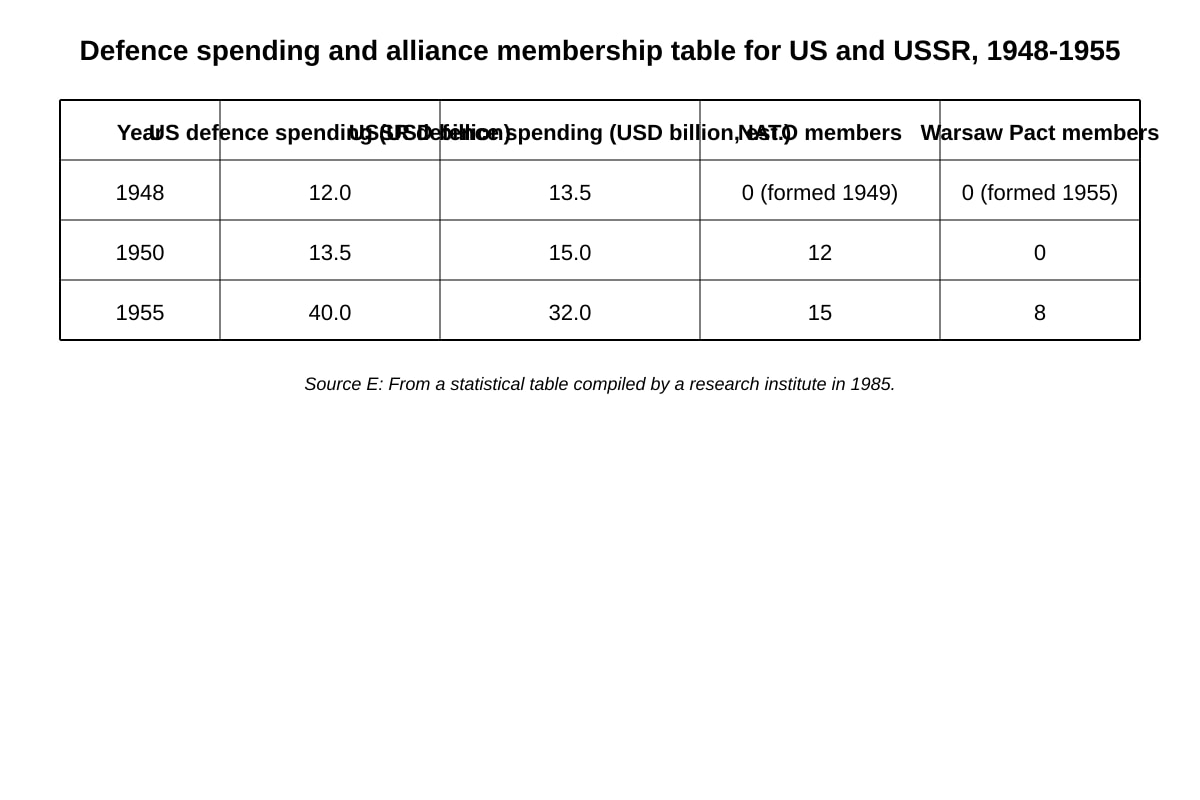
- Source E: Spending rises on both sides; NATO/Warsaw Pact formed → institutionalisation of security fears (alliance building).
- Cross-reference: A and C show each side feared the other's power (US atomic monopoly, Red Army). D and E corroborate structural security dilemma.
- Counter: B and A also show ideology (communism vs capitalism) as lens.
- Conclusion: Assertion is largely valid for early emergence (1946–55) but ideology cannot be separated from how security was interpreted.
Mark Breakdown Example (L5 response):
Use of 5 sources (5), cross-referencing (5), context of postwar power vacuum (5), evaluation of assertion (5), reasoned conclusion (5), writing (5) → 30.
Image Note: Q1-fig1 must show table exactly as Source E; answer uses values to show parallel increase in spending and alliance formation as evidence of security dilemma.