AI Generated Exam Paper
A Level History H1 Practice Paper 1
Free A Level History H1 Practice Paper 1, HY3 AI version, with questions, answers, and A Level-style practice for Singapore students.
These static practice materials are generated from the site's syllabus and paper-generation workflow, with source and model context shown so students and parents can evaluate the material before use.
Questions
Free quiz and exam paper access
Enter your details to view this paper
Your access is remembered on this device.
Answers
TuitionGoWhere Practice Paper Answers — History H1 A-Level (Version 1)
Subject: History H1
Level: A-Level
Paper: Practice Paper (Source-Based Skills Focus)
Total Marks: 40
Section A: Source-Based Case Study — Mark Scheme
Question 1 (a) — Compare Sources A and B [10 marks]
Level Descriptors (from syllabus):
- L3 (8–10): Effective use of both; clear explanation of similarities/differences with details; insight into reasons.
- L2 (4–7): Uses both; clear explanation with source details.
- L1 (1–3): Describes content; simple comparison.
- L0 (0): No relevant response.
Teaching Notes & Sample Answer (L3 standard):
Both Sources A and B depict the Soviet Union as a threat to Western/European stability after 1945. Churchill (A) uses the metaphor of an "iron curtain" to describe Soviet political control over Eastern Europe, listing capitals "in the Soviet sphere." Kennan (B) similarly sees "Russian expansive tendencies" and a global divide between socialist and capitalist camps.
Similarity: Both view USSR as expansionist and ideologically opposed to the West.
Difference: A is a public political speech focused on geographic division in Europe; B is a diplomatic telegram emphasising long-term policy of "containment" and ideological worldview. A is rhetorical, B is analytical.
Reason: Churchill as politician sought to alert public; Kennan as diplomat provided strategic prescription.
[Mark breakdown: identification of similarity 3, difference 3, use of details 2, insight into reason 2 = 10]
Common mistake: Only paraphrasing one source; not explicitly comparing.
Question 1 (b) — Test assertion using all sources [30 marks]
Assertion: Cold War emerged primarily due to aggressive Soviet expansionism rather than mutual misunderstanding.
Level Descriptors:
- L5 (25–30): Treats sources as set; critical awareness; evaluates in context; sustained argument + conclusion.
- L4 (19–24): Good use; attempts evaluation with gaps.
- L3 (13–18): Some cross-referencing; evaluation not fully in context.
- L2 (7–12): Face-value use; isolation.
- L1 (1–6): Limited; contextual only.
Teaching Notes & Sample Answer (L5 standard):
Introduction: The assertion blames USSR aggression. Sources offer mixed support.
Source A (Churchill) and B (Kennan) support assertion: A shows Soviet sphere over E. Europe; B notes expansive tendencies → implies aggression.
Source C (Pravda) rejects: calls Marshall Plan US imperialism, presents Soviet aid as equal → Soviet view is defensive/western aggression.
Source D (post-revisionist) opposes assertion: argues mutual misunderstanding of security needs; structural tensions → not solely USSR.
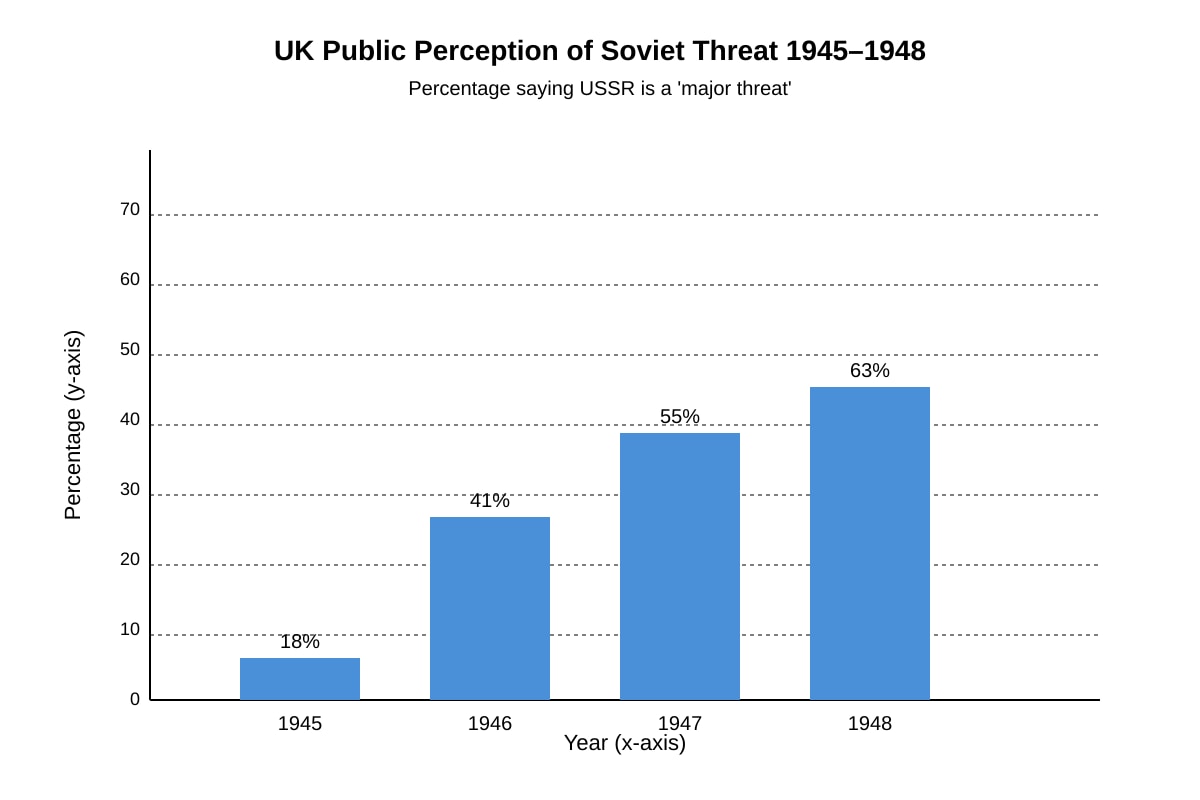
Source E (chart) shows rising UK perception of threat 18%→63% (1945–48); reflects Western belief in Soviet threat but is perception, not proof of aggression.
Own knowledge: Truman Doctrine, Berlin Blockade as Soviet pressure; but Yalta agreements show mutual wartime cooperation broken by suspicion.
Conclusion: Sources do not predominantly support assertion. A and B support; C, D, E (as perception) challenge. Cold War arose from both expansion and misunderstanding.
[Mark breakdown: use of 5 sources 10, evaluation in context 8, cross-ref 5, argument structure 4, conclusion 3 = 30]
Common mistake: Using sources in isolation; ignoring Source D's historiography.