AI Generated Quiz
A Level H1 General Paper Language Use Quiz
Free A Level H1 GP Language Use quiz, HY3 AI version, with questions, answers, and A Level-style practice for Singapore students.
These static practice materials are generated from the site's syllabus and paper-generation workflow, with source and model context shown so students and parents can evaluate the material before use.
Questions
Free quiz and exam paper access
Enter your details to view this paper
Your access is remembered on this device.
Answers
A-Level General Paper H1 Quiz - Language Use (Answer Key)
Total Marks: 40
Topic: Language Use (syllabus-aligned, AI-generated from Stage 4 templates; not claimed as past-year derived)
Section A: Word and Phrase Analysis
Q1. [1 mark]
Answer: The word "merely" suggests that the action or item is only of limited importance or extent; the author uses it to downplay the significance of what is described.
Teaching note: "Merely" is a diminisher. In context (line 8), it shows the author regards the cited point as trivial compared to the main argument. Common mistake: defining it as "only" without showing the downplaying effect.
Q2. [2 marks]
Answer: The author uses "of course" to signal an assumption shared with the reader / to preempt disagreement and make the point seem self-evident. (1 mark for identifying assumed/expected tone; 1 mark for linking to persuasion or reader alignment)
Teaching note: Discourse marker showing consensus. Mark breakdown: 1 for function (assumption), 1 for effect (persuasion). Trap: confusing with "certainly" as pure emphasis.
Q3. [1 mark]
Answer: "Creeping" suggests urbanisation is gradual and unnoticed / stealthy, carrying a negative connotation of threat.
Teaching note: Connotation over denotation. Negative tone implied.
Q4. [1 mark]
Answer: "Spawned" implies new technologies arose rapidly or were produced in large numbers, with a slightly negative or mechanical tone.
Teaching note: Avoid dictionary definition; show contextual nuance.
Q5. [2 marks]
Answer: By calling preferences "coded", the author means they are hidden within language or behaviour and not openly stated (1 mark); the word suggests underlying bias or meaning that requires decoding (1 mark).
Teaching note: Abstract term. Mark descriptors: 1 for "hidden", 1 for "requires interpretation".
Q6. [2 marks]
Answer: "Even" is used to indicate surprise or exception (1 mark); it emphasises that something unexpected (e.g., a group normally exempt) is included, strengthening the author's point (1 mark).
Teaching note: Concession/emphasis. Trap: stating grammatical class only.
Q7. [3 marks]
Answer: According to lines 60–63, "freedom" originally meant absence of restraint (1 mark); the author argues it has shifted to mean freedom of choice as a consumer (1 mark); this change reflects commercialisation of rights (1 mark). Use own words.
Teaching note: Show evolution: start → shift → cause. 3-mark causal chain.
Section B: Stylistic and Structural Choices
Q8. [2 marks]
Answer: The author uses three short statements to grab attention (1 mark) and to present the issue as stark and undeniable before elaboration (1 mark).
Teaching note: Technique + purpose. Trap: "to engage" without specifics.
Q9. [2 marks]
Answer: The rhetorical question at line 19 makes readers reflect on their own complicity (1 mark) and reinforces the author's criticism without direct accusation (1 mark).
Teaching note: Rhetorical question = no answer expected; effect on reader.
Q10. [2 marks]
Answer: Repetition of "we must" creates urgency (1 mark) and signals collective responsibility (1 mark).
Teaching note: Anaphora. Mark: 1 effect + 1 stance.
Q11. [3 marks]
Answer: Statistics lend objectivity/credibility (1 mark); they quantify the scale of the problem (1 mark); this persuades readers through evidence rather than emotion (1 mark).
Teaching note: 3-mark: source, scale, persuasion.
Q12. [2 marks]
Answer: The switch to colloquial tone makes the author seem relatable (1 mark) and underscores the everyday relevance of the issue (1 mark).
Teaching note: Register shift.
Q13. [2 marks]
Answer: Parentheses isolate the cost as an aside (1 mark) yet ensure the reader notes the negative trade-off (1 mark).
Teaching note: Punctuation as modifier.
Q14. [2 marks]
Answer: A single short final sentence leaves a memorable, emphatic conclusion (1 mark) and signals the end of argumentation (1 mark).
Teaching note: Closing impact.
Section C: Figurative and Extended Language
Q15. [2 marks]
Answer: "Double-edged sword" means social media has both benefits and harms (1 mark for two sides; 1 mark for contextual example e.g., connection vs. addiction).
Teaching note: Metaphor of duality.
Q16. [2 marks]
Answer: "Black box" means AI decisions are opaque/unexplainable (1 mark); users rely on it without understanding (1 mark).
Teaching note: Figurative for obscurity.
Q17. [2 marks]
Answer: "Melting pot" suggests cultures blend in cities (1 mark); implies both harmony and loss of distinct identity (1 mark).
Teaching note: Mixed metaphor reading.
Q18. [2 marks]
Answer: "Ticking time bomb" implies delayed but inevitable crisis (1 mark); conveys urgency and danger (1 mark).
Teaching note: Alarm metaphor.
Q19. [2 marks]
Answer: Author states the words are similar but not interchangeable (1 mark); meaning context changes applicability (1 mark).
Teaching note: Nuance of synonyms.
Q20. [3 marks]
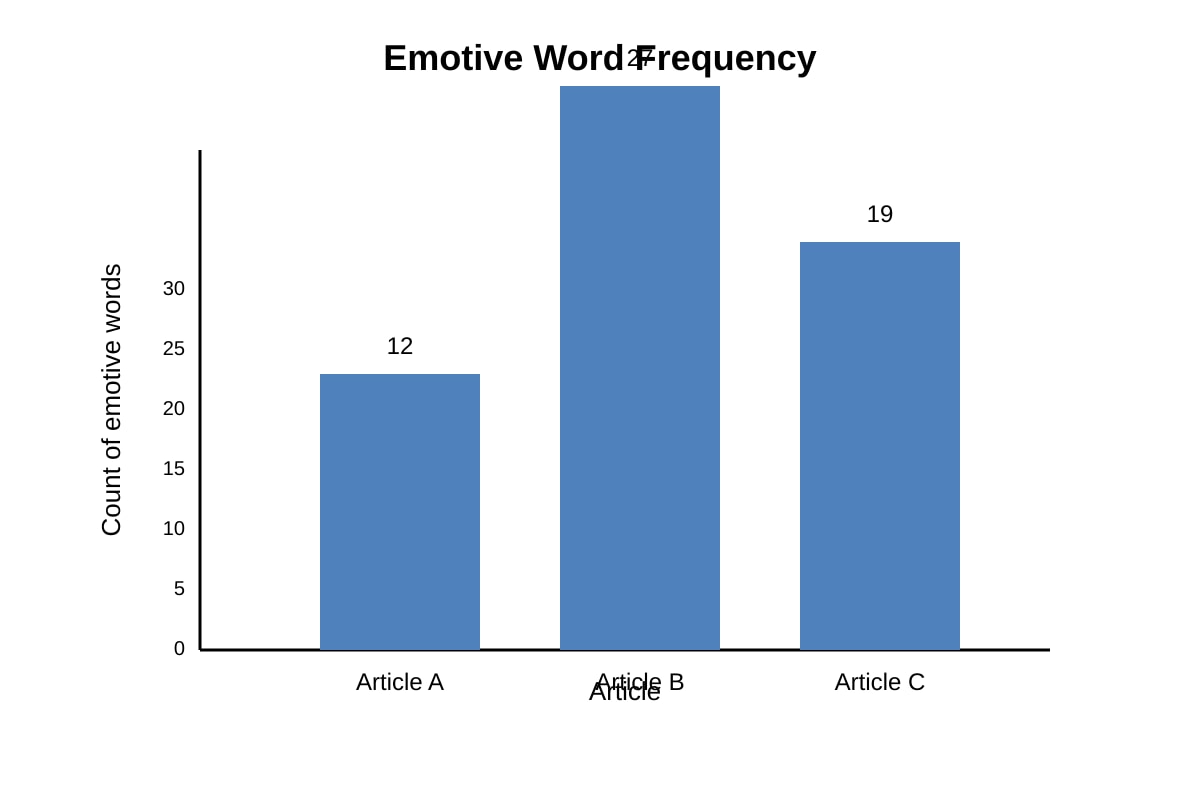
Answer: Chart shows Article B uses most emotive words (27) vs A (12) (1 mark); author argues higher emotive count reveals partiality (1 mark); visual evidence supports claim that word choice exposes bias (1 mark).
Teaching note: Image must show bars: A=12, B=27, C=19. Link data to line 44 claim.