AI Generated Quiz
A Level H1 General Paper Composition Situational Writing Quiz
Free A Level H1 GP Situational Writing quiz, LongCat AI version, with questions, answers, and A Level-style practice for Singapore students.
These static practice materials are generated from the site's syllabus and paper-generation workflow, with source and model context shown so students and parents can evaluate the material before use.
Questions
Free quiz and exam paper access
Enter your details to view this paper
Your access is remembered on this device.
Answers
A-Level General Paper H1 Quiz - Composition Situational Writing
Answer Key and Teaching Notes
Section A: Understanding Situational Writing Fundamentals (Questions 1–5)
1. (a) [1 mark]
Answer: A formal letter (specifically, a letter to the editor).
Teaching Note: Format refers to the type of text — letter, report, speech, proposal, article, blog post, etc. Students must identify the correct format from the task scenario. A "letter to the editor" requires the formal letter structure (sender's address, date, recipient's address, salutation, body, sign-off).
1. (b) [2 marks]
Answer: The register should be formal [1 mark]. This is because the letter is addressed to the editor of a national newspaper, which is a professional and public context. A formal register conveys seriousness and credibility, which is necessary when discussing a societal issue in a published forum [1 mark].
Teaching Note: Register refers to the level of formality in language. Students should consider: Who am I writing to? Where will this appear? Letters to editors, proposals, reports, and formal letters all require a formal register. Blog posts and some articles may allow a semi-formal register. Marks are awarded for identifying the correct register (1 mark) and justifying it with reference to audience/context (1 mark).
Common Mistake: Students often write "semi-formal" for letters to the editor. While the tone can be passionate, the register should remain formal because it is a published, public document.
2. (a) [1 mark]
Answer: To propose a community recycling initiative / To persuade the NEA to approve the club's recycling plan.
Teaching Note: Purpose is the why behind the writing. In this case, the club is submitting a proposal, so the primary purpose is to present a plan for approval. Students should look for action verbs in the task: "submit a proposal," "write a report," "persuade," etc.
2. (b) [1 mark]
Answer: The National Environment Agency (NEA) / NEA officers or decision-makers.
Teaching Note: Audience is the reader. Students must identify the specific person or group who will read the document. Here, the NEA is the recipient, so the audience is the officials or evaluators within that agency.
2. (c) [2 marks — 1 mark each]
Answer — Any two of the following:
- A clear title or heading identifying the proposal
- An introduction stating the purpose of the proposal
- Background information or context for the initiative
- Specific recommendations or proposed actions
- A timeline or implementation plan
- A budget or resource requirements
- Expected outcomes or benefits
- A conclusion summarising the proposal
Teaching Note: A formal proposal is a structured document that presents a plan for consideration. Key features include clear headings, logical organisation, specific recommendations, and evidence or justification for the proposed actions. Students should be familiar with the standard components of proposals, reports, and other formats.
3. [2 marks]
Answer:
A speech uses a conversational yet engaging tone [½ mark] and is structured with an attention-grabbing opening, a body with developed points, and a memorable conclusion [½ mark]. It often includes direct address ("Ladies and gentlemen"), rhetorical questions, and repetition to engage listeners.
A report uses a formal and objective tone [½ mark] and is structured with headings, subheadings, numbered sections, and an evidence-based, analytical approach [½ mark]. It presents findings and recommendations without personal persuasion.
Teaching Note: The key distinction is that a speech is designed to be heard (oral, engaging, persuasive), while a report is designed to be read (structured, factual, analytical). Students should understand that tone and structure are both shaped by purpose and audience.
Common Mistake: Students sometimes say a speech is "informal." While speeches can be conversational, they are not necessarily informal — a speech at a school assembly or conference still requires a degree of formality.
4. [1 mark]
Answer — Any one of the following:
- Use of first-person perspective (e.g., "I believe," "In my opinion")
- A conversational or semi-formal tone
- Use of subheadings or short paragraphs for readability
- Direct address to the reader (e.g., "Have you ever considered…?")
- A catchy or provocative title/headline
- Hyperlinks or references to other online content
- Personal anecdotes or informal examples
Teaching Note: Blog posts occupy a space between formal essays and casual social media. They are typically semi-formal, opinion-driven, and designed for online readability. Unlike formal essays, they may use first-person voice, shorter paragraphs, and a more personal tone.
5. [1 mark]
Answer — Any one of the that:
- It determines the register/formality of the language used (e.g., formal for officials, semi-formal for peers)
- It influences the tone (e.g., persuasive for sceptical readers, informative for general public)
- It affects the content and examples chosen (e.g., what the audience already knows or cares about)
- It shapes the vocabulary and sentence complexity appropriate for the reader
Teaching Note: Audience awareness is fundamental to situational writing. A common exam pitfall is writing in the same register regardless of the task. Students should always ask: Who is reading this? What do they expect?
Section B: Analysing Context, Purpose, and Audience (Questions 6–12)
6. (a) [3 marks — 1 mark each]
Answer — Any three of the following:
- An introduction stating the purpose of the report
- A description of the current public speaking programme (what it involves, how it runs)
- Findings or observations about the programme's effectiveness (e.g., student participation rates, feedback, outcomes)
- Evidence or data supporting the evaluation (e.g., survey results, attendance figures, competition results)
- Specific recommendations for improvement
- A conclusion summarising the evaluation and recommendations
Teaching Note: Reports require factual, organised content. Students should include specific, concrete details rather than vague generalisations. In an exam, the quality of the content points matters — they must be relevant and realistic.
6. (b) [1 mark]
Answer: The tone should be formal because the report is being written for the school principal, who is a senior authority figure, and the context is an official school evaluation. A formal tone demonstrates professionalism and respect.
Teaching Note: When the audience is a person in authority (principal, government agency, editor), the register must always be formal. This is a reliable rule for situational writing tasks.
7. (a) [2 marks — 1 mark each]
Answer — Any two of the following:
- Identification of the writer (name, account number, contact details)
- Statement of the purpose of the letter (to lodge a complaint about service disruptions)
- Brief background or context (e.g., how long the customer has been subscribed, nature of the disruptions)
- Reference to previous communication (if applicable, e.g., "I wrote to you on [date] regarding…")
Teaching Note: The opening of a complaint letter should establish who the writer is, what the problem is, and why they are writing. It should not immediately launch into emotional language or demands.
7. (b) [1 mark]
Answer: The tone should be firm but polite / formal and assertive. The writer wants to be taken seriously and achieve a resolution, so the language should be respectful but clearly convey dissatisfaction. An aggressive or rude tone would undermine the complaint's credibility.
Teaching Note: This is a key distinction — complaint letters should be assertive, not aggressive. Students should understand that effective complaints use formal language, specific details, and a constructive tone to achieve the desired outcome.
8. [2 marks — 1 mark for each technique with explanation]
Answer — Any two of the following with valid explanations:
Technique 1: Rhetorical questions — e.g., "Have you ever thought about what your community would look like without volunteers?" This engages the audience by making them reflect personally on the issue.
Technique 2: Direct address — e.g., "Fellow students, we all have a role to play." This creates a sense of inclusion and shared responsibility.
Technique 3: Repetition / Anaphora — e.g., "We can make a difference. We can change lives. We can build a stronger community." This reinforces the key message and creates a rhythmic, memorable effect.
Technique 4: Anecdote / Personal story — Sharing a brief story about a volunteering experience makes the speech relatable and emotionally engaging.
Technique 5: Statistics or facts — e.g., "Last year, over 10,000 young Singaporeans volunteered, contributing more than 50,000 hours of service." This adds credibility and weight to the argument.
Teaching Note: Speeches rely on oral techniques that work in a live setting. Students should be able to name specific techniques AND explain their effect on the audience. Generic answers like "to make it interesting" without context will not earn full marks.
9. [2 marks]
Answer: The use of slang ("like," "lol") and casual language is inappropriate because a proposal is a formal document addressed to a school committee (an official body) [1 mark]. The student should instead use formal vocabulary, complete sentences, and an objective tone to convey professionalism and ensure the suggestions are taken seriously [1 mark].
Teaching Note: This question tests register awareness. Students must recognise that proposals, reports, and formal letters require formal language regardless of the topic. Slang, abbreviations, and casual expressions undermine the writer's credibility.
Common Mistake: Students may argue that "the canteen committee is made up of students, so informal language is fine." This is incorrect — the format (proposal) and context (official submission) dictate the register, not the age of the audience.
10. [2 marks — 1 mark for purpose, 1 mark for audience]
Answer:
Purpose: To inform and persuade readers (town council members and residents) about the benefits of creating more recreational spaces for teenagers [1 mark].
Audience: Town council members and residents who read the monthly newsletter [1 mark].
Teaching Note: Articles for newsletters typically aim to inform and/or persuade a general or semi-specific audience. The purpose is not to instruct (like a report) or to apply (like a letter of application), but to present information in an accessible, engaging way.
11. [1 mark]
Answer: Reports include headings and subheadings because they are readers who need to navigate information quickly and find specific sections easily [½ mark]. Speeches are heard sequentially and do not require visual organisational markers; instead, speakers use verbal signposting (e.g., "My first point is…") to guide the audience [½ mark].
Teaching Note: This highlights the fundamental difference between written and oral communication. Reports are designed for reading (scanning, referencing), while speeches are designed for listening (linear, sequential).
12. [1 mark]
Answer: The command word "suggest" requires the writer to put forward ideas, recommendations, or proposals for consideration [½ mark]. The writer should offer specific, realistic, and well-justified suggestions rather than vague or generic ones [½ mark].
Teaching Note: Command words are critical in situational writing. "Suggest" differs from "explain" (which requires reasoning) and "describe" (which requires detail). Students should be familiar with common command words: suggest, explain, describe, evaluate, argue, persuade, recommend.
Section C: Applying Situational Writing Skills (Questions 13–20)
13. (a) [2 marks]
Model Answer:
This proposal outlines recommendations for improving mental health support in junior colleges across Singapore. Drawing on student feedback and observed gaps in current provisions, the following measures aim to create a more supportive and accessible counselling environment for all students. [38 words]
Marking Descriptors:
- 2 marks: Clear statement of purpose, appropriate formal tone, relevant context, within word limit.
- 1 mark: Purpose stated but tone or context is weak, or slightly outside word limit.
- 0 marks: No clear purpose, inappropriate tone, or largely irrelevant.
Teaching Note: The opening paragraph of a proposal should: (1) state what the document is, (2) provide brief context, and (3) preview what will follow. It should be concise and formal.
13. (b) [2 marks — 1 mark each]
Answer — Any two specific, realistic recommendations, such as:
- (i) Increase the number of trained counsellors in each JC to reduce the student-to-counsellor ratio to 1:500.
- (ii) Introduce mandatory mental health awareness workshops during orientation week.
- (iii) Establish a peer support programme where trained student volunteers provide initial guidance.
- (iv) Create an anonymous online platform for students to seek help without stigma.
- (v) Allocate dedicated quiet rooms in schools for students to decompress during stressful periods.
Teaching Note: Recommendations must be specific and actionable. Vary marks: 1 mark for a clear, specific recommendation; 0 marks for vague statements like "improve counselling" without detail.
14. [3 marks — 1 mark each]
Answer — Any three of the following:
- Reason for applying / Expression of interest in the position
- Relevant qualifications or skills (e.g., communication skills, knowledge of history/art, bilingual ability)
- Relevant experience (e.g., previous volunteer work, leadership roles, public speaking)
- What the applicant can contribute to the museum (e.g., leading tours, organising events, creating educational content)
- Availability (e.g., weekends, school holidays)
- Contact details for follow-up
Teaching Note: A letter of application should present the writer as a suitable candidate. It should include qualifications, experience, and enthusiasm — similar to a cover letter for a job. Students should avoid being too generic; specific details strengthen the application.
15. [1 mark]
Model Answer — Any one of the following:
- "Can we truly call ourselves a caring society if we turn a blind eye to those in need?"
- "What would it take for you to lace up your running shoes and make a difference this Saturday?"
- "Have you ever wondered how just one hour of your time could change someone's life?"
Teaching Note: A rhetorical question is a question asked for effect rather than to elicit an answer. It should provoke thought or emotion. The question must be relevant to the topic (charity run) and appropriate for the audience (peers).
Common Mistake: Students sometimes write genuine questions expecting an answer (e.g., "Would you like to join the charity run?"). This is not a rhetorical question — it is a direct invitation.
16. [2 marks — 1 mark per problem with correction]
Answer:
Problem 1: Use of informal/casual language and slang — "So basically, like," "TON," "lol" [½ mark].
Correction: Replace with formal, precise language — e.g., "A significant amount of food is wasted daily, which is a serious concern. Canteen stalls should reduce food production quantities accordingly" [½ mark].
Problem 2: Lack of objective, evidence-based tone — the statement is vague and opinionated without supporting data [½ mark].
Correction: Include specific data or observations — e.g., "According to canteen waste audits conducted in Term 2, approximately 30% of prepared food is discarded daily" [½ mark].
Teaching Note: Reports must be written in a formal, objective register. Slang, exaggeration, and unsupported claims undermine the document's credibility. Students should use precise language, evidence, and a neutral tone.
17. [2 marks — 1 mark for headline, 1 mark for subheading]
Model Answer:
Headline: "AI in Education: Revolution or Risk?" [1 mark]
Subheading: "As artificial intelligence transforms classrooms worldwide, Singapore's students and teachers grapple with the opportunities and challenges ahead." [1 mark]
Marking Descriptors:
- Headline: Should be concise, engaging, and relevant to the topic. It may use wordplay, a question, or a provocative statement.
- Subheading: Should expand on the headline, providing additional context or a teaser for the article content.
Teaching Note: Headlines and subheadings are features of article writing. A good headline grabs attention; a subheading provides context. Students should avoid vague headlines like "AI and Education" — they need to be more specific and engaging.
18. [1 mark]
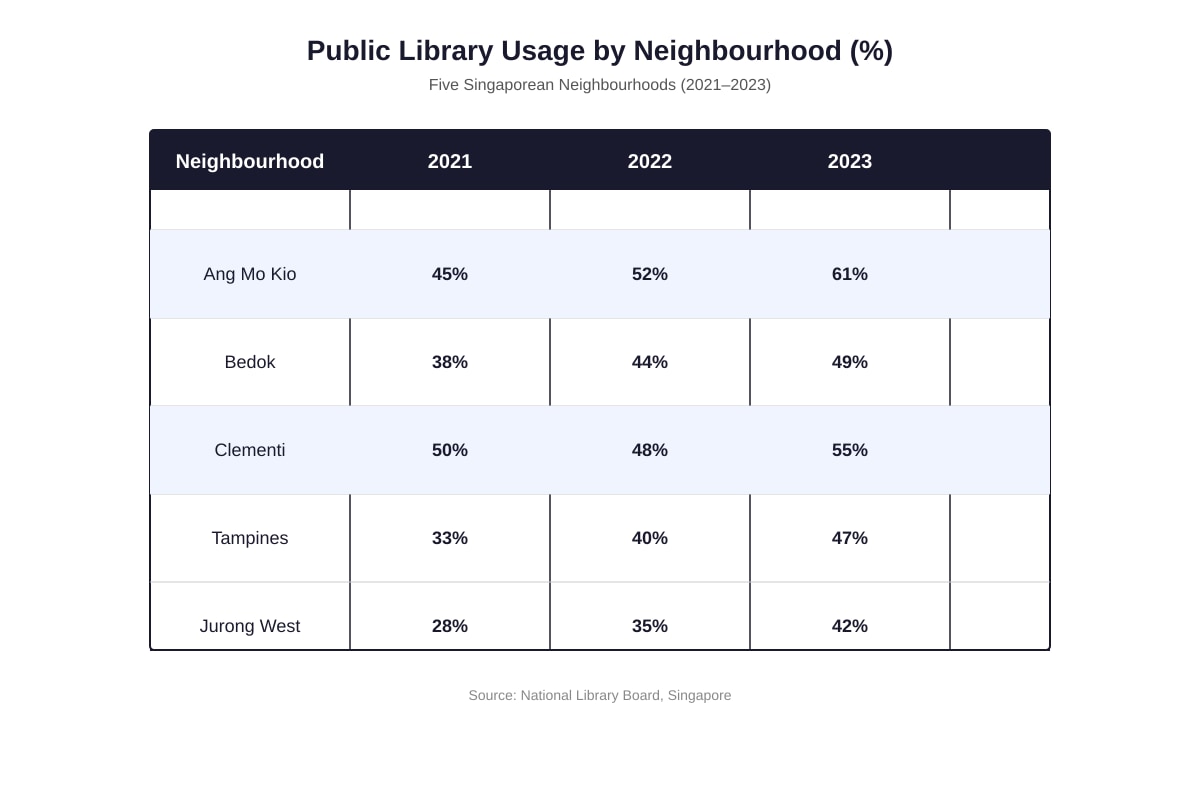
Answer: Across all five neighbourhoods, public library usage increased steadily from 2021 to 2023, with Ang Mo Kio showing the highest growth (from 45% to 61%) and Jurong West the lowest starting point (28% to 42%).
Acceptable alternatives:
- "Library usage increased in all five neighbourhoods over the three-year period."
- "There was a consistent upward trend in public library usage across all neighbourhoods between 2021 and 2023."
Teaching Note: When summarising data trends, students should identify the overall pattern rather than listing every data point. Key words: "increased," "steady/upward trend," "across all neighbourhoods." The answer should be concise — one sentence is sufficient for 1 mark.
Image Placeholder Note: The table (Q18-fig1) should display five neighbourhoods (Ang Mo Kio, Bedok, Clementi, Tampines, Jurong West) as rows and three years (2021, 2022, 2023) as columns, with percentage values clearly shown in each cell. The title "Public Library Usage by Neighbourhood (%)" should be visible. All values must be legible for students to identify the trend.
19. [2 marks — 1 mark each]
Answer — Any two of the following with explanation:
Way 1: Use formal vocabulary and avoid contractions (e.g., "do not" instead of "don't") to maintain a professional tone appropriate for a published letter.
Way 2: Support arguments with specific examples, data, or evidence (e.g., "The Consumer Price Index rose by 4.2% in 2023") rather than emotional generalisations, to strengthen persuasiveness.
Way 3: Use logical connectors and structured paragraphs (e.g., "Furthermore," "In addition," "Consequently") to present a coherent, well-organised argument.
Way 4: Maintain a respectful but assertive tone — avoid aggressive language or personal attacks, as this would undermine the letter's credibility with the editor and readers.
Way 5: Address counter-arguments to show balanced reasoning (e.g., "While the government has introduced relief measures, many households still struggle with daily expenses").
Teaching Note: Letters to the editor must be persuasive yet formal. Students should demonstrate awareness of tone, evidence, and structure. The most common weakness in student responses is relying on emotional appeals without evidence.
20. [1 mark]
Model Answer:
"Good morning, Principal, teachers, and fellow students. Today, I stand before you to speak about an issue that affects us all — the urgent need to protect our environment for future generations." [30 words]
Marking Descriptors:
- 1 mark: Appropriate formal opening, includes greeting/address to audience, states the topic clearly, suitable for a school assembly speech.
- 0 marks: Still informal, no clear topic, or inappropriate tone.
Teaching Note: A speech opening should: (1) greet the audience, (2) introduce the speaker (if relevant), (3) state the topic, and (4) capture attention. The rewritten version should eliminate filler words ("um," "like," "yeah"), slang, and vagueness.
Common Mistake: Students may write an opening that is too long or includes the entire argument. The opening should be brief and set the stage — the body of the speech develops the points.
Summary of Marks
| Section | Questions | Marks |
|---|---|---|
| A: Fundamentals | 1–5 | 10 |
| B: Analysis | 6–12 | 14 |
| C: Application | 13–20 | 16 |
| Total | 20 questions | 40 |
This quiz is designed to prepare students for the situational writing component of A-Level General Paper H1 Paper 1. It is not an official Cambridge examination paper but is aligned with the 8881 syllabus requirements and informed by analysis of school-based preliminary assessments.