From Real Exams Quiz
A Level H1 General Paper Composition Situational Writing Quiz
Free A Level H1 GP Situational Writing quiz, HY3 Exam version, with questions, answers, and A Level-style practice for Singapore students.
These static practice materials are generated from the site's syllabus and paper-generation workflow, with source and model context shown so students and parents can evaluate the material before use.
Questions
Free quiz and exam paper access
Enter your details to view this paper
Your access is remembered on this device.
Answers
A-Level General Paper H1 Quiz - Composition Situational Writing: Answer Key
Total Marks: 40
Topic: Composition & Situational Writing
Section A: Purpose, Audience, Context
Q1. [3 marks]
- Purpose (1): To invite residents to a dialogue session on hawker centre hygiene.
- Audience (1): Residents of the neighbourhood / local community.
- Context (1): A neighborhood council initiative to engage the public on local cleanliness issues. Teaching note: Situational writing always begins with PAC (Purpose, Audience, Context). Purpose = what the text aims to do; Audience = who receives it; Context = the real-world setting.
Q2. [2 marks]
- Primary audience (1): The general reading public / policymakers who read forum letters.
- Persuasive intent (1): To convince readers that tuition dependence is economically and socially unsustainable. Common mistake: Naming only "the editor" as audience; the editor is gatekeeper, not the target of persuasion.
Q3. [2 marks]
- Register (1): Formal, objective, bureaucratic-academic.
- Why (1): The recipient (MOE) expects evidence-based, neutral reporting suitable for administrative use. Marking: Award 1 for register term, 1 for reasoned link to recipient.
Q4. [2 marks]
- Complaint (1): Formal, direct, seeks redress, addresses provider as authority.
- Blog (1): Personal, reflective, subjective, addresses general readers informally. Teaching note: Same topic shifts in tone and structure by genre.
Q5. [2 marks] Any two of (1 each): budget limit, timeline, target age group, manpower, venue, approval constraints. Marking: Accept any two plausible contextual constraints.
Section B: Language and Tone
Q6. [1 mark]
- "The littering issue at the void deck requires prompt remediation." Marking: Must show formal vocabulary (e.g. "remediation" not "fix"), no colloquial particles.
Q7. [2 marks]
- Retain? (1): No, not for formal tasks.
- Explain (1): "I reckon" is informal/british-colloquial; weakens credibility in a formal letter. Teaching note: Forum letters to ST are public and semi-formal; avoid spoken markers.
Q8. [2 marks]
- Tone (1): Authoritative / admonishing / formal.
- Feature (1): Use of passive "are urged" + modal "must/strongly" + word "indiscriminate" (negative connotation). Accept any one clear feature.
Q9. [2 marks]
- Example (2 if complete, 1 if partial): "We sincerely apologise for the inconvenience and are reviewing your case urgently." Marking: Must show apology + cooperative stance.
Q10. [2 marks]
- (1) Exclamation marks signal excitement/emotion unsuitable for objective proposals.
- (1) They reduce perceived professionalism and may appear dismissive of process. Teaching note: Government proposals value restraint.
Section C: Structure and Format
Q11. [3 marks]
- (1) Salutation and clear subject line
- (1) Reason for request and new deadline proposed
- (1) Closing and contact Marking: 1 mark per element.
Q12. [2 marks]
- Order (2): Title, Introduction, Findings, Conclusion. Common mistake: Putting Conclusion before Findings.
Q13. [2 marks]
- Phrase (1): "I refer to the forum letter titled…" / "Regarding your article on…"
- Example (1): "I refer to the letter 'Tuition Woes' (ST, 3 May)." Marking: Must show explicit reference to a trigger.
Q14. [2 marks] Any two (1 each): spoken delivery (oral cues), greeting, no footnotes, audience eye-contact references, shorter sentences. Accept plausible format differences.
Q15. [2 marks]
- (1) How success will be measured
- (1) What criteria show the campaign worked (e.g. participation rate) Teaching note: Evaluation = accountability section.
Section D: Applied Situational Tasks
Q16. [5 marks] Marking descriptors:
- Purpose stated (1)
- Action required clear (1)
- Date of launch (1)
- Word count ~60 (1)
- Appropriate notice register (1)
Sample (5/5):
"NOTICE: Green Schools Recycling Drive. All students are to sort waste into labelled bins from 1 July. The initiative reduces landfill and earns class points. Launch assembly 1 July, 8am. Council."
Q17. [5 marks]
- Conciliatory opening (1)
- Acknowledges error / empathy (1)
- Outlines next step (1)
- Formal register (1)
- ~80 words (1)
Sample:
"Dear Ms Tan, Thank you for writing. We apologise for the oversight; your daughter's payment was misrecorded. We have reinstated her camp slot and will review our admin process. A staff member will call by Fri. Sincerely, VP."
Q18. [4 marks]
- Problem stated (1)
- Objective stated (1)
- Formal intro (1)
- ~50 words (1)
Sample:
"Introduction: Many students lack weekly aerobic activity, affecting focus. This proposal seeks to implement a 30-min fitness circuit every Wednesday to improve cohort health."
Q19. [4 marks]
- Thanks MP (1)
- Confirms participation (1)
- Formal email format (1)
- ~50 words (1)
Sample:
"Dear Mr Lim, Thank you for launching Silver Friends. Our centre confirms 20 seniors enrolled. We look forward to the 15 June briefing. Regards, CC Manager."
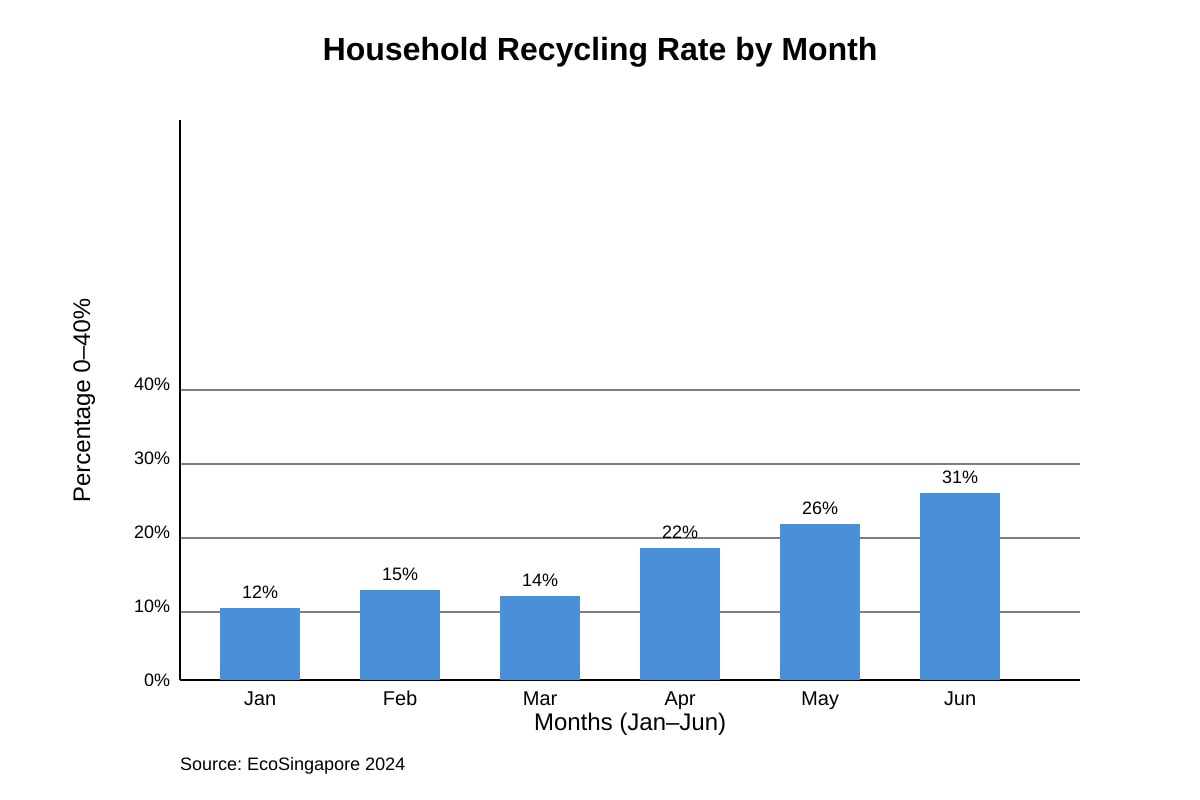
Q20. [5 marks] Expected visual: Bar chart titled "Household Recycling Rate by Month", Jan–Jun, values 12,15,14,22,26,31%, source EcoSingapore 2024. Marking:
- References data (1)
- Notes upward trend (1)
- Names months / values (1)
- Newsletter tone (1)
- ~40 words (1)
Sample:
"EcoSingapore data shows estate recycling rose from 12% (Jan) to 31% (Jun 2024), with sharp gains after April. Residents' efforts are working—keep sorting!"